
Temp Email for Spotify Signup: The Free Tier Lets You In — Your Playlists Decide Whether You Stay
Spotify is the easiest major signup on the internet to complete with a disposable email, and that is exactly what makes it the riskiest one to get wrong. Not because Spotify catches you. Spotify mostly does not care. The danger is slower and quieter than a rejection: the signup works, the music starts, and six months later the account holds two years of listening history while the inbox that created it expired in an afternoon.
The scale explains why the door is so open. Spotify reported 788 million monthly active users and 306 million Premium subscribers in its third-quarter 2026 results, published October 22, 2026. A service adding 11 million users in a single quarter cannot afford a signup form that interrogates people. So it does not. The email field is a formality on day one, and that formality is the whole story of this post: a temp email works here better than almost anywhere else, and the cost of using one arrives later, attached to the one thing Spotify builds that you cannot download or export — your taste.
My position, stated up front: use a temp email for Spotify when the account is genuinely disposable, and treat it as a mistake for any account you expect to keep. The test is never the signup. The test is the first forgotten password, the first Premium charge, and the first time Spotify decides to verify the address — all of which arrive by email, to an inbox that no longer exists.
The 90-second signup, and what it never asks for
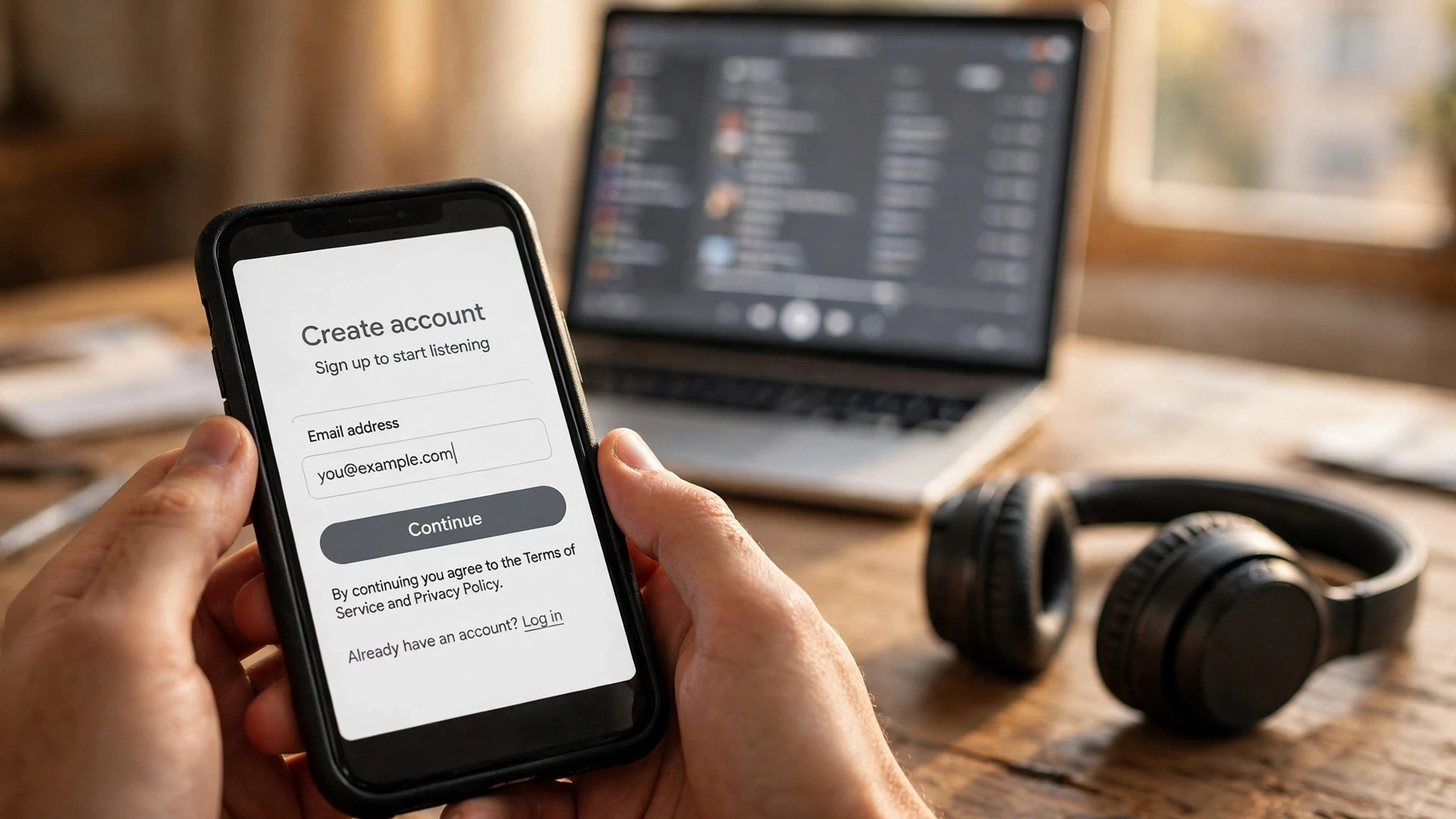
Go to the signup page and Spotify asks for five things: an email address, a password, a display name, a date of birth, and a gender. There is no phone number field. There is no identity document, no address, no second factor at the door. You can also continue with Google, Facebook, or Apple instead, which ties the account to that login and defeats the entire point of a disposable address, so the email path is the one that matters here.
Then comes the part that surprises people who have fought other platforms. Spotify sends a confirmation email, but it does not block listening while it waits. You can be playing music before the inbox has confirmed anything, and in many signups the confirmation never becomes a gate at all. Compare that with the platforms we have already covered in this series: Facebook sends a code and then runs identity checks for days afterward, and Amazon refuses many disposable domains at the email field itself, before you have seen a single product. Our piece on temp email for Amazon signup covers the strictest email wall on the consumer internet. Spotify is the opposite end of that spectrum, and the gap between the two is the reason this post exists.
A temp inbox only needs to stay alive for a few minutes to cover the whole flow. That is the appeal, and it is also the trap, because nothing in the signup tells you what the email will be asked to do later.
The rule Spotify never published
Here is the honest answer to the question every guide fudges: nobody outside Spotify knows its disposable-email rule, because Spotify has not published one. Its own support pages, checked as recently as July 2026, say neither that disposable addresses are accepted nor that they are banned. Temp-mail vendors claim Spotify fully supports their addresses. Scattered forum posts claim Spotify rejects them. Both claims can be true on different domains on different days, because acceptance is undocumented and conditional, not a policy you can rely on.
What Spotify does publish is one hard rule about addresses: the same login details cannot sit on two accounts. If your chosen address is already connected to an existing account, you get an "email already in use" message, and that applies to any address, disposable or not. There is a second documented rule worth knowing: if you close an account, you can reuse its email to create a new one 14 days after the closure. Beyond those two rules, a generic "invalid" or "try another email" message is user-reported behavior rather than published policy. Treat it as a domain Spotify happens to decline, not as a category ban.
Some well-known disposable domains do get declined, and the practical answer is the same one that applies everywhere in this series: a provider running many domains gives you somewhere to go when the first one fails, while a provider with one domain gives you a coin flip. Our piece on how websites detect disposable domains walks through the machinery — blocklists, reputation scores, and behavior signals — that decides your fate before a human ever looks at the account. Spotify runs a lighter version of that machinery than Meta does, which is why more domains get through, but lighter is not the same as absent.
The comparison matters because it sets expectations. Instagram maintains a blocklist and follows up with phone verification. Facebook lets some temp emails through and then asks for a video selfie or a government ID. Our piece on temp email for Facebook signup covers that checkpoint ladder in detail. Spotify asks for nothing comparable at signup, and that absence is not generosity. It is a different design: the account is cheap to create and expensive to lose, because the value accumulates inside it.
Your library is the asset. The email is just the key.

The free tier is a real product, not a locked shell. No payment method is requested at any point on the free path, so the disposable address is the only personal detail in play, and the music starts immediately. Of those 788 million monthly users, 499 million are on the ad-supported tier. For most of them, the account is worth exactly what is inside it: playlists, liked songs, followed artists, and the recommendation data that Discover Weekly and Wrapped are built from.
That library is an appreciating asset in a way a social media account is not. A two-year-old Spotify account knows things about your listening that a fresh account cannot rebuild in a weekend — which songs you skip after eight seconds, which artists you return to every winter, which podcast you actually finish. Your taste profile compounds quietly, and you only notice how much it was worth when it is gone. The playlists belong to the account, not to the address, and the address is the only way back into the account. That is the entire risk in one sentence.
Spotify has no phone number on the account and no second recovery path. Everything that goes wrong later, from a forgotten login to a Premium charge you did not expect, is fixed by email or not at all. A temp inbox that expires in an hour cannot receive a password reset in month six, and there is no support form that overrides that. This is the same structural problem our piece on temp email and two-factor authentication describes from the security side: the recovery channel is the account, and a disposable recovery channel is a countdown, not a safety net.
The day the inbox matters
Spotify states it plainly on its own support pages: "For security, we sometimes ask you to verify your email address." Sometimes. Not at signup, not on a schedule you can plan around — sometimes, weeks or months later, on a day you did not choose. When it does, you tap a button, Spotify sends a verification link to the address registered to the account, and opening that link confirms the mailbox is yours and reachable. If the mailbox expired in November, the link goes nowhere, and the account sits unverified until you fix an address you no longer control.
The password reset is the sharper version of the same problem. Spotify states: "You need access to the email address associated with your Spotify account to open the password reset link we email you." Lose that inbox and the self-serve options narrow to two: regain access to the old email, or create a new account and start fresh. Starting fresh means rebuilding the library from zero — every playlist, every liked song, every year of training data, gone because the recovery email went to an inbox that stopped existing.
There is one escape hatch, and most people who need it discover it too late. While you are still logged in, Spotify lets you change the email under Account, then Edit profile, with no code sent to the old address. If a throwaway account turns into the one with all your playlists, switch it to a real inbox that same day. The window for that fix is exactly as long as your login session lasts. Once you are logged out and the inbox is dead, the hatch is closed, and no amount of explaining the situation to support reopens it, because support cannot verify you are the owner without the email only the owner was supposed to hold.
The Premium wall a temp email cannot move
Everything above describes the free tier. Premium is where the disposable address stops mattering, because money brings its own requirements that no inbox can satisfy. A Premium free trial needs a valid payment method, and a temp email changes nothing about that. Student Premium needs a .edu address from an accredited institution, which a disposable inbox cannot provide. Family and Duo plans verify a shared home address, which has nothing to do with email at all. The email was never the barrier to paying; the barrier is everything around the payment.
What the email does control on a paid account is the paper trail. Premium receipts, trial reminders, billing notices, and unexpected-charge alerts all arrive by email. A dead inbox means a charge you did not expect and no warning before it, and a trial that converts to a paid plan while the reminder sits in an inbox that expired the week you signed up. That is a worse outcome than a failed signup, because a failed signup costs you a minute and a silent charge costs you money.
One more thing worth saying plainly: using temp mail to stack free trials technically violates Spotify's terms when it is done to abuse trial limits. A single test account for a genuine trial is one thing. Cycling disposable addresses to collect months of free Premium is the behavior the terms are written against, and it is also the behavior most likely to get the domains you use flagged for everyone else. TikTok is the closest comparison in this series — another platform where the signup is soft and the account quietly becomes worth keeping — and our piece on temp email for TikTok signup makes the same distinction between a test and a habit.
The 50-minute rule: using a temp email without losing the account
The fix is a decision you make before signup, not after the damage. Ask one question: is this account disposable, or is it a keeper? There is no wrong answer, but there is a wrong time to answer it, and that time is after the inbox expires.
A temp email is the right call for a genuinely disposable account. A party account for one night, where losing it costs nothing. A second account for a specific project, kept separate from your main listening. A test of a feature before you commit your main account. A developer test account with a known, empty library for trying playlist creation or the recommendation endpoints — the developer dashboard that holds your client ID stays on your real address, but the test account itself is exactly what a disposable inbox is for.
It is the wrong call for a main music account, and the rule for telling the difference is simple: if you would be annoyed to lose the playlists, put a real address on it. The practical version of that rule is a timer. Within the first hour — while the temp inbox is still alive and you are still logged in — open Account, then Edit profile, and switch the email to an address you control. Confirm it from the real inbox. That is the whole procedure, and it takes less time than the signup did. The temp email did its job, which was keeping your real address out of Spotify's marketing stream, and the real address does its job, which is keeping the account recoverable.
If the inbox already expired and you are still logged in, change the email today, right now, before you log out for any reason. If you are already logged out, be honest with yourself about what happened: the account is gone unless you can get back into the old inbox, and the playlists went with it. Do not pay an "account recovery" service to fix it. Spotify publishes no such path, and the services that claim one are selling a form you can fill out yourself for free.
FAQ
Can you use temp mail for Spotify signup?
Yes, usually. Spotify requires an email address to create an account, and a temporary address works for receiving the verification email in most cases. There is no published rule accepting or banning disposable email, so acceptance is conditional: some well-known disposable domains get declined, and switching to a different domain from the same provider is the usual fix.
Does Spotify send a verification email?
Yes, and sometimes not right away. Spotify sends a confirmation email, but playback does not wait for it, and Spotify may ask you to verify the address weeks or months after signup instead. The verification arrives as a link, not a code, and opening it confirms the mailbox is reachable.
Can I recover a Spotify account if the temp email expired?
Through self-serve, no. Spotify's password reset requires access to the registered email, and its own guidance narrows the options to regaining the old email or creating a new account. If you are still logged in, change the email under Account, then Edit profile, before you log out.
Can I use temp mail for a Spotify Premium trial?
The email part works, but the trial still needs a valid payment method, so a temp address does not get you Premium on its own. Student Premium needs a .edu address, and Family and Duo plans verify a shared home address.
Can I change the email on my Spotify account later?
Yes, while you are logged in. Go to Account, then Edit profile, and enter the new address. No code is sent to the old address for this change, which is why it is the escape hatch for any throwaway account that turned into a keeper.
Is using temp mail for Spotify against the rules?
Using a temporary address for a genuine signup is not, on its own, a violation. Using disposable addresses to cycle free trials and abuse trial limits technically violates Spotify's terms, and it is the fastest way to get the domains involved flagged for other users.
The bottom line
Spotify is the friendliest big signup for a temp email and the quietest trap in this series. The door is open, the music starts before any verification, and nothing in the first five minutes warns you that the account you just created is building something worth keeping. Free tier, party account, test account: a temp email is the right tool, and it works. Anything with playlists you care about, money attached, or a future longer than an hour: put a real address on it before the temp inbox expires, and treat the hour after signup as the only chance you get.
Need a disposable temporary email?
Protect your real inbox from spam and promotional clutter instantly and free.
Received a suspicious email, text, or charge alert?
Verify whether the sender domain is disposable, spoofed, or unverified before clicking links.