


Who Is Calling You? How Reverse Phone Lookup Can Help
A reverse phone lookup lets you find out who owns a phone number — before you answer, or after a suspicious call.
Here's a quick answer based on what most people want to know:
| Question | Quick Answer |
|---|---|
| What is it? | A search that takes a phone number and returns the owner's name, location, and carrier |
| Is it free? | Yes — basic info is free on many services; detailed reports may cost money |
| Does it work on cell phones? | Yes, though results vary for unlisted or prepaid numbers |
| Is it private? | Yes — the person you look up is never notified |
| What can it find? | Name, carrier, city/state, spam risk rating, and sometimes address history |
Americans waste an estimated 221 million hours every year dealing with spam calls. Over 2 billion spam calls have been identified in the U.S. alone. If you've ever stared at an unknown number and wondered whether to pick up, you're not alone.
The problem is real — and it's getting worse. Fraud losses from phone scams have grown to $10 billion a year, with over 800,000 imposter scam reports filed annually.
Reverse phone lookup tools exist to put the power back in your hands.
Whether you're trying to identify a missed call, screen a potential scammer, or verify someone you met online — knowing who's behind a number is the first step.
Understanding How a Reverse Phone Lookup Works
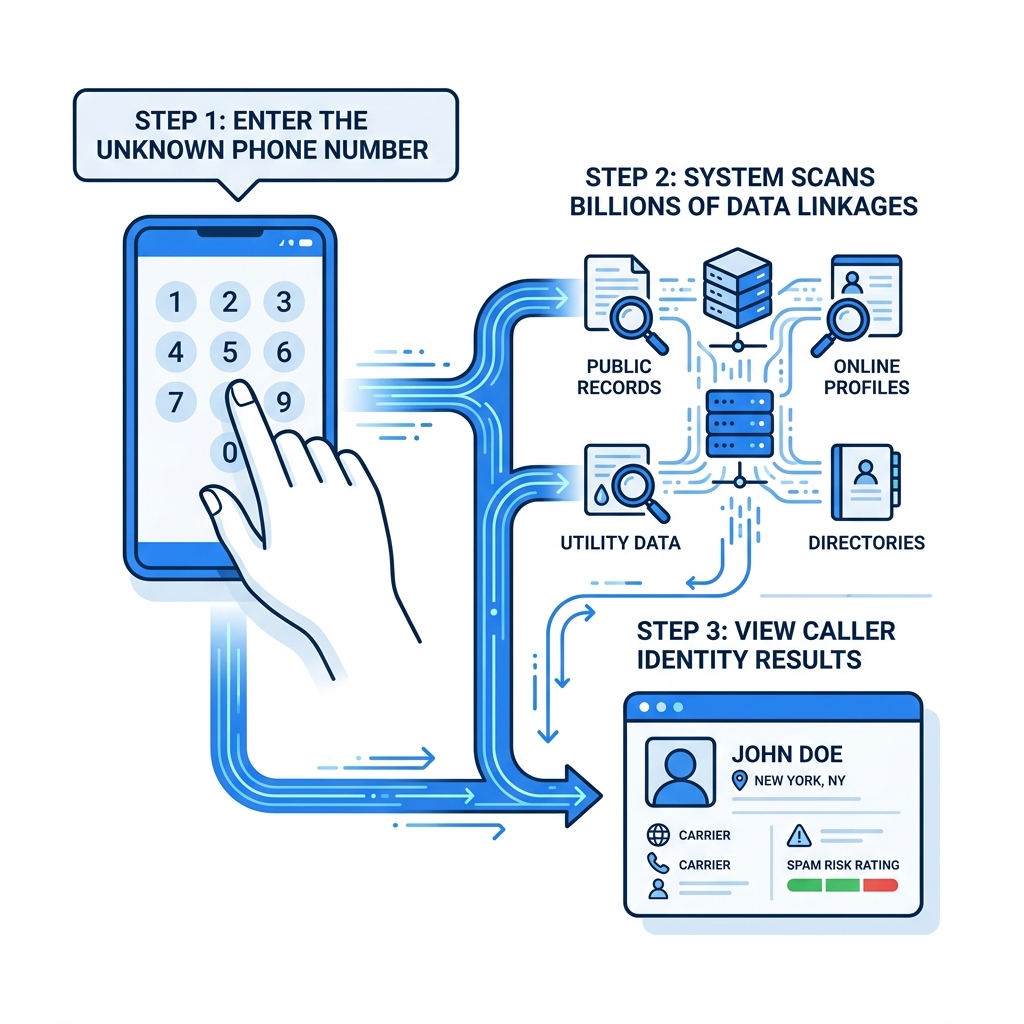
At its core, a reverse phone lookup is the digital equivalent of flipping through a massive, high-tech phone book in reverse. Instead of looking for a name to find a number, you start with the digits and work backward to find the human (or robot) on the other end.
These tools work by querying massive databases that aggregate billions of data points. Services like 411.com use sophisticated algorithms to crawl through public records, utility bills, social media profiles, and white page directories. When you enter a 10-digit number, the system scans its identity records to find "data linkages"—connections between that specific number and a name, address, or email.
Landline vs. Cell Phone Accuracy
Historically, landlines were easy to track because they were tied to physical addresses and listed in public directories. Cell phones and VoIP (Voice over IP) numbers are trickier. However, modern services have adapted. They now tap into carrier data from major providers like Verizon, AT&T, and T-Mobile. With over 260 million U.S. phone numbers covered by major databases, the accuracy for cell phones has improved drastically, though it still relies on how recently the owner updated their public information.

Information Found in a Search
When you perform a search, you aren't just getting a name. Depending on the depth of the tool, you can uncover:
- Owner Name: The primary individual or business registered to the number.
- Carrier Info: Whether the number belongs to a major carrier or a prepaid service.
- Location Data: The city, state, and zip code where the number was originally registered.
- Address History: Past and current physical addresses associated with the owner.
- Social Media: Links to profiles on platforms like Facebook, LinkedIn, or X (formerly Twitter).
- Criminal Records: In premium reports, you might even see background check data, including court records or owned assets.
Limitations of Search Tools
While these tools are powerful, they aren't magic. There are several "blind spots" to keep in mind:
- Unlisted Numbers: If someone has gone to great lengths to keep their number private, it may not appear in public databases.
- Burner Phones: Disposable "burner" phones or prepaid SIM cards often lack registration data, making them nearly impossible to trace to a specific person.
- Spoofed IDs: Scammers often use "neighbor spoofing" to make their number look like it's coming from your local area code. In these cases, the number you see isn't the real number they are calling from.
- Data Latency: It takes time for records to update. If someone just got a new number yesterday, the database might still show the previous owner.
- International Gaps: Many free tools are limited to the U.S. and Canada. Tracking a number from overseas requires specialized global services.
The Best Free and Low-Cost Methods to Identify Callers
You don't always need to open your wallet to find out who's calling. There is a spectrum of services ranging from "completely free" to "deep-dive premium."
| Feature | Free Services | Premium Services |
|---|---|---|
| Basic Name | Often included | Guaranteed (if available) |
| Carrier/Location | Usually free | Included |
| Spam Rating | High availability | Detailed stats |
| Address History | Rarely included | Standard |
| Criminal Records | Not available | Available |
| Social Media | Limited | Comprehensive |
Free Reverse Phone Lookup Tools
If you're looking for a budget-friendly way to screen calls, start with these:
- Search Engines: Sometimes, simply typing the number into Google or Bing in quotes (e.g., "(555) 555-5555") can reveal if the number is listed on a business website or a scam-reporting forum.
- Public Directories: Sites like Whitepages offer free basic lookups that can identify the city, state, and sometimes the line type (landline vs. mobile).
- Community-Driven Apps: Apps like Truecaller rely on a global community of over 450 million active users. When users report a number as "Spam" or "Telemarketer," that information is shared with everyone else in the network.
- Social Media Search: Try entering the phone number into the search bar of Facebook or LinkedIn. If the user hasn't adjusted their privacy settings, their profile might pop right up.
When to Use Paid Services
Free tools are great for a quick "vibe check," but they have limits. You should consider a paid service like Intelius or Whitepages Premium if you need:
- Background Checks: If you are vetting a potential date or a new neighbor.
- Asset Discovery: Finding out if someone owns property or has specific professional licenses.
- Verified Records: Paid services often have access to "deep web" records that aren't indexed by standard search engines.
- Unlimited Searches: If you're a realtor or business owner who needs to verify dozens of contacts a month, a subscription is much cheaper than individual reports.
Using Reverse Phone Lookup to Stop Scams and Spam
Spam isn't just annoying; it's expensive. With $10 billion in annual fraud losses, identifying a scammer before you engage is critical. Scammers use a variety of tactics to separate you from your money.
One common tactic is neighbor spoofing, where the caller ID mimics the first six digits of your own number. They hope that seeing a familiar area code will make you more likely to answer. This is why it’s important to research specific area codes. For example, if you get a call from a New York or Manhattan number, you might want to check if it's a 212 area code scam or a 332 area code scam before picking up. Similarly, calls from Arkansas might be a 479 area code scam.
Identifying a Reverse Phone Lookup Scam
Not all "reverse lookups" are legitimate. Some scammers use these tools to find your information. Be wary of:
- Voiceprint Scams: The caller asks, "Can you hear me?" If you say "Yes," they record your voice to use as a biometric "signature" for fraudulent transactions.
- Phishing Texts: You might get a text saying you've earned a "Zelle voucher" or that your bank account is locked. These often lead to fake websites designed to steal your credentials.
- Urgent Threats: Scammers impersonating the IRS or law enforcement will use high-pressure tactics, demanding immediate payment via gift cards or wire transfers.
Steps to Take After Identifying a Scammer
If your reverse phone lookup confirms the caller is a fraudster, follow these steps:
- Block the Number: Use your phone’s built-in blocking feature immediately.
- Report the Caller: Use apps to report the number so other users are warned.
- Silence Unknowns: Most modern smartphones have a setting to "Silence Unknown Callers," which sends any number not in your contacts directly to voicemail.
- Verify via Official Channels: If a caller claims to be from your bank, hang up and call the number on the back of your actual debit card. Never trust the number provided by the caller.
Privacy and Legal Considerations of Phone Searches
In an era of data breaches, privacy is a major concern. When you use a reverse phone lookup, you are accessing public records, but that doesn't mean there aren't rules.
Is a Reverse Phone Lookup Legal?
Yes, using these services for personal use is generally legal in the United States. These tools aggregate data that is already part of the public record. However, you must comply with the Fair Credit Reporting Act (FCRA). This means you cannot use a standard reverse phone lookup for:
- Employment screening
- Tenant vetting
- Determining creditworthiness
- Insurance eligibility
Using these tools for harassment or stalking is also strictly illegal and can lead to criminal charges.
Protecting Your Own Information
If you've ever looked up your own number and been shocked by how much info is out there, you aren't alone. Your "Identity Graph" is a collection of linkages that data brokers use to track you. To protect yourself:
- Opt-Out: Most major lookup services have an "opt-out" or "data removal" page where you can request your information be hidden.
- Unlist Your Number: Contact your service provider to see if you can have your number removed from public directories.
- Use Aliases: When signing up for newsletters or one-time discounts, don't use your real phone number or primary email. This is where a "PII firewall" becomes essential.
Frequently Asked Questions about Caller Identification
Do people get notified when I look up their number?
No. Legitimate reverse phone lookup services provide anonymous searches. The person owning the number will never receive a text, email, or notification that you searched for them. Your curiosity remains entirely confidential.
Why is my cell phone number not showing up?
If you look up your own number and find nothing, it could be because you use a prepaid plan, your number is relatively new, or you have strict privacy settings with your carrier. Data lag is also a factor; it can take several months for a new number to propagate through public record databases.
Can I find a real-time location with these tools?
No. For privacy and safety reasons, these tools do not provide real-time GPS tracking. They can show you the "registered address" or the city and state associated with the number's billing records, but they cannot tell you where the person is standing at this exact moment.
Conclusion
Navigating unknown callers doesn't have to be a guessing game. By using a reverse phone lookup, you can identify scammers, avoid annoying telemarketers, and protect your family from fraud. Whether you choose a free community app or a comprehensive paid report, having the facts before you pick up the phone is your best defense.
However, the best way to stop spam is to prevent your information from getting into the wrong hands in the first place. At Tempo Mail USA, we believe your personal data should be guarded like a fortress. We provide temporary email aliases that act as a proxy for your identity. By using our secure aliases, you create a PII (Personally Identifiable Information) firewall between yourself and the services you use.
Don't let data brokers and scammers build a profile on you. Protect your identity with Tempo Mail USA and take control of your digital footprint today.