



The 833 Area Code Scam: What You Need to Know Before You Pick Up
The 833 area code scam is a widespread fraud where criminals use toll-free 833 numbers to impersonate trusted organizations — like the IRS, your bank, or tech support — to steal your personal information or money.
Quick answer:
- 833 is a legitimate toll-free prefix (like 800 or 888), introduced in 2017
- Scammers use it because it looks official and has no geographic location to trace
- Common scams include IRS impersonation, fake tech support, debt collection fraud, and prize scams
- Not every 833 call is a scam — many real businesses use these numbers
- If a call is unsolicited, urgent, or asks for personal data or payment, treat it as suspicious
833 numbers are attractive to fraudsters for one simple reason: toll-free numbers feel trustworthy. When your phone shows a 1-833 number, your brain says "business call." Scammers know this — and they exploit it.
As one security researcher put it, scammers "specifically choose 833 toll-free numbers to mimic trusted businesses due to their legitimate reputation."
If you're protective of your personal information online, this matters. A single scam call can expose your name, address, Social Security number, or financial details — the exact data you work hard to keep private.
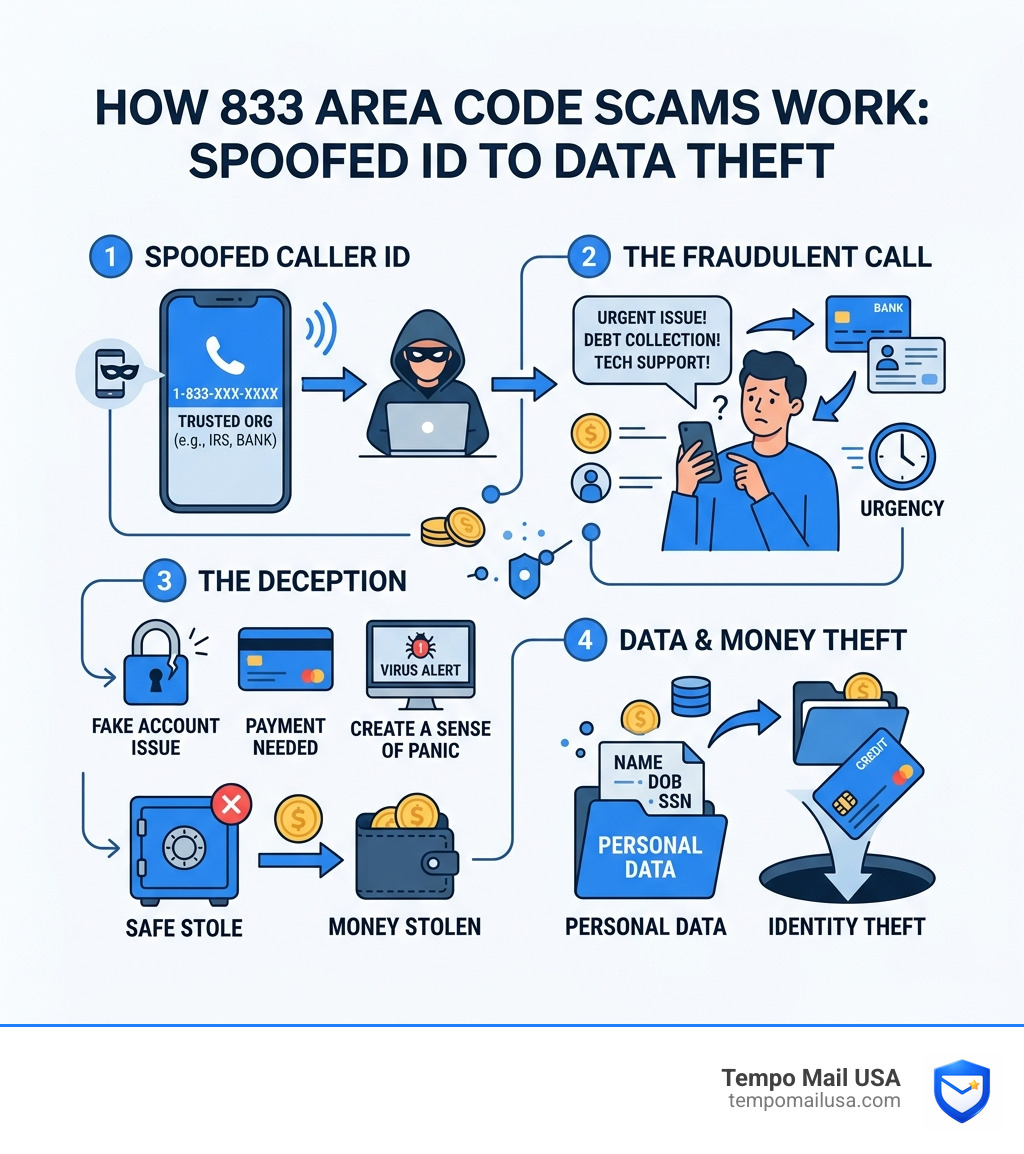
What is the 833 Area Code and Why is it Targeted?
To understand why the 833 area code scam is so effective, we first have to understand what the 833 area code actually is. Administered by the North American Numbering Plan Administrator (NANPA), the 833 prefix was officially launched on June 3, 2017. It isn't tied to a specific city or state; instead, it is a "non-geographic" toll-free code that covers the entire North American Numbering Plan (NANP) region, including the United States, Canada, and parts of the Caribbean.
Because these numbers are toll-free, the person receiving the call doesn't pay for the long-distance charges—the business owner does. This creates an immediate aura of professionalism and legitimacy. When we see an 833 number, we instinctively think of a large corporation or a government agency. Scammers love this psychological shortcut. By using an 833 number, they bypass our "stranger danger" filters that usually trigger when we see a random local area code we don't recognize.
Interestingly, this isn't the only prefix scammers love to exploit. For instance, many people have also dealt with the 212 area code scam that manhattan call stole, where fraudsters use the prestige of a New York City number to trick victims.
The Evolution of the 833 area code scam
Why did we even get an 833 area code? It all comes down to math. The classic 800 prefix, introduced in the 1960s, eventually ran out of available numbers. This led to the creation of 888, 877, 866, 855, and 844. By 2017, the demand for toll-free numbers was so high that NANPA had to release 833 as the 7th official toll-free code and the 394th area code still in use today.
Scammers jumped on the 833 bandwagon almost immediately. Because it was "new," many people weren't yet aware of its potential for abuse. Furthermore, scammers use a technique called "caller ID spoofing." This allows them to make a call from a laptop in a different country while making your phone display a "verified" 1-833 number. They can even spoof the name of a real company, making the 833 area code scam incredibly difficult to spot at first glance.
Legitimate Business Use vs. Fraudulent Activity
It is important for us to remember that not every 1-833 number is a villain. Thousands of legitimate businesses use them for customer support, sales hotlines, and national branding. Many companies even use "vanity numbers"—memorable sequences like 1-833-FLOWERS—to help customers remember how to reach them.
Legitimate 833 numbers are assigned on a first-come, first-served basis through "Responsible Organizations" (RespOrgs) or via FCC-sanctioned auctions. The problem is that scammers can also rent these numbers quite easily through various VoIP (Voice over Internet Protocol) providers. This creates a "double-edged sword" scenario where the same prefix used by your favorite online retailer might also be used by a criminal trying to drain your bank account.
Common Types of 833 area code scam Tactics
Scammers are creative, but they usually stick to a few tried-and-true scripts. Most of these tactics rely on "social engineering"—the art of manipulating people into giving up confidential information.
One of the most common ways an 833 area code scam starts is with a "voicemail lure." You might receive a message that sounds professional and urgent, prompting you to call back immediately to resolve a "problem." According to research on What is 833 Area Code Scam? Protect Yourself From Phone Scams, these calls often involve high-pressure tactics designed to make you act before you think.
Government and IRS Impersonation
Perhaps the most terrifying version of this fraud is the Tax 1333 scam. Starting around 2022, scammers began leaving voicemails claiming to be from "Tax 1333" or the IRS. The script usually says that your past-due tax debt has been placed in a "non-collectible status" and gives you a specific extension to call back.
As detailed in the guide on Tax 1333 Calls: How Scammers Fake IRS Voicemails About Overdue Taxes, the IRS will never initiate contact with you via a phone call or voicemail to demand payment or offer debt relief. They use the U.S. Postal Service for that. If you get a call from an 833 number claiming to be the IRS or the Treasury Inspector General for Tax Administration (TIGTA), it is a 100% certainty that it is a scam.
Tech Support and Debt Collection Fraud
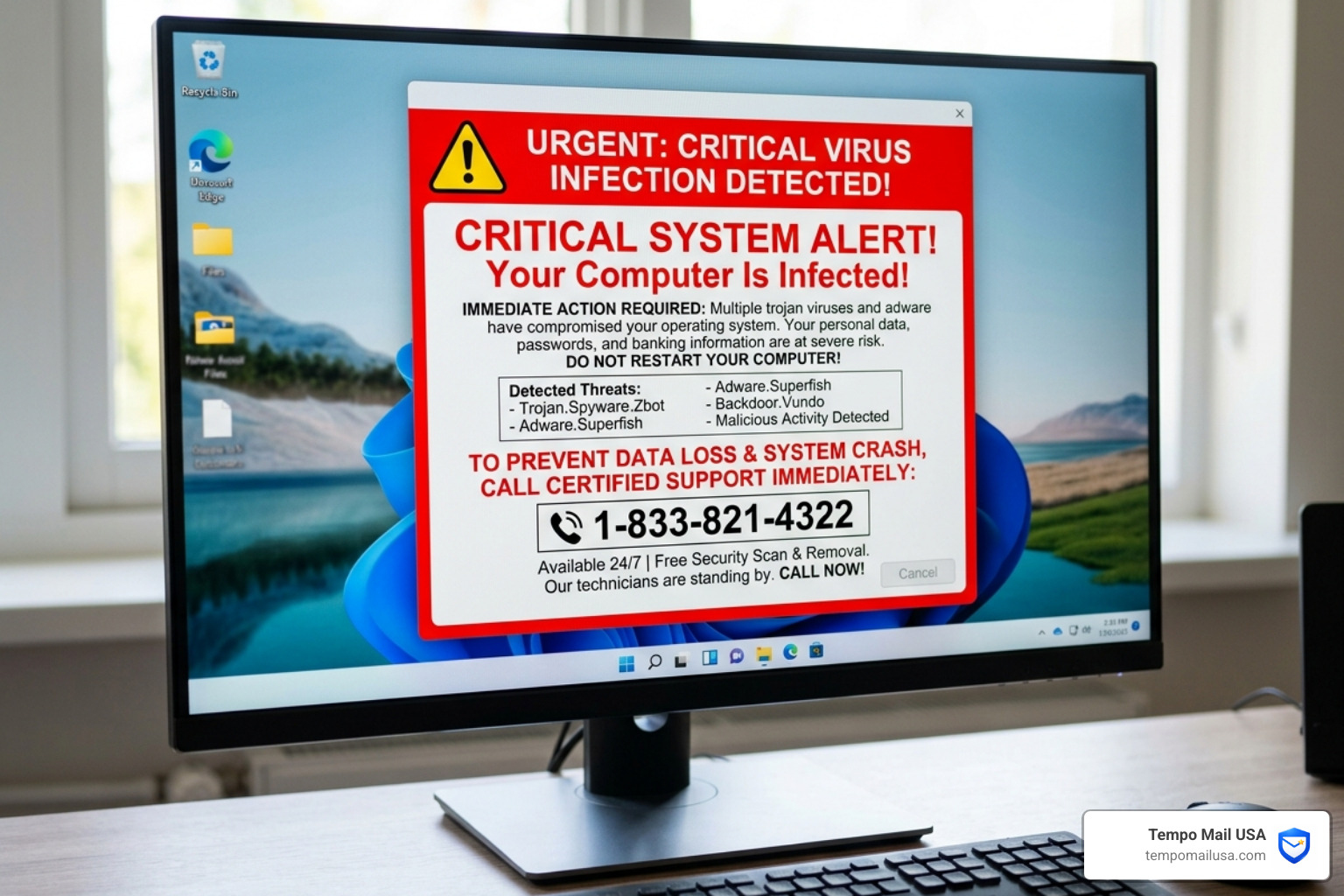
Another major category is the tech support scam. You might be browsing the web when a loud, flashing pop-up appears on your screen claiming your computer has a "malware failure" or a "security breach." It instructs you to call a 1-833 number for "Microsoft Support" or "Apple Care."
Once you call, the "agent" will ask for remote access to your computer. If you grant it, they can install actual malware, steal your saved passwords, or demand a "repair fee" paid via irreversible methods like gift cards, wire transfers, or cryptocurrency. Similarly, debt collection scammers use 833 numbers to threaten you with "legal action" or "arrest warrants" for unpaid bills you likely don't even owe.
Spotting an 833 area code scam Text
Scammers have also moved into "smishing" (SMS phishing). You might get a text from an 833 number that looks like this:
- "[Bank Name] Alert: Suspicious activity detected on your account. Click here to verify: [Suspicious Link]"
- "Your package delivery has failed. Please update your address at: [Suspicious Link]"
These texts are designed for credential harvesting. When you click the link, you are taken to a fake website that looks exactly like your bank's login page. Once you enter your username and password, the scammer has full access to your real account.
How to Identify and Block Fraudulent Calls
The best defense against an 833 area code scam is a healthy dose of skepticism. If you didn't initiate the call, you should assume the person on the other end might not be who they say they are.
To help you distinguish between a helpful business and a hungry fraudster, we've put together this comparison table:
| Feature | Legitimate Business Call | 833 Area Code Scam Call |
|---|---|---|
| Origin | You usually expect the call (e.g., a callback you requested). | Unsolicited; comes out of the blue. |
| Tone | Professional, patient, and informative. | Urgent, threatening, or overly aggressive. |
| Requests | Never asks for passwords or full Social Security numbers. | Demands PII (Personal Identifiable Information) or one-time codes. |
| Payment | Standard methods (credit card via secure portal). | Requests gift cards, crypto, or wire transfers. |
| Verification | Encourages you to call back via official website numbers. | Pressures you to stay on the line or use a provided "extension." |
Warning Signs and Verification Methods
If you're ever unsure about an 833 call, follow our "Golden Rule": Hang up and look it up.
- Screen your calls: Let unknown 833 numbers go to voicemail. Legitimate businesses will leave a detailed message.
- Independent Verification: If a caller claims to be from your bank, hang up. Find the official number on the back of your debit card or the bank's official website and call them back directly.
- Reverse Lookup: Use a reputable reverse phone lookup service or simply type the phone number into a search engine. Often, other victims will have already posted warnings about that specific number on community forums.
- Beware of One-Time Passcodes (OTPs): Never, under any circumstances, share a code sent to your phone with someone who called you. Scammers use these to bypass your two-factor authentication (2FA) in real-time.
Proactive Protection and Reporting
We can take several technical steps to reduce the number of scam calls reaching our pockets. Most modern smartphones have built-in "Silence Unknown Callers" features. Additionally, many mobile carriers offer free apps that flag "Scam Likely" calls based on massive databases of reported fraud.
The telecommunications industry is also fighting back with the STIR/SHAKEN protocol. This technology helps verify that the number appearing on your caller ID is actually the number the call originated from, making spoofing much harder. However, it isn't perfect, so don't let a "Verified" label give you a false sense of security.
If you are targeted, please report it! This helps protect others in our community. You can file complaints at:
- FCC (Federal Communications Commission): fcc.gov/complaints
- FTC (Federal Trade Commission): reportfraud.ftc.gov
- Do Not Call Registry: Ensure your number is on the list at donotcall.gov. While scammers ignore the law, it helps filter out legitimate telemarketers so the scams stand out more clearly.
Frequently Asked Questions about 833 Numbers
Are all 833 area code calls scams?
No. Many real companies use 833 for their legitimate customer service lines. The prefix itself is just a tool; it’s the behavior of the person using it that determines if it’s a scam. If you were expecting a call from a company you do business with, it might be real. If it’s unsolicited and urgent, be careful.
How can I tell if an 833 number is legitimate?
The best way is to verify the number through an official source. Check the company’s official website, a recent billing statement, or the physical card in your wallet. If the number calling you doesn't match the one listed on their official "Contact Us" page, it's likely a scam.
What should I do if I already gave information to an 833 scammer?
Don't panic, but act quickly:
- Financials: Call your bank or credit card company immediately to freeze your accounts and dispute any fraudulent charges.
- Passwords: Change your passwords for your email and financial accounts. Use unique, strong passwords for every site.
- Credit: Place a fraud alert or a "credit freeze" on your files with the three major credit bureaus (Equifax, Experian, and TransUnion).
- Security: If you gave them remote access to your computer, disconnect from the internet and run a full antivirus scan.
Conclusion
The 833 area code scam is a reminder that in our digital world, our personal information is constantly under fire. Scammers rely on our trust in "official" toll-free numbers to strip away our privacy.
At Tempo Mail USA, we believe that the best way to stop a scam is to never let the scammer get your real information in the first place. We provide secure identity proxying that acts as a PII (Personally Identifiable Information) firewall. By using temporary email aliases and protective tools, you can interact with services online without exposing your true identity to potential data breaches or marketing lists that scammers use to find their next targets.
Staying safe requires a mix of good technology and good old-fashioned skepticism. By understanding how these scams operate and practicing good cybersecurity hygiene, we can keep our data—and our bank accounts—safe from fraudsters.