



Why Understanding Scam Synonyms Matters for Online Safety
Scam synonym options include fraud, swindle, con, hoax, scheme, hustle, flimflam, racket, and deception. Each term describes dishonest methods used to trick people out of money, personal information, or valuable assets.
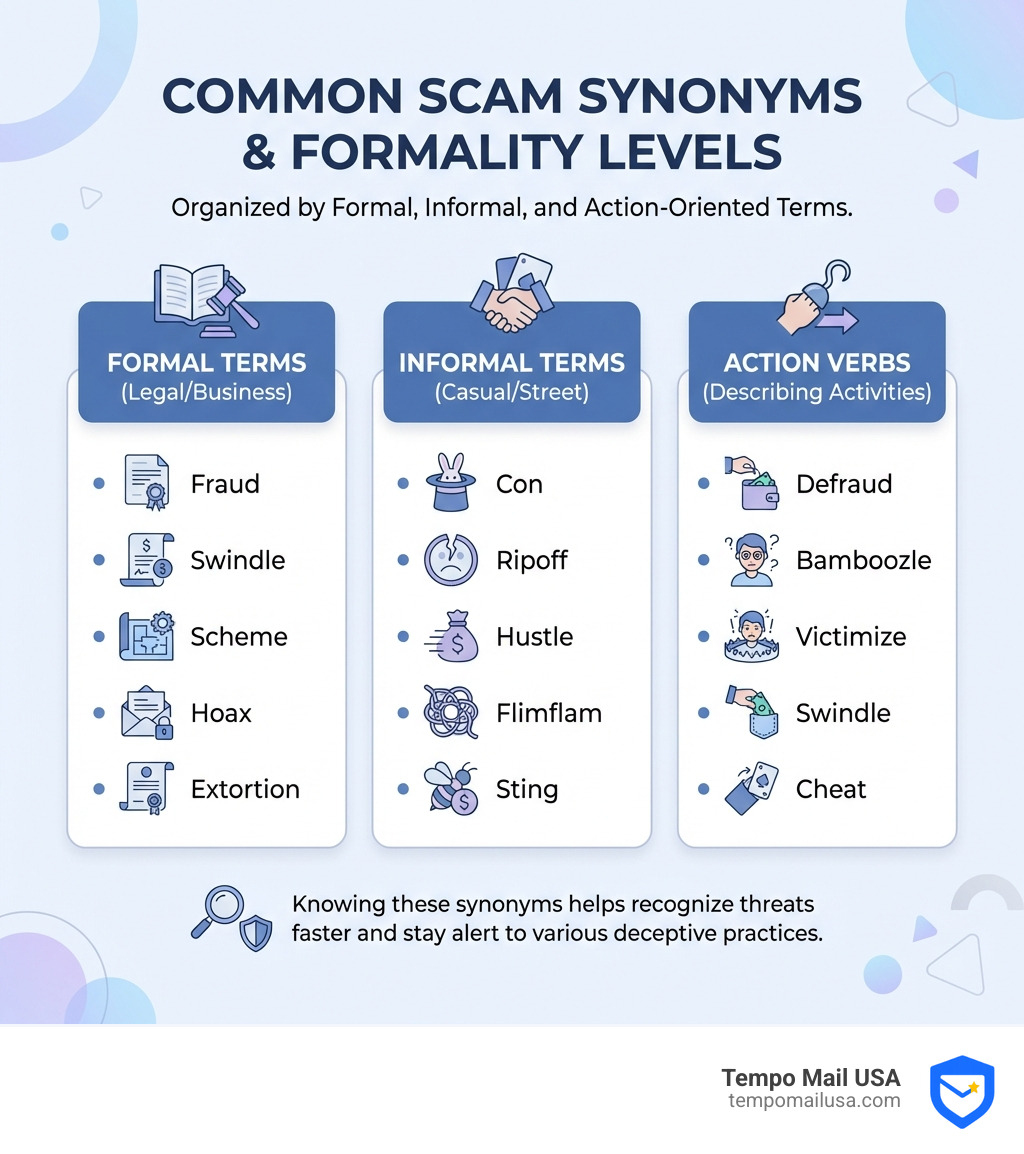
Quick Reference: Most Common Scam Synonyms
| Formal Terms | Informal Terms | Action Verbs |
|---|---|---|
| Fraud | Con | Defraud |
| Swindle | Ripoff | Bamboozle |
| Scheme | Hustle | Victimize |
| Hoax | Flimflam | Swindle |
| Extortion | Sting | Cheat |
In 2024, Americans reported $470 million in losses to text scams alone—more than five times the amount reported in 2020. One 18-year-old in Michigan lost $4,800 to a "transfer it to protect it" scam after receiving an email from someone impersonating his bank.
Understanding different words for scams helps you recognize threats faster. When you know that "phishing," "flimflam," and "Ponzi scheme" all describe deceptive practices, you're better equipped to protect your personal identifiable information.
The word "scam" itself originated from US carnival slang—it started as the language of con artists and evolved into everyday vocabulary. Today, scammers use increasingly sophisticated methods, from AI-generated deepfake videos to convincing text messages that mimic legitimate organizations.
Knowing these synonyms isn't just about expanding your vocabulary. It's about staying alert to the many forms fraud can take—whether someone calls it a scheme, swindle, or hustle, the goal is always the same: to steal from you.
Common Scam Synonym Options in American and British English
When we talk about a scam synonym, we often find ourselves navigating a rich mix of words that vary not only in formality but also in regional usage. What might be a common term in American English could sound a bit archaic or overly formal in British English, and vice versa. Let's explore some of the most prevalent terms we encounter.

In American English, beyond the ubiquitous "scam," we frequently hear terms like "fraud," "con," "swindle," and "hoax." These words are often used interchangeably in casual conversation, though, as we'll explore, they carry distinct nuances. For instance, a "swindle" often implies a more elaborate scheme to cheat someone out of money or possessions, while a "con" suggests a confidence trick where the victim is persuaded to trust the deceiver.
British English offers its own colorful vocabulary. While "scam" is certainly understood and used, you might also hear "fiddle," "racket," or "stratagem." A "fiddle" (British, informal) usually refers to a dishonest arrangement, often involving money, like "tax fiddles." A "racket" (slang) can denote an illegal business or activity, typically involving extortion or fraud. "Stratagem" is a more formal term, referring to a plan or scheme, especially one used to outwit an opponent or achieve an end. Collins Dictionary provides excellent insights, noting "swindle" as a key scam synonym for both noun and verb forms. For example, a dictionary entry might show scam (noun) in the sense of swindle with synonyms like "swindle," "fiddle" (British, informal), "racket," and "stratagem."
The unfortunate reality is that these terms are becoming increasingly relevant in our digital lives. We've seen alarming statistics, such as Americans losing $470 million to text scams in 2024 alone, a fivefold increase since 2020. This includes heartbreaking incidents like an 18-year-old losing $4,800 to a "transfer it to protect it" scam after receiving an email impersonating his bank. These are not just statistics; they are real-world examples of how various forms of deception, whether we call them scams, swindles, or fiddles, impact individuals. This is why understanding the terminology is a crucial first step in protecting ourselves and our finances. If you ever suspect you've been targeted, knowing how to Report USPS Scam Emails or other fraudulent communications is vital.
Formal Scam Synonym Terms
When we need to be precise or discuss these deceptive practices in a more serious context, several formal scam synonym options come to mind. These terms often appear in legal documents, news reports, or academic discussions, carrying a weight of specific implications.
- Fraud: This is perhaps the most widely recognized formal scam synonym. Fraud typically involves intentional deception to secure unfair or unlawful gain. It's about a deliberate perversion of the truth. For example, we hear about "voter fraud" or "insurance fraud," where individuals make false claims to gain an advantage. The Merriam-Webster thesaurus highlights "fraudulent" as an adjective for dishonest actions, such as making a fraudulent claim to an insurance company. If you're wondering, Is Temu a Scam Site? you're essentially questioning its legitimacy and whether its practices constitute fraud.
- Extortion: This term refers to obtaining something, especially money, through force or threats. While a scam relies on deception, extortion relies on coercion. It's a darker, more aggressive form of illicit gain.
- Deceit/Deception: These words describe the act of misleading or cheating someone. They are broad terms that encompass the core element of any scam: causing someone to believe something that is not true, especially in order to gain some personal advantage. The Merriam-Webster thesaurus emphasizes that "deceit" and "deception" are fundamental to the act of defrauding.
- Scheme: While "scheme" can sometimes imply a neutral plan, in the context of a scam synonym, it almost always refers to a cunning or dishonest plan to achieve something, often illegally. Investment schemes that turn out to be fraudulent are common examples.
- White-collar crime: This is a broader category that includes many formal scam-related activities. It refers to nonviolent crimes committed by individuals, typically for financial gain, through deception. This could include embezzlement, insider trading, and various forms of fraud.
These formal terms help us categorize and understand the gravity and specific nature of different deceptive acts. They move beyond the casual "scam" to define the legal and ethical boundaries that have been crossed.
Informal Slang and Regional Terms
Beyond the formal language, scams is rich with informal, often colorful, slang and regional terms. These are the words we might hear in casual conversation, crime dramas, or specific communities. They capture the essence of being tricked or cheated with a certain flair.
- Ripoff: This is a very common informal scam synonym, particularly in American English. A "ripoff" refers to an act of cheating someone by overcharging or selling them something of poor quality. It's often used when we feel we've paid too much for something that wasn't worth it. The Daily Beast mentioned "return scams" involving purchasing broken electronics and then buying new items, essentially a form of ripoff.
- Flimflam: This delightful-sounding word refers to a confidence trick or swindle. It implies a deceptive or dishonest trick, often with an element of persuasion or smooth talk. Thesaurus.com lists "flimflam" as a strong match for scam synonym.
- Snow job: This term describes an effort to deceive or mislead someone with flattery, elaborate explanations, or exaggerated claims. It's about overwhelming someone with information (often false) to prevent them from seeing the truth.
- Sting: A "sting" often refers to a carefully planned operation to trap criminals, but it can also refer to a cunning trick or swindle, especially one that results in financial loss for the victim.
- Hustle: While "hustle" can mean to work hard, in the context of scams, it refers to an illicit or unethical way of doing business, often involving aggressive and deceptive tactics to make money.
- Bunco: An older, somewhat informal term, "bunco" is a confidence game or swindle. It's less common now but still appears in older literature or specific regional dialects. Thesaurus.com lists "bunco" as a synonym.
- Shell game: This refers to a classic street con where a small object is hidden under one of several shells or cups, which are then shuffled. The victim is supposed to guess where the object is, but the operator manipulates the shells to ensure the victim always loses. It's a metaphor for any deceptive scheme where the truth is hidden or manipulated.
- Shady deal: This phrase describes a dishonest or suspicious business transaction or arrangement. It suggests something clandestine and unethical, lacking transparency.
These informal terms often paint a vivid picture of the deceptive act, making them memorable and impactful. They also remind us that scams aren't always grand, elaborate schemes; sometimes, they're simple, everyday tricks designed to part us from our money or information. Understanding these informal terms, alongside formal ones, provides a comprehensive view of the deceptive landscape. For instance, knowing these terms helps us better understand and identify threats like What is a Phishing Scam? which often use elements of these informal tricks.
Nuanced Differences: Fraud vs. Swindle vs. Hoax
While many words can serve as a scam synonym, it's crucial to understand the subtle yet significant differences between terms like "fraud," "swindle," and "hoax." These distinctions aren't just academic; they can impact how we perceive an event, its legal ramifications, and even our emotional response to being targeted.
Let's break them down:
| Term | Primary Intent | Key Characteristic | Typical Outcome | Example Context |
|---|---|---|---|---|
| Fraud | Financial gain, material benefit | Deliberate perversion of truth, false representation | Financial loss, legal consequences | Investment schemes, tax evasion, identity theft |
| Swindle | Financial gain | Obtaining money/property by deceit; often implies a more elaborate, persuasive scheme | Financial loss | Con games, elaborate sales pitches, fake inheritances |
| Hoax | Deception, mischief, amusement, sometimes social/political disruption | Creating a false belief; the truth is often easily disproven later | Embarrassment, wasted resources, public misinformation | Fake news, urban legends, prank calls, Project Blue Book |
Fraud is perhaps the most legally charged of the three. It inherently involves a deliberate misrepresentation of facts or truth to gain an unfair or unlawful material advantage. Think of someone making a false insurance claim for a staged accident, or a company knowingly selling a defective product as functional. The intent is always malicious, and the goal is almost always tangible financial gain. The Merriam-Webster thesaurus emphasizes that fraud usually implies a "deliberate perversion of the truth." For instance, thousands of people lost money when an investment scheme turned out to be a fraud.
Swindle, while closely related to fraud, often implies a more elaborate and persuasive scheme to cheat someone out of money or possessions. A swindle is a form of fraud, but it often involves a "confidence trick" where the swindler gains the victim's trust before exploiting it. The term "swindle" often conjures images of a smooth talker or a complex setup. Collins Dictionary defines "swindle" as a stratagem for gain. An example from the research mentioned a tax swindle. The legal system often differentiates, with a jury finding someone guilty of "aiding and abetting theft by swindle." It's less about a direct lie on a document (like some forms of fraud) and more about a manipulative process.
A hoax, on the other hand, is a deceptive trick, often intended for mischief, amusement, or to create a sensation, rather than direct financial gain. While a hoax can cause harm, including financial loss or widespread panic, its primary intent isn't always to steal money. For example, the Air Force's Project Blue Book classified some UFO sightings as 'unexplained' because there was "no evidence of a hoax." A viral internet challenge that turns out to be fake is a hoax. The consequences are often embarrassment, wasted time, or public misinformation. While a diet scam (falsely claiming weight loss) is a fraud, a story about a mythical creature that never existed, even if it scares people, is a hoax.
The word "scam" itself, as we noted, has an interesting origin, coming from US carnival slang. This background hints at the deceptive, often theatrical nature of these schemes. It's a broad term that can encompass elements of all three: the financial deception of fraud, the manipulative trickery of a swindle, and the false pretense of a hoax.
Understanding these nuances helps us better identify the nature of the threat. Is it a direct financial attack (fraud)? A long-term manipulative scheme (swindle)? Or a deceptive trick that might lead to other problems (hoax)? This clarity is vital, especially when dealing with increasingly sophisticated digital threats like OTP Fraud Surges, where a misstep can lead to significant losses.
Action Words: Verbs Used as a Scam Synonym
Beyond the nouns that describe deceptive acts, there's a whole vocabulary of verbs that tell us how the scam is carried out. These action words vividly illustrate the process of tricking, cheating, and defrauding someone. When we use these verbs, we're not just naming the scam; we're describing the active role of the perpetrator.
Let's explore some powerful verbs that function as a scam synonym:
- Defraud: This is a very direct and formal verb, meaning to illegally obtain money from someone by deception. It's the action counterpart to "fraud." For example, we might say, "The company attempted to defraud its investors." The Merriam-Webster thesaurus lists "defrauding" with synonyms like "cheating" and "swindling."
- Diddle: A more informal and somewhat playful term, "diddle" means to cheat or swindle someone out of money or possessions. It implies a petty or sneaky form of deception. "He tried to diddle us out of a few dollars."
- Bamboozle: This wonderfully expressive verb means to deceive or get the better of someone by trickery, flattery, or humbug. It often suggests a sense of confusion or bewilderment on the part of the victim. "We were bamboozled by the elaborate sales pitch."
- Hornswoggle: A colorful, informal Americanism, "hornswoggle" means to swindle, cheat, or dupe. It carries a folksy, slightly old-fashioned charm but is clear in its meaning of deception.
- Victimize: This verb means to make someone a victim of a crime or an act of injustice. While broader than just scams, it's highly relevant when discussing the impact of deceptive practices. "The elderly couple was victimized by a phone scam."
- Cheat: A fundamental verb for dishonest actions, "cheat" means to act dishonestly or unfairly in order to gain an advantage. This can be in games, tests, or, of course, financial transactions. Collins Dictionary directly links "scam" as a verb to "cheat": scam (verb) in the sense of cheat.
- Cook the books: This informal idiom means to dishonestly alter accounts or financial records, typically to steal money. It's a specific type of financial deception. "The accountant was fired for cooking the books."
- Wangle: (Informal) This means to obtain something by clever or dishonest means. It often implies a manipulative or tricky approach to get what one wants, especially by persuasion or trickery. "She managed to wangle a free ticket."
- Short-change: Literally, to give someone less money than they are owed when giving change. Metaphorically, it means to treat someone unfairly by depriving them of something they deserve. "The travel agency short-changed us on our promised amenities."
These verbs help us articulate the active nature of fraudulent behavior. They highlight that scams are not passive events but involve deliberate actions taken by perpetrators to exploit others. Recognizing these actions is a key step in preventing ourselves from becoming targets. Tools like an AI Scam Checker can help us identify potential deceptive language used in these attempts, and knowing how to respond to specific threats, like a How to Spot a DMV Text Scam, empowers us to act decisively.
Frequently Asked Questions about Scam Synonyms
We often get questions about the nuances of language, especially when it comes to terms that describe deceptive activities. Let's tackle some common queries regarding scam synonym options.
What is the most common scam synonym?
While "scam" itself is incredibly common, if we're looking for another word that is widely understood and frequently used as a direct scam synonym, "swindle" and "con" are strong contenders.
"Swindle" is a classic term that immediately brings to mind acts of cheating someone out of money or possessions. It's often used interchangeably with "scam" in many contexts, especially when financial trickery is involved. The Merriam-Webster thesaurus lists "swindle" as a primary synonym for "scam."
"Con," short for "confidence trick," is also very popular, particularly in informal American English. It implies gaining someone's trust to deceive them. We often hear about "con artists" or "con games."
Other frequently used terms include "racket" (especially for organized illegal activities) and "ripoff" (for instances of overcharging or receiving poor value). Understanding these terms is crucial for identifying various deceptive practices, including something as prevalent as a What is a Phishing Scam?.
How does a hoax differ from a scam?
This is a great question that gets to the heart of the nuanced differences we discussed earlier. The key distinction lies in the primary intent and typical outcome:
- Scam (and its close synonyms like fraud, swindle): The primary intent is almost always financial gain or material benefit for the perpetrator. The outcome is typically a financial loss or loss of valuable assets for the victim. For example, a fake charity asking for donations is a scam because the goal is to steal money.
- Hoax: The primary intent is deception, mischief, or amusement, though it can sometimes be for social or political disruption. While a hoax can lead to financial loss (e.g., spending money on a fake product promoted by a hoax), this isn't its direct and primary goal. The outcome is often embarrassment, wasted time, or the spread of misinformation. A classic example is a fabricated story designed to go viral, like the alleged UFO sightings investigated under Project Blue Book, where no evidence of a hoax was found. A "prank" is a simple, often harmless, form of hoax.
So, while both involve "deception," a scam is almost always about illicit gain, whereas a hoax is primarily about creating a false belief, often for other, non-financial motives.
Why should I learn different synonyms for scam?
Learning different scam synonym terms is more than just a vocabulary exercise; it's a critical tool for improved online safety and personal protection. Here's why:
- Improved Identification: Scammers don't always use the word "scam" to describe their activities. They might call it a "scheme," a "deal," a "program," or an "opportunity." By understanding the full range of synonyms, we become more adept at recognizing fraudulent activities, regardless of the language used to disguise them. This helps us spot red flags earlier.
- Improved Avoidance: The better we can identify deceptive practices, the better we can avoid them. If we know that "flimflam" and "hustle" describe manipulative tactics, we're less likely to fall for high-pressure sales or overly flattering offers that are too good to be true.
- Better Communication: When we need to report a suspicious activity or warn others, having a precise vocabulary allows us to communicate the nature of the threat more clearly. Is it a straightforward "fraud," a subtle "swindle," or a misleading "hoax"? Using the right term adds clarity and impact.
- Broader Understanding of Threats: The digital landscape is constantly evolving, and so are the methods of deception. From phishing emails to ransomware scams, AI-generated deepfakes, and text scams, the forms of fraud are diverse. Expanding our vocabulary helps us grasp the various types of threats to our digital assets and personal information.
- Vocabulary Expansion: On a simpler note, it genuinely expands our vocabulary! English is a rich language, and mastering its nuances improves our communication skills in all areas of life.
Understanding the many words for "scam" equips us with a more robust mental "scam dictionary," making us more vigilant and resilient against the constant barrage of attempts to trick us.
Conclusion
As we've explored the rich and often unsettling world of scam synonym terms, one thing becomes abundantly clear: deception comes in many guises. From the formal charges of "fraud" and "extortion" to the street-smart "ripoff" and "flimflam," the language we use to describe these illicit activities reflects their diverse nature and impact. We've seen how a "hoax" differs from a "swindle," and how active verbs like "defraud" and "bamboozle" paint a picture of the perpetrator's intent.
The statistics are stark: hundreds of millions of dollars lost annually to text scams alone, with individual stories of significant financial and emotional distress. This isn't just about money; it's about the security of our personal identifiable information (PII) and our peace of mind in an increasingly connected world.
Understanding these synonyms isn't merely an academic exercise. It's a vital tool in our personal cybersecurity arsenal. The more words we have to describe deceptive practices, the more finely tuned our radar becomes for detecting them. This heightened awareness empowers us to identify threats faster, avoid falling victim, and even help others stay safe.
We at Tempo Mail USA understand the constant threat of online deception. Our mission is to provide you with the tools to build a robust defense, safeguarding your PII. By creating secure email aliases, we act as a "firewall" for your identity, helping you protect your valuable digital assets from the relentless efforts of scammers, fraudsters, and swindlers.
Stay informed, stay vigilant, and remember that knowledge is your first line of defense against those who seek to exploit.
Ready to fortify your online identity and avoid the myriad forms of scams? Protect your identity and avoid scams with Tempo Mail USA.