



Is Data Annotation a Scam? Here's the Quick Answer
Is data annotation a scam? The short answer is: the industry is real, but scams inside it are everywhere.
Quick verdict:
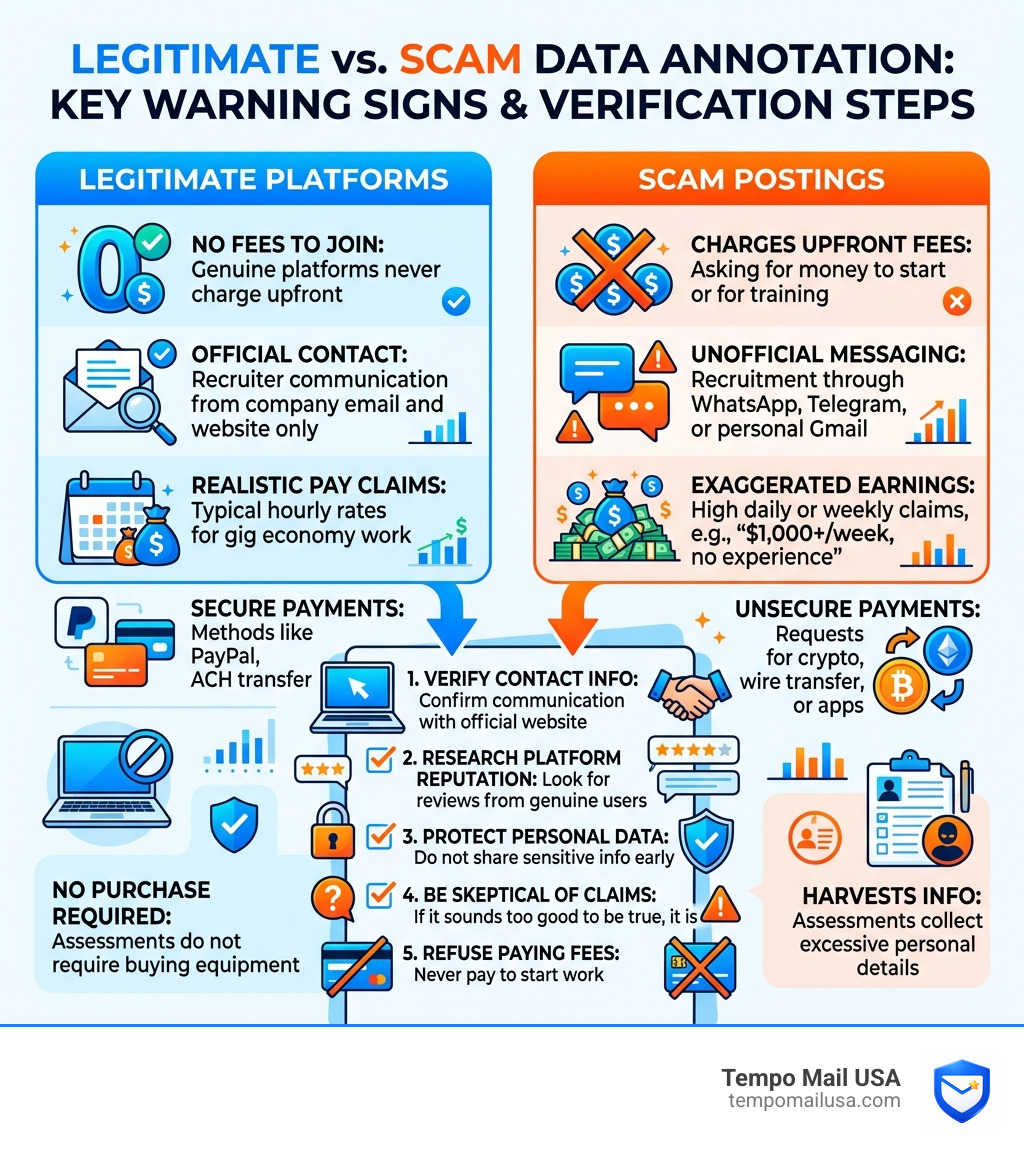
| Legitimate Platforms | Scam Postings | |
|---|---|---|
| Fees to join | None | Often charge upfront |
| Payment method | PayPal, ACH | Crypto, wire transfer, Venmo |
| Recruiter contact | Official email/site | WhatsApp, Telegram, Gmail |
| Pay claims | $20-$40/hr realistic | "$1,000+/week, no experience" |
| Assessment | Unpaid but no purchase required | Harvests your personal info |
Legitimate platforms like DataAnnotation.tech, Remotasks, and Outlier.ai have paid out millions of dollars to real workers. These are genuine gig economy jobs that help train AI models.
But here's the problem: scammers have noticed how popular these jobs are. They copy the branding, post fake listings, and use the attention to steal personal information or money.
One community warning from Windsor, Ontario captures it well — a job seeker spent just 10 minutes on what looked like a data annotation assessment, entered their name, email, and phone number, and immediately received a credit card scam call.
That's the core tension. The work is real. The impersonators are not.
This checklist will help you tell the difference before you share a single piece of personal information.
Understanding AI Training: What is Data Annotation?
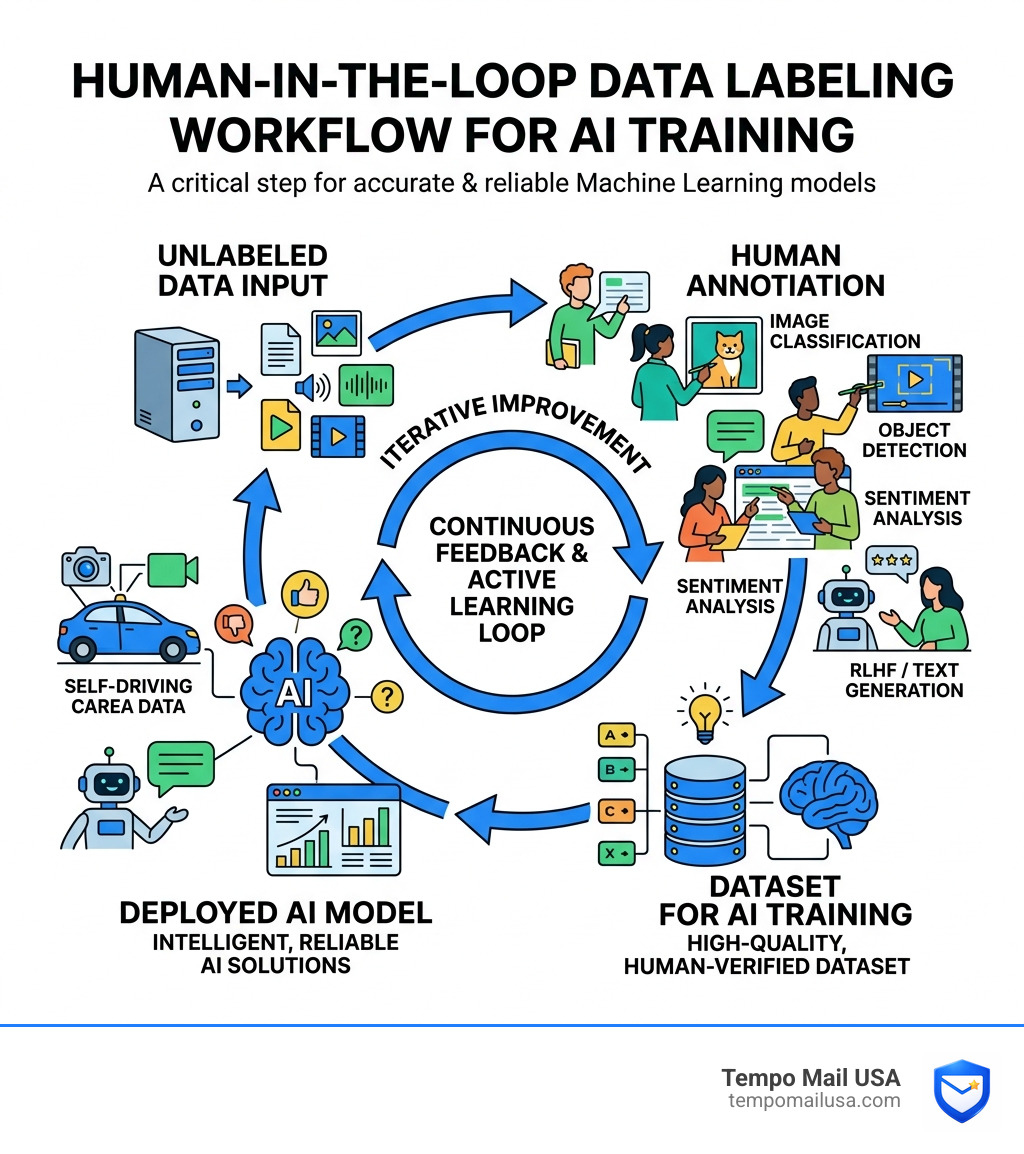
To determine if is data annotation a scam, we first need to understand what the job actually entails. In April 2026, AI is no longer just a buzzword; it is a massive industry fueled by human intelligence. Data annotation is the process of labeling data—text, images, audio, or video—so that machine learning models can understand it.
Think of it like being a teacher for a very fast, but very literal, student. If an AI needs to recognize a stop sign in a self-driving car video, a human must first draw "bounding boxes" around thousands of stop signs to teach the computer what they look like. This is often called "supervised learning."
Another major part of the work is Reinforcement Learning from Human Feedback (RLHF). This is where you might chat with a bot and rate its responses. Is the bot being helpful? Is it hallucinating facts about the Roman Empire? Is it being rude? Humans provide the "ground truth" that AI models can't figure out on their own.
According to a 2022 Google Research paper, there are already millions of people engaged in this work globally, and that number could grow into the billions. It is a critical part of the "human-in-the-loop" workflow. Whether you are performing sentiment analysis on social media posts or fact-checking quantum physics claims, you are providing the essential "brain power" that makes AI smart.

Is Data Annotation a Scam? Evaluating Platform Legitimacy
When people ask is data annotation a scam, they are usually reacting to the high pay rates advertised on social media. Platforms like DataAnnotation.tech, Remotasks, and Outlier.ai often advertise $20 to $40 per hour. In a world of $3-per-hour micro-tasks, this sounds suspicious.
However, the data suggests these platforms are legitimate businesses. DataAnnotation.tech, for instance, has reportedly paid over $20 million to its remote workforce since 2020 and maintains a global contractor base of over 100,000 people. On Trustpilot, the platform holds a 4.2/5 score, with many users praising the prompt PayPal payments and flexible scheduling.
Legitimate platforms work directly with major tech companies (though they often keep client names secret via NDAs). They act as a sophisticated middleman, providing high-quality, human-verified data to the labs building the next generation of LLMs.
Why Some Think Data Annotation is a Scam
If the platforms are real, why is there so much negativity online? Much of the "scam" talk comes from the platform's "algorithmic management" style. Here are the common pain points:
- The "Ghosting" Assessment: DataAnnotation reports a 2.6% acceptance rate. That means over 97% of people who take the initial test never hear back. Because there is no "HR department" to send rejection emails, many applicants assume the site is a data-harvesting scam.
- Sudden Deactivations: Workers may have a full dashboard of tasks one day and an empty screen the next. If the quality of your work drops below a certain threshold, the algorithm may offboard you without warning or explanation.
- Payment Glitches: While most users report reliable payouts, some have faced account freezes during the 7-day review period, leading to claims of "unpaid labor."
As noted in Data Annotation Platforms: Scam or Not Scam… That Is the Question – Data Annotation Hub, "legit doesn't always mean fair." These are gig economy platforms, not traditional employers. They offer no job security, no benefits, and very little transparency.
Verifying Official Communication Channels
To protect yourself, you must verify who you are talking to. Scammers often use "phantom recruiters" who pretend to be from real companies. A common tactic is using a name like "Phoebe R." or "Jean-Philippe" on LinkedIn to pitch biology or coding tasks.
Always check the email suffix. A legitimate recruiter from DataAnnotation will not email you from a @gmail.com, @hotmail.com, or @outlook.com address. They will also never ask to move the conversation to WhatsApp or Telegram. According to Is DataAnnotation a Scam? My Honest Take After Looking at the Reality - Pixelation, the most reliable way to join is to go directly to the official .tech domain rather than clicking on ads or unsolicited links.
Red Flags: How to Spot if a Data Annotation Job is a Scam
The most dangerous part of the industry isn't the real platforms; it's the fake ones. Scammers create carbon copies of sites like DataAnnotation.tech but use URLs like .cc, .org, or .net.
Here is a comparison table to help you spot a fraud:
| Feature | Legitimate Platform | Fraudulent Impersonator |
|---|---|---|
| Initial Cost | $0 (Always free to join) | Asks for "training fees" or "software costs" |
| Communication | Through the platform dashboard | WhatsApp, Telegram, or Signal |
| Interview | Skills-based assessment | "Text-based" interview on a messaging app |
| Payment Info | PayPal/Bank (after work is done) | Asks for bank login or "recharge" payments |
| Urgency | Take your time on assessments | "Must start now," high-pressure tactics |
A major red flag is the "Task Scam." This is where a site asks you to "optimize" or "annotate" data but requires you to "top up" your account with your own money to unlock more earnings. No legitimate data annotation company will ever ask you to pay them to work.
If you encounter one of these, you should report it immediately. You can find resources on how to do this in our Best Phishing Reporting Tool Guide - Free & Pro Options.
Protecting Your PII: Is Data Annotation a Scam or a Data Harvest?
One of the biggest risks in 2026 is data mining. Scammers use fake job assessments to harvest your Personally Identifiable Information (PII). By the time you realize there is no job, they already have your full name, birth date, email, and phone number.
This information is often used for identity theft. As we've detailed in our report on How Much Do Americans Lose to Identity Theft, the financial impact of a single leaked profile can be devastating.
To protect yourself:
- Use a Proxy Email: Never use your primary personal or work email to sign up for new platforms. Using an alias allows you to test the platform's legitimacy without exposing your real identity.
- Watch for SSN Requests: Legitimate US-based platforms will eventually need your tax information (W-9) for 1099 reporting, but they will never ask for your Social Security Number during the initial "starter assessment."
- Audit Your Digital Footprint: If you think you've already been targeted, follow our guide on How to Remove Personal Info from the Internet.
For an extra layer of safety, consider using the Best Phishing Detection Tools for Ultimate Security to scan any links sent by "recruiters."
Realistic Earnings and the Assessment Process
Let’s talk about the money. Is it possible to make a full-time living? For most, no. But as a side hustle, it can be quite lucrative.
According to Is Data Annotation Jobs Legit? Here's What Real Workers Are Saying — and How to Tell the Genuine Opportunities from the Fakes - Financial News, the pay scales in April 2026 generally look like this:
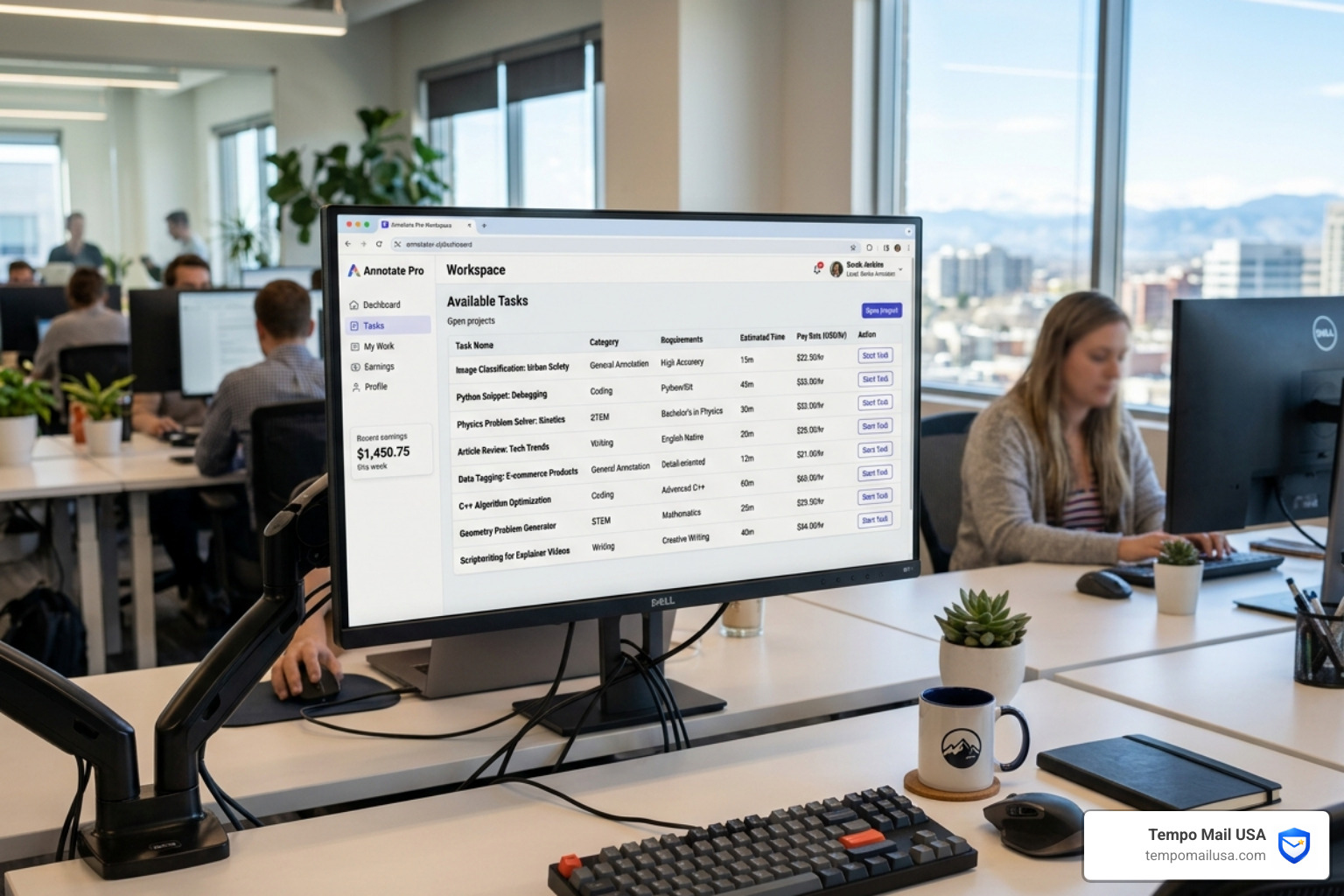
- General Annotation: $20–$25 per hour.
- Coding & STEM Tasks: $40–$60 per hour (some specialized chemistry or physics tasks can reach $100+).
- Writing & Creative Tasks: $25–$35 per hour.
The assessment process is the "gatekeeper." It usually takes 1–3 hours and is unpaid. You should treat this like a final exam. Legitimate companies are looking for meticulous detail, perfect grammar, and the ability to follow complex instructions. If you rush through it in 15 minutes, you will almost certainly be ghosted.
Once you are in, the payment structure is usually straightforward. For example, DataAnnotation.tech typically holds funds for 7 days for quality review. After that, you can cash out to PayPal. There is often a 72-hour "cooldown" between cashouts to prevent fraud.
Frequently Asked Questions about Data Annotation Legitimacy
How much can I realistically earn per week?
Most workers report earning between $200 and $500 per week as a part-time side hustle. While some power users manage to make $1,000+ by working 40+ hours, project availability fluctuates. It is not a guaranteed "salary."
Why was my account deactivated without notice?
Legitimate platforms use automated quality checks. If your "fact-check" accuracy drops or if the system detects AI-generated content in your own submissions (the irony!), you may be permanently banned. There is rarely an appeals process.
Do I have to pay for training or equipment?
Absolutely not. If any "employer" asks you to pay for a "starter kit," a "training manual," or "specialized software," it is a 100% confirmed scam.
Conclusion
Data annotation is a legitimate and vital part of the modern tech economy, but it requires a high level of vigilance. The industry is currently in a "Wild West" phase where legitimate opportunities are frequently shadowed by sophisticated scammers looking to harvest your PII.
At Tempo Mail USA, we believe your privacy should be your first priority when exploring the gig economy. By using secure email aliases and shielding your real identifiable information, you can explore these platforms without the fear of your data being sold to the highest bidder or used in a phishing attack.
Before you take that next assessment, ensure you have a "firewall" between your personal life and these algorithmic platforms. Protect your identity with Tempo Mail USA and keep your side hustle safe.