



How Much Americans Really Lose to Identity Theft (And Why It Should Alarm You)
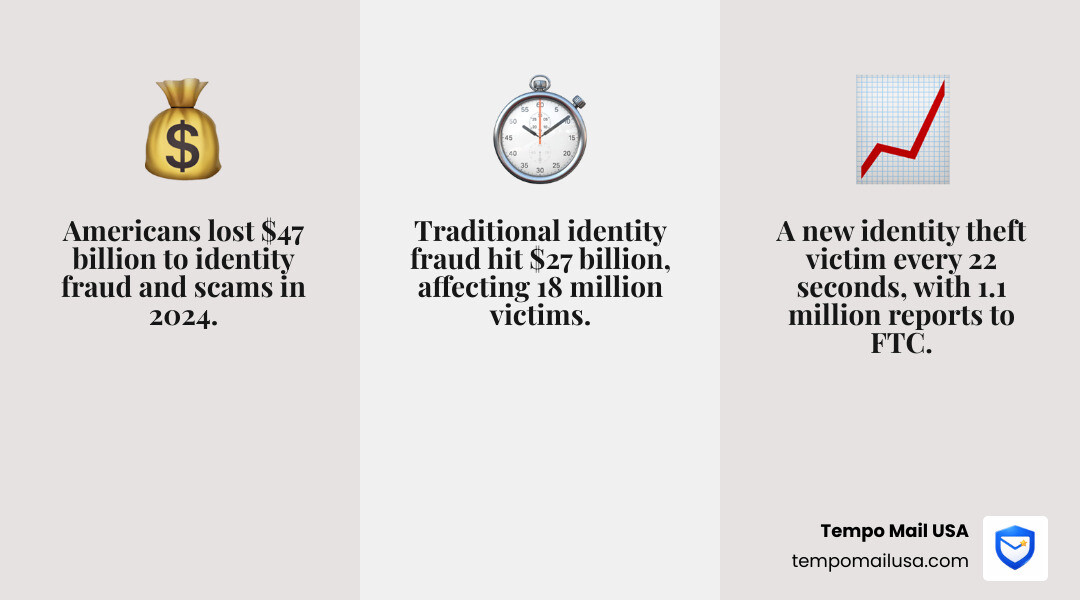
How much do americans lose to identity theft is a question with a jaw-dropping answer: in 2024 alone, American adults lost a combined $47 billion to identity fraud and scams — up $4 billion from the year before.
Here's a quick breakdown of the key numbers:
| Category | 2024 Loss |
|---|---|
| Total identity fraud + scams | $47 billion |
| Traditional identity fraud | $27 billion (18 million victims) |
| Account takeover fraud | $15.6 billion |
| New-account fraud | $6.2 billion |
| Scams (separate from fraud) | $20 billion |
| Median loss per victim | $497 |
| Victims aged 70+ median loss | $1,650 |
And those are just the reported figures. Experts widely agree the real number is higher, because most victims never report what happened to them.
The FTC received over 1.1 million identity theft reports in 2024. That works out to a new victim roughly every 22 seconds. Yet 57% of scam victims don't report the crime at all — often out of embarrassment or not knowing where to turn.
The financial hit is only part of the story. Victims also spend an average of 100 hours over a full year cleaning up the damage. For complex cases, full recovery can stretch to 22 months or longer.
Whether you're signing up for a newsletter, creating a trial account, or just browsing online, every time you hand over your real email address or personal information, you're adding one more link in a chain that criminals are actively trying to break.
1. The Staggering Bill: How Much Do Americans Lose to Identity Theft Annually?
When we look at the sheer scale of the problem, the numbers feel like something out of a high-stakes thriller. But for millions of us, this is reality. In 2024, the total financial damage hit $47 billion. As we move through 2026, the trend shows no signs of slowing down. This isn't just a "big business" problem; it's a "you and me" problem.
Traditional identity fraud—where a criminal steals your existing information to commit crimes—accounted for $27 billion of that total in 2024, affecting 18 million people. That is a massive jump from the $23 billion lost in 2023. If you’re wondering why these numbers keep climbing, it’s because our lives are more digital than ever. Every time a data breach occurs, our PII (Personally Identifiable Information) becomes a hot commodity on the dark web.
To protect yourself against these mounting costs, many are turning to Identity Theft Insurance Coverage to help mitigate the out-of-pocket expenses that come with restoration. According to reports from the Identity Fraud, Scams Cost Americans Billions in 2024 research, the complexity of these crimes is evolving alongside our technology.

Analyzing How Much Do Americans Lose to Identity Theft in 2025
As we stepped into 2025, the data became even more sobering. Reports indicated that identity theft cases exceeded 1.15 million in the US alone. Total financial fraud losses reached a peak of $12.5 billion for the year, with a significant portion attributed to sophisticated investment and imposter scams.
Investment scams were particularly brutal, with losses totaling $5.7 billion. Scammers have become experts at mimicking legitimate wealth management platforms. Meanwhile, imposter scams—where someone pretends to be a government official or a trusted business—drained $2.95 billion from American pockets. Reliable statistics from the US Identity Theft Statistics: Prevalence, Trends, and Reported Losses | National Identity Theft Authority highlight that while the number of reports has stabilized in some areas, the dollar amount lost per incident is skyrocketing.
The Growth of New-Account Fraud
One of the most insidious trends we’ve seen is the rise of "new-account fraud." This is when a thief uses your stolen information to open entirely new lines of credit, bank accounts, or even utilities. In 2024, this category reached $6.2 billion in losses, up from $5.3 billion the previous year.
Criminals are increasingly targeting specific niches, such as Payday Loan Identity Fraud, where the high-speed nature of the lending process makes it easier to bypass traditional checks. We also see a spike in Subscription Fraud Identity Theft, where thieves use stolen identities to sign up for services that they never intend to pay for, leaving the victim to deal with the collections agencies later.
2. Beyond the Median: Why High-Value Scams Drive Total Losses
While the median fraud loss per victim was $497 in 2024, that number doesn't tell the whole story. The "total" is driven up by high-value hits that can wipe out a person's life savings in a single afternoon. Account takeover fraud—where a criminal gains access to your existing bank or brokerage account—resulted in a massive $15.6 billion in losses.
The shift is clear: criminals aren't just looking for your credit card number anymore; they want the keys to your entire financial kingdom.

How Much Do Americans Lose to Identity Theft Through Specific Payment Methods?
The way we move money matters. Scammers have a "favorite" list of payment methods that are hard to reverse. Bank transfers and payment fraud cost consumers over $2 billion in 2024. Cryptocurrency is another major frontier, with losses hitting $1.42 billion as scammers exploit the anonymity and lack of regulation in the crypto space.
We’ve also seen the rise of "digital skimming." This is a high-tech version of the old card skimmers you’d find on gas pumps. Instead of a physical device, hackers inject malicious code into legitimate websites to capture payment info as you type it. This makes Wealth Management Identity Fraud a growing concern for anyone managing their portfolio online.
The Rise of Synthetic Identity Fraud
Perhaps the most "Frankenstein" version of this crime is synthetic identity fraud. This is where a criminal combines real information (like a stolen Social Security number) with fabricated data (like a fake name and address) to create a "synthetic" person.
This type of fraud now accounts for 30% of cases. It is particularly dangerous because it often uses the SSNs of children or the deceased—people who aren't checking their credit reports. Criminals can nurture these fake identities for years, building up high credit scores before "busting out" with massive loans. This is often fueled by Social Media OSINT Identity Fraud, where hackers gather bits of real data from your public profiles to make their fake identities look more convincing.
3. The Generational Divide in Financial Impact
Identity theft doesn't discriminate, but it does hit different age groups in different ways. Interestingly, Millennials (ages 30-39) are the most targeted group, making up 42% of all reports. They are online more, use more apps, and have more digital touchpoints.
However, the younger generation isn't safe either. In 2025, a shocking 51% of consumers aged 19 and younger reported losing money to scams. This often happens through social media or gaming platforms. We must be vigilant about Elder Financial Abuse Online, as the tactics used against our parents and grandparents are becoming increasingly heartless.
Targeting the Vulnerable: Seniors and Identity Fraud
While Millennials are targeted more often, seniors lose more money. For victims aged 70 and older, the median loss was $1,650—more than triple the national average. Criminals prey on the trust and perceived wealth of older adults, often using tech-support scams or "grandparent" scams to drain accounts.
Education is the best defense here. We recommend looking into Elder Financial Exploitation Detection techniques to help spot the warning signs before a loved one loses their retirement fund.
Healthcare and Benefit Fraud Risks
Identity theft isn't always about your bank account; sometimes, it's about your health. Medical identity theft accounted for over 10,000 reports in recent years. This happens when someone uses your name or insurance info to get medical treatment or prescription drugs.
The danger here is twofold: not only does it drain your insurance benefits, but it also corrupts your medical records. If a thief has a different blood type or a different medical condition, that information could end up on your file, leading to life-threatening mistakes in an emergency. This is closely linked to Medicaid Billing Identity Theft, which costs taxpayers billions and puts vulnerable patients at risk.
4. The Hidden Costs: Time, Recovery, and Emotional Toll
When people ask, how much do americans lose to identity theft, they usually mean dollars. But the "cost" of identity theft is also measured in hours and heartaches. On average, victims spend 100 hours over the course of a year trying to resolve the issue. If you’ve ever sat on hold with a bank for an hour, imagine doing that 100 times.
According to IRS data, the average recovery time for tax-related identity theft is 22 months. That’s nearly two years of financial limbo where your refunds might be frozen and your credit is under a cloud. Even the out-of-pocket costs—things like notary fees, legal help, and registered mail—average about $202 per victim.
The Psychological Impact of Victimization
We cannot overlook the emotional damage. Identity theft is a violation of privacy that leaves many feeling vulnerable and paranoid.
- 43% of victims report experiencing anxiety or depression.
- 42% struggle with long-term trust issues.
- A heartbreaking 16% of victims in 2023 reported contemplating suicide—a massive increase from decades ago.
This isn't just a financial hiccup; it's a traumatic life event. The feeling that someone is "living" as you and spending your hard-earned money is deeply unsettling.
Long-Term Credit and Financial Damage
The ripple effects on your credit score can last for years. A single fraudulent account can tank a credit score, leading to higher interest rates or denials for mortgages and car loans. Employment identity theft is also on the rise, growing 20% year-over-year. This is where someone uses your SSN to get a job, which can lead to you being hit with a massive tax bill for income you never earned.
If you're worried about your exposure, you should check Is My Email on the Dark Web Check for Free to see if your credentials have already been leaked in a breach.
5. Proactive Defense: How to Shield Your PII
So, how do we fight back? The first step is realizing that your PII is a "hot commodity." We need to treat our data like the currency it is.
The most effective tool in your arsenal is a credit freeze. This prevents anyone (including you) from opening new credit accounts in your name until you "unfreeze" it with a PIN. It's free and takes about 10 minutes to set up with the three major bureaus. We also strongly recommend using a password manager and enabling multi-factor authentication (MFA) on every single account that allows it.
For a deeper dive into cleaning up your digital footprint, check out our guide on How to Remove Your Personal Information from the Internet.
Recognizing Modern Phishing Tactics
Criminals are now using AI to create "perfect" phishing emails and texts. In 2024, 16% of data breaches were powered by AI-driven attacks. These messages no longer have the "bad grammar" or "obvious typos" we used to look for.
Text message fraud (smishing) is now the preferred contact method, with 54% of victims being contacted via text. Be wary of any message that creates a sense of "urgent" panic, especially those leading to a Fake Online Store Identity Theft where your credit card info is harvested the moment you try to "buy" a discounted item.
Frequently Asked Questions about Identity Theft Losses
Which state has the highest rate of identity theft?
Florida consistently takes the top spot, with 528 identity theft complaints per 100,000 residents. Other high-risk states include Georgia, Delaware, Nevada, and Maryland. While the reasons vary, high populations of seniors and high levels of digital commerce often contribute to these rankings.
How often does identity theft occur in the US?
It happens every 22 seconds. In 2024, the Consumer Sentinel Network took in over 6.4 million reports. Statistics show that roughly 22% of Americans—nearly 1 in 4—will experience identity theft at some point in their lives.
What is the most common type of identity theft reported?
Credit card fraud remains the king of identity theft, with 449,032 reports in 2024. This includes both the misuse of existing cards and the opening of new fraudulent accounts. Government documents and benefits fraud (including tax and unemployment fraud) is another major subcategory.
Conclusion
The question of how much do americans lose to identity theft has a complicated answer that goes far beyond the $47 billion headline. It’s a loss of time, a loss of trust, and a constant threat to our digital well-being.
At Tempo Mail USA, we believe the best way to win the fight is to stop the criminals before they even get your data. Our temporary email aliases act as a PII firewall. By using an alias when you sign up for websites, newsletters, or trials, you keep your real email address—and the identity attached to it—off the dark web. If a site you signed up for gets breached, you simply delete the alias, and the hacker is left with a dead end.
Protecting your identity in 2026 requires more than just a strong password; it requires a strategy. Start shielding your personal information today at https://tempomailusa.com and take the first step toward a more secure digital life.