



Why Inbox Overload Is Killing Your Security Culture
How can enterprises improve employee awareness without spamming inboxes? Here's the short answer:
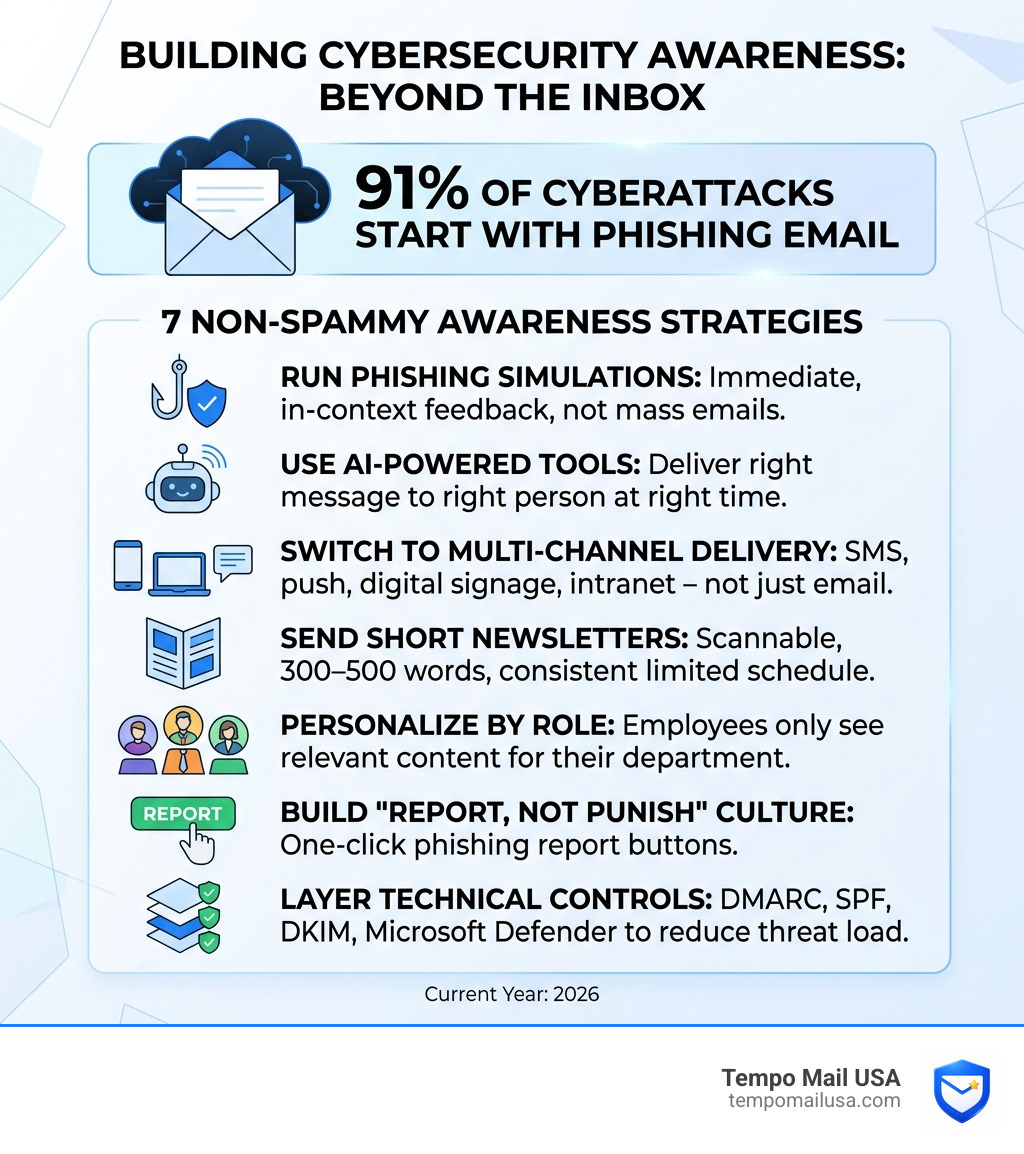
Quick Answer: 7 Ways to Improve Employee Awareness Without Spamming
- Run phishing simulations with immediate, in-context feedback instead of mass email blasts
- Use AI-powered tools to deliver the right message to the right person at the right time
- Switch to multi-channel delivery — SMS, push notifications, digital signage, and intranet — not just email
- Send short, scannable newsletters (300–500 words max) on a consistent but limited schedule
- Personalize by role and department so employees only see what's relevant to them
- Build a "report, don't punish" culture with one-click phishing report buttons
- Layer technical controls like DMARC, SPF, DKIM, and Microsoft Defender to reduce the threat load reaching inboxes in the first place
Here's an uncomfortable truth: the average office worker already receives 117 emails every single day. They're interrupted roughly 275 times. Most messages get skimmed in under a minute — or ignored entirely.
Now imagine your security team piling more emails on top of that. Phishing awareness reminders. Policy updates. Mandatory training links. Compliance notices.
The result? Employees tune out. And when they tune out, they click things they shouldn't.
CISA has reported that more than 90% of successful cyberattacks start with a phishing email. Yet traditional awareness programs — built almost entirely around email — are contributing to the very inbox fatigue that makes employees vulnerable in the first place.
This is the core problem enterprises face in 2026: more communication does not equal more awareness. In fact, it often means less.
The good news is there's a smarter way to build genuine security awareness — one that doesn't flood inboxes, doesn't exhaust your team, and actually works.
The High Cost of Inbox Fatigue in 2026
As we navigate April 2026, the digital landscape is more crowded than ever. We’ve all felt that sinking feeling when we open our laptops on a Monday morning only to find a mountain of unread messages. This isn't just a nuisance; it’s a significant security vulnerability.
When employees suffer from "inbox fatigue," they stop scrutinizing senders. They stop hovering over links. They just want to clear the pile. This productivity drain is massive. According to the Microsoft Work Trend Index 2025, employees are interrupted every two minutes by meetings, emails, or chats. These 275 daily interruptions create a state of constant distraction where sophisticated phishing attempts can easily slip through.
If your awareness program relies on sending "All-Staff" emails every time a new threat emerges, you aren't training your team—you're contributing to the noise. To truly protect the organization, we must learn How to Plan, Execute, and Improve Your Internal Comms Email Strategy so that messages are purposeful and rare.
Furthermore, relying on humans to filter everything is a recipe for disaster when nearly 45.6% of global email traffic is spam. We need to ensure that our technical filters are doing the heavy lifting. You can explore how to lighten the load by checking out these Say Goodbye to Spam: Best Email Filtering Tools Reviewed.

How Can Enterprises Improve Employee Awareness Without Spamming Inboxes?
To answer the big question—how can enterprises improve employee awareness without spamming inboxes?—we have to look at the shift from "compliance-based" training to "behavior-based" awareness.
Traditional training is often a once-a-year, hour-long video that everyone puts on mute. Modern awareness is about micro-learning: small, digestible bits of information delivered when they are most relevant.
| Feature | Traditional Mass-Email Training | Modern Behavioral Awareness |
|---|---|---|
| Frequency | Once a year or monthly "blasts" | Real-time, situational nudges |
| Content | Long videos or text-heavy PDFs | Micro-learning, 2-minute videos |
| Delivery | Email only | Multi-channel (SMS, Apps, Signage) |
| Goal | "Check the box" compliance | Long-term habit formation |
| Feedback | Pass/Fail quizzes | "Report, don't punish" culture |
By moving away from the "Send All" mentality, we foster a security culture where employees feel like partners rather than targets. They need to Master How to Spot Phishing Emails through experience, not just lectures. This involves Internal Communication Campaigns: Creative Strategies for Employee Engagement that treat security like a brand rather than a chore.
Implementing Non-Intrusive Phishing Simulations
Phishing simulations are one of our most powerful tools, but they must be handled with care. If they feel like a "gotcha" from IT, you’ll lose employee trust.
The data is clear: sustained security awareness programs can reduce phishing susceptibility by 70% to 85% over 12 months. In fact, many UK SMEs saw their phishing click rates drop from 34% to just 5% after a year of consistent, non-intrusive training.
The key is positive reinforcement. When an employee reports a simulation, celebrate it! If they click, don’t send them to the principal’s office. Instead, provide a 30-second "teachable moment" right there in the browser. This is especially vital when Stay Safe: Combatting PayPal Phishing Attacks Effectively or dealing with other high-frequency brand spoofs.
Using AI to Improve Employee Awareness Without Spamming Inboxes
In 2026, AI is the secret weapon for internal communicators. We no longer have to guess when employees are most likely to read an update. AI-powered tools can analyze historical engagement data to perform "send-time optimization." This ensures that a security alert arrives when an employee is actually at their desk and focused, rather than buried under 20 other notifications at 9:00 AM.
AI also allows for Scaling Deskless Comms with AI-Driven Content Distribution. By using behavioral analytics, the system can recognize that a developer needs deep-dive technical security updates, while a sales rep needs quick tips on mobile security. This level of precision is exactly how can enterprises improve employee awareness without spamming inboxes—by only sending what is necessary to the person who needs it.
Strategic Content Delivery Beyond the "Send All" Button
If you must use email, make it count. The days of the 2,000-word "Security Monthly" are over. No one reads them.
Best practices for 2026 suggest that internal newsletters should be between 300 and 500 words—about a 2 to 3-minute read. They should be scannable, using bold headers, bullet points, and high-quality visuals. Think of your security updates like a news feed, not a textbook.
To keep things fresh, follow these 13 Employee Newsletter Best Practices To Keep Your Employees Engaged. When you consolidate five separate emails into one well-designed weekly digest, you are actively helping your team How to Stop Spam Emails from their own company.
Multi-Channel Approaches for Deskless Workers
We often forget that 80% of the global workforce doesn't sit at a desk. For healthcare workers, manufacturing teams, and retail staff, email is a terrible way to communicate.
To reach these groups without spamming their personal or work inboxes, we have to go multi-channel:
- SMS Alerts: Reserved for critical, time-sensitive security threats.
- Digital Signage: Placing "Security Tip of the Week" on screens in breakrooms or lobbies.
- Push Notifications: Using a dedicated company app for quick, actionable nudges.
Using a Guide to Employee Engagement: How to Make Newsletters & Announcements Unmissable helps ensure that your frontline workers are just as aware as your C-suite, without ever needing to check a cluttered inbox.
Personalization to Improve Employee Awareness Without Spamming Inboxes
Personalization isn't just about putting a name in the subject line. It’s about dynamic segmentation. If a specific department is being targeted by a "Whaling" attack (targeting high-level executives), only that group needs the alert.
We can also use "retargeting" tactics. If an employee hasn't completed a mandatory security module, the system can send a gentle nudge only to them, rather than a "Friendly Reminder" to the whole company. This is a game-changer for workforce engagement.
You can even teach employees to manage their own digital footprint. For example, helping them Beat Spam: How to Stop Unwanted Emails on Gmail shows that the company cares about their individual productivity, not just corporate compliance.
Technical Layers: Authentication and PII Protection
We cannot talk about awareness without talking about the technology that supports it. If your technical defenses are weak, your employees are forced to be "human firewalls" for thousands of junk messages every day. That’s an unfair burden.
Enterprises must implement and enforce modern authentication protocols:
- SPF (Sender Policy Framework): Verifies which mail servers are authorized to send email on behalf of your domain.
- DKIM (DomainKeys Identified Mail): Adds a digital signature to emails to ensure they weren't tampered with in transit.
- DMARC (Domain-based Message Authentication, Reporting, and Conformance): Tells receiving servers what to do if an email fails SPF or DKIM.
Shockingly, in 2025, DMARC adoption among UK SMEs was only 38%. By tightening these screws, you stop spoofed emails from ever reaching the inbox. Additionally, Microsoft reported that simply using Multi-Factor Authentication (MFA) can prevent 99% of credential-based attacks.
At Tempo Mail USA, we believe the best way to stop a phishing attack is to ensure the attacker doesn't have your real email address in the first place. We provide temporary email aliases that act as a PII (Personally Identifiable Information) firewall. By using aliases for third-party services and newsletters, enterprises can shield their primary internal addresses from the "leak-and-target" cycle that fuels most phishing campaigns.
Encrypted Email Isn’t Optional Anymore: Here Is Why. Combining encryption with a strategy to Check Your Email Spam Score: A Step-by-Step Guide ensures your technical layer is as robust as your human layer.
Frequently Asked Questions about Enterprise Awareness
How often should we send security updates?
The "sweet spot" for internal communications is generally 2–3 touchpoints per week across all channels. If you are sending daily security emails, you have already been relegated to the "ignore" folder. Consistency is better than volume. A predictable Tuesday morning "Security Minute" is much more effective than five random alerts.
What metrics prove awareness program success?
Stop looking at "completion rates" for training videos. They don't prove anyone learned anything. Instead, track:
- Reporting Rate: How many employees clicked the "Report Phish" button on a simulation? (Higher is better).
- Remediation Time: How long does it take for IT to be notified of a real threat?
- Phishing Susceptibility: The percentage of people who click on simulations over time.
How do we encourage reporting without punishment?
You must foster a "Report, Don't Punish" culture. If an employee clicks a link and realizes they made a mistake, they should feel safe calling the help desk immediately. If they fear being fired, they will hide the mistake, giving the attacker more time to move through your network.
Using tools like a one-click Phish Alert Button makes reporting easier than deleting. For more tips on managing the "junk" in a user-friendly way, see our Mastering Gmail Spam: A Step-by-Step Guide.
Conclusion
Building a secure enterprise in 2026 isn't about shouting louder; it's about speaking smarter. When we ask, "how can enterprises improve employee awareness without spamming inboxes?", the answer lies in a multi-layered approach that respects the employee’s time and cognitive load.
By combining AI-driven delivery, multi-channel engagement, and "teachable moments" via simulations, we can create a workforce that is vigilant rather than exhausted. But even the best-trained employees shouldn't have to stand alone.
Technical controls like DMARC and MFA provide the foundation, but at Tempo Mail USA, we recommend adding one more layer: the PII firewall. By using our secure email aliases, your enterprise can disconnect its real identities from the public-facing web, significantly reducing the amount of targeted spam and phishing that ever reaches your team's inboxes.
Protect your enterprise identity and give your employees their focus back. Protect your enterprise identity with secure email aliases and start building a security culture that breathes.