


Why Encrypted Mail Services Are Your First Line of Defense Against Data Exposure
Encrypted mail services are specialized email platforms that protect your messages using end-to-end or zero-access encryption, so only you and your intended recipient can read them — not hackers, advertisers, or governments.
Top encrypted email service categories at a glance:
| Service Type | Best For | Free Tier | Encryption Type |
|---|---|---|---|
| Privacy-First | Overall digital sovereignty | Yes | End-to-end, zero-access |
| Quantum-Safe | Future-proof security | Yes | Post-quantum E2E |
| OpenPGP-Ready | Advanced power users | Yes | Browser-based OpenPGP |
| Enterprise-Grade | Business/compliance | Yes | Industrial-grade E2E |
| Alias-Centric | Identity masking | No | PGP |
| Productivity-Integrated | Existing office users | No | Message-level encryption |
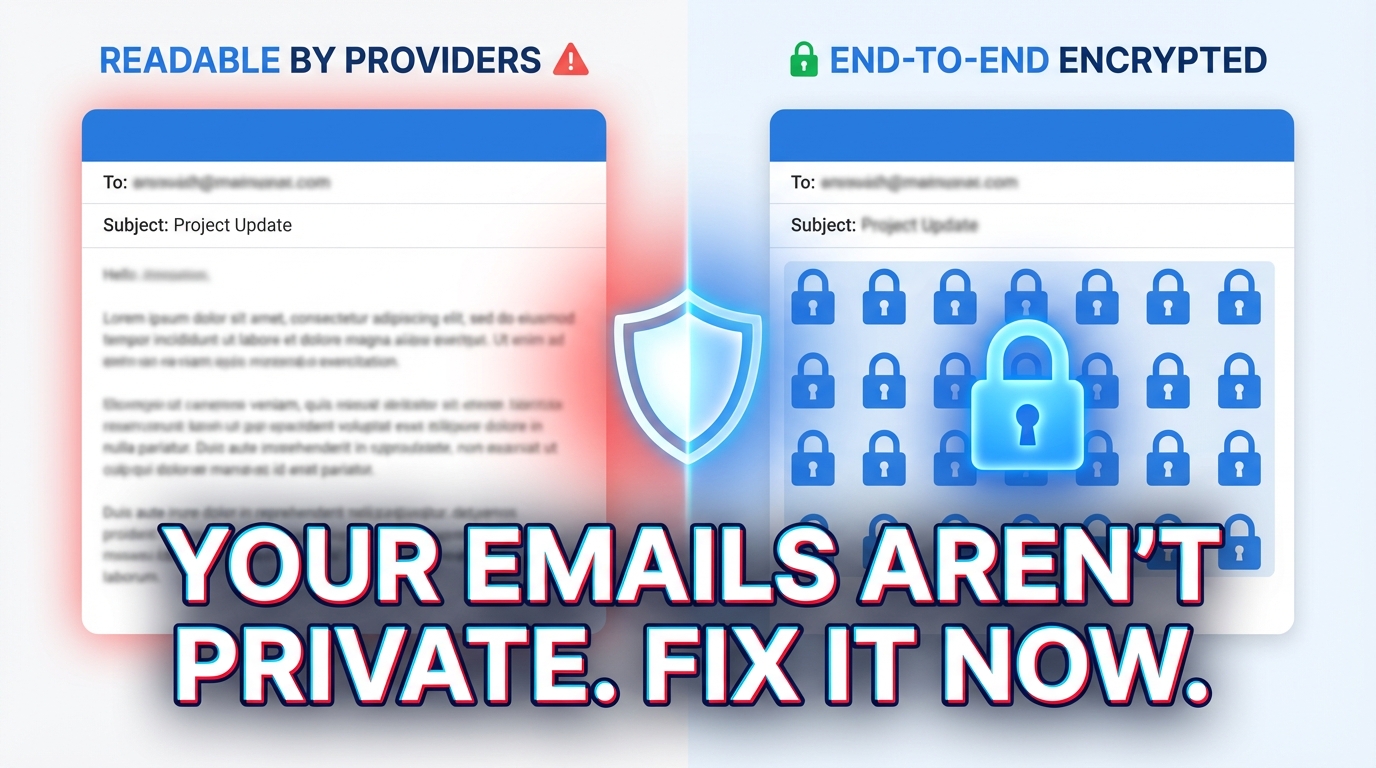
Here's the thing most people don't know: your regular email is not truly private.
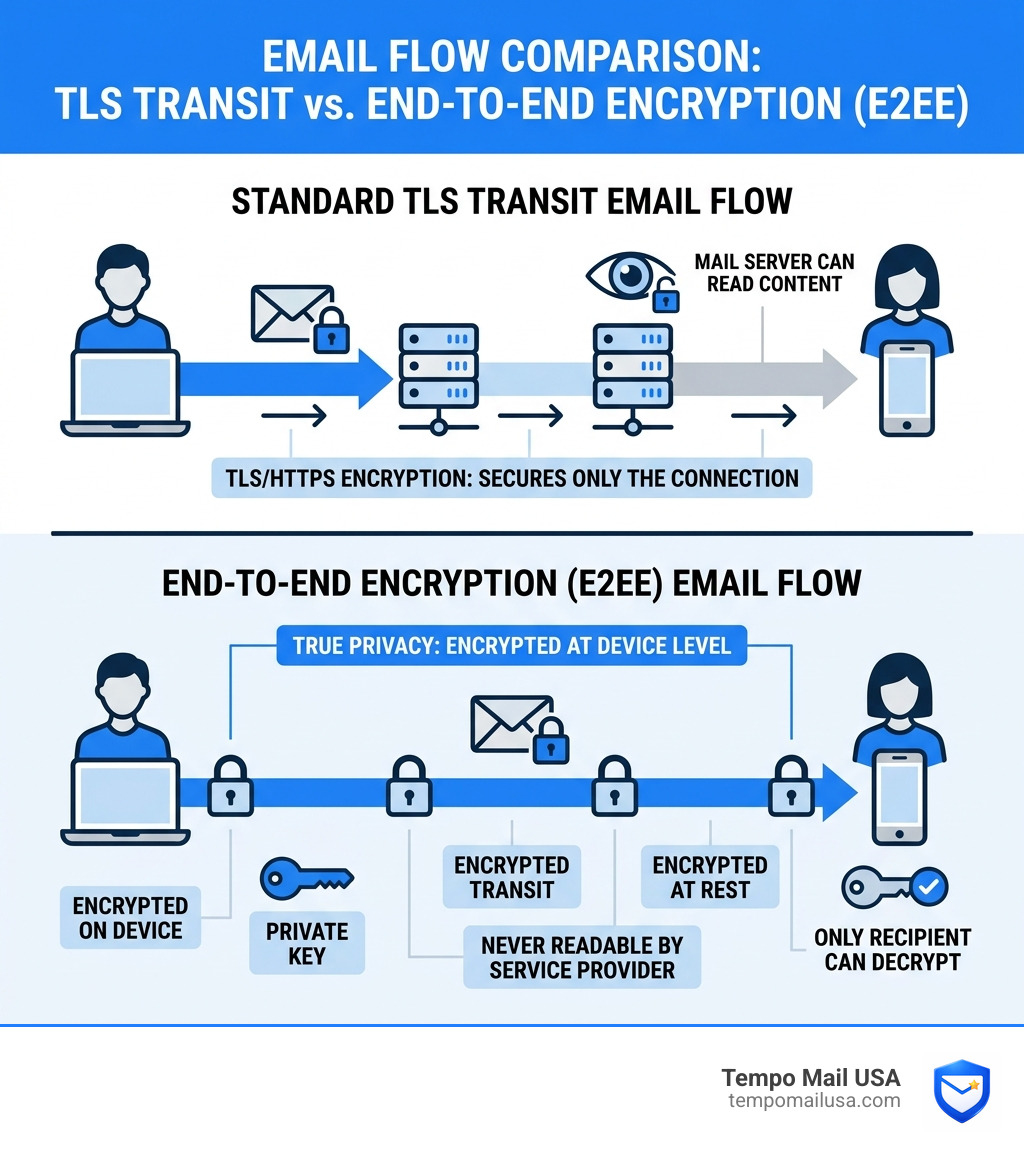
Standard email providers use HTTPS to protect your connection, but the provider can still read your messages. They can be compelled to hand them over to government agencies. As PCMag puts it, that's a big difference between transit security and actual end-to-end encryption.
Ray Tomlinson sent the first email in 1971. He was thinking about delivery — not about keeping it secret. More than 50 years later, most email still works the same way. Your messages travel like postcards: readable by anyone handling them along the route.
That's exactly the problem encrypted mail services are designed to solve.
With over 100 million accounts worldwide on leading private platforms, and tens of thousands of businesses choosing dedicated encrypted providers, the shift toward private email is accelerating fast.
Below, we break down the top service categories, what they actually protect, and which one fits your situation best.
The Evolution of Encrypted Mail Services in 2026
As we move through 2026, the digital landscape has become more treacherous than ever. Traditional email providers, while convenient, have essentially turned our private communications into a commodity. Whether it's for training AI models or serving "relevant" ads, your data is being mined. This is why encrypted mail services have transitioned from a niche tool for activists to a mainstream necessity for anyone who values their digital sovereignty.
The modern standard for privacy is built on two pillars: end-to-end encryption (E2EE) and zero-access architecture. E2EE ensures that a message is encrypted on your device and only decrypted on the recipient's device. Even the service provider carrying the message cannot see the content. Zero-access architecture takes this a step further, ensuring that even your stored "at rest" emails are encrypted with a key that only you possess.
When you Protect Your Privacy with Free Private Email Services, you are essentially building a vault around your digital life. Leading secure providers have scaled this technology to serve over 100 million accounts, proving that high-level security doesn't have to come at the expense of a user-friendly interface.
For background on the underlying standard, see OpenPGP, which remains one of the most recognized frameworks for secure email encryption and authenticated messaging.
Key Protocols Powering Encrypted Mail Services
To understand how these services keep you safe, we need to look under the hood at the protocols they use:
- OpenPGP (Pretty Good Privacy): This is the gold standard for email encryption. It uses a public/private key pair system. You share your public key with the world so they can encrypt messages to you, but only your private key can unlock them. Advanced platforms allow you to manage these keys directly in your browser.
- S/MIME: Often used in corporate environments, this relies on centralized certificate authorities to verify identities.
- Post-Quantum Cryptography: This is the new frontier. With the rise of quantum computing, traditional encryption could eventually be cracked. Leading innovators are pioneers here, implementing algorithms designed to withstand the processing power of future quantum computers.
- Zero-Knowledge Calendars and Contacts: True privacy doesn't stop at the message body. Leading services now encrypt your metadata, calendar events, and contact lists so that no one can map out your life's schedule.
By adopting these protocols, businesses can ensure robust data privacy compliance with regulations like GDPR and HIPAA, which require stringent protections for sensitive information.
Why Your Business Needs Encrypted Mail Services
In the corporate world, an unencrypted email is a liability. Industrial-grade encryption is no longer optional; it is a requirement for data privacy compliance. Whether you are a small legal firm or a massive financial institution, the risk of corporate espionage or a data breach is ever-present.
Enterprise-grade services provide Department of Defense-grade security that integrates directly into existing enterprise platforms. This allows businesses to maintain their workflow while adding a layer of advanced malware protection and encryption that shields sensitive attachments and intellectual property. When your communication is encrypted, you are essentially neutralizing the threat of "man-in-the-middle" attacks where hackers intercept data during transit.
Enterprise VPN Solutions and Secure Cloud Storage for Business
While secure email is the foundation, a truly private digital ecosystem requires more. Many top-tier encrypted mail services now bundle their offerings with enterprise VPN solutions and secure cloud storage for business.
A VPN (Virtual Private Network) is essential for masking your IP address and encrypting all your internet traffic, preventing your ISP or local network snoops from seeing what you do online. When combined with secure cloud storage, businesses can collaborate on documents in a "zero-knowledge" environment where the storage provider has no way of accessing the files.
| Feature | Personal Plans | Business/Enterprise Plans |
|---|---|---|
| Storage | 500MB - 15GB | 1TB+ per user |
| Custom Domains | Usually limited to 1 | Unlimited with catch-all support |
| Admin Controls | None | User management, remote wipe, audit logs |
| Support | Standard | Priority 24/7 |
| Compliance | Basic Privacy | GDPR, HIPAA, DMARC/DKIM/SPF |
For a deep dive into how to structure your organization's defenses, check out The Digital Shield: Protecting Your Email Data.
Preventing Phishing with Disposable Email Infrastructure
One of the most significant vulnerabilities in any security stack is the "real" email address. Once your primary email is leaked in a data breach, it becomes a permanent target for phishing, spam, and advanced malware protection bypass attempts. This is where Tempo Mail USA becomes an indispensable part of your privacy toolkit.
At Tempo Mail USA, we provide secure identity proxying. Think of it as a digital firewall for your PII (Personally Identifiable Information). Instead of giving your real email to every newsletter, e-commerce site, or "free" whitepaper download, you use a temporary email alias.
Why Temporary Aliases are Essential:
- Block Tracking: Most marketing emails contain hidden pixels that track when and where you open an email. Using an alias helps break the link to your permanent identity.
- Neutralize Data Breaches: If a site you signed up for is hacked, the hackers only get a disposable alias, not your primary login credential.
- Prevent Data Mining: Data brokers thrive on connecting your email address to your buying habits. A "firewall" of aliases makes this impossible.
We highly recommend integrating Tempo Mail USA into your daily browsing. By using our premium temporary email utility, you instantly block tracking and malicious data payloads. For more information, read The Ultimate Guide to Private Disposable Email.
Identity Theft Protection Services and Advanced Malware Protection
Email is the primary vector for 90% of cyberattacks. From sophisticated phishing schemes to "stalkerware" that monitors your every move, the threats are diverse. This is why identity theft protection services and advanced malware protection are often integrated into the best encrypted mail services.
Security Checklist for Email Users:
- Enable Two-Factor Authentication (2FA): Use hardware keys (like YubiKey) or TOTP apps, never SMS.
- Check for Leaks: Use tools to see if your credentials appear in known breaches.
- Verify Senders: Look for BIMI (Brand Indicators for Message Identification) or digital signatures to ensure the sender is who they claim to be.
- Use Credit Monitoring Software: Monitor your financial health to catch identity theft early.
Advanced security platforms use AI-powered threat detection to spot phishing and malicious URLs before they even reach your inbox. This proactive approach is a cornerstone of modern cybersecurity. For a list of the most secure providers, see our guide on the Best Private Email Service: Secure & Anonymous Providers.
Data Privacy Compliance and Cybersecurity Insurance
The legal landscape of privacy is as important as the technical one. Where your data is stored matters.
- Switzerland: Known for strict privacy laws (many top-tier services are based here).
- Germany: Home to leading providers operating under the world’s strictest GDPR interpretations.
- Belgium: Secure providers benefit from Belgian laws that require a local court order for any data request—a rare occurrence.
- Iceland: Privacy-focused services utilize Icelandic data sovereignty, which is among the strongest in the world.
For businesses, maintaining data privacy compliance is not just about avoiding fines; it’s about being insurable. Many cybersecurity insurance providers now require proof that a company uses encrypted mail services and multi-factor authentication before they will issue a policy. Without these protections, your business is considered high-risk.
Learn more about the intersection of law and tech in Why You Need a Secure Temp Mail Service for Privacy.
Frequently Asked Questions about Encrypted Mail Services
What are the critical security distinctions between dedicated encrypted mail services and conventional email providers?
Conventional big-tech providers encrypt the "pipe" (the connection) between you and their servers using TLS. However, once the email arrives, they hold the keys to the "envelope." Dedicated encrypted mail services use end-to-end encryption, meaning the provider never has the keys. They couldn't read your mail even if they were served a subpoena.
Can I use encrypted mail services with my existing custom domain?
Yes. Most paid tiers of professional encrypted mail services allow you to link your own domain (e.g., name@yourcompany.com). This gives you professional branding combined with elite security.
What is the difference between end-to-end and zero-access encryption?
End-to-end encryption (E2EE) protects the message while it is moving from sender to recipient. Zero-access encryption protects the message while it is sitting on the server. A top-tier service uses both to ensure that your data is never visible to the service provider at any stage.
What role does cybersecurity insurance play in protecting my business's email data?
Cybersecurity insurance provides financial protection in the event of a breach, covering legal fees, recovery costs, and notification expenses. However, to qualify for lower premiums, insurers typically require the use of enterprise VPN solutions, secure cloud storage for business, and encrypted mail services.
Conclusion
In an era where data is the new oil, your privacy is the most valuable asset you own. Transitioning to encrypted mail services is no longer a "paranoia" move—it is a logical, proactive step toward securing your digital identity. By combining these services with identity theft protection services and the disposable email infrastructure provided by Tempo Mail USA, you create a multi-layered defense that is nearly impossible for hackers to penetrate.
Don't let your personal and professional life become an open book for big tech and malicious actors. Secure your identity today at Tempo Mail USA and take the first step toward true digital sovereignty.