


Why Email Data Protection Matters More Than Ever
Email data protection is the set of security measures, technologies, and practices used to safeguard sensitive information in email communications from unauthorized access, theft, and misuse. Here's what you need to know:
Key Components of Email Data Protection:
- Encryption - Scrambles email content so only intended recipients can read it
- Authentication - Verifies sender identity to prevent impersonation attacks
- Access Controls - Limits who can view, forward, or download email data
- Data Loss Prevention (DLP) - Prevents accidental or malicious data leaks
- Regulatory Compliance - Ensures adherence to laws like GDPR and PECR
Your inbox is a goldmine of personal data. Every day, email users send over 122 work-related emails on average, many containing sensitive information like Social Security numbers, credit card details, patient records, and confidential business data. Yet most people don't realize just how vulnerable their email communications are.
The numbers tell a sobering story: 91% of cyber attacks begin with a phishing email. Meanwhile, Gmail blocks nearly 10 million spam emails every single minute. These aren't just statistics - they represent real threats to your privacy, finances, and identity.
Email data breaches can lead to identity theft, financial fraud, legal penalties, and loss of customer trust. For businesses, the consequences include massive fines (up to €20 million or 4% of global revenue under GDPR), reputational damage, and potential legal action. Even if email content isn't sensitive, exposing recipient lists can reveal confidential information about who's receiving messages.
The good news? You don't need to be a cybersecurity expert to protect your email data. Understanding the risks and implementing basic security measures can dramatically reduce your exposure to threats.
Primary Risks and the Importance of Email Data Protection
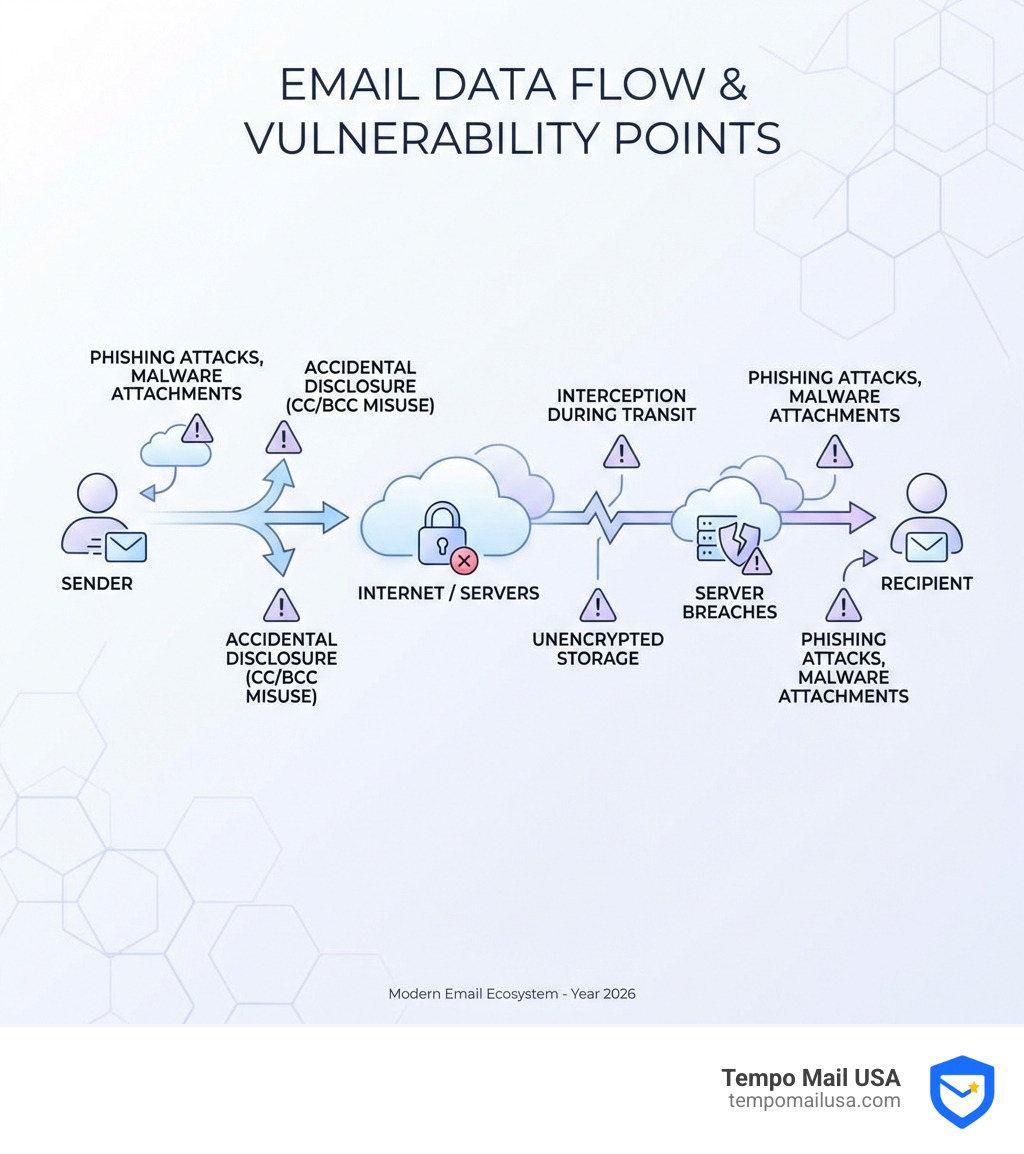
In today's digital landscape, email isn't just a communication tool; it's a critical repository of sensitive information. This makes email data protection paramount for organizations of all sizes. The primary risks associated with email data breaches can be devastating, extending far beyond a simple inconvenience.
Imagine a single email falling into the wrong hands. It could contain confidential client lists, proprietary business strategies, or even personal employee data. This is why we say that 91% of cyber attacks begin with a phishing email. Phishing, a malicious attempt to trick recipients into revealing sensitive information or deploying malware, is a pervasive threat. When successful, it can lead to:
- Data Breaches: Unauthorized access to sensitive information, often involving customer or patient Personally Identifiable Information (PII). This can include Social Security numbers, credit card details, health records, and more.
- Identity Theft and Financial Fraud: Cybercriminals frequently use information gleaned from emails to commit identity theft or directly access financial accounts.
- Reputational Damage: A data breach can severely erode trust with customers, partners, and the public, leading to long-term brand damage and loss of business.
- Legal and Regulatory Penalties: Failing to protect data can result in significant fines and legal action, especially under strict regulations like GDPR.
- Credential Harvesting: Phishing emails often aim to steal login credentials, giving attackers access to other systems and accounts.
- Malware Distribution: Malicious attachments or links in emails can install ransomware, spyware, or other harmful software, crippling operations.
- Business Email Compromise (BEC): Sophisticated scams where attackers impersonate executives or vendors to trick employees into making fraudulent payments or divulging sensitive information.
For any organization, safeguarding email communications is not just good practice; it's a fundamental necessity for business continuity, legal compliance, and maintaining stakeholder trust. Without robust email data protection, we are constantly exposed to these escalating threats. Understanding these risks is the first step in building a resilient defense strategy for your Email Privacy & Cybersecurity.
Core Technologies for Securing Sensitive Information
Effectively protecting sensitive information sent via email requires a multi-layered approach, leveraging a suite of specialized technologies. These tools work in concert to create a digital shield around your communications.
Here are some of the key features of a comprehensive email data protection solution:
- Encryption: This is the cornerstone of secure communication. Encryption transforms readable data (plaintext) into an unreadable format (ciphertext), ensuring that only authorized recipients with the correct decryption key can access the information. We often use strong standards like AES-256 for this purpose.
- Digital Signatures (S/MIME): Beyond just confidentiality, digital signatures provide authenticity and integrity. They verify the sender's identity and confirm that the email hasn't been tampered with since it was sent. Think of it as a digital tamper-proof seal.
- Information Rights Management (IRM): IRM allows senders to control what recipients can do with an email and its attachments after it's been opened. This can include preventing forwarding, printing, or copying of content. It's like putting a digital lock on your sensitive documents, even after they've been delivered.
- Two-Factor Authentication (2FA): While not directly an email content protection method, 2FA significantly improves the security of email accounts themselves. By requiring a second form of verification (like a code from your phone) in addition to a password, it drastically reduces the risk of unauthorized access due to stolen credentials.
- Transport Layer Security (TLS): This protocol encrypts email traffic as it travels between email servers, protecting it from interception during transit. It's like sending your email through a secure tunnel, making it much harder for snoopers to read. This is a foundational element, and understanding how it works, alongside tools like Understand VPN Tunnels for Email Privacy, is crucial.
Comprehensive solutions often integrate these features, sometimes within a single platform, to simplify management and provide a unified view of security. These platforms might offer features like advanced threat protection against ransomware and impersonation attacks, secure messaging for large file transfers, and robust content control to prevent inadvertent data leaks.
The Role of Encryption in Email Data Protection
Encryption is often touted as the ultimate safeguard for email communications, and for good reason. It's the process of encoding information so that only authorized parties can understand it. In the context of email, encryption plays a dual role: protecting data both "at rest" (when it's stored on a server or device) and "in transit" (as it travels across networks).
When you send an encrypted email, the message is scrambled using a complex algorithm and a unique key. This means that if an unauthorized party intercepts the email, all they see is a jumble of characters – utterly meaningless without the corresponding decryption key.
There are different levels of encryption, but the most robust for email is end-to-end encryption. This ensures that the message is encrypted at the sender's device and only decrypted at the recipient's device. No intermediary, not even the email service provider, can read the content. This is often combined with zero-access encryption, meaning the service provider itself cannot access your encryption keys or the content of your emails. This is a powerful concept for true privacy, as it means not even a subpoena can compel the provider to reveal your message content.
The process typically involves public and private keys. Your public key can be shared with anyone, allowing them to encrypt messages for you. Your private key, however, is kept secret and is used to decrypt messages sent to you. This ensures both confidentiality and message integrity, as any alteration to the encrypted message would render it undecipherable. Without encryption, your emails are essentially digital postcards, visible to anyone who intercepts them. With it, they become secure, sealed envelopes.
Advanced PII Protection with Identity Proxying
While encryption secures the content of your emails, protecting your Personally Identifiable Information (PII) goes a step further. This is where advanced solutions, including identity proxying services, come into play.
Identity proxying works by creating a "firewall" between your real email address and the various online services you interact with. Instead of using your primary email address, you use unique, secure email aliases for different sign-ups and communications. These aliases forward messages to your real inbox, but they hide your true identity.
Think of it like having a personal assistant who handles all your correspondence. They give out a unique contact number for each person or company, and all calls are routed through them. If one of those unique numbers starts getting spam or unwanted calls, the assistant can simply cut that line, and your main number remains untouched.
This approach is incredibly powerful for PII protection. If a company you've signed up with experiences a data breach, only the alias is exposed, not your real email address. This drastically reduces the risk of your primary inbox being flooded with spam, phishing attempts, or becoming a target for identity theft.
Services like ours, Tempo Mail USA, specialize in this. We provide you with these "firewall" aliases, effectively creating an additional layer of defense for your PII. This is particularly useful for Why Use Temporary Email for Safe Signups and when you need Free Disposable Email Addresses: Why Use Them?. By controlling who has your real email and who only has an alias, we empower you to take back control of your digital footprint and significantly reduce your vulnerability to online threats.
Navigating Regulatory Frameworks: GDPR and PECR
The digital world is not a lawless frontier. Several regulatory frameworks exist to govern how organizations handle personal data, and email communications are very much within their scope. The General Data Protection Regulation (GDPR) and the Privacy and Electronic Communications Regulations (PECR) are two of the most significant, particularly for organizations operating in or targeting individuals in Europe and the UK.
The GDPR, for instance, mandates "data protection by design and by default." This means that privacy and security considerations must be integrated into all products, services, and processes from the outset, not as an afterthought. Its core principles, outlined in Article 5, emphasize lawfulness, fairness, transparency, purpose limitation, data minimization, accuracy, storage limitation, integrity, confidentiality, and accountability.
For email, this translates into several key obligations:
- Consent: Under GDPR, consent for processing personal data must be freely given, specific, informed, and unambiguous. This impacts everything from how we collect email addresses to how we use them for marketing.
- Right to be Forgotten (Article 17): Individuals have the right to request that their personal data be erased. This has significant implications for email retention policies, requiring organizations to periodically review and reduce stored email data that is no longer necessary.
- Data Erasure: We must ensure that personal data, including email content and addresses, is not stored longer than necessary.
- Transparency: Individuals must be informed about how their email data is being used. This is often covered in a clear and accessible Privacy Policy.
PECR, which complements GDPR in the UK, specifically addresses electronic communications. Article 13 of the ePrivacy Directive, which PECR implements, sets out rules for direct marketing using electronic mail. It dictates when we can send marketing emails and the conditions under which we must obtain consent. For more details on how the GDPR affects email, you can refer to How does the GDPR affect email?.
Failing to comply with these regulations can lead to severe consequences, including substantial fines. For GDPR, penalties can reach up to €20 million or 4% of an organization's global annual revenue, whichever is higher. This underscores the critical importance of embedding robust email data protection practices into our operations.
Compliance Strategies for Email Data Protection and Marketing
When it comes to email marketing and communications, navigating the legal landscape of GDPR and PECR requires careful strategy. Our goal is to engage with our audience respectfully and lawfully, ensuring we protect their data while also reaching them effectively.
One key concept under PECR is the "soft opt-in." This exception allows organizations to send marketing emails to existing customers without explicit consent, provided certain conditions are met:
- We obtained their contact details during a sale or negotiation of a sale.
- We are marketing our similar products or services.
- We provided an opportunity to refuse or opt-out when we collected their details, and in every subsequent communication.
Beyond the soft opt-in, explicit consent remains the gold standard for marketing. This means an individual must actively and unambiguously agree to receive marketing communications. We must ensure that our consent requirements are clear, granular, and easily auditable.
Crucially, every marketing email must include simple and clear unsubscribe mechanisms or opt-out links. It should be effortless for individuals to withdraw their consent at any time. We should never make it difficult by requiring them to log in or jump through hoops to unsubscribe. The ICO provides extensive Guidance on direct marketing that we must follow.
For organizations, this means:
- Documenting Consent: Keeping clear records of when and how consent was obtained.
- Easy Opt-Outs: Implementing prominent and functional unsubscribe links in all marketing emails.
- Regular Audits: Periodically reviewing our email lists to ensure compliance and remove inactive or opted-out subscribers.
- Training: Educating staff on the nuances of email marketing regulations to prevent accidental non-compliance.
Adhering to these strategies not only ensures legal compliance but also builds trust with our audience. It helps us Stop Spam in its Tracks and understand How to Stop Spam Emails from a sender's perspective, fostering a healthier email ecosystem for everyone.
Best Practices for Organizational Email Security
Even with advanced technologies and regulatory frameworks, human error remains a significant vulnerability in email data protection. Implementing best practices at the organizational level, combined with robust technical solutions, is essential to minimize risks.
One of the most common pitfalls involves sending emails to multiple recipients, particularly when dealing with sensitive information. The use of CC (Carbon Copy) and BCC (Blind Carbon Copy) fields can lead to accidental data disclosure, potentially revealing recipient lists that themselves might be sensitive. The ICO has noted hundreds of personal data breach reports related to the misuse of the BCC field.
| Feature | How it Works | Data Protection Risk (if misused) | Recommended Use Cases |
|---|---|---|---|
| CC (Carbon Copy) | All recipients can see each other's email addresses. | Accidental disclosure of all recipients' identities, which could be sensitive or confidential. | Informing relevant parties who are aware of each other (e.g., internal team, project members). |
| BCC (Blind Carbon Copy) | Recipients cannot see each other's email addresses, but the sender can see all. | If forgotten, can lead to mass disclosure (e.g., using "To" or "CC" instead of "BCC"). Does not protect content. | Sending to a large mailing list where recipients' identities should remain private from each other (e.g., internal newsletter). |
| Mail Merge Service | Personalized emails sent individually from a template, hiding other recipients. | Low, if configured correctly. | Bulk emails to external customers or clients with personalized content. |
For bulk email communications, especially those containing personal or sensitive information, relying solely on BCC is insufficient. We should assess whether using more secure methods is appropriate. Mail merge services (offered by providers like Google and Microsoft) are excellent alternatives as they send individualized emails, preventing accidental disclosure of recipient lists.
Beyond bulk emails, other best practices for organizational email data protection include:
- Staff Training: Regular and comprehensive training for all employees on security risks, phishing awareness, and proper email handling procedures. This includes knowing when to use secure alternatives and how to recognize suspicious emails. Our AI Phishing Detector can also be a valuable tool for staff.
- Email System Configuration:
- Delay-Send Rules: Implement a delay for outgoing emails, giving users a window to recall or correct errors before messages leave the system.
- Auto-Complete Settings: Turn off the auto-complete function for email addresses to prevent accidental selection of incorrect recipients.
- Alerts for CC Field: Set rules within the email system to provide alerts or warnings when the CC field is used, prompting users to consider if it's appropriate.
- Regular Security Checks: Use tools like the NCSC email security check tool to assess and improve email system security.
- Content Control and Data Loss Prevention (DLP): Implement policies and tools that prevent sensitive information from leaving the organization via email, either maliciously or inadvertently.
- Secure File Transfer: For sharing large or highly sensitive files, consider secure file transfer services instead of attaching them directly to emails.
- Temporary Email Handling: Educate employees on Temporary Email Handling Tips for Secure Online Use to minimize exposure of their primary work email.
By adopting these practices, we can significantly strengthen our organizational defenses, reduce the likelihood of accidental data disclosures, and foster a culture of security awareness.
Frequently Asked Questions about Email Security
We understand that email data protection can seem complex, so we've compiled answers to some common questions to help clarify key aspects.
What are the primary risks of an email data breach?
The primary risks of an email data breach for organizations are multi-faceted and can have severe consequences. They include:
- Financial Loss: This can stem from regulatory fines (e.g., GDPR penalties up to €20 million or 4% of global revenue), legal fees, costs associated with incident response, and lost revenue due to operational disruption.
- Reputational Damage: A breach can severely harm an organization's brand image, leading to a loss of customer trust and market share. Once trust is broken, it's incredibly difficult to rebuild.
- Legal Penalties: Beyond fines, organizations can face lawsuits from affected individuals and enforcement actions from regulatory bodies.
- Identity Theft: If personal data (like PII) is exposed, individuals whose information was compromised are at high risk of identity theft, which can have long-lasting impacts on their financial and personal lives.
- Loss of Customer Trust: Customers expect their data to be safe. A breach signals a failure in this fundamental responsibility, leading to churn and difficulty attracting new clients.
- Operational Disruption: Attackers might deploy ransomware or other malware, bringing business operations to a standstill.
These risks highlight why robust email data protection is not just an IT concern but a critical business imperative. Tools like an AI Spam Email Checker: Safe, Private, No Login can be part of a proactive defense.
How does encryption protect my messages?
Encryption protects your messages by changing them into a scrambled, unreadable format. Here's a simplified breakdown of how it works:
- Sender-Side Encryption: When you send an encrypted email, your email client (or a dedicated security solution) encrypts the message using a specific key. This turns the plaintext (readable message) into ciphertext (unreadable gibberish).
- Secure Transmission: The encrypted message is then sent across the internet. Even if it's intercepted during transit, its contents remain unintelligible to anyone without the correct key.
- Recipient-Side Decryption: Only the intended recipient, who possesses the corresponding decryption key, can open up and read the original message. Their email client or security solution automatically decrypts the message for them.
- No Intermediary Access: With true end-to-end encryption and zero-access encryption, not even the email service provider can read the content of your messages. This ensures maximum privacy and confidentiality.
- Data at Rest and in Transit: Encryption protects your email data whether it's stored on a server (at rest) or moving across networks (in transit), providing a continuous layer of security.
Encryption acts like a digital lock, and only the intended recipient has the matching key. This makes it a fundamental tool in ensuring the confidentiality and integrity of your email communications.
Is an email address considered personal data under GDPR?
Yes, under GDPR, an email address is generally considered personal data. The GDPR defines personal data as any information relating to an identified or identifiable natural person (a "data subject").
Here's why an email address falls into this category:
- Identifiable Individuals: If an email address allows us to identify a living person, either directly (e.g., jane.doe@company.com) or indirectly (e.g., by combining it with other readily available information), it is personal data. An email address that clearly relates to a particular person, such as one revealing their name, is explicitly personal information.
- Legal Obligations: Because email addresses are personal data, their collection, storage, and processing are subject to all the requirements of GDPR and related data protection laws. This includes ensuring a lawful basis for processing, adhering to data minimization principles, and implementing appropriate security measures.
Therefore, organizations have significant legal obligations when handling email addresses, just as they do with other forms of PII. Our Terms and Conditions outline our commitment to protecting your data in line with these regulations.
Conclusion
In an age where our inboxes are central to both our personal and professional lives, the importance of robust email data protection cannot be overstated. From defending against sophisticated phishing attacks to navigating the complexities of global privacy regulations, safeguarding our digital communications is a continuous and evolving challenge.
We've seen that the risks of neglecting email data protection are severe, leading to financial ruin, reputational damage, and the erosion of trust. We've also explored the powerful technologies that form our digital shield: encryption, digital signatures, Information Rights Management, and the innovative approach of identity proxying services like ours, which create a "firewall" around your PII.
Furthermore, understanding and complying with regulatory frameworks like GDPR and PECR is not just about avoiding fines; it's about building ethical and trustworthy relationships with our contacts. By adopting best practices for organizational security—from careful bulk email handling to comprehensive staff training—we significantly strengthen our collective defense.
The future of email data protection lies in a unified approach, where security, threat management, and compliance are integrated into a seamless platform. This eliminates the "tool sprawl" that often complicates security operations, allowing us to focus on what truly matters: keeping our data safe.
Effective email data protection is about empowerment. It empowers individuals to communicate privately and securely, and it empowers organizations to operate confidently in a world full of digital threats. By embracing these principles and tools, we can truly Stop Spam Forever: Email Privacy Protection Tips You Need and ensure our digital interactions remain private and secure.
Protect Your Identity with Tempo Mail USA