
The Ultimate Guide to Private Disposable Email

Why Privacy Matters When Choosing a Disposable Email
What disposable email should I use if I care about privacy? For privacy-conscious users, the best options are services with zero-knowledge architecture, no IP logging, and automatic deletion—like Tempo Mail Usa for temporary needs and secure identity proxying. Avoid free public services that offer public inboxes and lack encryption, as these can expose your sensitive information to anyone.
Quick Comparison of Privacy-Focused Options:
| Service Type | Best For | Privacy Level | Example Services |
|---|---|---|---|
| Temporary Inboxes | One-time signups, downloads | High (if no-logging) | Tempo Mail USA |
| Forwarding Aliases | Ongoing subscriptions, tracking leaks | Very High | Secure alias services |
| Encrypted Providers | Sensitive communications | Highest | Encrypted mail providers |
| Free Public Services | Low-risk only | Low (public access) | Public inbox sites |
Every day, your email address acts as a gateway to your identity online. Nearly half of all email traffic was spam as of late 2024, and the number of high-risk email domains exploded from under 1 million in 2019 to over 3.3 million in 2023. When you hand out your real email to websites, you're essentially shouting your digital address in a crowded room—and hoping nobody with bad intentions is listening.
The problem isn't just spam. It's data breaches, identity theft, and companies selling your information to the highest bidder. If you use the same email across four sites in a single day, that scales to 1,460 databases per year holding your address—each one a potential leak waiting to happen.
Disposable emails solve this by creating a firewall between your real identity and the internet. But not all disposable services protect your privacy equally. Some log your IP address, display your messages in public inboxes, or fund themselves with tracking ads. Others strip metadata, encrypt forwarding, and delete everything automatically.
The difference between privacy (hiding your identity from services), security (protecting data in transit), and anonymity (remaining untraceable) matters here. A disposable email might keep your real address private from a website, but if the service itself logs your activity or operates in a surveillance-friendly jurisdiction, you haven't gained much.
This guide breaks down which disposable email services actually protect your privacy, when to use each type, and how to avoid the common mistakes that unmask users.
Understanding Disposable Emails: Types and Technology
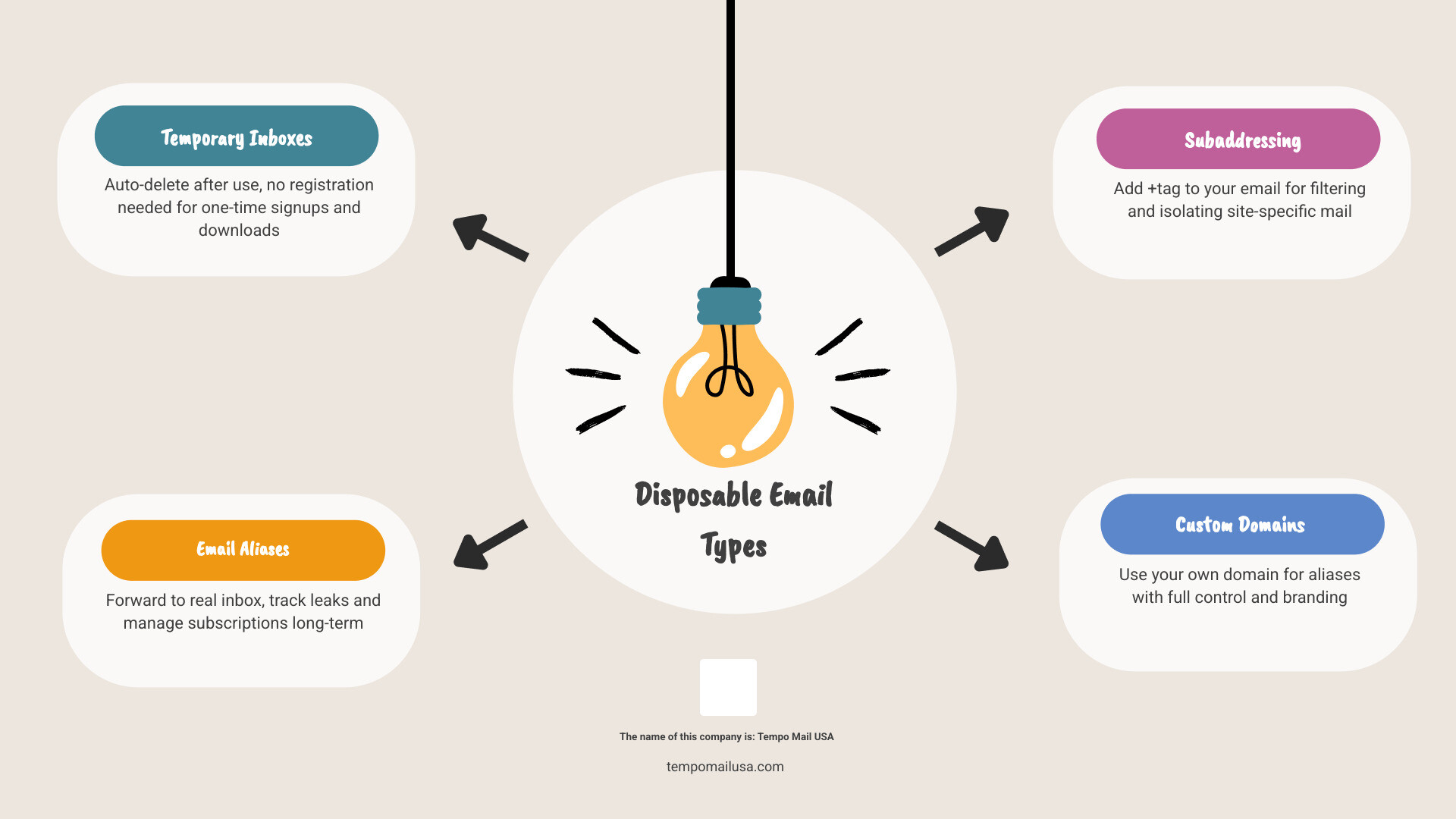
When we talk about disposable emails, we aren't just talking about one single tool. It’s a whole toolbox of different technologies designed to keep your real inbox clean and your identity safe. Understanding the "how" behind these tools helps you choose the right one for your specific threat model.
Subaddressing (The "Plus" Trick)
Most major providers like Gmail or Outlook support subaddressing. By adding a plus sign and a keyword (e.g., yourname+amazon@gmail.com), you create a unique address. While great for filtering, it’s the weakest for privacy. Savvy marketers can easily strip the +amazon part to find your real address, and because your real domain is still visible, it doesn't provide true anonymity.
Forwarding Services
Forwarding services act as a middleman. You create an alias that forwards mail to your real inbox. The benefit here is longevity; you can keep the alias active for years and simply "kill" it if it starts receiving spam. High-quality forwarding services offer the ability to reply from the alias without revealing your real address.
Temporary Inboxes
This is the "burner phone" of the email world. You visit a site, get a random address, and use it immediately. There is no password to remember and often no registration required. What is temporary email and how to use it safely involves knowing that these are best for one-off tasks where you never need to access the account again.
SMTP Protocols and PII Protection
At the technical level, these services use standard SMTP (Simple Mail Transfer Protocol) but add a layer of proxying. By using a disposable email, you are effectively firewalling your Personally Identifiable Information (PII). The website sees a random string of characters, while your real identity remains tucked away behind the service's servers.
| Feature | Temporary Inboxes | Forwarding Aliases | Subaddressing |
|---|---|---|---|
| Longevity | Minutes to Days | Permanent | Permanent |
| Privacy | High | Very High | Low |
| Anonymity | Excellent | Good | None |
| Reply Support | Rare | Yes | Yes |
| Setup Time | Instant | 2-5 Minutes | Instant |
What disposable email should I use if I care about privacy?
If privacy is your top priority, you cannot just pick the first result on Google. Many "free" services are actually data-harvesting operations in disguise. To truly protect yourself, we recommend looking for specific features that ensure your data isn't being logged or sold.
The Privacy Checklist
When asking, "What disposable email should I use if I care about privacy?", check for these non-negotiables:
- No-Logging Policy: The service should not store your IP address or the content of your emails once they are delivered or deleted.
- Metadata Stripping: Every email contains "headers" that reveal your IP, your device type, and even your location. A privacy-focused service should strip this data before the email reaches its destination.
- Jurisdiction Matters: Privacy-friendly countries (like Switzerland or Germany) have much stricter data protection laws than those in the "Five Eyes" intelligence-sharing alliance.
- Encryption: Look for services that support OpenPGP or zero-access encryption at rest. This ensures that even if the service provider is hacked, your messages remain unreadable.
Using a service that checks these boxes is essential to protect yourself from spam and more serious threats like identity correlation.
What disposable email should I use if I care about privacy for sign-ups?
For free trials or one-time downloads, we suggest a high-quality temporary inbox. These allow you to bypass the "new account hassle" just to read an article or grab a PDF. What are the benefits of using temporary email in this context is the ability to isolate your accounts. If a site you signed up for with a temporary email gets hacked, the hackers get a useless, expired address rather than your primary login.
What disposable email should I use if I care about privacy during data breaches?
Data breaches are no longer a matter of "if," but "when." In 2021 alone, billions of records were leaked. When you use a unique alias for every site, you gain "breach isolation." If a site like TeeSpring suffers a leak, only the alias you used for them is compromised.
This makes leak tracking incredibly easy. If you start getting spam on serviceA@youralias.com, you know exactly who sold your data or got hacked. This identity proxying is the ultimate defense against the "domino effect" of credential stuffing attacks. You can learn more about how temporary emails protect you from data breaches to stay one step ahead of cybercriminals.
Operational Security and Best Practices for Anonymity
Choosing the right service is only half the battle. To maintain true anonymity, you need good "OpSec" (Operational Security). Even the best disposable email can't save you if you leave a trail of digital breadcrumbs elsewhere.
Hide Your IP Address
Most websites log your IP address during sign-up. If you use a disposable email but sign up from your home IP, your identity can still be linked. We always recommend using a VPN or the Tor browser when accessing sensitive sites. This hides your location and makes your IP address virtually untraceable.
Avoid Public WiFi Risks
Public WiFi is a playground for hackers. Without a VPN, man-in-the-middle attacks can intercept your verification codes in real-time. Follow public WiFi safety tips like using encrypted connections and avoiding sensitive logins on open networks.
Stylometry and Fingerprinting
Advanced trackers don't just look at your email; they look at your "browser fingerprint"—the unique combination of your screen resolution, fonts, and plugins. They even use "stylometry" to analyze your writing style. To stay truly anonymous:
- Clear your cache and cookies after every session.
- Don't reuse pseudonyms across different platforms.
- Use a hardened browser like Firefox or Brave with privacy extensions.
Using Tempo Mail USA for Private Disposable Email
At Tempo Mail USA, we’ve built our service specifically for those who demand more than just a "10-minute" solution. We provide secure identity proxying that acts as a permanent firewall for your digital life.
Our platform offers:
- Custom Domains: Use your own domain to maintain agency and professional appearance while keeping your real inbox hidden.
- Catch-all Addresses: Create aliases on the fly without even logging into our dashboard. Just make up an address like
anything@yourdomain.comand it will automatically arrive in your secure inbox. - Advanced Privacy Controls: We strip tracking pixels and malicious attachments before they ever reach you.
Whether you are a software developer needing random mails for testing or a casual user trying to avoid the marketing onslaught, our ultimate guide to top temporary email features shows how we prioritize your privacy. For the best experience, remember our temporary email handling tips for secure online use to keep your data truly your own.
Frequently Asked Questions about Disposable Emails
When should I avoid using disposable emails?
While they are powerful, they aren't for everything. Never use a disposable email for:
- Banking and Financial Services: You need long-term access for security alerts and recovery.
- Government Accounts: Losing access to a temporary inbox could mean losing access to your tax or health records.
- Primary Social Media: If you get locked out, you won't be able to receive the password reset link. The risks of temporary email domains in these cases far outweigh the privacy benefits.
Are free 10-minute emails safe for sensitive data?
Generally, no. Most free "10-minute" services use public inboxes. This means if someone else guesses your generated address, they can see your verification codes or private messages. Furthermore, many of these sites are funded by intrusive ads. We've detailed the ad-tracker risks in free services that can compromise your browser security.
How can I track which websites sell my data?
This is one of the coolest "detective" uses for disposable emails. By using a unique alias for every site (e.g., brandname@youralias.com), you can see exactly who is leaking your data. If you get a spam email for "cheap insurance" sent to the address you only gave to a specific "pet supply" store, you’ve caught them red-handed. Discover why Tempomailusa is the best temp email for setting up these advanced tracking workflows.
Conclusion
Digital autonomy is no longer a luxury; it is a necessity. In an era where your personal data is the world's most valuable commodity, protecting your email address is the first step toward reclaiming your privacy.
By using identity proxying and the right disposable email strategy, you can enjoy the benefits of the internet without the constant fear of spam, breaches, or surveillance. Whether you need a 10-minute burner or a long-term alias, choosing a reputable provider is the key.
Ready to take control? Protect your privacy with Tempomailusa and start building your digital firewall today.
Need a disposable temporary email?
Protect your real inbox from spam and promotional clutter instantly and free.
Received a suspicious email, text, or charge alert?
Verify whether the sender domain is disposable, spoofed, or unverified before clicking links.