

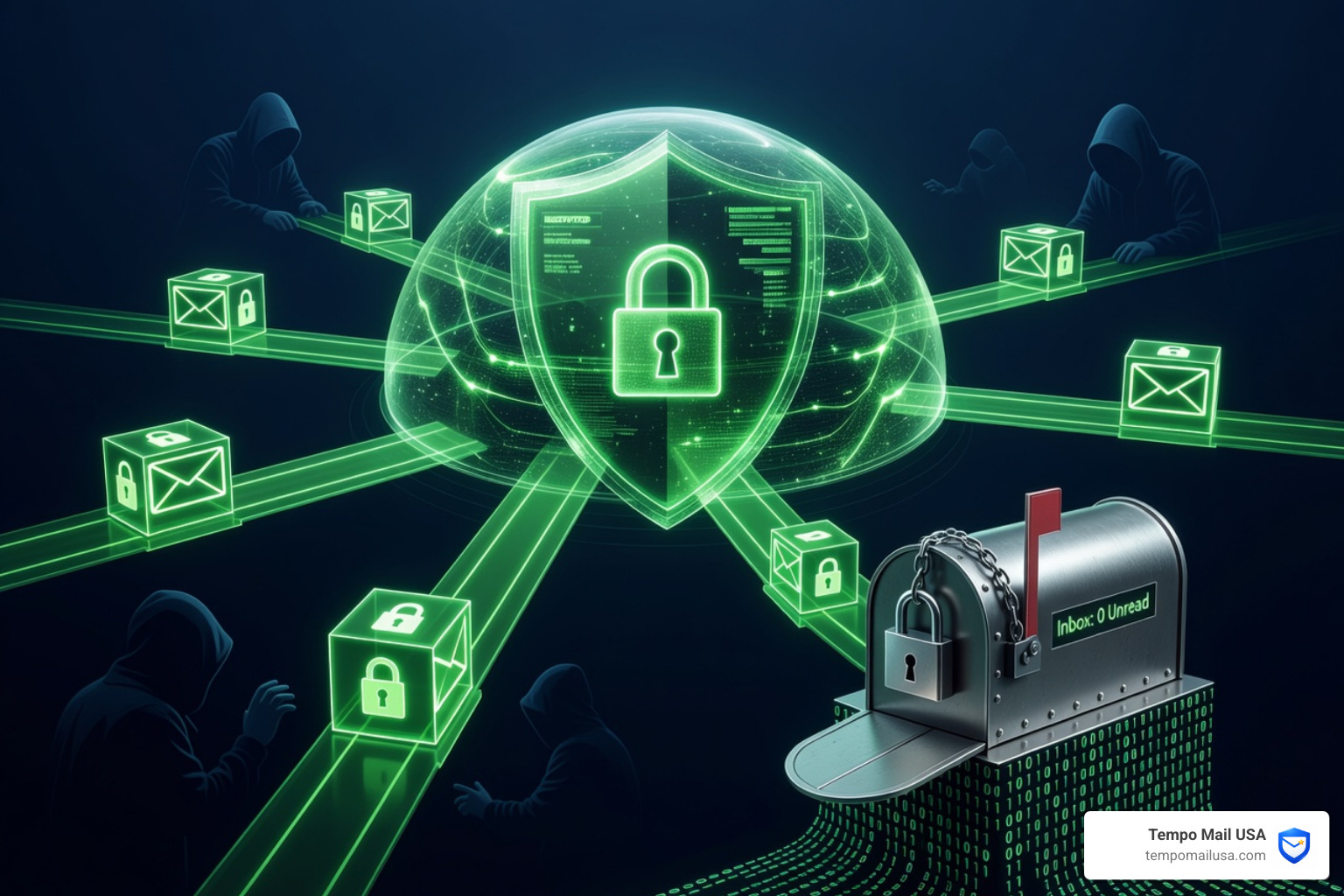

Your Inbox Is Being Watched — Here's How to Stop It
The best private email service 2026 has to offer is no longer a niche concern for tech experts — it's something every person who values their personal data needs to think about right now.
Traditional email providers have billions of users. And they scan your inbox. Purchase receipts, travel bookings, subscription confirmations — all of it gets read to build an advertising profile on you. Your email is the master key to your digital life. It's linked to your bank, your medical records, and your password resets. A breach there doesn't just expose one account — it can unravel everything.
When searching for the top private email services for 2026, look for these key categories:
- All-around security: Providers using end-to-end and zero-access encryption for daily use.
- Maximum encryption: Services implementing post-quantum algorithms for long-term data protection.
- Alias-focused: Solutions that prioritize disposable addresses to mask your identity.
- Professional suites: Encrypted platforms that support custom domains and team management.
The privacy landscape in 2026 looks more complicated than ever. AI-powered phishing is more convincing. Data brokers are more aggressive. And the business model of many free providers still depends on reading your messages to sell you things.
Switching to a private email provider is one of the most effective steps you can take to protect your personal information online.
Key Features of the Best Private Email Service 2026
When we evaluate what makes an email provider "secure," we aren't just looking at a fancy lock icon in your browser. In 2026, a truly private service must operate on a foundation that assumes the provider itself cannot be trusted with your data.
End-to-End Encryption (E2EE)
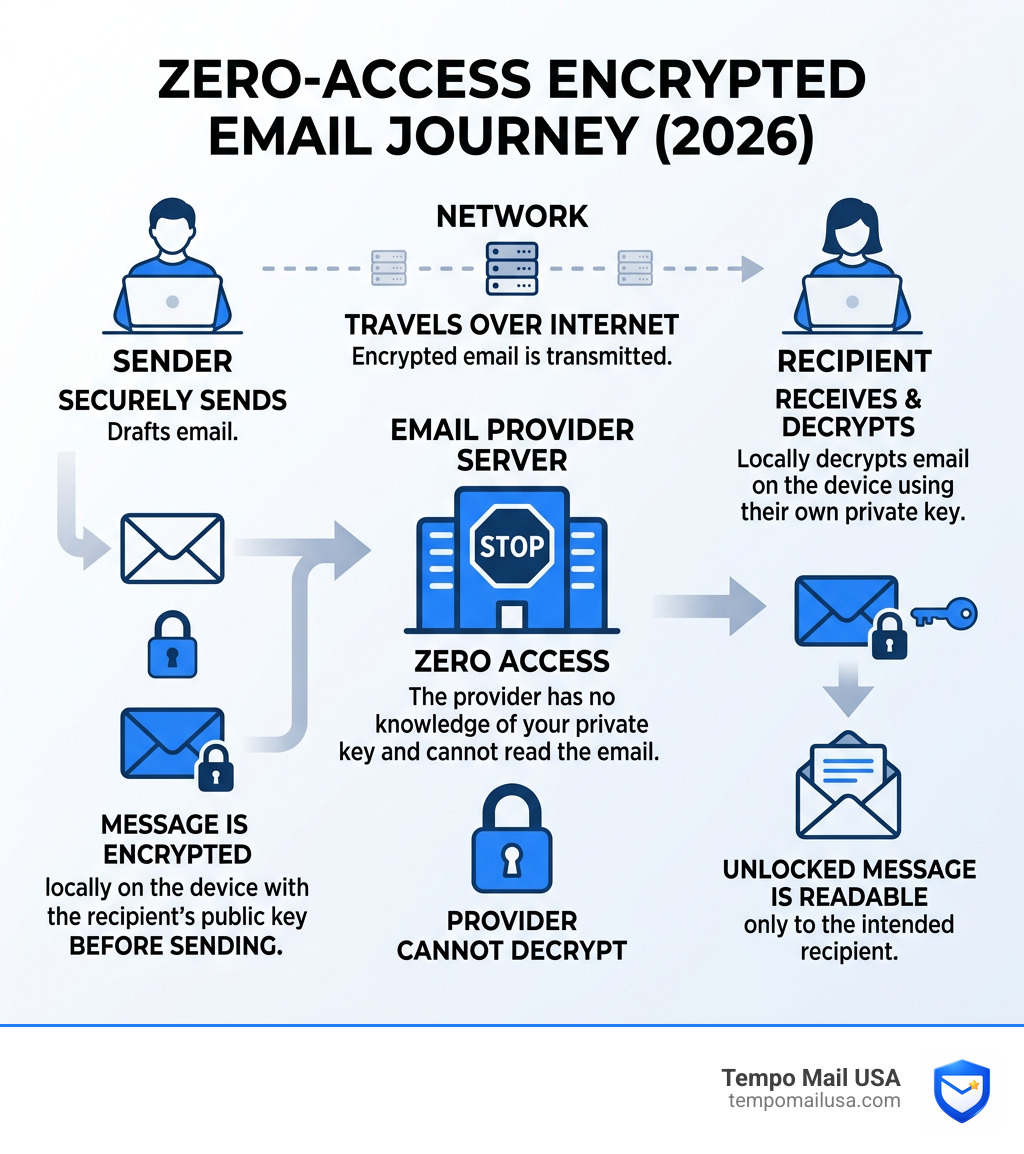
Standard email providers use TLS (Transport Layer Security) to protect your message while it travels from your computer to their server. However, once it arrives, they hold the keys. They can read it, scan it, and hand it over to third parties. The best private email service 2026 uses E2EE, meaning the message is scrambled on your device and only unscrambled on the recipient's device. Even the email company can’t see the contents.
Zero-Access Architecture
This is the "gold standard" for 2026. Zero-access architecture means that your stored emails, attachments, and even your calendar are encrypted with a key derived from your password. Since the provider doesn't store your password, they have zero access to your data at rest. If a government demands your data or a hacker breaks into the server, all they will find is gibberish.
Open-Source Code
Transparency is the enemy of backdoors. We prioritize services that publish their code for public inspection. This allows independent security researchers to verify that the encryption is actually working as advertised. This is a core component of the Zero Trust security model, where "trust" is replaced by mathematical verification.
Privacy Tools and Integration
A secure inbox shouldn't feel like a chore. The latest best email privacy tools in 2026 protect your inbox by integrating features like tracker blocking, which prevents companies from knowing when and where you opened an email.
Choosing the Best Private Email Service 2026 for Personal Use
For the average person, "security" shouldn't mean "difficult." We look for providers that offer:
- User-friendly interfaces: If it looks like a 1990s terminal, you won't use it. The best modern providers have mastered the user experience while keeping the back end locked down.
- Mobile app compatibility: Privacy doesn't stop when you leave your desk. High-quality iOS and Android apps with biometric locks are essential.
- Storage and Pricing: While some offer free tiers, usually capped at 500 MB to 1 GB, paid plans unlock hundreds of gigabytes of storage and extra features like VPNs.
Evaluating the Best Private Email Service 2026 for Business
Businesses have higher stakes, including HIPAA or GDPR compliance.
- Custom Domains: You need to be able to use your own company domain instead of the provider's domain.
- Admin Controls: The ability to manage user seats, reset employee accounts (within security limits), and audit logs is vital.
- Migration Tools: Many top-tier services offer advanced migration tools that allow businesses to port years of data with just a few clicks.
- Security Standards: Beyond just email, Every website should use HTTPS and businesses should ensure their email hosting follows similar strict encryption-in-transit protocols.
Advanced Security, Jurisdiction, and Post-Quantum Encryption
Where your data lives matters just as much as how it is encrypted. In privacy, geography is destiny.
The Power of Jurisdiction
Many of the top-rated services are based in Switzerland, Germany, or the Netherlands. Why? Because these countries have strict data protection laws that exist outside the "Five Eyes" intelligence-sharing alliance (US, UK, Canada, Australia, New Zealand). In Switzerland, for example, a provider cannot be forced to spy on a user without a specific court order that meets a very high legal threshold.
Data Residency and Sovereignty
In 2026, we are seeing a shift toward "data sovereignty." This means your data is stored on servers in jurisdictions that respect your right to privacy. While no location is 100% immune to legal pressure, choosing a provider in a privacy-friendly nation adds a significant layer of protection against mass surveillance programs.
Addressing Vulnerabilities
No system is perfect. Historically, EFAIL vulnerabilities showed that even PGP encryption could be tricked into leaking data if the email client handled HTML incorrectly. The best services in 2026 have built-in protections to mitigate these risks, often by handling encryption in-memory or using proprietary systems that fix PGP's legacy flaws.
Future-Proofing with Quantum-Resistant Cryptography
The biggest threat on the horizon for 2026 and beyond is the "Harvest Now, Decrypt Later" strategy. Malicious actors are stealing encrypted data today, waiting for powerful quantum computers to arrive that can crack current encryption standards.
To combat this, forward-thinking providers have begun implementing Post-Quantum Cryptography (PQC). By using algorithms like CRYSTALS-Kyber (now a NIST standard), these providers ensure that your messages remain secure even in the age of supercomputing.
Furthermore, advanced providers are working to encrypt metadata. While standard PGP leaves subject lines and sender/recipient info exposed, the best private email service 2026 aims to scramble as much of this "digital breadcrumb" trail as possible.
Essential Privacy Tools: Aliases and Identity Firewalls
Even with the most secure encryption, your email address itself can be a liability. Every time you give your real email to a shopping site, a newsletter, or a social media platform, you are handing over a "digital fingerprint" that data brokers use to track you across the web.
This is where email aliasing becomes your most powerful defense.
The PII Firewall
Think of an email alias as a "privacy proxy." Instead of giving out your primary address, you generate a temporary, unique address for every service you use. If that service gets hacked or starts sending spam, you simply delete the alias. Your real inbox remains untouched, and your Personally Identifiable Information (PII) stays hidden.
Using temp mail for privacy is no longer just for avoiding spam; it's a proactive security measure. It acts as a firewall between your real identity and the data-hungry internet.
Comparing Standard Email vs. Alias-Protected Email
| Feature | Standard Email | Alias-Protected Email (Tempo Mail USA) |
|---|---|---|
| Identity Protection | None; your email is your ID | High; real ID is never shared |
| Spam Control | Filters (often fail) | Absolute; just kill the alias |
| Data Breach Risk | High; your "master" email is leaked | Low; only a fake alias is leaked |
| Tracking | High; cross-site tracking via email | Zero; unique email for every site |
| PII Shielding | Your name/data linked to email | Your data is hidden behind a proxy |
By combining a secure provider with a robust aliasing system, you create a "defense-in-depth" strategy. One protects the content of your messages, while the other protects your identity.
Frequently Asked Questions about Private Email
Are free email services truly private?
In Big Tech, if you aren't paying for the product, you are the product. However, in the privacy sector, many providers offer free tiers as a public service. These are truly private (no ad scanning), but they usually have limits on storage (e.g., 1 GB) and the number of messages you can send. For 2026, we recommend a paid plan if you intend to use the service as your primary inbox.
What is zero-access encryption?
Zero-access encryption means that the moment an email lands in your inbox, it is encrypted with your public key. Only you, using your private key (which is unlocked by your password), can read it. The provider hosts the data, but they don't have the "eyes" to see it. It's like a storage locker where you are the only one with the key.
Can I keep my old email address?
Yes and no. Most private providers require you to create a new address (e.g., yourname@secure-mail.com). However, some specialized encryption tools allow you to add an encryption layer to your existing account. If you want a complete break from surveillance, we recommend starting fresh with a new provider and using migration tools to bring your old data over.
Does private email hide my IP address?
Most secure providers strip your IP address from the metadata of outgoing emails. However, the provider itself might still see your IP when you log in. For 2026, the gold standard is to use a VPN alongside your private email to ensure your physical location remains hidden from everyone.
Conclusion
The year 2026 marks a turning point in digital history. With the rise of AI-driven data harvesting and the looming threat of quantum computing, the "convenience" of free, data-mining email services has become a massive liability.
Taking back control of your inbox isn't just about avoiding annoying ads; it's about future-proofing your digital identity. By choosing the best private email service 2026 has to offer — whether it's a provider focused on all-around excellence, quantum-ready security, or alias-heavy privacy — you are drawing a line in the sand for your personal privacy.
At Tempo Mail USA, we believe that your real email address is your most sensitive piece of data. By using secure aliases and temporary identities, you can interact with the world without ever exposing your true self to the trackers and hackers waiting on the other side.
Ready to secure your digital future? Start by choosing a provider that respects your data, and then shield that provider with an identity firewall. Your 2026 self will thank you.
Visit Tempo Mail USA to learn more about protecting your PII