


Decoding the Official IRS Tax Scam 2026 Dirty Dozen List
Every year, the Internal Revenue Service compiles a list of the most egregious schemes affecting taxpayers. This "Dirty Dozen" isn't just a list of suggestions; it is a formal warning issued by the IRS and its Security Summit partners to highlight the specific tactics fraudsters are using right now. For 2026, the list reflects a terrifying blend of old-school deception and high-tech manipulation.
The IRS tax scam 2026 landscape is dominated by 12 key threats. These range from "ghost preparers" who vanish after filing fraudulent returns to sophisticated cyberattacks aimed at stealing your IRS online account credentials. The IRS released the Dirty Dozen tax scams for 2026 to remind us that as the agency modernizes, so do the criminals.
One of the biggest shifts we've seen this year is the move away from fuel tax credit scams toward more complex financial fabrications. To help you distinguish between what’s real and what’s a trap, we’ve put together a quick comparison of legitimate tax benefits versus the fraudulent schemes currently circulating.
| Feature | Legitimate Tax Credit/Refund | Fraudulent 2026 Scheme |
|---|---|---|
| Source of Info | Official IRS.gov guidance or certified CPA | Social media "hacks," TikTok videos, or unsolicited DMs |
| Documentation | Requires real W-2s, 1099s, and receipts | Often uses fabricated Form 2439 or modified wage info |
| Eligibility | Based on specific legal criteria (e.g., income level) | Promoters claim "everyone qualifies" regardless of income |
| Fees | Standard service fees or hourly rates | Fees based on a percentage of the "huge" refund |
| IRS Contact | Initial contact is almost always via U.S. Mail | Urgent texts, AI robocalls, or social media messages |
The New Form 2439 Capital Gains Scheme
The most notable addition to the IRS tax scam 2026 list involves a highly technical document: Form 2439, Notice to Shareholder of Undistributed Long-Term Capital Gains. Historically, this form is used by Regulated Investment Companies (RICs) or Real Estate Investment Trusts (REITs) to inform shareholders of gains that weren't distributed but for which tax was paid by the fund.
Scammers have identified this as a weak point. They are now encouraging taxpayers to file overstated or entirely fabricated claims for these undistributed gains to trigger massive, fraudulent refunds. In many cases, these claims are tied to non-legitimate investment funds or even real organizations that the taxpayer has no connection to.
If you see a "tax pro" or a social media ad suggesting you can get thousands back by filing this specific form without owning shares in a qualifying fund, run the other way. You can view the Form 2439 official documentation on the IRS website to see how it’s actually supposed to be used. Claiming this improperly can lead to audits, heavy penalties, and even criminal prosecution.
Bogus Credits and Overstated Withholdings
Beyond Form 2439, we are seeing a massive resurgence in "bogus credits." One of the most persistent is the "self-employment tax credit." While there were legitimate credits available during the pandemic era, scammers are now promoting them to gig workers and small business owners who don't qualify, often promising up to $32,000 in "free money."
We’ve also noticed a strange uptick in "overstated withholding" schemes. Scammers use fake W-2s or 1099 forms to claim they had massive amounts of tax withheld throughout the year. In some niche versions of this IRS tax scam 2026, fraudsters even use the "Alaska Permanent Fund Dividend" as a cover to hide these inflated numbers. These "viral hacks" might look tempting on a 30-second video, but the IRS’s automated systems are increasingly good at spotting these discrepancies, leading to frozen refunds and immediate flags on your account.
High-Tech Impersonation: AI and Phishing Tactics
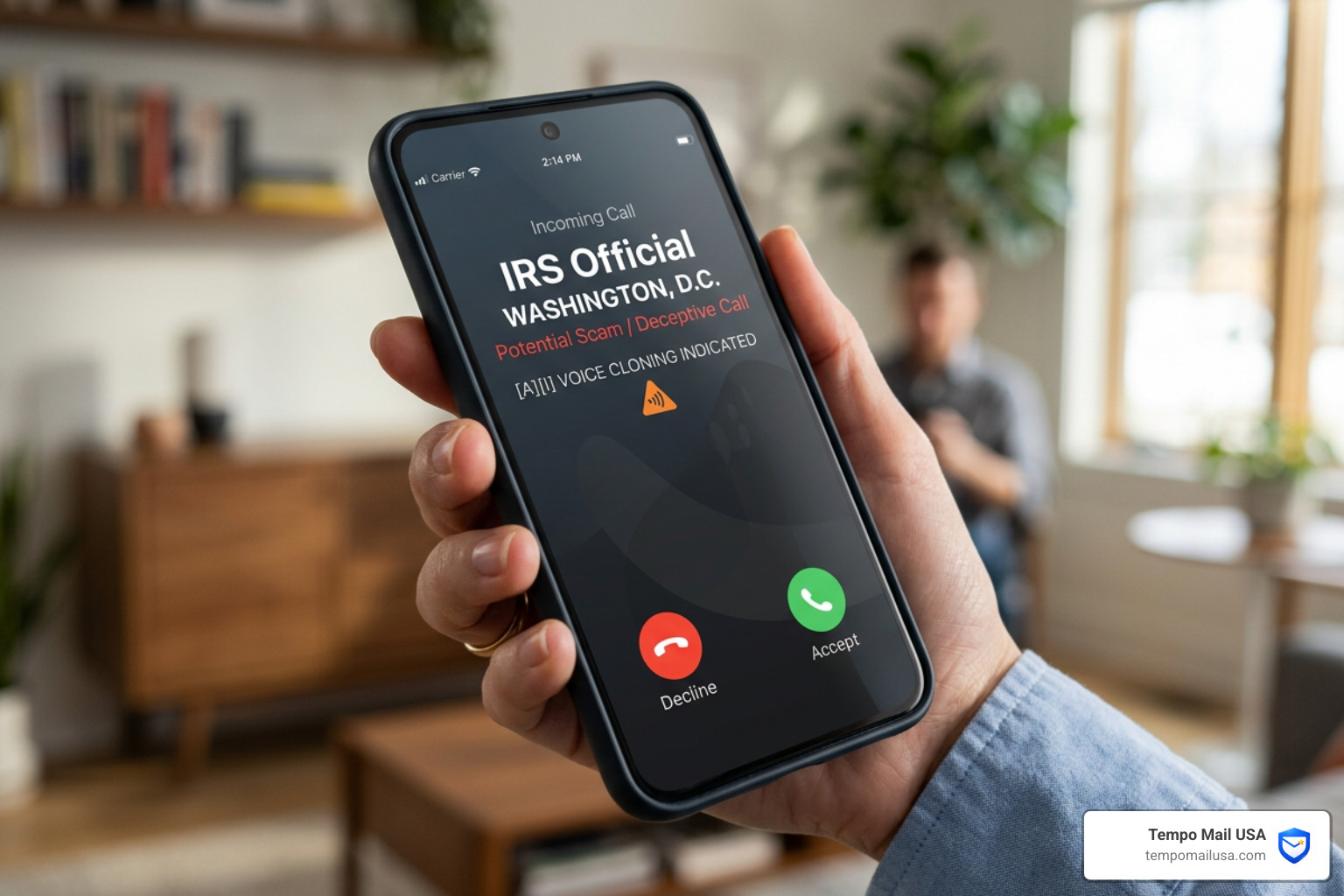
Technology has given scammers a massive upgrade. In previous years, you could often spot a phone scam by a robotic voice or a suspicious accent. In 2026, AI voice cloning has changed the game. Scammers can now use a few seconds of audio to create a perfectly natural-sounding "IRS agent" who speaks with authority and no detectable "scammer" traits.
These AI robocalls often use "spoofed" caller IDs, making it look like the call is coming directly from Washington, D.C., or a local IRS office. They may even know the last four digits of your Social Security number or your home address, which they’ve bought from data breaches on the dark web. If you're wondering how they got your info in the first place, it often starts with a simple phishing link. You can learn more about these foundational traps in our guide: What is a Phishing Scam? Protect Yourself.
Recognizing an IRS Tax Scam 2026 via Social Media
Social media has become a primary breeding ground for IRS tax scam 2026 activity. In fiscal year 2025 alone, the IRS reported over 600 social media impersonator accounts. These accounts often look incredibly official, using the IRS logo and professional-looking graphics.
The scam usually follows one of two paths:
- The "Tax Hack" Video: A creator shares a "secret" way to get a bigger refund (like the Form 2439 or fuel tax credit scams).
- The Direct Message (DM): An "agent" reaches out claiming there is an issue with your return or that you are eligible for a special stimulus payment. They will ask you to click a link to "verify your identity."
These links often lead to fake IRS login pages designed to steal your credentials. Once they have your login, they can access your real tax transcripts, change your direct deposit information, and steal your entire refund.
Spear-Phishing Attacks on Tax Professionals
Scammers aren't just targeting individual taxpayers; they are going after the "big fish" — tax professionals and accounting firms. These are known as spear-phishing attacks because they are highly targeted.
A typical IRS tax scam 2026 spear-phishing email might look like a "new client inquiry." It will have an attachment labeled "My 2025 Tax Docs.zip" or a link to a "secure cloud folder." When the tax pro clicks it, malware is installed on their system, giving the scammer access to the data of hundreds of clients at once. This is why it’s so critical for professionals to Report Phishing Attack: Your Guide to Outsmarting Scammers and maintain high-level cybersecurity.
Fraudulent Filings: Ghost Preparers and Bogus Credits
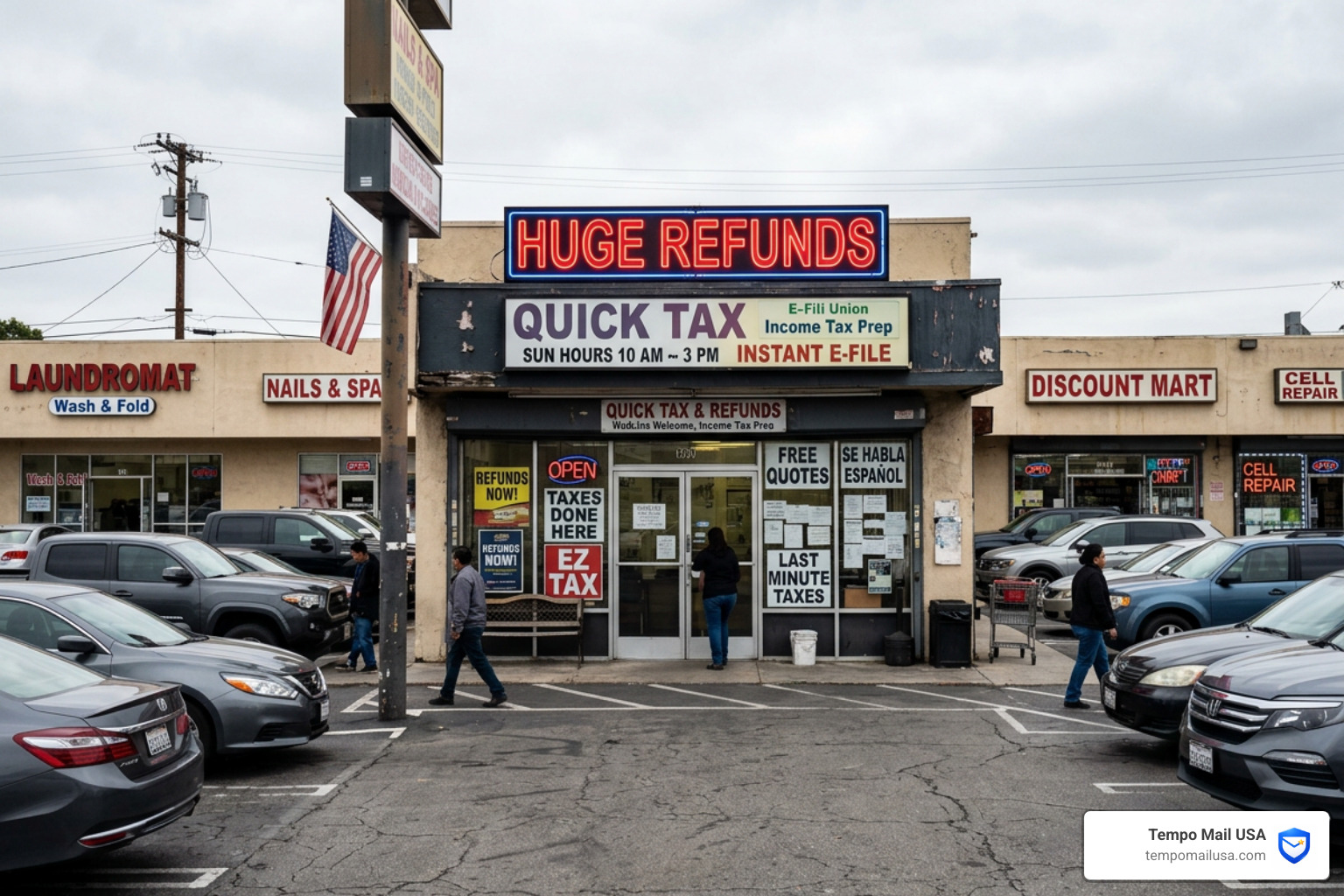
One of the most dangerous characters you’ll meet during tax season is the "ghost preparer." These are individuals who get paid to prepare your taxes but refuse to sign the return or provide a Preparer Tax Identification Number (PTIN).
By law, any paid preparer must sign the return and include their PTIN. Ghost preparers "ghost" the return by printing it out and asking you to sign it as "Self-Prepared," or by filing it electronically without their digital signature. This allows them to bake in fraudulent credits and inflated deductions to get you a huge refund (and take a huge fee) while ensuring that when the IRS eventually audits the return, you are the only one on the hook. To avoid these traps, it’s vital to Master How to Spot Phishing Emails and other deceptive communications that might lead you to these fraudulent services.
The Danger of OIC Mills and Misleading Promotions
An "Offer in Compromise" (OIC) is a legitimate IRS program that allows taxpayers with severe financial hardship to settle their tax debt for less than the full amount. However, it is not for everyone.
"OIC Mills" are aggressive promoters who claim they can settle your debt for "pennies on the dollar." they charge thousands in upfront fees, even if they know you don't qualify. Before you pay anyone to help with tax debt, use the free Offer in Compromise Pre-Qualifier tool provided by the IRS to see if you even stand a chance of being accepted.
Fake Charities and Non-Cash Contribution Scams
Scammers love a good crisis. Whenever a natural disaster strikes, fake charities pop up almost overnight. They use names that sound very similar to well-known organizations to trick you into "donating." Not only does your money go to a criminal, but you also hand over your credit card info and SSN.
Furthermore, we’ve seen a rise in "non-cash contribution" scams. This involves "donating" items like artwork, clothing, or even land easements and using an "inflated appraisal" to claim a massive deduction. The IRS is cracking down on these "conservation easement" and high-value item scams with increased audits. Always verify a charity's status through Charity Navigator or the IRS Tax-Exempt Organization Search tool before giving.
Proactive Protection: Securing Your Identity This Tax Season
Protecting yourself from an IRS tax scam 2026 requires a mix of common sense and technical safeguards. The single best thing you can do is file your taxes as early as possible. If you file first, a scammer who tries to file a fraudulent return using your SSN will have their return rejected by the IRS because a return is already on file for that number.
Another powerful tool is the IRS Identity Protection PIN (IP PIN). This is a six-digit number assigned to you that prevents anyone else from filing a tax return using your SSN. It’s like two-factor authentication for your taxes. We also recommend setting up your own IRS online account directly at IRS.gov. Do not let a third party "help" you set this up, as they will likely steal your access. For more digital safety tips, see our guide on How to Report Bogus Emails Safely.
Reporting an IRS Tax Scam 2026 to Authorities
If you encounter a scam, don't just delete it — report it. Your report could be the piece of evidence the Treasury Inspector General for Tax Administration (TIGTA) needs to shut down a major fraud ring.
- For Phishing Emails: Forward them to phishing@irs.gov.
- For Phone Scams: Report them to TIGTA at their "IRS Impersonation Scam Reporting" page.
- For General Fraud: Use the official online tool at IRS.gov/SubmitATip to report suspected tax fraud or abusive schemes confidentially.
How the Real IRS Contacts You
The most important thing to remember is that the real IRS has a very specific way of doing business. They will never:
- Call you out of the blue to demand immediate payment using a specific method like a gift card, wire transfer, or cryptocurrency.
- Threaten to bring in local police or other law-enforcement groups to have you arrested for not paying.
- Demand that you pay taxes without giving you the chance to question or appeal the amount they say you owe.
- Ask for credit or debit card numbers over the phone or via email.
The IRS almost always initiates contact through U.S. Mail. If you get a call and you’re worried it might be real, the best move is to Hang up on unexpected calls and call the IRS yourself at 1-800-829-1040.
Frequently Asked Questions about IRS Tax Scam 2026
What is the most common IRS tax scam 2026?
The most common scams remain phishing and smishing. Because they are cheap and easy to blast out to millions of people, scammers continue to use fake emails and texts to "bait" taxpayers into clicking links. However, AI-powered phone scams are rapidly becoming the most "successful" in terms of dollars lost per victim because they are so convincing.
How do I know if an IRS email is real or a scam?
It’s simple: The IRS does not initiate contact with taxpayers by email. If you receive an email claiming to be from the IRS regarding a refund, a tax bill, or an account issue, it is a scam. Period. Do not click any links, do not open any attachments, and do not "unsubscribe." Just forward it to phishing@irs.gov and delete it.
What should I do if I already gave my info to a scammer?
If you’ve accidentally shared your SSN or financial info:
- Go to IRS.gov/idtheft and follow the recovery steps.
- File Form 14039, Identity Theft Affidavit, if your tax return is rejected because of a duplicate filing.
- Place a fraud alert or credit freeze on your files with Equifax, Experian, and TransUnion.
- Report the theft to the FTC at IdentityTheft.gov.
Conclusion
The IRS tax scam 2026 season is proving to be one of the most technologically advanced yet. From AI voice cloning to complex Form 2439 fabrications, the "Dirty Dozen" list is a sobering reminder that our personal information is under constant attack. While the IRS is doing its part with "Slam the Scam Day" and new reporting tools, the ultimate responsibility for protection lies with us.
At Tempo Mail USA, we believe that the best way to avoid being a victim is to never give scammers your real information in the first place. By using our temporary email aliases, you create a powerful identity firewall. Our secure aliases act as a PII (Personally Identifiable Information) proxy, shielding your real email address and personal data from the various services and platforms that scammers often scrape for targets.
Don't let your primary inbox become a hunting ground for fraudsters. Protect your digital identity, stay vigilant this tax season, and Protect your identity with Tempo Mail USA. Together, we can make 2026 the year we finally slam the scam for good.