

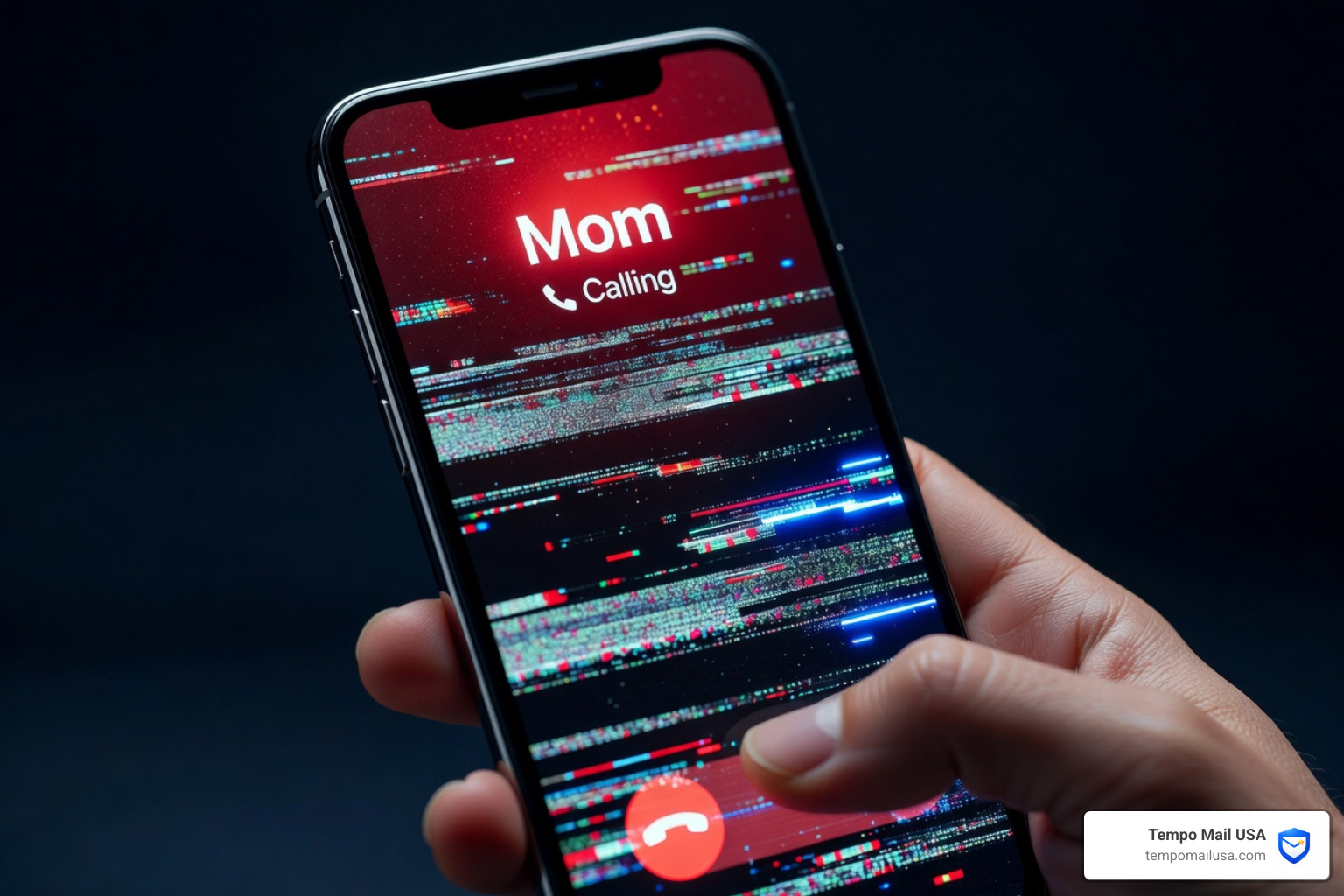

How AI Voice Cloning Scams: How Hackers Are Faking Voices to Steal Your Money
AI Voice Cloning Scams: How Hackers Are Faking Voices to Steal Your Money is a rapidly growing threat where criminals use artificial intelligence to copy someone's voice and use it to trick victims into sending money or handing over sensitive information.
Here's what you need to know right now:
- What it is: AI clones a real person's voice, then uses it to impersonate them in a phone call or voice message
- How little audio it takes: As few as 3 seconds of your voice — from a social media video, voicemail, or podcast — is enough
- How convincing it is: 70% of people cannot tell the difference between a real voice and an AI clone
- Who gets targeted: Families (fake emergencies), employees (fake boss calls), and anyone with public audio online
- The financial damage: 77% of people who received a cloned voice call lost money; billions are stolen annually
- How to protect yourself: Use a family code word, hang up and call back on a verified number, and limit public audio of yourself online
Think about the last voicemail you left. Or that video you posted on social media. Or the podcast episode you appeared on.
That audio is all a scammer needs.
In one well-documented case, a mother received a call from what sounded exactly like her daughter — crying, panicked, claiming she'd been kidnapped. The caller demanded $1 million. The voice wasn't her daughter's. It was an AI-generated clone built from a short audio sample.
This isn't science fiction. It's happening right now, at scale, to ordinary people.
The technology has advanced so fast that a 95% voice match is now achievable with widely available tools. And with one in four people already having experienced or knowing someone who experienced a voice cloning attack, the odds that it reaches someone close to you are no longer remote.
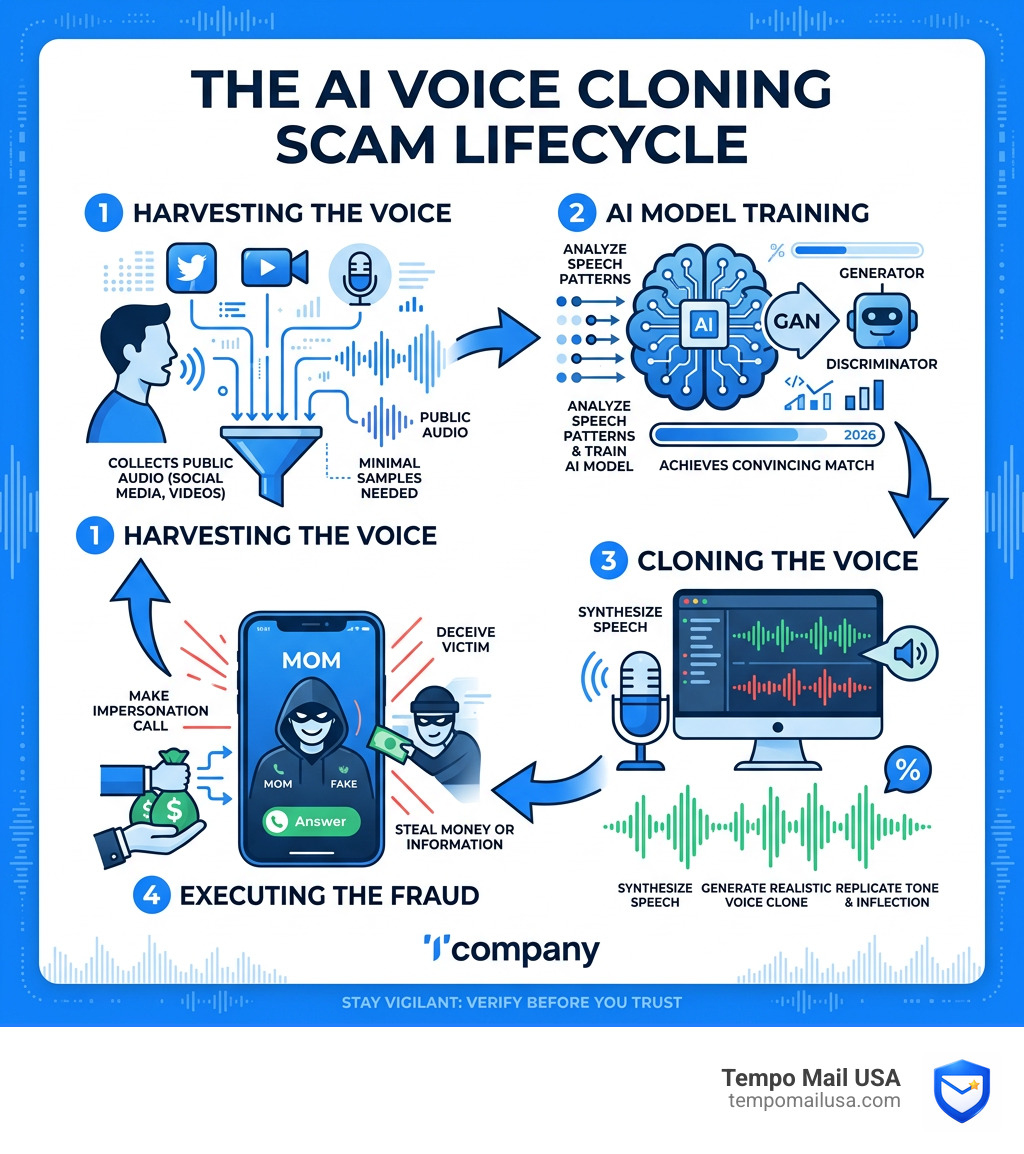
To understand how these scams work, we have to look under the hood of modern artificial intelligence. The core technology behind these attacks often involves Generative Adversarial Networks (GANs). Think of a GAN as a competition between two AI models: one tries to create a fake voice (the generator), and the other tries to spot the fake (the discriminator). They practice against each other until the generator becomes so good that even the discriminator—and certainly the human ear—can't tell the difference.

In the past, you needed hours of high-quality studio recording to "train" a computer to sound like a specific person. Today, hackers can achieve AI Voice Cloning Scams: How Hackers Are Faking Voices to Steal Your Money with startling precision using as little as three seconds of audio.
The AI doesn't just record your words; it creates "speaker embeddings." This is a mathematical map of your unique vocal traits, including:
- Pitch and Tone: The highness or lowness of your voice.
- Vocal Cadence: The rhythm and speed at which you speak.
- Accent and Inflection: The subtle "musicality" of your regional speech patterns.
- Artifacts: Tiny quirks like a specific way you clear your throat or a slight lisp.
Once the AI has this map, the scammer can type any text into a computer, and the software will "speak" it in your voice. This is called voice synthesis, and it is the engine driving billions of dollars in losses annually.
Human Speech vs. AI-Generated Artifacts
While AI is good, it isn't perfect—yet. Here is a comparison of what to listen for:
| Nuance | Human Speech | AI-Generated (Cloned) |
|---|---|---|
| Breathing | Natural pauses for air; erratic based on emotion. | Often perfectly timed or entirely absent. |
| Background Noise | Changes as the person moves or shifts. | May sound "looped" or unnaturally silent. |
| Emotion | Genuine cracks in voice, laughter, or sighs. | Can sound "too perfect" or slightly robotic/flat. |
| Flow | Smooth transitions between words. | May have tiny "glitches" or choppy transitions. |
Common Tactics Used in AI Voice Cloning Scams
Scammers are master psychologists. They know that when we hear a familiar voice in distress, our logical brain shuts down and our emotional brain takes over. This is why AI Voice Cloning Scams: How Hackers Are Faking Voices to Steal Your Money are so effective.
Family Emergency and Kidnapping Scams
The most heart-wrenching tactic is the "grandparent" or "kidnapping" scam. A mother in Arizona, Jennifer DeStefano, famously testified before the U.S. Senate about receiving a call where she heard her daughter’s voice sobbing, claiming she had been taken. The "kidnappers" demanded a ransom. In reality, her daughter was safe at a dance rehearsal. The voice was a 100% synthetic clone.
Executive Impersonation (CEO Fraud)
Businesses are also massive targets. Scammers clone the voice of a high-ranking executive and call a junior employee in the finance department. They claim there is an "urgent, confidential acquisition" and demand an immediate wire transfer. One famous case in the UK saw a manager transfer over $240,000 because he was certain he was speaking to his boss. In Hong Kong, a finance worker was even tricked by a deepfake video call featuring multiple cloned voices, resulting in a $25 million loss.
Real Estate and Legal Wire Fraud
Because real estate transactions involve large sums of money, scammers often impersonate real estate agents or attorneys. They might leave a voicemail "updating" the wiring instructions for a house down payment. If you don't recognize what is a phishing scam in audio form, you could lose your life savings in seconds.
The Anatomy of an AI Voice Cloning Scams Attack
These attacks don't happen in a vacuum. They follow a calculated process:
- Reconnaissance: Hackers use Open Source Intelligence (OSINT) to find targets. They look for people with public profiles, such as CEOs, influencers, or even just parents who post videos of their kids on social media.
- Audio Harvesting: They extract audio from YouTube, TikTok, or even a 3-second "wrong number" call where you just say, "Who is this?"
- The Hook: They use "vishing" (voice phishing) to initiate the scam. To make it more believable, they often combine it with other methods. For example, if you master how to spot phishing emails, you might notice a follow-up email that "confirms" the fake phone call you just received.
- Urgency Triggers: The scammer will always create a sense of crisis. They’ll say the police are about to arrest someone, or a deal will fall through if money isn't sent in the next 10 minutes. This prevents you from hanging up to verify the story.
Why Voice Authentication is No Longer Secure
For years, banks promoted "Voice ID" as a secure biometric, claiming "my voice is my password." Unfortunately, AI has turned this into a liability. OpenAI CEO Sam Altman has noted that AI has effectively defeated current voice authentication methods.
Reporters have already proven they can break into their own bank accounts using cheap, AI-generated clones of their voices. As OTP fraud surges, relying on voice as a primary security layer is no longer a safe bet. Hackers are now using cloned voices to bypass multi-factor authentication by calling customer service lines and impersonating the account holder to "reset" security credentials.
How to Detect and Prevent Voice Cloning Fraud
The rise of AI Voice Cloning Scams: How Hackers Are Faking Voices to Steal Your Money means we have to change how we interact with our phones. We can no longer assume that the person on the other end is who they say they are, even if they sound exactly like a loved one.
The Zero-Trust Callback Workflow
The single most effective defense is a "zero-trust" approach. If you receive an unexpected call asking for money, personal info, or urgent action:
- Acknowledge the info: Listen to what they say.
- Hang up: Do not stay on the line.
- Verify independently: Call the person back using a number you have saved in your contacts, or call the official number of the business they claim to represent. Never use a "call back" number provided by the suspicious caller.
Use Family Code Words
A McAfee study on scam prevalence found that one in four people have already encountered these scams. To protect your inner circle, establish a "Safe Word" or "Code Word." This should be a random word or phrase known only to your family. If a "loved one" calls in a panic, ask for the code word. If they can't provide it, it's a clone.
Advanced Security Measures
For businesses and high-risk individuals, tech-based defenses are necessary:
- Off-Script Questioning: Ask the caller a question only the real person would know—something not available on social media (e.g., "What did we have for dinner last Tuesday?").
- Hardware-Based MFA: Move away from voice or SMS codes. Use FIDO2 security standards or hardware keys like a YubiKey.
- Deepfake Detection: Companies are starting to use tools like Pindrop Pulse to analyze the "liveness" of a voice during a call.
If you do encounter a scam, it is vital to take action by reporting phishing attacks to the authorities to help them track these evolving networks.
Personal Protections Against AI Voice Cloning Scams
Your digital footprint is the "fuel" for voice cloning. To reduce your risk:
- Audit Social Media: Set your profiles to private. If your videos are public, anyone can harvest your voice.
- Limit Public Audio: Be mindful of where you leave voicemails or participate in public forums.
- Call Screening: Use features on your smartphone that screen unknown callers before your phone even rings.
- Reporting: If you are targeted, report scams to the FTC immediately. You should also stay updated on AI email security updates to ensure your other communication channels remain secure.
Frequently Asked Questions about AI Voice Scams
How much audio do hackers need to clone a voice?
It used to take hours, but recent 3-second cloning stats show that hackers only need about three seconds of clear audio to achieve 85% accuracy. With a one-minute sample, the accuracy jumps to over 95%, making the clone virtually indistinguishable from the real person.
Can banks detect cloned voices during authentication?
Some can, but it’s an arms race. Banks use spectral analysis and machine learning to look for "artifacts"—tiny digital signatures that AI leaves behind. Tools like Pindrop Pulse detection are leading the way, but many smaller institutions still rely on older technology that is easily fooled by high-fidelity clones.
What should I do if I think I’m on a scam call?
Hang up immediately. Do not engage, as the scammer may be recording your voice to create a clone of you for future scams. Once you've hung up, verify the caller's identity through a trusted channel. If you suspect your identity has been compromised, follow the steps for how to report phishing in the USA to alert the FBI and FTC.
Conclusion
The human voice was once the ultimate proof of identity, but in the age of AI, that "human firewall" is under siege. Protecting yourself requires a mix of old-school skepticism and modern privacy tools.
At Tempo Mail USA, we believe that the best way to stop a scam is to prevent the hacker from finding you in the first place. By using temporary email aliases, you can shield your real identity and Personal Identifiable Information (PII) from the public databases that hackers use to find their next targets. Think of it as a digital firewall for your life.
Stay vigilant, keep your family code words secret, and always verify before you act. For more information on how we handle your privacy, you can review our Data Deletion and Retention Policy. Don't let a 3-second clip of your voice become a hacker's ticket to your bank account.