

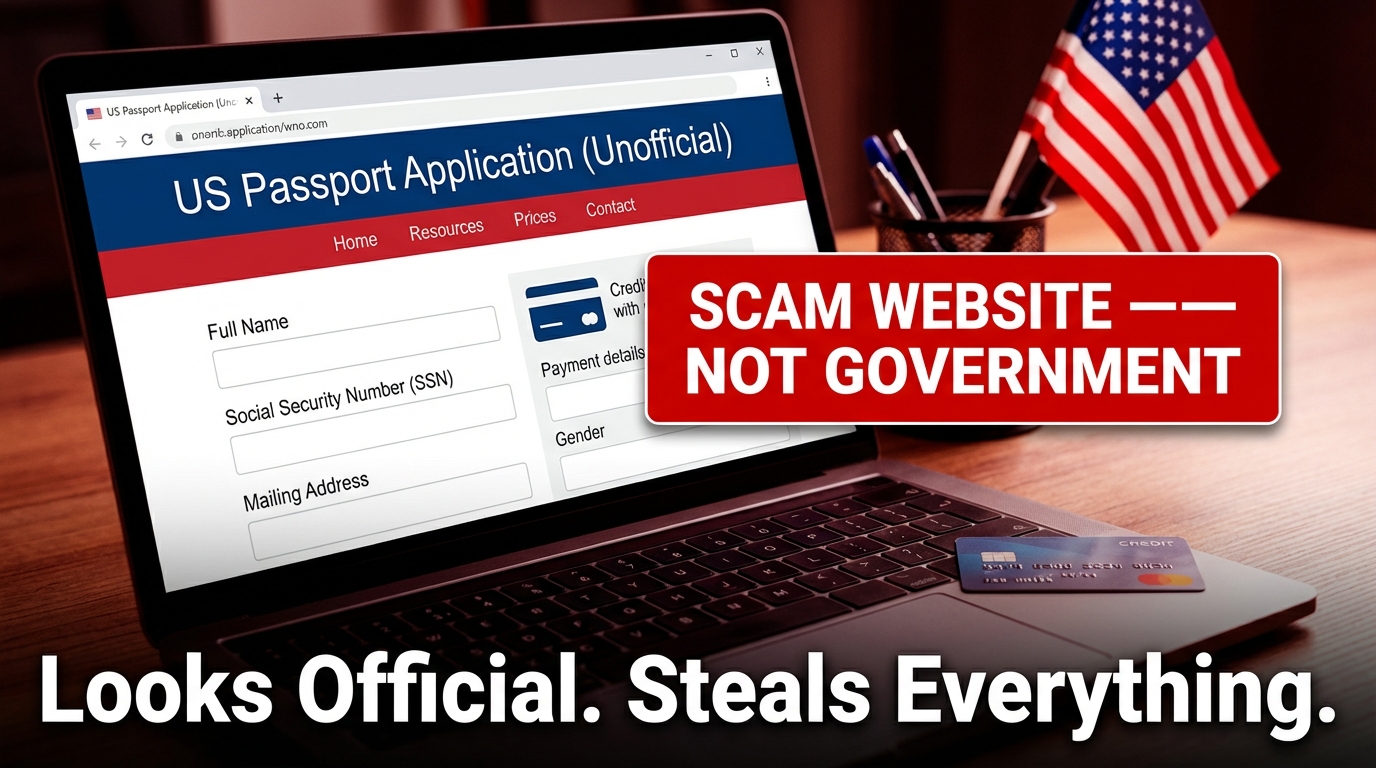

Is uspassportandvisa.org a Scam? (Quick Answer)
The uspassportandvisa.org scam is real and well-documented. Here's what you need to know upfront:
| Question | Answer |
|---|---|
| Is it an official government site? | No. The U.S. government only uses .gov domains |
| What does it charge? | $60-$132 for forms that are 100% free at travel.state.gov |
| What do you actually get? | A pre-filled PDF you could download yourself for free |
| Is your data safe? | No. It collects SSNs, bank info, and passport numbers |
| How many complaints exist? | 80+ reports on BBB Scam Tracker since January 2025 |
| What should you use instead? | travel.state.gov — the only official source |
If you landed on uspassportandvisa.org while searching for passport renewal help, you're not alone — and you're right to be suspicious.
The site launched in January 2025 and quickly racked up over 80 complaints on BBB's Scam Tracker. One victim described the experience bluntly: they filled out a full DS-11 form — including their Social Security number and home address — paid $85.53, and received nothing more than a recopied version of a form that's freely available from the U.S. Department of State.
That's the core of this scam. It looks official. It charges a fee. And it hands you back something worth nothing — while keeping your most sensitive personal data.
What makes this especially dangerous isn't just the wasted money. It's the personal information people hand over in the process: Social Security numbers, dates of birth, passport numbers, even parents' details. That data doesn't disappear after you hit submit.
This guide breaks down exactly how the scam works, what risks you're exposed to, and what to do if you've already used the site.
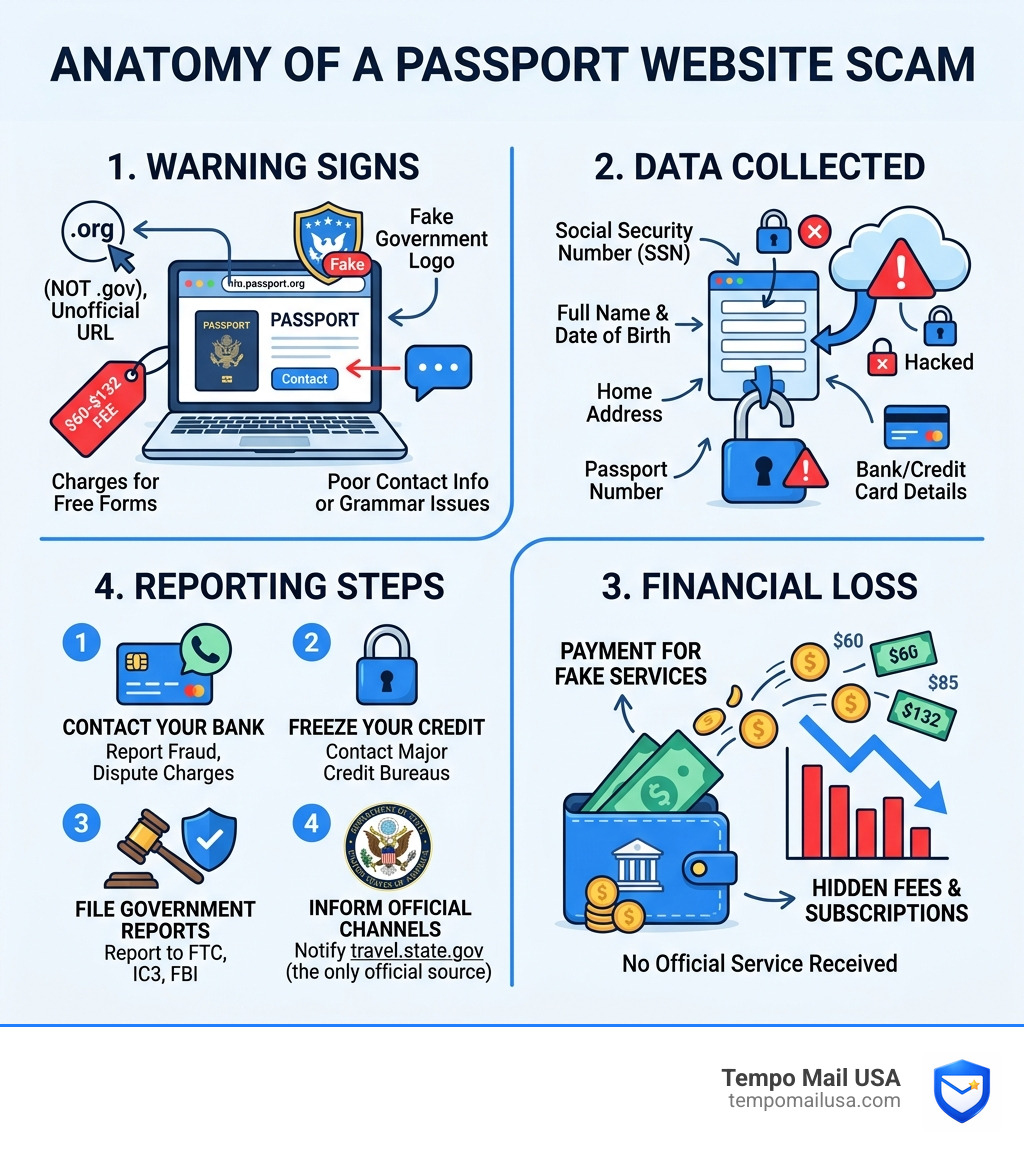
How the uspassportandvisa.org Scam Operates
The uspassportandvisa.org scam is a masterclass in digital deception. It doesn't rely on brute force; instead, it uses subtle psychological tricks and technical manipulation to catch travelers when they are at their most vulnerable—usually when they are rushed or stressed about upcoming international trips.
Step 1: SEO Manipulation and Sponsored Results
Scammers know that most people start their passport journey with a Google search. By using aggressive SEO tactics and paying for "Sponsored" ads, they ensure that uspassportandvisa.org ranks at the very top of search results, often appearing above the actual official government site. When you're in a hurry, you're likely to click the first link you see, assuming the top result must be the most relevant.
Step 2: Deceptive Design and Patriotic Imagery
Once you click, you are greeted by a website that looks remarkably official. It uses red, white, and blue color schemes, patriotic imagery, and professional-looking seals that mimic the aesthetic of a U.S. government portal. This is designed to lower your guard and make you feel like you are in a secure, authorized environment.
Step 3: PII Harvesting (The Real Danger)
The site asks you to fill out "application forms." To "process" your request, they require highly sensitive Personally Identifiable Information (PII). This includes:
- Full Legal Name and Date of Birth
- Social Security Number (SSN)
- Home Address
- Passport Numbers (if renewing)
- Parental Information (names and birth dates)
This is essentially a phishing scam designed to harvest data that can be used for identity theft or sold on the dark web. By the time you reach the payment page, they already have everything they need to impersonate you.
Step 4: The Deceptive Fee
After you’ve surrendered your data, the site demands a fee—typically ranging from $88 to $132. They claim this is for "processing" or "expediting." In reality, official U.S. passport forms are 100% free to download. According to Scams Details, victims pay this amount expecting an official document, only to receive a simple PDF of the information they just typed in—a form they still have to print out and take to an official post office or passport agency anyway.
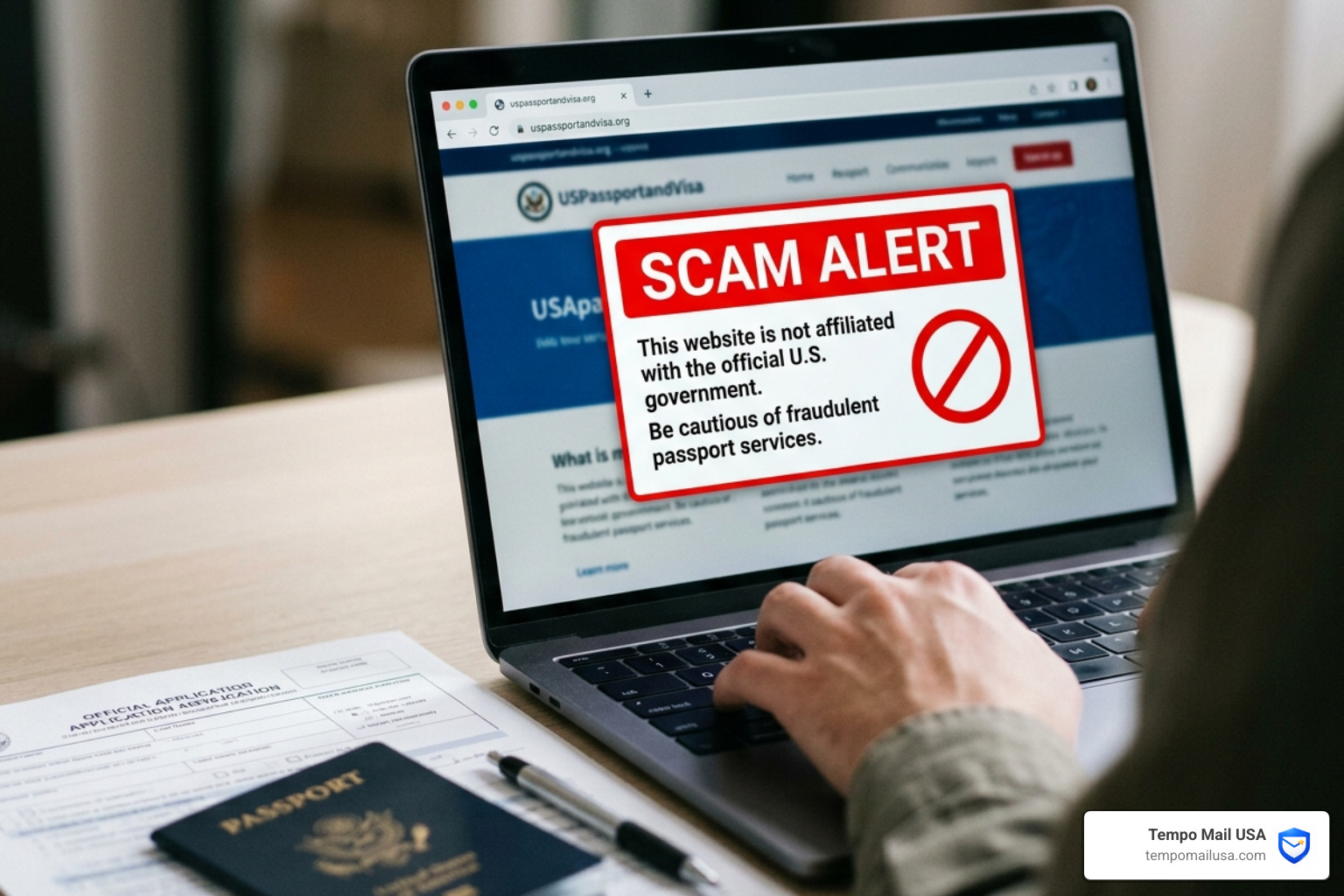
Red Flags of the uspassportandvisa.org Scam
Spotting a fraudulent site before you enter your data is the best way to stay safe. While the uspassportandvisa.org scam tries hard to look legit, there are several glaring red flags if you know where to look.
The .Gov vs. .Org Rule
This is the single most important rule in government interactions: Official U.S. government websites always end in .gov. No exceptions. A site ending in .org, .com, .net, or .us is a private entity. While some legitimate third-party "expeditors" exist, they are rarely necessary and often charge exorbitant fees for things you can do yourself.
Buried Disclaimers
To avoid immediate legal shutdown, these sites often hide a tiny disclaimer at the very bottom of the page in small, grey text. It usually says something like, "We are a private company and not affiliated with any government agency." If you see this, close the tab immediately.
Comparison Table: Official vs. Scam
| Feature | Official (travel.state.gov) | uspassportandvisa.org |
|---|---|---|
| Domain Extension | .gov (Strictly regulated) | .org (Anyone can buy this) |
| Form Cost | $0.00 (Always free) | $88 - $132 |
| Data Privacy | Federal privacy protections | High risk of data harvesting |
| Trust Score | Verified Government | Scam-Detector Score: 3/100 |
| Urgency | Standard processing times | "Act now" / "Expedite here" |
Technical Red Flags
When we look under the hood, the technical data is even more concerning. The domain was registered very recently (January 2025), which is a common trait of "burn and turn" scam sites. Furthermore, if you master how to spot phishing emails or websites, you'll notice they lack transparent contact information, such as a physical office address or a verifiable corporate phone number.
Risks of Using uspassportandvisa.org Scam Services
The loss of $88 is frustrating, but it’s the tip of the iceberg. The long-term risks associated with the uspassportandvisa.org scam are far more severe because of the specific types of data they collect.
1. Identity Theft and Data Brokers
When you provide your SSN, date of birth, and parents' names, you are handing over the "keys to the kingdom." Scammers can use this information to open new credit lines, file fraudulent tax returns, or apply for loans in your name. This data is also frequently sold to data brokers or on black market forums, where it can be used for years to come.
2. Financial and Bank Fraud
By providing your credit card or bank information to pay the "fee," you've exposed your accounts. Victims have reported unauthorized transactions appearing on their statements weeks after using the site. Even if you only intended to pay once, your card details are now in the hands of a fraudulent organization.
3. Secondary Phishing Attacks
Once you are marked as a "lead" (someone willing to pay for travel services), you will likely be targeted by secondary scams. These might come as emails claiming there is a "problem with your application" that requires more money, or fake "Global Entry" renewal notices.
4. Compromising Family Data
Because passport forms require information about your parents, you aren't just risking your own identity—you're risking theirs too. This makes it one of the more insidious forms of data theft we see in the industry. Protecting yourself with the best identity theft protection services is highly recommended if you've already interacted with this site.
Immediate Steps for Scam Victims
If you’ve already entered your information into uspassportandvisa.org, don't panic—but do act fast. Time is of the essence when your Social Security number is involved.
1. Secure Your Credit
Since they have your SSN, you must prevent them from opening accounts in your name.
- Place a Fraud Alert: Contact one of the three bureaus (Equifax, Experian, or TransUnion). They are legally required to notify the other two.
- Freeze Your Credit: This is the strongest step. It prevents anyone (including you) from opening new credit until you unfreeze it with a PIN.
2. Report the Identity Theft
You need an official paper trail.
- Visit IdentityTheft.gov: This is the FTC’s official portal. Follow the steps for how to report identity theft to the FTC.
- File an IC3 Report: The FBI’s Internet Crime Complaint Center (ic3.gov) tracks these larger scam networks.
3. Dispute the Charges
Call your bank or credit card issuer immediately. Tell them you were a victim of a fraudulent website.
- Use the US Bank fraud phone number if you are a customer there, or your specific bank's fraud department.
- Request a new card with a different number and CVV.
4. Monitor Your Accounts
Keep a close eye on your email and bank statements. If you receive suspicious emails, make sure you know how to report phishing emails to the authorities and your email provider.
Frequently Asked Questions about uspassportandvisa.org
Is uspassportandvisa.org a legitimate government website?
Absolutely not. It is a private, third-party website that uses deceptive design to appear official. The only official website for U.S. passports is travel.state.gov. Any site asking for a fee to download blank forms or "pre-fill" them is not a government entity. The U.S. Department of State does not charge for the forms themselves, only for the actual processing of the passport, which is paid via check or money order at a registered acceptance facility (like a post office).
How much money do victims typically lose to the uspassportandvisa.org scam?
Most victims report losing between $60 and $132. However, the financial loss can grow much higher if the scammers use your credit card details for unauthorized purchases later. The "service" you receive for this money is a simple PDF of a form that is available for free. Because the site often has "no refund" policies buried in their terms, getting your money back usually requires a formal dispute through your bank.
What are the long-term risks of the uspassportandvisa.org scam?
The primary long-term risk is persistent identity theft. Unlike a stolen credit card, which can be canceled, your Social Security number and date of birth are permanent. If this data is sold on the black market, you could face fraudulent activity years after the initial incident. This is why we recommend checking the best identity theft protection in the USA to find a service that monitors your PII across the dark web.
Conclusion
The uspassportandvisa.org scam is a reminder that the internet can be a treacherous place for the uninformed traveler. These bad actors count on your urgency and your trust in professional-looking websites to steal both your money and your identity.
At Tempo Mail USA, we believe in building a "PII Firewall" around your digital life. One of the best ways to stay safe from sites like these is to practice excellent digital hygiene. Using a temporary email alias when exploring new services can prevent your primary email from being added to "victim lists" used by scammers. While a temporary email can't stop you from typing in your SSN, it can shield your identity from the initial phishing attempts that lead to these sites.
Stay vigilant, always check for the .gov extension, and never pay for a form that the government provides for free. If you want to take your privacy to the next level and protect your personal information from prying eyes, explore our tools at https://tempomailusa.com. Together, we can make the internet a safer place, one alias at a time.