


US Cryptocurrency Scam Statistics Are at a Record High — Here's What You Need to Know
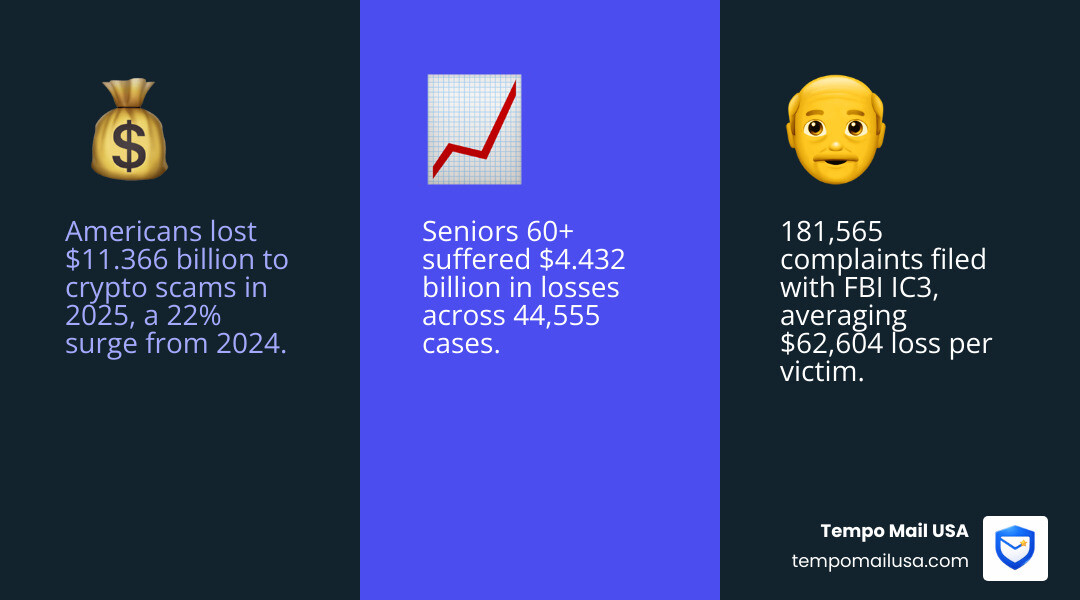
US cryptocurrency scam statistics paint a stark picture: Americans lost a record $11.4 billion to crypto-related fraud in 2025 alone, according to the FBI's Internet Crime Complaint Center (IC3). That's a 22% jump from 2024.
Here are the key numbers at a glance:
| Metric | 2025 Figure |
|---|---|
| Total US crypto scam losses | $11.366 billion |
| Total complaints filed | 181,565 |
| Average loss per victim | $62,604 |
| Victims losing $100,000+ | ~18,600 |
| Seniors (60+) losses | $4.432 billion |
| Crypto ATM fraud losses | $389 million |
| Investment scam losses | $7.228 billion |
These aren't just numbers. Behind each one is a real person — often someone who trusted a stranger online, clicked a link, or followed investment advice from what seemed like a legitimate source.
Scams have become more sophisticated, more automated, and more ruthless. Organized criminal networks in Southeast Asia — many operating through forced labor compounds — now run crypto fraud like a corporate enterprise, complete with AI tools, fake trading platforms, and scripted psychological manipulation.
And the problem is almost certainly bigger than the data shows. Experts estimate FBI figures capture only about 15% of actual global crypto fraud losses.
The State of US Cryptocurrency Scam Statistics
As we move through 2026, the landscape of digital finance has never been more treacherous. While the blockchain offers transparency and innovation, it has also become the preferred playground for international syndicates. The total reported loss of $11.366 billion in 2025 is a sobering milestone. This figure highlights a massive surge in the "industrialization of fraud," where scams are no longer just one-off emails but high-tech operations.
According to the $11.4B Lost to Crypto Scams in 2025: FBI Internet Crime Report, there were 181,565 complaints filed last year. When we break down these us cryptocurrency scam statistics, we see an average loss per case of $62,604. That is enough to wipe out a family's entire college fund or a significant portion of a retirement nest egg.

The illicit share of on-chain volume actually dipped slightly to 1.2%, but don't let that fool you. The total volume of crypto transactions grew so significantly that even a smaller "percentage" represents a massive increase in raw dollar value. In fact, total illicit crypto volume reached an all-time high of USD 158 billion globally in 2025.
If you find yourself caught in these statistics, seeking fraud resolution and identity theft protection services is critical. We often see that victims of one scam are immediately targeted by "recovery scams," where fraudsters pose as lawyers or government agents promising to get your money back for a fee. It’s a double-whammy that we want to help you avoid.
Investment Fraud and US Cryptocurrency Scam Statistics
Investment fraud remains the undisputed heavyweight champion of crypto crime. In 2025, investment-related crypto scams accounted for $7.2 billion in losses. This represents roughly 62% of all fraud inflows for the year.
Most of these schemes follow a familiar, heartbreaking pattern. We’ve seen a rise in Ponzi Scam Explained Meaning Red Flags, where early "investors" are paid with the funds of newer victims to create an illusion of high returns.
Recent complaints have highlighted several fraudulent trading platforms that you should steer clear of:
- capitalcrypto.net: A California resident recently lost over $100,000 here after a romance scammer convinced them to take out loans to pay "withdrawal fees."
- cryptovaultNC.com: Victims were lured into investment groups on messaging apps, only to be hit with demands for "taxes" totaling over $50,000 before they could access their "profits."
- tonwek.com and bmcmarkets.com: These platforms often use fake AI trading signals to convince users to deposit more funds, leading to losses averaging $50,000 per victim.
These platforms are designed to look incredibly professional, often featuring real-time charts and customer service bots. However, they are nothing more than digital facades.
Emerging Threats in US Cryptocurrency Scam Statistics
While online platforms are a major threat, we’re seeing a dangerous shift toward physical infrastructure: Crypto ATMs. These kiosks are popping up in convenience stores and gas stations across the country, and they have become a "perpetual crime scene."
In 2025, crypto ATM fraud caused $389 million in losses, a staggering 58% increase from the previous year. Scammers often use a Coinbase Text Scam Alert Stay Safe Online tactic to create a sense of urgency. They might call a victim claiming their account is compromised or they have an outstanding legal warrant, then instruct them to withdraw cash and deposit it into a crypto ATM using a provided QR code.
Once that money is deposited, it’s gone. It bypasses the traditional banking system's fraud protections and lands directly in the scammer's wallet. Seniors are hit particularly hard here, accounting for over $257 million of these ATM-related losses. If you are managing finances for an elderly relative, setting up credit monitoring software and discussing these specific kiosk threats is a vital protective step.
Dominant Fraud Typologies: From Pig Butchering to AI Deepfakes
The term "Pig Butchering" (Sha Zhu Pan) has become a household name in the worst way possible. These scams involve "fattening up" the victim with affection and fake financial gains before "slaughtering" them by stealing their entire investment.
According to reports, Crypto scams cost Americans $11.4 billion in 2025, FBI says, and these long-term psychological plays are the most damaging. Scammers may spend months building a relationship on social media or dating apps before ever mentioning cryptocurrency.
If you suspect you've been targeted, you need to act fast. We recommend you Report Bitcoin Scam 17 Billion Stolen Do This First to ensure law enforcement has the best chance of tracking the funds. The psychological manipulation used in these scams is intense; victims are often convinced they are at fault or that they just need to pay "one more fee" to get their money back.
The Role of Artificial Intelligence in Modern Fraud
In 2026, we are seeing the full impact of AI on the scam ecosystem. The 2026 Crypto Crime Report: Scams reveals that AI-enabled scams were 4.5 times more profitable than traditional methods last year.
Scammers are using:
- Deepfake Impersonation: Video and audio of celebrities or exchange CEOs (like the "Coinbase Text Scam") are used to promote fake giveaways.
- Automated Phishing Kits: Tools like the "Lighthouse" kit allow scammers to launch massive campaigns for under $500.
- Chatbots: AI bots can now handle thousands of "romance" conversations simultaneously, scaling the reach of pig butchering operations.
An average AI-driven scam operation now extracts about $3.2 million, compared to just $719,000 for those without AI. This "industrialization" means that the person you think you are talking to on LinkedIn might actually be a sophisticated script designed to find your financial weak points.
Demographic and Regional Hotspots for Crypto Fraud
Where you live and how old you are significantly impacts your risk profile. California remains the top target in the US, with residents losing a massive $2.1 billion in 2025. Texas follows with $1.01 billion, and Florida rounds out the top three at $914 million. These states are targeted because of their high crypto adoption rates and overall liquidity.
Age is the other major factor. Americans aged 60 and older are the most targeted demographic. In 2025, seniors lost $4.4 billion to crypto fraud. This is often due to scammers exploiting a lack of technical familiarity or targeting those with significant retirement savings.
We saw this in the Janus Henderson Scam Fca Fine Fake Investment Fraud case, where imposter platforms used the names of legitimate firms to trick retirees into "low-risk" crypto investments.
The Industrialization of Scams: Social Media and Infrastructure
We need to talk about where these scams start. It isn't just the "dark web." It's the apps you use every day.
- Facebook and Instagram: Prime territory for romance scams and fake "sponsored" investment ads.
- WhatsApp and Telegram: The "closing rooms" where scammers move victims to provide "one-on-one" coaching.
- LinkedIn: A growing hotspot for professional-themed investment fraud.
Many of these operations are run by Southeast Asian crime syndicates. These groups often use human trafficking victims — people lured by "tech jobs" only to be held in forced labor compounds in Myanmar or Cambodia — to run the scams.
A recent example of this industrial scale was the "E-ZPass" phishing campaign. This scheme reached 330,000 texts in a single day, amassing $1 billion over three years by duping over 1 million people globally. They used a simple premise: "You have an unpaid toll," leading victims to a site that stole their credit card and crypto wallet info.
Protecting Your Digital Identity in a High-Risk Environment
The us cryptocurrency scam statistics we've discussed are intimidating, but you aren't helpless. Protecting your digital assets requires a "defense-in-depth" strategy.
First, consider your entry point. Most scams start with an unsolicited message to your email or phone. This is where identity theft protection and data privacy compliance become your best friends.
The PII Firewall: A Smarter Way to Sign Up
When you sign up for a new crypto exchange, a newsletter, or a "free" investment guide, you are handing over your Primary Identifiable Information (PII). If that site is breached — or if it was a scam site to begin with — your real email address is now on a "sucker list" sold between criminal networks.
We recommend using a secure identity proxying service like Tempo Mail USA. By using temporary email aliases, you create a "PII Firewall." If a service you signed up for starts sending you suspicious "urgent account recovery" emails, you can simply delete that alias. Your real inbox stays clean, and the scammers lose their link to you.
Advanced Digital Hygiene
Beyond email, you should be using:
- Advanced Malware Protection: To stop "drainer" scripts from executing in your browser.
- Enterprise Password Managers: To ensure you aren't reusing passwords across different platforms.
- Secure VPNs: A high-quality VPN like NordVPN is essential for encrypting your traffic, especially if you are checking your wallet or exchange account on public Wi-Fi.
Think of these tools not as a chore, but as the "locks and alarms" for your digital home. In an era where AI can clone a voice or a face, having a "PII Firewall" is one of the few ways to ensure your real identity remains disconnected from the reach of global scam syndicates.
Frequently Asked Questions about US Cryptocurrency Scam Statistics
What was the total amount lost to crypto scams in the US in 2025?
According to FBI reports, Americans lost a record $11.366 billion to cryptocurrency-related scams in 2025, representing a 22% increase from the previous year. This surge is attributed to the growing sophistication of organized crime groups and the widespread use of AI.
Which demographic is most targeted by cryptocurrency fraudsters?
Seniors aged 60 and older are the most heavily targeted group, accounting for over $4.4 billion in reported losses across approximately 44,555 complaints in 2025. Scammers often target this group due to their higher average net worth and potential unfamiliarity with the technical nuances of blockchain technology.
How is AI changing the landscape of cryptocurrency scams?
AI has "industrialized" fraud, making scams 4.5 times more profitable through the use of deepfakes, automated chatbots, and sophisticated phishing kits. These tools allow scammers to impersonate trusted figures and manage thousands of victims simultaneously, significantly increasing the scale and efficiency of their operations.
Conclusion
The battle against crypto fraud is ongoing. While law enforcement has stepped up — with initiatives like Operation Level Up preventing over $225 million in losses and US authorities seizing more than $15 billion in illicit proceeds in 2025 — the best defense is personal vigilance.
By understanding the us cryptocurrency scam statistics, you can recognize the patterns before they affect you. Be skeptical of "guaranteed" returns, be wary of strangers on social media, and always protect your PII. Using tools like Tempo Mail USA to mask your identity and NordVPN to secure your connection are simple, effective ways to stay out of the FBI's next report. Stay safe, stay private, and always do your own research.