


Is the Luce Research Scam Real? Here's What You Need to Know Fast
The luce research scam allegations are real complaints — but the full picture is more nuanced than a simple yes or no.
Quick verdict:
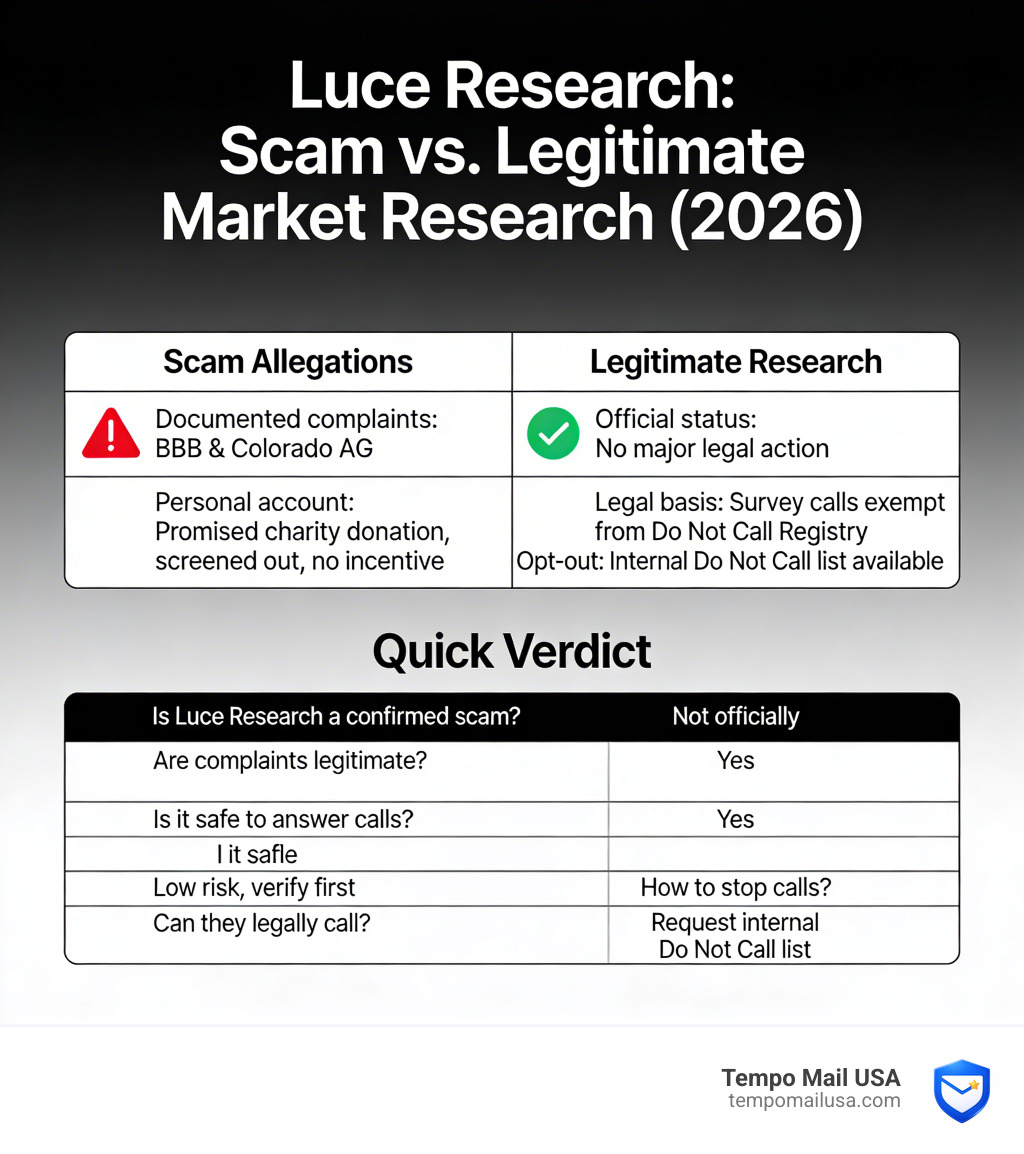
| Question | Answer |
|---|---|
| Is Luce Research a confirmed scam? | Not officially — no major legal action has been taken |
| Are complaints legitimate? | Yes — documented complaints exist with the BBB and Colorado AG |
| Is it safe to answer their calls? | Low risk, but verify before sharing personal information |
| Can they legally call your number? | Yes — survey calls are exempt from the Do Not Call Registry |
| How do you stop their calls? | Request removal via their internal Do Not Call list |
Luce Research is a Colorado-based market research firm that conducts telephone surveys. They claim their calls are legitimate opinion research — not sales or charity solicitations.
But not everyone agrees.
A personal account from one recipient tells a familiar story: they agreed to a survey after being promised a charity donation, only to be screened out early and denied the incentive. When they complained — to the company, the Colorado Attorney General, and the Better Business Bureau — the response was minimal. The BBB logged the case as "information only" and took no further action.
That kind of experience is exactly what fuels scam allegations. And if you value your privacy, it raises a fair question: how much should you trust a cold-calling research firm with your opinions, your time, and potentially your data?
Investigating the Luce Research Scam Allegations

When we hear the word "scam," we usually think of someone trying to steal credit card numbers or install malware. However, in market research, a "scam" often refers to deceptive practices, aggressive data harvesting, or broken promises regarding incentives. The luce research scam narrative is built on these types of frustrations.
The most notable formal record of these allegations dates back to May 2010. A complaint was filed with the Colorado State Attorney General alleging fraudulent business practices. This complaint was eventually forwarded to the Better Business Bureau (BBB) for their records. However, the outcome wasn't exactly a "smoking gun." The BBB assigned it Case #37016781 but kept it as "information only." This meant it stayed in their files for three years without actually lowering the company's official rating.
While this might seem like a "get out of jail free" card for the company, for consumers, it highlights a frustrating gap in accountability. If a company's practices are annoying or ethically questionable but not strictly illegal, regulatory bodies often hesitate to take decisive action. This is a common theme we see when uncovering the truth about Atkins Research Global and other similar firms that walk the fine line between data collection and harassment.
Common Complaints and the Luce Research Scam Narrative
The "scam" label doesn't usually come from nowhere. Most people who use the term luce research scam are reacting to a specific pattern of behavior. The most frequent grievance involves "charity baiting."
In this scenario, a caller tells a participant that if they complete a survey, a donation will be made to a specific charity. However, many participants report that after answering several minutes of questions, they are suddenly told they "don't qualify" and the call is terminated. Because the survey wasn't "completed," the donation is never made. This feels like a bait-and-switch to the consumer who just gave away their valuable time and opinions for free.
| Consumer Complaint | Company Justification |
|---|---|
| "They promised a donation but hung up on me." | "Incentives are only for those who qualify and finish the full script." |
| "They call me even though I'm on the DNC list." | "Survey calls are legally exempt from the National Do Not Call Registry." |
| "The callers are aggressive and won't take no for an answer." | "We are trained data collection specialists pursuing campaign goals." |
| "I never gave them my number." | "Numbers are often generated randomly or sourced from public records." |
Official Investigations and Regulatory Responses
As we mentioned, the Colorado Attorney General and the BBB have looked into Luce Research in the past. The fact that Case #37016781 resulted in no formal charges suggests that the company is likely operating within the letter of the law, even if their methods frustrate the public.
This tension between industry practices and public trust isn't new. Historically, the "marketplace" has always struggled with the ethics of paid research. For example, scientific research on marketplace science trust shows that as far back as the 1800s, scientists were accused of "swindling" when their research was funded by private industry interests. In the modern era, this translates to market research firms being viewed with suspicion because their "surveys" often feel more like data-mining operations for political or corporate clients.
Legitimacy Check: Is Luce Research a Real Company?
To be clear: Luce Research is a real, registered business. They aren't a "ghost" operation calling from a basement in a foreign country with no physical footprint. They have a physical address in Colorado Springs and have been in operation for many years.
In fact, some defenses of the company point to their involvement in high-level academic and mathematical sciences. There are claims that Luce Research (or entities associated with the name in academic circles) achieved "world-leading" or "internationally excellent" ratings in the Research Excellence Framework (REF 2021). These ratings are prestigious and suggest that, at some level, the organization contributes to legitimate scholarly work.
However, for the average person getting a call at 6:00 PM on a Tuesday, academic prestige doesn't mean much if the caller is being pushy. If you're trying to figure out if a company is worth your time, you might want to check out our Is Testerup a scam survival guide for more tips on vetting digital and phone-based services.
Services and Claims vs. Reality
Luce Research describes themselves as "Data Collection Specialists." Their stated goal is to help clients "target and tally" or "individualize and influence." This is fancy marketing speak for:
- They find out what people think (Data Collection).
- They help clients use that data to change minds (Influence).
While they claim to be conducting "legitimate research campaigns," the reality for the consumer is often a series of screening questions. If you don't fit the specific demographic their client is looking for (e.g., a specific age, income level, or political leaning), they will end the call. This is standard industry practice, but when it's combined with a promise of a charity donation, it feels deceptive.
Evidence of Professional Affiliations
Luce Research maintains a professional website and provides options for people to opt out of their internal calling lists. They adhere to the basic standards of the market research industry, which distinguishes them from "true" scams like those involving identity theft or bank fraud.
The organization positions itself as a bridge between the public and policymakers. They argue that their work is essential for mathematical sciences and social research that underpins modern technology and governance. By maintaining a physical presence and responding (even if defensively) to public inquiries, they maintain a veneer of legitimacy that fly-by-night scammers lack.
Navigating Telemarketing Laws and Survey Exemptions
One of the biggest reasons people suspect a luce research scam is because they receive calls despite being on the National Do Not Call (DNC) Registry. It feels like a violation of the law, but here’s the kicker: it’s usually perfectly legal.
According to the FTC’s National Do Not Call Registry FAQ, the DNC list only stops telemarketing calls—calls intended to sell you something. It does not stop:
- Political organizations
- Charities
- Telephone surveyors
- Debt collectors
- Companies you have an existing business relationship with
Luce Research utilizes this "surveyor exemption" to its fullest extent. Since they aren't technically selling a product or asking for a direct donation to themselves, they can legally dial numbers on the registry.
Protecting Yourself from a Potential Luce Research Scam
Even if the calls are legal, you don't have to put up with them. We at TempoMailUSA believe that your personal data—including your phone number and your opinions—belongs to you.
If you want to reduce the "noise" from firms like Luce Research, you should look for "Privacy Preference" or "Opt-Out" signals. Luce Research actually provides a UCP Text Message Opt-In/Out page and an internal Do Not Call list.
By adding your number to their internal list, you are using the company’s own system to stop the calls. This is often more effective than the national registry for these specific types of firms. For more tips on keeping your inbox and phone line clean, check out our more info about identifying phishing emails.
How to Handle Unwanted Survey Calls
If you pick up the phone and hear a Luce Research representative, you have a few options:
- The Immediate Hang-up: You are under no obligation to speak to them.
- The Direct Request: Say, "Please place my number on your internal Do Not Call list." Under the Telemarketing Sales Rule (TSR), they are generally required to honor this request for that specific company.
- Verify the Incentive: If they mention a charity donation, ask for the name of the charity and the specific conditions for the donation before answering any questions. If they are evasive, it’s probably best to end the call.
- Record and Document: If you feel harassed, keep a log of the date, time, and the caller's name. This documentation is vital if you ever decide to file a formal complaint with the BBB or your state's Attorney General.
Frequently Asked Questions about Luce Research Scam
Why does Luce Research call numbers on the Do Not Call Registry?
As mentioned, the FTC provides specific exemptions for "opinion research" and "telephone surveys." Because Luce Research identifies as a research firm rather than a telemarketer, they are not legally barred from calling numbers on the National DNC Registry. They view their calls as a way to gather data for the "public good," even if the public finds the calls intrusive.
Is the charity donation promise a scam?
It is not a "scam" in the sense that the money never exists, but it is often a "conditional offer." The script usually requires the participant to complete the entire survey. If the survey is 20 minutes long and you are screened out at minute 15 because of your answers, the company justifies not making the donation. This "bait-and-switch" feel is the primary source of the luce research scam reputation.
How can I stop Luce Research from calling me?
The most effective way is to visit their website and use their Opt-Out Preference tools. You can also tell the representative directly to put you on their internal DNC list. If the calls persist, you can file a complaint with the Better Business Bureau, though as we've seen, this often results in the complaint being filed as "information only."
Conclusion
So, what is the final verdict on the luce research scam?
Luce Research is a legitimate business that uses aggressive, but largely legal, loopholes to conduct market research. While they aren't "stealing" in the traditional sense, their tactics—like calling DNC numbers and using conditional charity incentives—feel deceptive to many consumers.
The reality is that in our modern data economy, your information is a product. Companies like Luce Research are the "harvesters." The best way to protect yourself isn't just to complain to the BBB; it's to take proactive steps to shield your identity.
At TempoMailUSA, we see this all the time. Whether it's unwanted phone calls or spam emails, the goal of these firms is to get a piece of your personal data. By using tools like secure email aliases and being stingy with your phone number, you act as your own firewall.
Stay vigilant, ask questions, and remember: if a "free" survey feels like it's taking too much of your time or data, it's okay to just hang up. Protect your identity today and keep your personal information where it belongs—with you.