
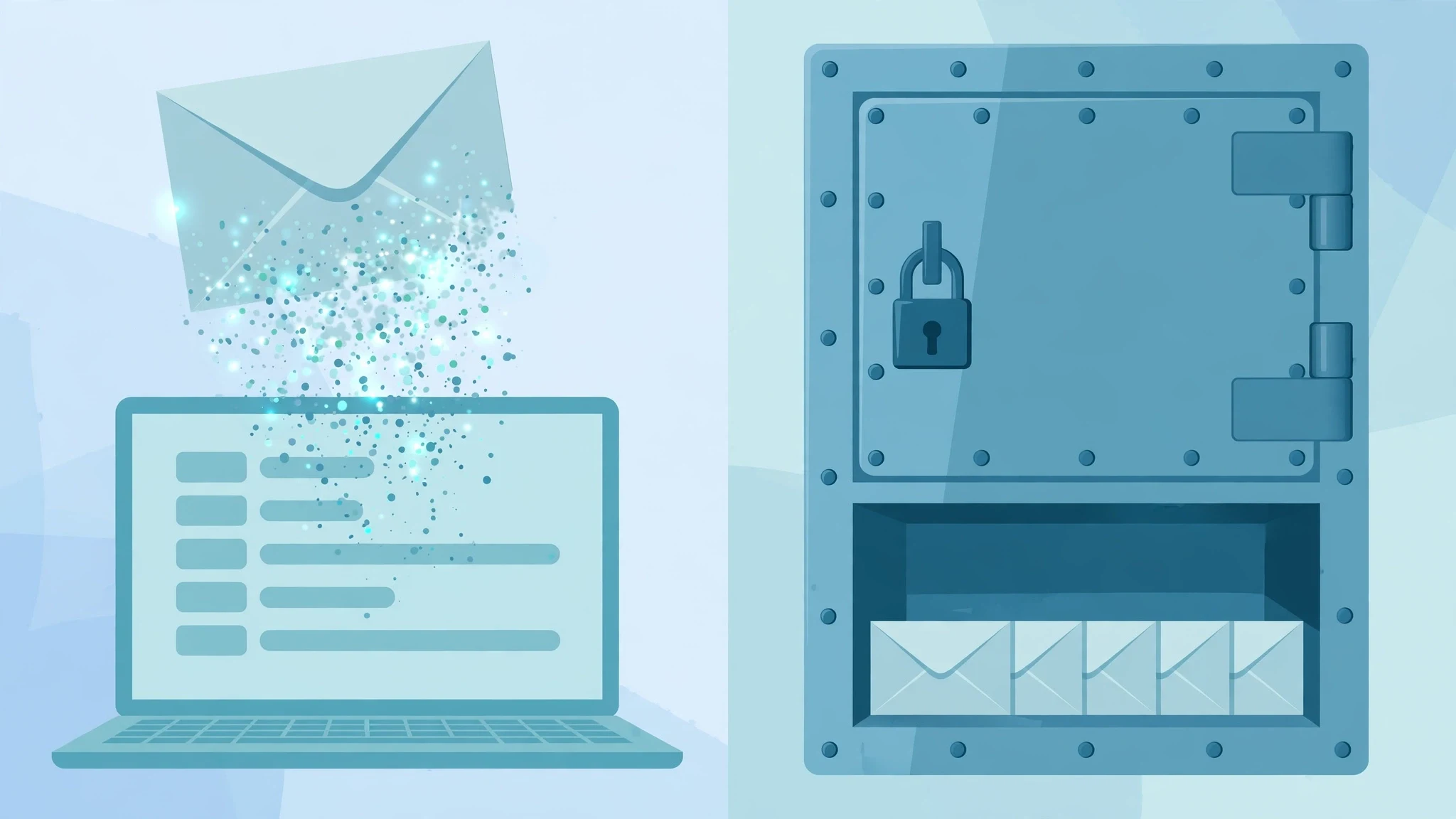
Temp Mail vs Proton Mail: When a Disposable Inbox Wins — and When It Costs You
This morning, something small and telling showed up in search behaviour. In the United States, over the past day, "proton mail" surfaced as a breakout rising query connected to "temp mail" searches, next to "tempmail" rising 250 percent and "temp phone number" rising 60 percent. Nobody searching for a disposable inbox wakes up thinking about encryption standards. They are thinking about one signup, right now, and whether handing over their real address is worth it. Proton Mail entering that same search moment tells you what people want: not a lecture about privacy, but a way to stop regretting the address they gave away.
I have watched this confusion play out for years: a reader upgrades a trial signed up on a throwaway, then cannot reset the password because the throwaway is gone; another opens a private mailbox for every coupon and download, then wonders why their "private" inbox looks like the spam folder they fled. Both made a sensible choice in the wrong place. The fix is learning which inbox belongs to which signup, before you type anything.
The search spike that started this argument
Let me be precise about what the trend signal is, because trend stories get inflated fast. Proton Mail was not sitting in the top 25 trending searches in the US this morning — that list was dominated by election results. Its signal is narrower and, for our purposes, more useful: in Google Trends' past-day Explore view, "proton mail" appeared as a breakout rising query related to "temp mail." Breakout means the increase was sharp enough that Trends does not bother with a percentage. It does not mean millions of people searched it, and I will not pretend it does.
What it does mean is that a visible slice of people weighing disposable email are also weighing a permanent private mailbox in the same session. Disposable versus private is no longer a choice people make once and settle; they compare them per signup, and they should. The rest of this article gives you that comparison, limits stated plainly.
The 90-day test
Forget brand loyalty for a minute and ask one question about the signup in front of you: will I need this inbox in 90 days? If the honest answer is no, a disposable address is not merely acceptable, it is the better tool. If the answer is yes, or even "probably, for a password reset," a disposable address is a liability wearing a convenience costume.
A disposable inbox exists to be abandoned. That is its strength and its entire risk, in the same feature. You use it to read a confirmation code, download a file, or test a tool, and then you walk away and the marketing that would have followed you for years has nowhere to go. A permanent private mailbox exists for the opposite job: to still be there when a service asks "is this really you?" six months later. Most signup regret comes from using one of these tools for the other's job.
In practice: a webinar, a whitepaper, a coupon, a forum thread you will read once, a tool you are testing for an afternoon — disposable. A bank, a tax tool, a password manager, a client portal, a domain registrar, anything that can lock you out of money or work — permanent. In between sits the interesting middle: newsletters you might like, apps you might keep, stores you might order from again. For those, use an alias or a secondary permanent address, which I come back to below.

What Proton Mail actually protects — and what it does not
Proton Mail is a Swiss-based email service built around encryption, and the details matter more than the slogan. Messages between two Proton Mail users are end-to-end encrypted automatically, and stored messages are protected with zero-access encryption, which means Proton itself cannot read the contents of your stored mail. That is a real, structural difference from a conventional free mailbox, where the provider holds the keys and can process content to run its features. If your threat is a provider reading your mail, or a breach exposing readable stored messages, Proton's design answers it.
It does not answer everything, and anyone selling it as total privacy is overselling. Subject lines and sender and recipient addresses are not end-to-end encrypted under the OpenPGP standard Proton follows, though they are stored with zero-access encryption. Proton has also complied with a Swiss court order to log a user's IP address in the past, while maintaining that message encryption was not bypassed. Switzerland sits outside the EU with historically strict data protection law, but a Swiss company still answers to Swiss courts. None of this makes Proton Mail bad; it makes it a product with a defined boundary, worth knowing before you move your life into it.
The free plan has boundaries of its own, and they are why a free Proton account is not a replacement for a disposable inbox. Recent reviews of Proton's own pricing pages list the free tier at one address, 500 MB of storage rising to 1 GB once you finish the setup checklist, and 150 sent messages a day, with tight limits on folders, labels, and filters. Paid plans add storage, addresses, custom domains, and access from other mail apps, with Mail Plus listed at $3.99 a month on annual billing. A free account is a genuine way to try encrypted email, but a cramped place to keep years of mail, and reviews note it can be deleted after 12 months without use, with reminders beforehand. A private mailbox only protects you if you keep it alive.
Proton also offers hide-my-email aliases, which forward to your inbox under stand-in addresses. This quietly resolves half the argument in this post: an alias gives you a disposable-feeling address for a signup while a permanent mailbox sits behind it, so a password reset still reaches you. The free tier includes a limited number; paid plans raise the cap. If you take one idea from this article, take that one: for signups you might keep, an alias beats both a throwaway and your main address.
The comparison, without the marketing fog
People compare these tools as if one must win. They do different jobs, and a side-by-side look makes that obvious.
A disposable inbox is free, instant, and requires no account. It stops marketing at the source because the address dies. It fails, by design, at recovery: lose the inbox and you lose the reset link, the receipt, and sometimes the account itself. It also fails at trust: many services block known disposable domains, and some let you register and then refuse verification, which you only discover after investing time.
A permanent private mailbox like Proton Mail is built to last, encrypts stored mail so the provider cannot read it, and works for banking, work, and anything with a reset link. It costs attention: one address on the free plan, limited storage, and a daily sending cap mean you cannot treat it as a dumping ground for every trial and newsletter without it becoming the noisy inbox you left. Its privacy also carries the subject-line and legal-request limits above.
Gmail sits in a third position: generous free storage, strong spam filtering, and deep integration, with no end-to-end encryption on free accounts and a provider that holds the keys. Gmail's plus-addressing tricks give it a partial throwaway mode, which we covered when we looked at Gmail's temporary email options. The honest ranking is not "best to worst." It is: disposable for the forgettable, private for the recoverable, and your everyday mailbox for everything you already trust with your name.
Five signups, five different answers
Abstract rules are easy to agree with and easy to ignore at the signup form. So here are five concrete signups, with the answer I would actually give.
First, a free AI tool you found on social media and want to try for an evening. Disposable. You are testing the tool, not joining its mailing list for life, and if it turns out to be a data-harvesting front, your real address was never in the room. If you end up using it daily, move it to a permanent address or an alias before you store anything valuable in it.
Second, a newsletter from a writer you already like. Alias or a secondary permanent address, not a throwaway and not your main inbox. A throwaway loses you the archive the day it expires; your main inbox makes every send compete with work mail. An alias keeps the archive reachable and the unsubscribe one click away.
Third, a shopping account with one order and a possible return. This is the signup people get wrong most often. The confirmation, the shipping update, and the return window all live in that inbox, and returns routinely stretch past 30 days. Use an alias on a permanent mailbox. A throwaway that expires before the return window closes is a small disaster you chose in advance.
Fourth, a bank, a broker, or any account tied to money. Permanent private mailbox, full stop, with a recovery method you have actually tested. Here a disposable address is not clever, it is a security hole: anyone who later claims that address inherits a path to your reset emails. If you have ever used a throwaway for a money account, move it today, before you need the reset.
Fifth, a verification code for a service you do not trust yet, like a forum or a download gate. Disposable, with one condition: do not create anything in that account you would mind losing. The moment you upload work or link a payment method, the account has outgrown the inbox and you should migrate it. If a service sends you a code you did not request, that is a different problem, and we have walked through what an unsolicited verification code means separately.
The trap that costs people real accounts
The most expensive mistake in this whole area is not spam. Spam is annoying and filterable. The expensive mistake is building something valuable on an address you cannot get back into. I have seen the pattern often enough to name its stages: trial on a throwaway, upgrade on the same throwaway because switching felt like friction, password forgotten months later, reset link sent to an inbox that expired, support asked to verify identity through the very email you cannot access, account effectively gone.
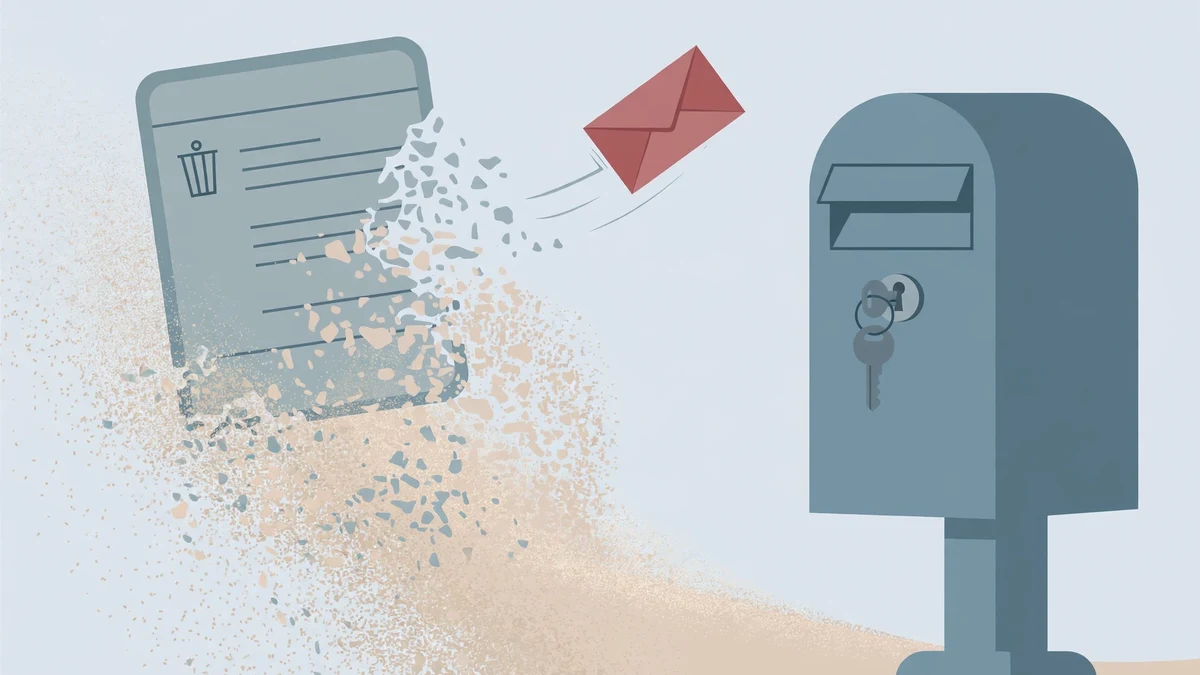
Services are not sympathetic to this story, and in fairness, they cannot easily be. From their side, a person who cannot receive mail at the registered address looks exactly like a person trying to take over someone else's account. That is why the 90-day test matters more than any feature list: it forces the question at signup, when the answer is cheap, instead of at recovery, when it is expensive.
There is a second, quieter trap: reusing the same disposable address everywhere because it is convenient. A throwaway reused across dozens of services stops being disposable and starts being a profile linking all those signups together. We have written about why reusing the same temp email rebuilds your profile before, and the point stands: if one address serves every trial, it is not protecting you, it is just a second permanent address with worse recovery.
My setup, stated plainly
My opinion, without hedging: run three tiers and stop improvising at each form. Tier one is disposable addresses for genuine one-offs, used through a temporary email generator and abandoned without guilt. Tier two is aliases on a permanent mailbox for newsletters, shopping, and tools you might keep. Tier three is a private permanent mailbox for money, work, identity, and recovery, kept alive, with recovery options that are real, and never handed to a download gate.
I would not run Proton Mail free as my only mailbox — one address and 1 GB is too small for a whole life — and I would not run a disposable inbox as my only signup tool, because recovery is not optional for the accounts that matter. The combination is the product. People who argue about which single tool wins are usually selling one of them. You are not buying a philosophy; you are routing mail, and routing is a job for more than one address.
One more opinion: do not let a search spike make the decision for you. The breakout interest in Proton Mail this morning is interesting because it shows people comparing, not because it settles anything. Open a private mailbox because it is trending, use it for every trial because it feels virtuous, and within a month you will have a private, encrypted, completely unmanageable inbox. Trends tell you what to investigate. They do not tell you what to sign up for.
Moving a signup from disposable to permanent without losing it
If you already have accounts sitting on throwaway addresses, do not panic and do not try to fix them all in one sitting. Work through them in this order, because the order is the risk order.
Start with anything tied to money, work, or identity, and change the registered email to a permanent address while you can still sign in. Then handle accounts holding work you cannot recreate: documents, projects, photos, saved writing. Then handle shopping accounts with open orders or return windows. For each one, change the email, confirm the change from the new inbox, and then sign out and back in to prove the new address works before you abandon the old one. That last step is the one people skip, and it is the one that catches a typo in the new address.
For accounts you cannot change because the throwaway is already gone, try support with whatever proof you have: receipts, order numbers, payment records. Sometimes it works. Often it does not, and that is the cost of the original choice, stated without softening. Going forward, treat any account you create on a disposable address as rented, not owned, and move it the week you decide to keep it, not the month you need to recover it. If you want the operator's view of what a disposable provider can see in the first place, our earlier look at who can read your throwaway mail is the right background reading.
Frequently asked questions
Can I use a temp mail address for Proton Mail signup? You can try, but you should not build a private mailbox on a disposable address. Proton Mail is precisely the account you will need to recover one day, and a recovery path that expires defeats the purpose of the mailbox. Sign up with an address you control long-term, or at minimum one whose recovery you have tested.
Is Proton Mail really private? It is private in a specific, documented way: stored messages are zero-access encrypted so Proton cannot read them, and mail between Proton users is end-to-end encrypted. Subject lines and addressing metadata are not end-to-end encrypted, and Swiss legal orders can compel limited metadata. That is strong protection against provider snooping and bulk breaches, not invisibility from lawful process.
Does a disposable inbox protect me better than Proton Mail? For a one-off signup, yes, in the narrow sense that matters: the address dies, so the marketing and the breach exposure tied to it die with it. For anything you need to keep, no: a disposable inbox protects you from spam by sacrificing recovery, which is a bad trade for a real account.
Can I use Proton Mail as a throwaway? You can use its aliases that way, and that is the smart version of the idea. Opening a whole free Proton account per trial is wasteful, limited to one address per account, and still leaves you managing many logins. Aliases give you the throwaway behaviour with a permanent mailbox behind it.
What happens if my temp mail inbox expires before a password reset? Usually, you lose access to that reset path. Support may help with other proof, but you should assume the account is unrecoverable and act accordingly: move valuable accounts off disposable addresses before this happens, not after.
Should I pay for Proton Mail? Pay if you need more than the free tier gives: more storage than 1 GB, more addresses, a custom domain, or access from other mail apps. Do not pay to solve a disposable-inbox problem; if your issue is trial spam, a throwaway or an alias solves it free. Pay for permanence, not for volume.
The comparison people are searching for this morning has a boring, useful answer. Use a disposable inbox where forgetting is the feature. Use a private mailbox where remembering is the feature. And when you are not sure which one a signup is, use an alias, because "not sure yet" is a legitimate third answer, and it is the one that keeps both doors open.
Need a disposable temporary email?
Protect your real inbox from spam and promotional clutter instantly and free.
Received a suspicious email, text, or charge alert?
Verify whether the sender domain is disposable, spoofed, or unverified before clicking links.