

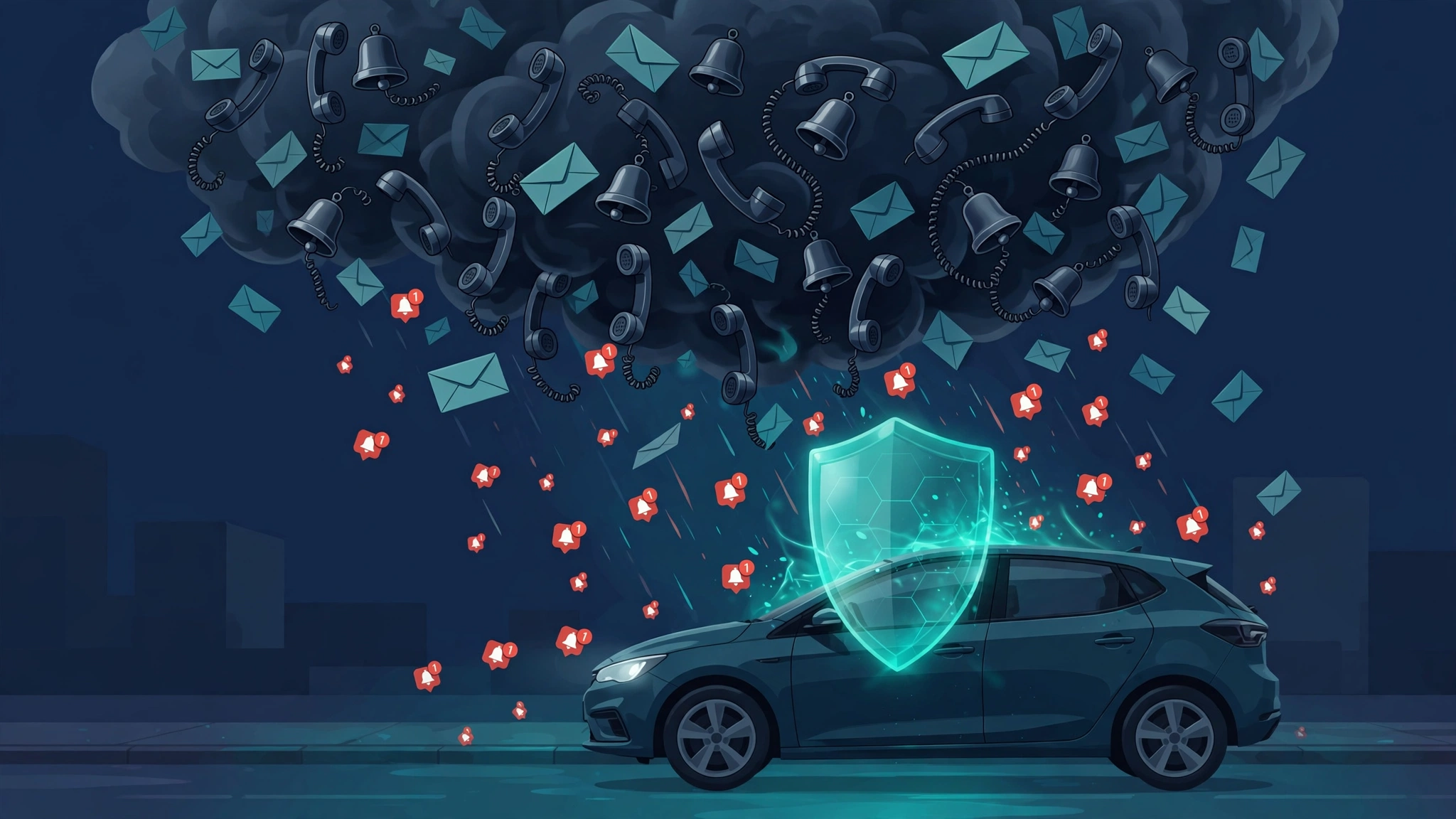
It starts innocently, the way these things always do. Tuesday evening, renewal notice sitting on the counter, and you think: I should check whether I am overpaying. Twenty minutes, you tell yourself. One comparison site, a few numbers, back to the couch.
The form is friendly. Zip code. Car. Driving history. Then the email field, then the phone number, then the big cheerful button: "Get My Quotes."
Here is what the button does not say: you have just listed yourself for sale.
That Form Is Not a Form. It Is a Storefront.
Most quote-comparison sites do not sell insurance. They sell you. Your details — name, address, vehicle, driving record, email, phone — get packaged into a lead and auctioned to agents and insurers who pay for the right to call you. The lead platforms are not obscure either: a 2026 academic study of this exact ecosystem names platforms like QuoteWizard and NextGen Leads, and got buyer access to watch the market operate from the inside (https://arxiv.org/html/2604.06759).
CarInsurance.com puts it more bluntly for consumers: some quote comparison websites sell leads to multiple agencies, which is why "you may receive dozens of calls after requesting a quote" (https://www.carinsurance.com/how-to-stop-spam-and-telemarketing-robocalls/). Dozens. That is the polite, industry-adjacent phrasing. The researchers measured what "dozens" actually looks like.
This is worth sitting with for a moment, because it reframes the whole interaction. You thought you were the customer of a comparison tool. You were the inventory. The comparison tool's actual customers are the agents buying your contact details. Nothing about this is hidden in some dark corner of the internet — it is the business model, operating in daylight, and your Tuesday-evening quote hunt is the supply.
The 60-Second Storm

The arXiv study from April 2026 is the best measurement anyone has published of what happens after you hit submit, and the numbers are genuinely startling. The researchers created 105 synthetic consumer profiles — each with a unique email address and phone number — submitted them to lead-generation sites, and monitored every call, text, and email for 60 days.
The totals: 6,819 calls from 1,053 distinct phone numbers. Individual profiles received up to 593 calls, including 150 redials from a single caller. Calls frequently began within seconds of submission — fast enough, the researchers note, to interfere with normal phone use. Over 80 percent of the calls came through VoIP platforms, and 59 percent spoofed local area codes, which is why your caller ID keeps showing your own town.
Then they went to the Better Business Bureau and analyzed 7,432 real consumer reviews and complaints about these sites, to check whether the lab result matched lived experience. It did, with interest. About half of complaining consumers reported four or more calls per hour. Twenty percent reported more than fourteen calls per hour — roughly one call every four minutes, sustained. One consumer wrote: "From the moment I hit submit, I received 40 calls in the first 60 seconds." Another reported 972 calls in 24 hours.
Read that first number again. Forty calls in sixty seconds. That is not marketing; that is a denial-of-service attack on your Tuesday evening, delivered by an industry you invited in with one form.
The national backdrop makes it worse. YouMail's Robocall Index put U.S. robocall volume at nearly 3.9 billion calls in September 2026 alone — 128 million a day, 1,482 every second — with roughly 2 billion unwanted calls landing every month (https://www.prnewswire.com/news-releases/us-robocalls-dip-to-nearly-3-9-billion-in-september-according-to-youmail-robocall-index-302900739.html). Your quote form does not create this storm. It just hands the storm your exact coordinates.
Your Email Is the Cheapest Thing on the Manifest
Everyone talks about the calls, because the calls are the trauma. But the email address you typed has its own afterlife, and it is quieter and longer.
The study tracked emails too, and found the predictable pattern: most sites send the heaviest email volume in the first two weeks, then taper to a trickle. That sounds manageable until you learn the other finding — the one that should change how you think about opt-outs entirely. The researchers tested opt-out mechanisms and found that while every method reduced contact volume, none was fully effective. Marketing contact kept resuming from new numbers and new domains, making blocking a game of whack-a-mole against an opponent with infinite moles.
Your email becomes a permanent fixture in someone's CRM. It gets forwarded to partner agencies, folded into "aged lead" lists that get resold months later (the study bought access to an Aged Lead Store — aged leads are literally a product category), and attached to a profile containing your car, your address, your driving history. This is where the temp-mail instinct comes from, and it is a sound instinct: if the address they have is disposable, the two-week email storm hits an inbox you can abandon, and the aged-lead resale six months from now arrives at a dead letterbox.
But — and this is the part the burner-email cheerleaders skip — email is the cheapest item on the manifest. The expensive item is your phone number, and a temp email does nothing about that.
Why a Burner Email Is Only Half the Shield
Let me be straight about what temp mail can and cannot do at a quote site, because half-measures sold as full solutions are how people get hurt.
What it does well: it quarantines the email fallout. The drip campaigns, the partner offers, the aged-lead resurrections — all of it lands in a disposable inbox. When the shopping is done, you close the tab and the entire email dimension of the storm never reaches your real life. That alone is worth the thirty seconds it takes.
What it does not do: anything about your phone. The 593-calls-per-profile nightmare in the study was a phone-number problem, not an email problem. If you type your real number into the form, the burner email is a raincoat in a hurricane — technically present, functionally irrelevant to the main event.
There is also a gate to get through first. Quote sites, like every other lead-hungry business, run email validation. Disposable domains get rejected outright by blocklists, scored down by validation APIs, or fingerprinted by mail infrastructure — the full machinery of which we tore down separately (why websites block temp mail). A burned, overused temp domain will bounce off the form. A fresh one usually sails through. And some quote sites send a verification code to the address before showing results, which is its own small adventure — codes that never arrive, codes that arrive late — covered in our OTP troubleshooting guide.
My honest position: temp mail for insurance quotes is genuinely useful, but only as half of a two-part defense. The email half is solved. The phone half needs its own answer, and pretending otherwise would be dishonest. Here is the full playbook.
The Playbook: Shopping Quotes Like a Ghost

Step one: start with the direct insurers. GEICO, Progressive, State Farm, and the rest all quote directly on their own sites, and your details stay inside that one company instead of entering the lead auction. Direct quotes are the cleanest data you will get, and they cost you nothing but time. Do these first, before any aggregator touches your information.
Step two: pick one aggregator, not five. Every additional comparison site is a separate listing of you for sale. One aggregator plus your direct quotes is plenty of market coverage. More sites do not meaningfully improve your price discovery; they multiply your exposure linearly.
Step three: arm the email half. Generate a fresh temp address and use it on the aggregator's form. Fresh matters — heavily reused domains are the ones sitting on blocklists. Keep the inbox open in a tab while you shop, because the quotes and any verification codes arrive there. If you want to keep access to the inbox across sessions (quote links, "your quotes are ready" follow-ups), grab the recovery key — our guide to reusable temp mail with a recovery key walks through it.
Step four: arm the phone half. This is the step everyone skips and the step that matters most. Use a secondary number if you have one — a work line, a VoIP number, a prepaid line. If you must use your primary number, know what you are signing up for: the study's numbers are the honest preview. And use the phone's built-in spam screening. Both iPhone and Android now ship call screening that answers unknown callers for you; turning it on before quote day takes five minutes and blunts the worst of the storm.
Step five: treat the form like a data diet. The form asks for a lot. Give it what it needs to price you and nothing decorative. Every optional field — the "best time to call" dropdown, the newsletter checkbox pre-ticked at the bottom — is another vector. Uncheck everything pre-checked. Skip every optional field. Remember that quote emails can carry genuinely sensitive details (your name, address, vehicle, sometimes partial policy data), which is worth keeping in mind when deciding which inbox receives them — our piece on whether a temp mail provider can read your emails is the candid version of that conversation.
Step six: exercise your opt-out rights after. Legitimate agencies must honor removal requests — ask to be taken off their marketing lists, and register with the national Do Not Call list for the legitimate marketers who respect it. The study's finding stands as a warning: opt-outs reduce the volume but do not end it, because contact resumes from new numbers and domains. Expect the taper, not a clean break.
Step seven: abandon the inbox when you are done. Once you have picked a policy, close the temp inbox. The aged-lead market will keep your address on file and resell it in six months, and it will arrive at an inbox that no longer exists. That is the entire point.
When the Burner Stays in the Drawer
Temp mail is a shopping tool, not a relationship tool, and knowing the boundary is the difference between clever and costly.
Do not use a burner for the policy you actually buy. Your insurer needs a working email for billing notices, policy documents, claims correspondence, and fraud alerts. Lose access to that address and you lose access to your coverage communications — the same recovery trap we documented for password resets (the temp-mail password-reset trap), except this time the locked account is your car insurance.
Do not use it with an agent you intend to keep. If you find an independent agent you like during the shopping process, give that human your real details. The burner is for the auction; the relationship gets the real you.
And do not use it for anything claims-related, ever. A claim is the one moment the entire insurance apparatus must be able to reach you instantly, on channels you actually monitor. Shopping is disposable. Claims are not.
Frequently Asked Questions
Will using a temp email get me worse quotes? No. Quotes are priced from your driving profile — age, vehicle, history, location — not from your email domain. The email is a contact field, not a rating factor. What can happen is the form rejecting a burned disposable domain at validation; a fresh domain avoids that.
Is it legal to use a temp email for insurance quotes? Using a disposable address for quote shopping is not fraud — you are providing a working contact method during the shopping phase. What would cross the line is falsifying the rating information itself (your driving history, garaging address, mileage). Keep the facts true; the email is just the envelope they arrive in.
Can the quote site tell I am using temp mail? Often, yes — if the domain is a well-known disposable one. Validation services score disposable domains in real time. Fresh, less-abused domains pass far more often, which is why rotating to a new address beats reusing a famous one.
What about the phone verification some sites require? Some aggregators verify the phone number via call or SMS before showing quotes. A temp email does not help there — that is the phone half of the shield, and it needs its own answer (a secondary number or your screening-enabled primary). There is no email trick that bypasses a phone check.
Should I worry the temp inbox will expose my personal details? Quote emails do contain personal information — your name, vehicle, sometimes address details. Anyone with access to that inbox could read them. Use a reputable temp mail service, do not forward the inbox anywhere, and abandon it when the shopping ends. The exposure window should be days, not years.
What if I already submitted my real email everywhere? You cannot un-ring the bell, but you can quiet it. Unsubscribe from each sender, request removal from agency marketing lists, register on the Do Not Call list, and turn on your phone's spam screening. Per the 2026 study, expect a taper rather than silence — aged leads resurface. Going forward, the burner-first habit means you only do this cleanup once.
The Tuesday-evening quote hunt does not have to end with 40 calls in 60 seconds. The lead market runs on your contact details, and the email half of that market is entirely optional — a fresh temp address, a recovery key while you shop, and an abandoned inbox when you are done. Handle the phone half with equal seriousness, keep your facts honest, and move the real relationship to a real address the day you sign. Shop like a ghost. Insure like a grown-up.