


[FEATURED IMAGE — file: images/wedding-featured.webp (uploads to uploads/content/wedding-featured.webp)
[IN-CONTENT IMAGE 1 — file: images/wedding-in1-followup.webp (uploads to uploads/content/wedding-in1-followup.webp)
[IN-CONTENT IMAGE 2 — file: images/wedding-in2-booking.webp (uploads to uploads/content/wedding-in2-booking.webp)
It is 8 PM on a Thursday. You and your partner are on the couch, laptop open, working through the wedding checklist. Tonight's item: photographers. You open a wedding marketplace, filter by your city and budget, and send inquiries to seven photographers. Same message, same details, seven clicks. The site says the vendors typically respond within a day. You close the laptop.
Here is what you actually did in those seven clicks: you handed your email address to a lead-generation machine that will still be emailing you after the honeymoon. The photographers reply — and so do the florists the platform suggested, and the videographers who bought the same lead list, and the venues that paid for "couples planning a wedding in your area." Your wedding is in nine months. Your inbox will be hearing about it for at least twelve.
I run a temp mail service, and wedding planning is one of the few life events where I watch people discover — too late — that their email address became a product before the first vendor meeting. Not through anything shady. Through the ordinary, documented mechanics of how wedding marketplaces make money. So here is the honest version: where a disposable address is the smartest move in your wedding plan, where it will genuinely ruin your day, and the two-inbox system I recommend to every engaged couple I know.
You Didn't Email Twelve Vendors. The Platform Did.
Start with the first surprise, because it explains everything downstream.
When you send an inquiry on the big wedding marketplaces, the platform does not just forward your message to the vendor you picked. Multiple vendors and venue owners have documented what happens next: after you contact one venue, the platform recommends a dozen comparable venues — and, in some documented cases, sends them your inquiry as a boilerplate email as if you had contacted them yourself. You chose one historic venue in your city. Twelve farms and country clubs an hour away just received "your" message.
This is not a glitch. The marketplace's own vendor team has acknowledged the mechanics while disputing the framing: they say couples reach out to four vendors per category on average, that templated messages are offered to help couples save time, and that "less than 1%" of leads were marked as spam by vendors last year. Note the direction of that statistic — it measures how vendors feel about the leads, not how couples feel about the follow-up avalanche. The couple's experience is the mirror image: one evening of inquiries becomes dozens of inbound threads, many from vendors you never chose.
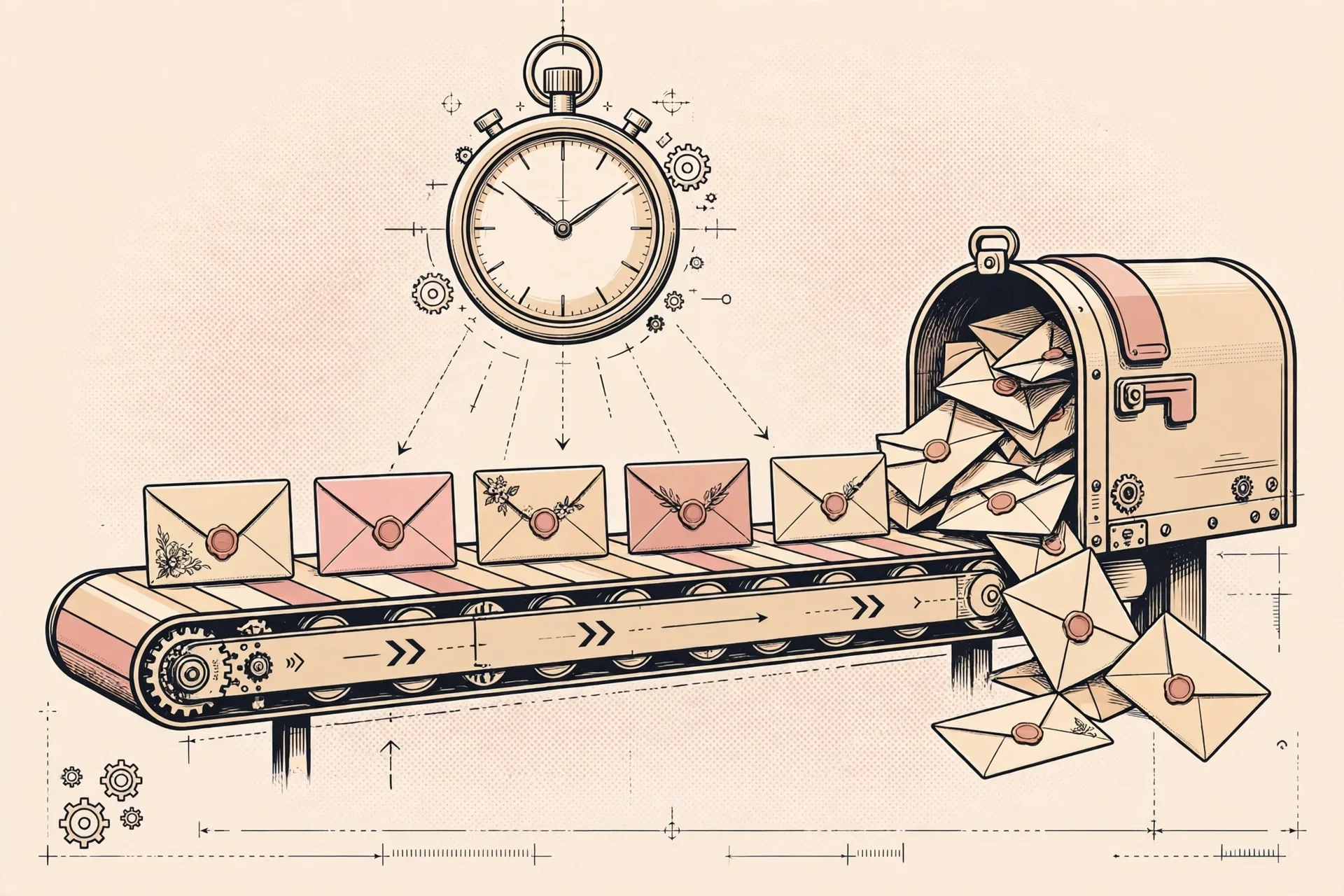
The vendors, for their part, are not sitting around waiting. Former employees and vendor consultants have described the economics plainly: wedding platforms charge vendors for advertising and leads, vendors are locked into contracts, and a slow or missing response to an inquiry is lost money. So the response machinery is industrial. One vendor-side walkthrough of the first hour after a Thursday-evening inquiry blast lays out the typical sequence: the couple submits at 8:00 PM, the first automated personalized reply lands at 8:03, a receptionist calls at 8:07, a generic "we'll be in touch within 24 hours" arrives at 8:45 — and by Friday morning the couple has already mentally shortlisted the two fastest responders while four more thoughtful, slower replies are still in flight.
Read that again and notice who the follow-up machine serves. The speed is not for you. It is the vendor protecting a paid lead.
The Follow-Up Machine Runs on Paid Leads
The wedding industry has published its own numbers on this, and they are worth reading as the other side's playbook — because when you know what the follow-up cadence is designed to do, you can decide what address it gets to do it to.
The marketplace's vendor-education arm publishes lead-conversion guidance openly: roughly one in two couples expect to hear back from a vendor within 24 hours or less, and couples are nearly 40% more likely to respond when vendors use a consistent follow-up cadence. That second number is the important one. "Consistent follow-up cadence" is the industry's polite term for the drip: the check-in at day three, the "just wanted to bump this" at day seven, the seasonal promo at day thirty, the "we still have your date open" at day ninety. It works — the 40% figure is the proof — which is why every vendor does it, which is why your inbox fills.
Do the arithmetic on a normal wedding. You are hiring across, conservatively, eight categories: venue, photographer, videographer, florist, caterer, music, planner or coordinator, cake. You inquire with four vendors per category — the platform's own average — and the platform's recommendation engine multiplies several of those into boilerplate blasts to vendors you never picked. Even before the cold outreach from adjacent businesses begins, you are looking at thirty to fifty vendor relationships, each running its own follow-up cadence, across a planning window of nine to eighteen months. Then the wedding ends, and the cadences keep running: the "anniversary session" emails, the vendor review requests, the referrals-for-friends pitches. Some of these threads will outlive the marriage's first year.
None of this is a scam. It is a paid-lead marketplace working as designed, and the design assumes your email address is a durable, permanent, always-monitored channel. That assumption is the thing you get to break.
My opinion, stated plainly: the wedding industry's follow-up machine is the most aggressive legitimate email operation most people will ever personally trigger — more sustained than job boards, more personalized than retail drip campaigns, and longer-lived than either. It deserves a proportionate defense.
The Nine-Month Inbox Burial
Let me make the timeline concrete, because "a lot of emails" does not convey what actually happens to a real inbox.
Month one is the inquiry storm: dozens of threads, many legitimate and useful — this is when you are actually choosing vendors, and you want the replies. Months two through four are the drip: the vendors you didn't pick keep checking in, the platforms send "still planning?" nudges, and adjacent categories start arriving (you inquired about photographers; now videographers, photo-booth companies, and album designers have your address). Months five through eight are the long tail: seasonal promotions, "your date is still available" revivals from vendors you ghosted in month one, and the review-request machinery spinning up for vendors you did book. After the wedding: anniversary-marketing, referral asks, and the slow decay into generic list mail as your address gets folded into broader marketing databases.
There is a second-order effect nobody warns you about. Your wedding email address becomes, for about a year, your highest-value marketing identity. You are demonstrably spending tens of thousands of dollars, on a deadline, in a specific city. Every data broker and list buyer in the wedding-adjacent economy — honeymoon travel, home goods, baby products, financial services — wants exactly this profile. The address you used for vendor inquiries will be the one that receives the "newlywed" targeting wave. I have watched friends still getting wedding-adjacent mail two years later, long after they stopped caring about chair sashes.
The unsubscribe math is grim. Each vendor thread has its own unsubscribe link, its own list, its own platform. There is no master switch. You can spend an evening unsubscribing and still wake up to the ones that don't honor it promptly, the ones whose "unsubscribe" just changes your preferences, and the ones that sold the address onward before you opted out. The only clean exit is an address that stops existing.
Which brings us to the actual question: where does a disposable address fit in a process that lasts a year?
Where the Burner Earns Its Place: The Inquiry Blast
The first phase of wedding planning — the inquiry blast — is temp mail's home turf, and it is not close.
Think about what the inquiry email actually needs to do. You are price-fishing and availability-checking across multiple vendors you will mostly reject. The email's job is to carry your date, your guest count, and your budget to a vendor and carry their quote back to you. That job is measured in days. Once you have picked your photographer, the other six photographers' threads have exactly zero future value to you — but they retain full future value to the photographers, who will keep emailing them for months.
This is the same evaluation-without-the-aftermath logic we described for free trials: the service gets its genuine inquiry, you get the quote, and the follow-up marketing dies with the address instead of living in your inbox for a year. Use a disposable address for the blast across every category. When a vendor makes the shortlist — the two or three finalists you are actually choosing between — move the conversation to a real address. The burner did its job: it absorbed the other thirty threads.
Two practical notes from watching people do this wrong. First, use a reusable temp inbox with a recovery key for the blast, not a ten-minute one — vendor quotes arrive over days, and a dead inbox mid-negotiation means re-sending inquiries. Second, never put anything identifying beyond what the inquiry needs: the vendor needs your date and guest count, not your home address and phone number. The inquiry form will ask for both. It does not need both to quote you. And if a vendor's form rejects your temp address outright, that is the detection arms race at work — we mapped how the five-layer bouncer decides which domains survive signup forms.
There is one more scenario where the burner is quietly perfect: the platform account itself. The marketplace wants you to create an account to message vendors, save favorites, and build checklists. That account exists to keep you in the ecosystem — and in the email program — long after the wedding. A disposable address on the platform account, with your real address reserved for the vendors you actually book, splits the relationship exactly where it should split.
The Booking Line You Don't Cross
Here is where I stop recommending temp mail, firmly, because the failure mode is not spam — it is a ruined wedding day.
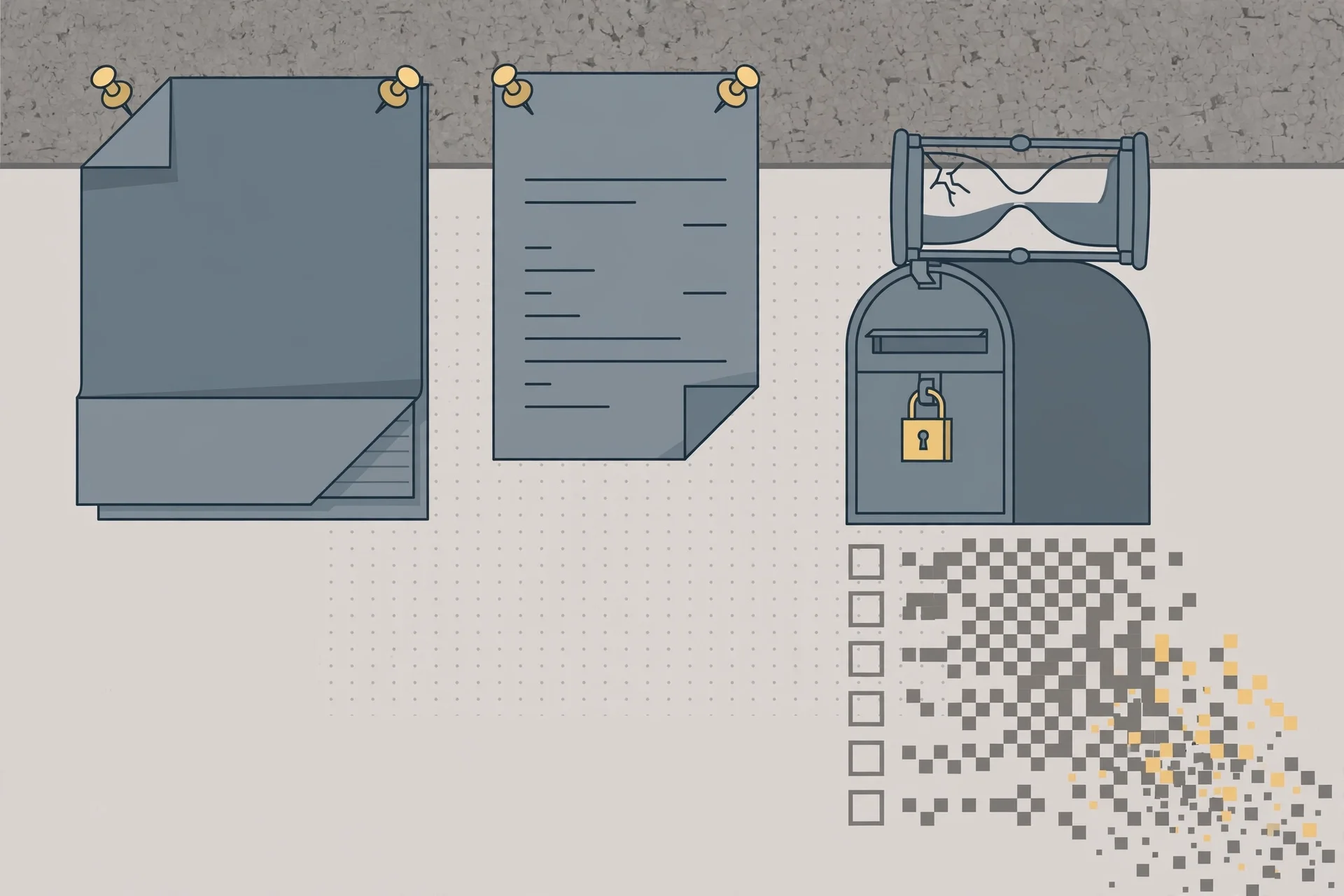
The moment you book a vendor, the email relationship changes completely. The address on file becomes the channel for the contract, the deposit invoice, the payment links, the portal login for the venue's client dashboard, the final timeline, the day-of contact sheet, and the "the florist needs to move your delivery window" email that arrives at 9 PM the night before. Every one of these is time-sensitive, irreplaceable, and tied to money. This is the password-reset trap wearing a boutonnière: the account — your entire wedding — outliving the address.
Consider the specific mechanics. Venue and planner client portals send login links and document updates to the email on file; lose access to the address and you lose access to the portal the week you need it most. Payment links for deposits and final balances arrive by email; a dead inbox means a missed payment, which means — in the vendor's terms — a breach of contract. The day-of timeline, the vendor contact sheet, the rain-plan decision: all email, all in the final 72 hours, all unmissable. And unlike a forgotten streaming subscription, you cannot rebook a wedding date. This is the password-reset trap wearing a boutonnière: the account — your entire wedding — outliving the address.
There is a quieter risk in the same category. Some temp inboxes are public — anyone who knows the address can open them — and wedding correspondence is full of exactly the details you would not put on a notice board: your venue, your date, your home address on the contract, partial payment information. Our breakdown of the public-inbox problem is the full version; the short version is that vendor contracts should never transit an inbox a stranger could open.
So the rule is a bright line, not a judgment call: burner for the blast, real address for the booking. The second a vendor moves from "candidate" to "contracted," migrate the thread to a permanent address — ideally an email alias on your real inbox, so the wedding mail stays filterable and separate without being disposable. Migration takes five minutes while both addresses work. After the temp address dies, it ranges from a support-ticket ordeal to impossible, and the stakes are your wedding, not a forum account.
One exception people ask about: the group planning thread — the email chain with your partner, your planner, your parents. That runs on everyone's real addresses by necessity. Keep it real, keep it in one thread, and let the burner handle only the vendor-fishing that feeds into it.
The Two-Inbox System, Start to Finish
Here is the whole playbook compressed into the order you will actually use it.
Phase 1 — Blast (months 9–12 out): Generate one reusable temp address with a saved recovery key. Use it for every marketplace account, every vendor inquiry form, every "check availability" click across all categories. This is the address that absorbs the thirty-to-fifty vendor threads. Let it.
Phase 2 — Shortlist (ongoing): When a vendor makes your final two or three in a category, move that conversation to an email alias on your real inbox — one alias for the whole wedding, so every booking thread is filterable in one place. Tell the vendor explicitly: "please use this address going forward." Vendors are used to couples switching emails; it happens constantly.
Phase 3 — Booked (contracts signed): The alias is now the address of record for contracts, deposits, portals, and timelines. It is permanent, monitored, and backed up. The temp address keeps receiving the drip from the vendors you didn't pick. Ignore it with a clear conscience.
Phase 4 — After the wedding: Let the temp address expire. The follow-up cadences, the anniversary marketing, the referral asks — they all die with it. Keep the alias for a few months for the photo-delivery and album-design threads, then retire it or keep it as your household's vendor address. Either way, your primary inbox never saw any of it.
The total cost of this system is about twenty minutes of setup and one habit: never type your real address into an inquiry form. The total savings are a year of inbox burial and the certainty that nothing time-sensitive ever went to an address that no longer exists.
Wedding planning will still be stressful. Your inbox does not have to be.
Frequently Asked Questions
Can I use a temp email for wedding vendor inquiries?
Yes — the inquiry phase is one of the best uses of a disposable address. You are contacting many vendors you will not book, and each inquiry enrolls you in months of follow-up marketing. Use a reusable temp inbox with a recovery key so quotes arriving over several days still reach you.
Should I use temp mail for the vendors I actually book?
No. Once a vendor is contracted, the email on file carries your contract, deposit invoices, payment links, portal logins, and day-of coordination. Use a permanent address — ideally an email alias on your real inbox — from the moment of booking. This is the same account-outliving-the-address failure we documented in the password reset trap, except the stakes are your wedding day.
Do wedding websites sell my email address?
The marketplaces' business model is selling vendor access to couples, and inquiry data flows through that model by design — including, in documented cases, your inquiry being forwarded as boilerplate to vendors you never selected. Whether you call that "selling" or "lead distribution," the practical result for your inbox is identical. Assume any address you type into a wedding platform will be widely shared.
How long will vendors keep emailing me after the wedding?
In our experience, the active follow-up runs through the planning window (nine to eighteen months), and the marketing tail — anniversary sessions, referral asks, list mail — can persist for a year or more after the wedding. There is no master unsubscribe; each vendor and platform has its own list. Letting a disposable inquiry address expire is the only clean exit.
Is it unprofessional to contact wedding vendors from a disposable address?
For initial inquiries, no — vendors care about your date, guest count, and budget, not your email domain. Switch to a permanent address when a vendor makes your shortlist, well before contracts. By the booking stage, professionalism matters and the address should be stable.
What is the single biggest email mistake couples make during wedding planning?
Using one real address for everything: the inquiry blast and the bookings together. The blast buries the inbox, and the burial means time-sensitive booking emails — payment links, timeline changes, portal logins — drown in vendor drip. Split the relationship: burner for the blast, permanent alias for the bookings.