
Temp Email for Manus Signup: the Code Lands in Seconds — Then Manus Asks for Your Phone
The short answer has a second sentence
Yes, a temporary email works for Manus signup. The verification code lands in seconds, you paste in six digits, and the account opens. That is the true short answer, and it is also a trap, because it stops one screen too early. Manus does not only ask for an email. If you register directly with an email address, the next screen asks for a phone number — and a disposable inbox cannot provide one.
That is the whole story in two sentences: the email door works, and the phone door behind it is the one that decides whether the account is yours to keep. Every other AI tool in this series had its gate at the inbox. DeepSeek runs an allowlist that refuses disposable domains before any code is sent. Kimi publishes no blocklist at all, so the email sails through and the real question is which Kimi you signed up for. Grok's account is owned by the X login it is tied to, so the inbox is never just an inbox in this series. Manus is the first one where the email is the easy part and the phone is the argument. The rest of this post walks the actual flow screen by screen, explains why the phone step exists, prices what the free account buys, and tells you the three ways to play it — including the one route that skips the phone step entirely.
The signup flow, exactly as it runs
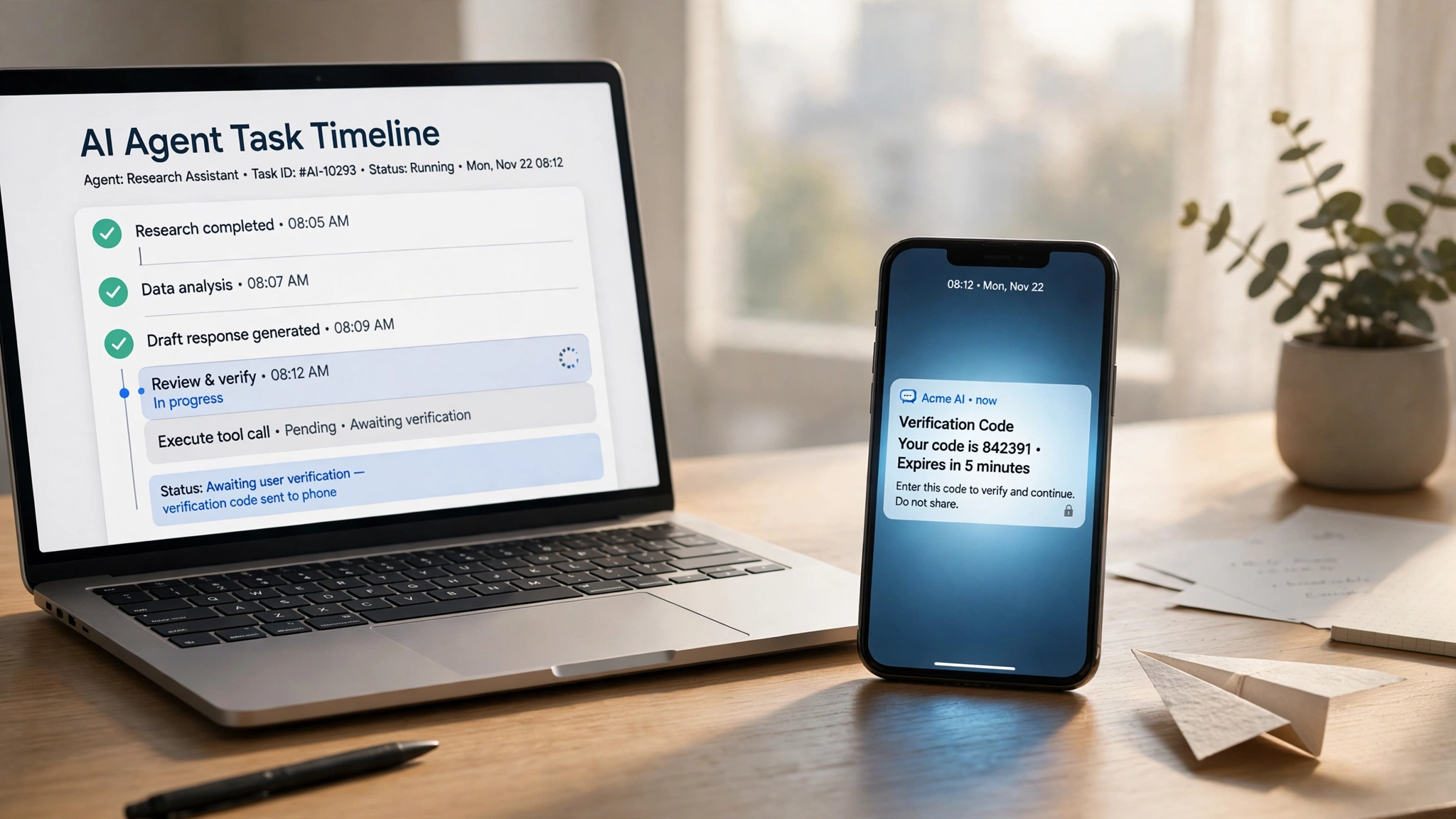
Manus lives at manus.im, and the sign-in page is manus.im/login. The form offers email, Google, Apple, Microsoft, Facebook where supported, and a passkey where offered. Pick email. You type the address, pass a Cloudflare check, set a password, and Manus sends a six-digit code from the Manus Team to that inbox.
That much is confirmed not by a help page but by people filming their own screens. In August 2026, two separate screen recordings walked the whole flow on a phone: a temporary address pasted into the Manus signup form, the Cloudflare check, a password set, then a switch to a Temp Mail app where the Manus email was already sitting in the inbox, the six-digit code copied, pasted back into the browser, and accepted. The email leg took seconds. No blocklist stopped the domain, no warning appeared, no second identity check fired at that stage. As far as the inbox is concerned, Manus treats a disposable address like any other address.
Then the flow kept going, and this is the part the recordings are actually useful for. After the code was accepted, the browser moved to a phone verification screen at manus.im/verify-phc. The person in the recording picked a country code and typed in a disposable number from a public pool to receive the SMS. That is where the honest version of this story begins, because a temp email gets you through the first door and leaves you standing in front of a second one that wants something a temp inbox does not have.
The phone gate is policy, not a glitch
It is tempting to read the phone screen as a bug, a regional quirk, or a temporary anti-abuse measure. It is none of those. Manus's own help center draws the line plainly: direct email registration requires phone-number verification, while signing in with Google, Apple, or Microsoft does not. Facebook sign-in is available only in selected countries. The distinction is deliberate — an email address you control for ten minutes proves you can receive a message, and Manus wants a second anchor for an account that is about to be handed real work.
The phone side has its own reputation problem. Guides that track Manus OTP failures report that the platform usually flags free temporary SMS numbers and fails verification on them, and that a wrong-OTP message is often a catch-all for an expired code, a formatting mismatch, or a number the system has marked high-risk. Codes expire in five to ten minutes, and requesting a new one invalidates the old one instantly. A public-pool number is therefore the worst of both worlds: it is likely already registered to someone else's Manus account, and if it is not, the system may reject it as high-risk anyway.
So the practical shape of the gate is this. A disposable domain is not the problem — no published blocklist exists for Manus, and the code demonstrably arrives. The problem is that the email path and the phone path are chained together, and the chain is only as disposable as its least disposable link. If you want a Manus account with no phone attached at all, the email form is the wrong door. The social sign-in route is the one that skips the phone step, and that fact changes the whole calculation, which is why it gets its own section later.
What 300 credits a day actually buys
Manus sells credits, not seats, and the free tier is thinner than the marketing suggests once you read the limits rather than the headline. Here is the pricing as read from manus.im/pricing by independent trackers in late October and early November 2026:
| Plan | Price | Credits | Limits |
|---|---|---|---|
| Free | $0 | 300 refresh credits a day | 1 concurrent task, 2 scheduled automations, Manus 2.0 Lite only |
| Pro | $20/month ($17 yearly) | 4,000 a month + 300 a day | 20 concurrent tasks, 20 scheduled automations |
| Pro | $40/month ($34 yearly) | 8,000 a month + 300 a day | Same task limits, 7-day free trial |
| Pro | $200/month ($167 yearly) | 40,000 a month + 300 a day | Same task limits, Wide Research |
| Team | $20/seat/month | 4,000 pooled credits per seat | Admin dashboard, audit logs |
Three details matter more than the prices. First, the free daily credits are capped at 1,500 a month, so the 300-a-day headline is really a 1,500-a-month ceiling that you hit after five full days of use. Second, monthly credits do not roll over, and Manus publishes no fixed credit cost per task — the price of a job depends on its complexity, and a heavy task can eat a day's allowance in one run. Third, new accounts get a one-time signup bonus on top of the daily credits, but published figures for that bonus range from 200 to 1,500 depending on when the guide was written, so treat the bonus as a moving target and the 300 daily credits as the durable number.
Stack that against the series. Lovable gives you five build credits a day that vanish at midnight. Gamma gives you 400 credits once, and then the meter is empty forever. Manus sits between them: a real daily allowance, but a small one, gated to the Lite model, and capped monthly. It is enough to test whether an agent fits your work. It is not enough to run your work on.
The invite-code market is selling you nothing
If you search for Manus access today, you will still find people selling invitation codes. Do not buy one. Manus opened public registration on May 13, 2025, a little over two months after its invite-only launch on March 6, 2025. Anyone can sign up directly at manus.im with an email or a Google account, with no code and no waiting queue. Guides that still describe a request form and an approval email are describing the closed launch window, not the product as it exists now.
Invitation codes still exist, but their job changed. Sharing your link now earns both sides bonus credits when a friend signs up — and Manus's own redemption terms limit that to accounts registered within the last three months, one redemption per month. An old saved code may simply no longer apply, and a code sold by a stranger is worth exactly what the public signup page already gives you for free: nothing extra. Treat any offer to sell you access as a scam, and check the address bar before you type anything: the official site is manus.im, and lookalike domains like manusai.io and manus-ai.com are not it. That warning matters more than usual here, because the next section explains what a Manus account actually holds.
What the inbox owns once you are in

Manus is not a chatbot, and that distinction is why the email question matters more here than it did for Kimi or Grok. A chatbot keeps a conversation history. Manus keeps a workspace: research reports it wrote, slide decks it built, websites and apps it deployed, spreadsheets it filled, and scheduled automations that run whether you are watching or not. Manus 2.0, released September 28, 2026, added event-triggered automations that watch your email, calendar, Slack, and Notion, plus Cloud Computers that stay on for always-on projects. All of that is tied to the account, and the account is recovered — or not — through the inbox you signed up with.
Lose the inbox and you lose more than a login. Password resets go there. Billing notices go there. Referral credits land there. The automations that email you their results have nowhere to send them if the address is dead. A temp inbox that expires in ten minutes is fine for an account you will abandon; it is a bad foundation for a workspace that accumulates work every day you use it. That is the honest trade, and it is the reason the recommendation at the end of this post splits by how seriously you plan to use the tool.
There is a numbers argument for choosing the domain carefully, too. A November 2026 census of disposable domains tracked 228,253 of them, and found only 37.31 percent could still receive mail — and 2.32 percent of live domains were dead within 30 days of first being seen. A temp domain is not a permanent address with a timer; it is a lottery ticket that is already losing. If the account matters, the inbox behind it should be one you can still open next month.
My Computer, and the permission question
Manus 2.0 also shipped a desktop app with a feature called My Computer, launched March 16, 2026, and it is the part of the product that should make you pause before signing up with an address you cannot recover. My Computer lets the agent control your actual computer from your phone — open apps, move files, run tasks on your machine instead of in its cloud workspace. It is the headline feature of the Manus desktop app, and the company built a permission system around it for exactly that reason: Manus asks before it runs a task, and only actions you mark as trusted run automatically.
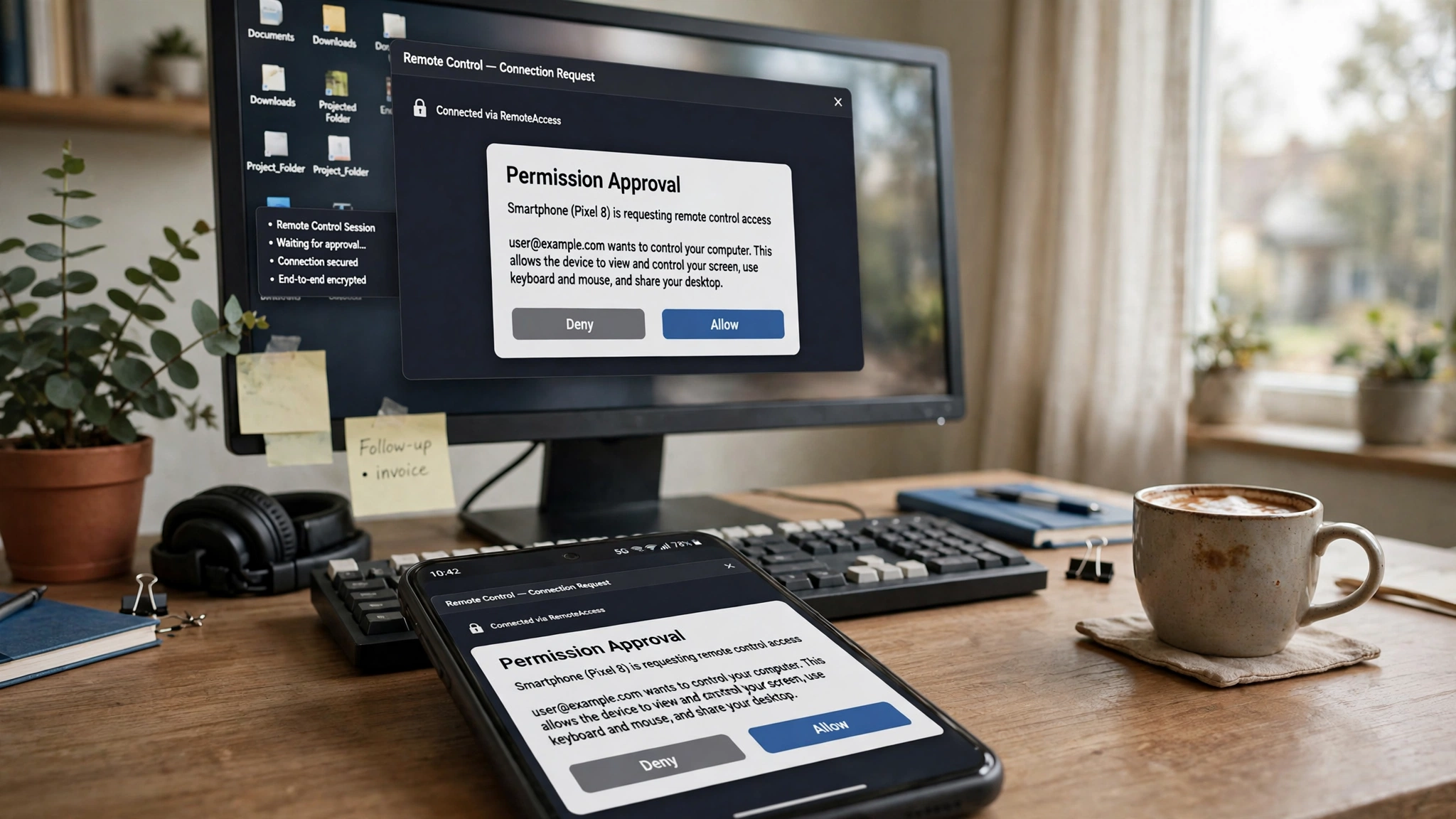
The design is sound and the reviews say the permission system is the strongest decision in the product. The risk is not the feature; it is the account holding it. Reviewers also report that the CAPTCHA step has broken for some users and locked them out of paid accounts, with no quick recovery path. An account that can drive your computer, billed to a card, authenticated through an inbox that expired in ten minutes, is an account you cannot get back into when something goes wrong. If you plan to install the desktop app and turn My Computer on, sign up with an email you control. That is not a policy argument. It is a practical one: the recovery path for a machine-control account should not be a dead inbox.
The company behind the account changed twice in a year
There is one more reason the inbox choice matters, and it has nothing to do with signup forms. Manus has changed owners — or nearly changed owners — twice in twelve months. The company launched in March 2025, moved its base from China to Singapore in mid-2025, and in December 2025 Meta agreed to buy it. Chinese regulators blocked that deal in April 2026, and Manus returned to independent operation under its founding team on September 1, 2026. A month later it raised more than $500 million at a reported $4 billion valuation, led by Boyu Capital with Tencent participating.
None of that makes Manus unreliable. The product kept shipping through all of it — Manus 2.0 landed September 28, 2026, right in the middle of the independence transition — and the funding round suggests the company is capitalized, not struggling. But an account is a bet on a company's future, and this company's future has been negotiated in public twice in a year. If you build automations and a file library inside Manus, you are trusting that the next twelve months look like the last two, not the twelve before them. A recoverable email is the cheapest insurance against that bet going sideways, because it is the one thing that stays yours no matter who owns the company.
Three ways to play it
There is no single right answer, because the right inbox depends on what you want the account for. These are the three honest options, in order of how much you trust the account to matter.
First, the no-phone route: sign up with Google, Apple, or Microsoft instead of email. Manus's own rules say phone verification is not required for those logins. The catch is that your Google or Apple account becomes the identity, so you have traded a disposable email for a permanent one — just not your own inbox. This is the best option for a quick test drive with no phone and no cost, and it is the only route that genuinely keeps your number out of it.
Second, the split route: temp email plus your real phone number. The code lands in the disposable inbox in seconds, the phone step takes your actual number, and the account opens. You keep your real inbox out of Manus's marketing and breach surface, and you keep a working recovery path through the number. This is the best option if you want to test the agent seriously — including the free daily credits — without handing over your primary email.
Third, the keeper route: a real email you control, ideally an alias you can disable per service. Use this the moment you pay for Pro, turn on My Computer, or build automations you would miss. The $20-a-month plan is cheap; losing a workspace full of client research because the inbox expired is not.
When a temp email is the wrong call
A temp email is the wrong call the moment the account holds anything you cannot recreate. Paying for a plan is the obvious line — billing notices, receipts, and refund requests all go to the signup inbox, and a support ticket from a dead address is a support ticket nobody can answer. My Computer is the second line: an agent with access to your real machine should be attached to an account you can recover. Scheduled automations are the third: an automation that emails you its results needs an inbox that still exists when the results arrive. And anything involving client work, connected Slack or Notion accounts, or files only Manus holds is the fourth — if the agent is the only copy, the inbox is the only key.
None of this means the temp email failed. It did exactly what it was built to do: it proved the email door opens. It just cannot prove the phone door, hold the workspace, or answer a password reset. Use it to look around. Use something permanent to stay.
FAQ
Does Manus accept a temp email for signup?
Yes. The email verification code lands in a disposable inbox in seconds — screen recordings from August 2026 show the full flow working with a temporary address, with no blocklist stopping the domain. Manus publishes no disposable-domain blocklist. The catch is the next screen, not the email: direct email registration then requires phone verification.
Why does Manus ask for a phone number after the email code?
Because Manus's help center requires phone verification for direct email registration, while Google, Apple, and Microsoft sign-in do not need it. The email proves you can receive a message right now; the phone is the second anchor for an account that will hold your files, automations, and connected services. It is policy, not a bug or a regional quirk.
Can I sign up for Manus without a phone number?
Yes, by signing in with Google, Apple, or Microsoft instead of email — Manus says phone verification is not required for those routes. Facebook sign-in is available only in selected countries. Free temporary SMS numbers from public pools usually fail verification or are already registered to someone else, so they are not a reliable substitute.
Do I still need a Manus invite code?
No. Manus opened public registration on May 13, 2025. Invitation codes now only earn referral bonus credits, limited to accounts registered within the last three months and one redemption per month. Anyone selling you a code is selling you something the signup page gives away for free.
What happens to my Manus account if my temp email expires?
You lose the recovery path: password resets, billing notices, and referral credits all go to the signup inbox. The workspace itself — files, automations, connected accounts — stays attached to the account, but you may not be able to get back into it. A November 2026 census found only 37.31 percent of tracked disposable domains could still receive mail, so treat any temp domain as short-lived by design.
How many free credits does Manus give?
The free plan refreshes 300 credits a day, capped at 1,500 a month, usable only with Manus 2.0 Lite, with one concurrent task and two scheduled automations. New accounts also get a one-time signup bonus, but published figures range from 200 to 1,500 depending on when the guide was written. Paid plans start at $20 a month for 4,000 credits, then $40 for 8,000 and $200 for 40,000, with 300 daily credits on top of each.
Is it safe to let Manus control my computer?
My Computer asks before it runs a task, and only actions you mark as trusted run automatically — reviewers call the permission system the strongest part of the product. The risk is account recovery, not the feature: some users report CAPTCHA failures locking them out of paid accounts. If you turn it on, use a recoverable email, keep your login details and receipts, and connect only the folders and accounts a task needs.
Need a disposable temporary email?
Protect your real inbox from spam and promotional clutter instantly and free.
Received a suspicious email, text, or charge alert?
Verify whether the sender domain is disposable, spoofed, or unverified before clicking links.