
Temp Email for DeepSeek Signup: the Allowlist Says No Before You Even Type
The door that only opens for four names
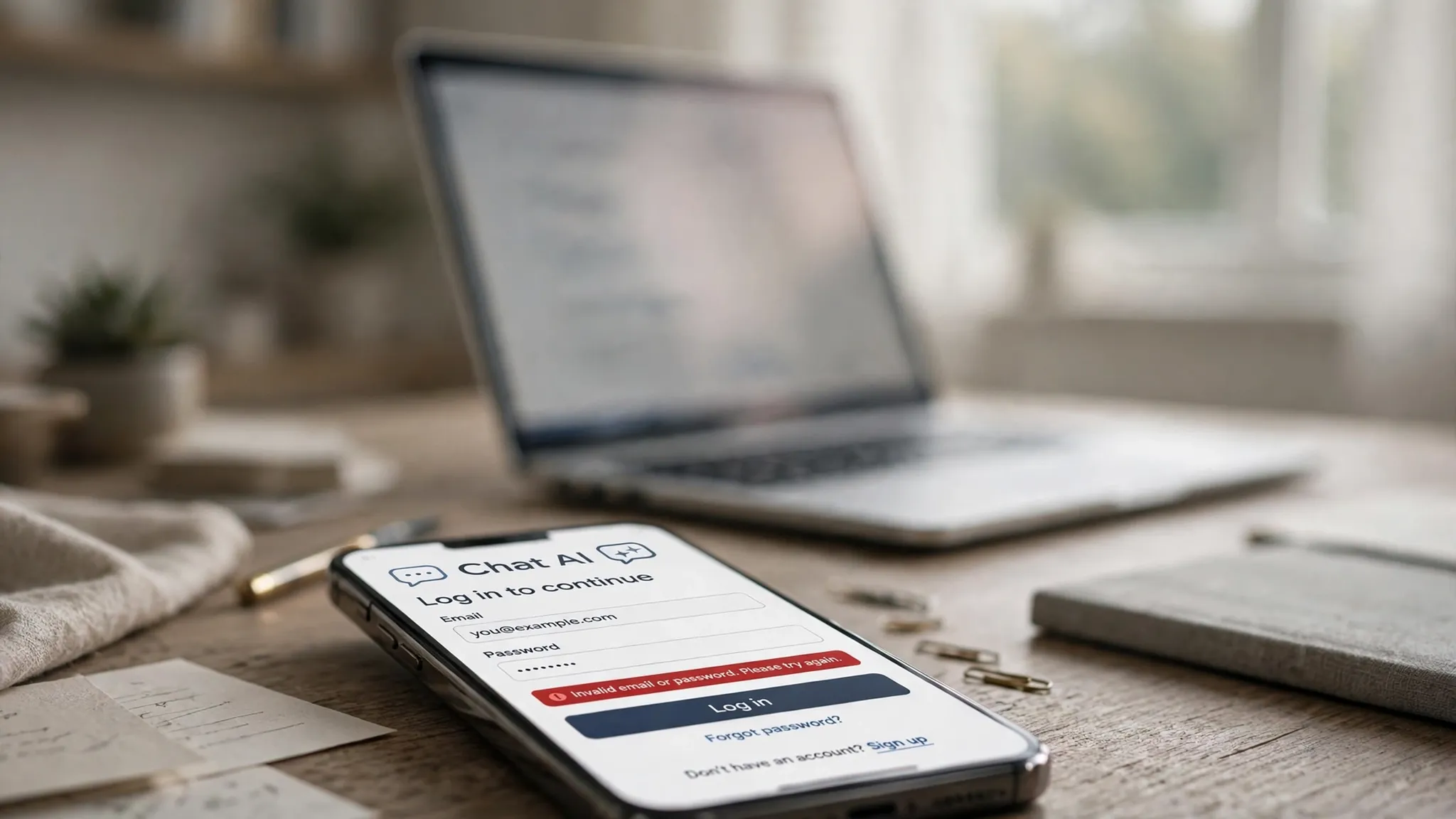
Most sites that refuse a disposable email do it the same way: they keep a list of throwaway domains and turn those away at the door. DeepSeek does the opposite. It keeps a list of the domains it *will* accept, and everything else — your temp inbox, your custom domain, your small privacy-focused provider — gets the same short refusal. That inversion is the whole story of this post, and it is why the usual temp-mail playbook fails here before it even starts.
The short version: a temporary email address almost certainly will not get you a DeepSeek account. Not because the inbox is broken, not because the code is slow, and not because you picked the wrong temp-mail service. Because DeepSeek's signup form checks the domain against its own support list first, and a disposable domain is not on it. The rest of this post is the evidence for that claim, the exact error you will see, the four doors that actually open, and the lock-in that makes the email you choose matter more here than on almost any other AI tool we have covered.
"Your email domain is currently not supported"
That is the sentence DeepSeek shows when your domain is not on its list, and it is worth quoting exactly because it is unusually honest. It does not say the address is invalid. It does not say the code failed. It says the *domain* is not supported — a policy decision, stated as a fact, before any code is sent. DeepSeek's own FAQ gives the same answer and the same remedy: register with a major provider such as Gmail, Outlook, Hotmail or Yahoo, or email service@deepseek.com.
Read that list again. Gmail, Outlook, Hotmail, Yahoo. Four names, all of them twenty-plus-year-old mainstream providers. The FAQ does not say "any real email provider." It names the four. And the allowlist logic behind it is harsher than a blocklist in one specific way: a blocklist only punishes addresses that look disposable, while an allowlist punishes everything it has not pre-approved. A custom domain you own and pay for can be turned away. A privacy-first mailbox from a small European provider can be turned away. The temp inbox never had a chance, but neither did a lot of perfectly legitimate addresses.
Two independent temp-mail guides that re-checked DeepSeek in October 2026 reached the same conclusion, and both stress the same point: a working inbox does not override the domain check. One puts it bluntly — even a custom domain you own can be refused. The other notes that DeepSeek's FAQ documents the error as official policy, not a bug. There is a competing claim floating around from a third site, published in May 2026, that DeepSeek "generally accepts temporary email addresses" and "rarely runs a disposable-domain blocklist." That claim is technically true about blocklists and completely wrong about the outcome, because DeepSeek does not run a blocklist at all. It runs the opposite. The May post is describing the wrong mechanism, and anyone who follows it will meet the error message above.
The four ways in, ranked honestly
DeepSeek's chat service at chat.deepseek.com does not offer a guest mode. As of November 2026, every user has to verify an account — by email, Google sign-in, or a mainland China phone number — before sending a first prompt. There is no anonymous trial, no "continue without an account" link, no back door through the API docs. That matters because it removes the easiest workaround: you cannot simply skip the account step and use the model.
Here are the doors that exist, in the order I would actually recommend them to a US user. The contrast with other AI tools is sharp: Perplexity lets you search with no account at all before it asks you to sign up, and Gemini's signup takes a disposable inbox without complaint. DeepSeek is the strict one in the group.

1. An email address on a supported provider. This is the intended path. You enter the address, DeepSeek sends a six-digit-style verification code, you type it in, the account opens. A password can be set, and reset later through Forgot Password. If you want the account kept apart from your main inbox, the realistic move is an alias on a mainstream provider — a Gmail plus-address or an Outlook alias — rather than a disposable domain. An alias is still Gmail or Outlook as far as DeepSeek's list is concerned, so it passes the domain check, and it still keeps DeepSeek's mail out of your primary inbox. What an alias does *not* do is hide your identity from DeepSeek; the account is still tied to the same Google or Microsoft identity. Treat it as inbox hygiene, not anonymity.
2. Sign in with Google. One click, no code to wait for, and it sidesteps the domain question entirely because Google is the identity. The catch, documented by DeepSeek itself, is geographic: Google login does not work from mainland China IP addresses. For a US user that is irrelevant, which makes this the fastest reliable door. The trade is the obvious one — you are handing Google's identity graph to a second company — but if you already use Google to sign into half the internet, this is not a new kind of exposure.
3. Sign in with Apple, on iOS. The same logic as Google, inside Apple's sign-in system. It works, it is quick, and Apple's Hide My Email relay is the one mechanism here that actually delivers real separation: the address DeepSeek sees is an Apple relay address, and Apple forwards the mail. The catch is that the relay address is still a permanent, recoverable address — the opposite of disposable — which is exactly what DeepSeek wants from you.
4. A phone number with a text code. DeepSeek accepts phone registration, and for users in mainland China the phone route is the default (WeChat login, by contrast, only works from mainland China IPs). For a US user, a phone number works but it is the worst privacy trade of the four: the account is then tied to a number that identifies you far more precisely than any email address, and the number is the recovery path. Phone-first signups have the same shape elsewhere — Signal's signup and WhatsApp's both run on the number, not the inbox — but on those apps the number *is* the product. On DeepSeek it is just a second lock you did not need. A temp SMS number is not a shortcut here either — shared and virtual numbers are routinely flagged, and DeepSeek's own help pages note that a "current device environment error" means the service has flagged the IP address or phone number as high risk.
What is *not* on this list: a temp inbox, a custom domain, a privacy mailbox, a burner number from a public pool. Every one of those fails at a different checkpoint, and the failure is the point — DeepSeek built the signup this way on purpose.
Why DeepSeek runs a guest list instead of a bouncer
The allowlist did not come out of nowhere. It came out of January 2025, the month DeepSeek went from a niche research lab to the most downloaded free app in the United States.
On January 20, 2025, DeepSeek released R1, a reasoning model it said could match the best US models at a fraction of the training cost — a reported $5.58 million. Within a week, its AI assistant app had overtaken ChatGPT at the top of Apple's US App Store free chart, and on Monday, January 27, Nvidia lost nearly $600 billion in market value in a single day as investors repriced the whole AI trade. Then, that same Monday, DeepSeek said its services were facing "large-scale malicious attacks" and that it would limit new user registrations to keep the service running for existing users. Its sign-in page carried the notice for days: "Due to large-scale malicious attacks on DeepSeek's services, registration may be busy. Please wait and try again." At one point the company restricted new signups to mainland China mobile numbers only.
That week explains the signup form you meet today. A service that was attacked the moment it became famous, that had to throttle its own front door to stay alive, does not go back to trusting every domain on the internet. An allowlist is the cheapest durable form of that lesson: four providers, all with their own abuse teams, all with phone-verified accounts behind them, all hard to spin up ten thousand at a time. It is not a judgment on temp mail specifically. It is a scar from a week when the signup form itself became the attack surface.
That history also answers the question people ask next: will the list loosen? Maybe, eventually, if the abuse pressure drops. But there is no public roadmap for it, no beta program for new providers, and no support channel that will add your domain on request. The FAQ's remedy — use a major provider or email service@deepseek.com — has been the answer since the allowlist appeared, and it has not changed through 2026.
The lock-in nobody reads
Here is the part that should decide your email choice even if you get past the domain check: the email you register with is, for practical purposes, permanent.
DeepSeek's FAQ says changing the bound email is not supported. A bound phone number can be changed in Settings, under Account settings, but the email cannot. So the address you type on day one is the address that receives your password resets, your login codes, and your account notices for the life of the account. If you somehow got in with an inbox that expires in ten minutes, you would own an account you can never recover, never reset, and never prove is yours — and the FAQ's own advice about delayed codes (check the address, check spam and filters, wait before requesting again after too many attempts) assumes an inbox that will still exist next week.

The rest of the lock-in is just as final. Deleting a DeepSeek account deletes all its chats for good — there is no grace period, no export-and-restore, no "undo" in the settings. The terms of use ban registering accounts in bulk, and users under 18 need a guardian's consent. None of this is unusual for a consumer AI service. What is unusual is how early it bites: on most tools, the lock-in shows up months later, when you need a password reset. On DeepSeek, the permanence of the email is the first decision the signup forces you to make, and it is the one the allowlist makes for you if you let it.
That is also why the temp-mail question is the wrong question for this service. A disposable inbox is a tool for accounts you plan to abandon. DeepSeek's design assumes the opposite — an account you keep, tied to an identity you can prove, with a recovery path that still works next year. The honest version of "can I use a temp email for DeepSeek" is "should I plan to throw this account away," and if the answer is yes, the honest follow-up is that DeepSeek is the wrong tool for a throwaway session anyway. Use it logged in, or use a model that allows guest access.
What your DeepSeek account actually costs you in privacy
The signup friction is only half the trade. The other half is what DeepSeek does with the account once it exists, and here the facts are printed in its own documents rather than hidden.
DeepSeek's privacy policy says personal data is collected, processed and stored in the People's Republic of China. That includes the account information you hand over at registration — email address and/or telephone number — and the inputs you send afterward: prompts, uploaded files, photos, feedback and chat history. This is not a rumor or a reading between the lines; it is the policy's own statement of where the data lives.
For a US user, that has two practical consequences. First, the data is subject to Chinese law, including the data-security and intelligence statutes that US privacy coverage of DeepSeek has spent most of 2025 writing about. Second, it means the privacy question is not "can I hide my email from DeepSeek" but "am I comfortable with this company holding my prompts and my identity under that jurisdiction." A temp inbox never answered the second question, because the inbox was never the sensitive part — the prompts were.
My judgment, for whatever it is worth: if you are using DeepSeek for throwaway brainstorming and code help, the trade is reasonable and the product is genuinely good — R1's reasoning quality at a free tier is the reason it topped the App Store in the first place. If you are pasting proprietary work, client data, or anything you would not want stored under a foreign jurisdiction's data laws, do not paste it into any hosted chatbot, DeepSeek included, and the signup email is the least of your problems. The privacy decision is about what you type after login, not what you typed to get in.
What to use instead
If you still want a DeepSeek account without handing it your primary inbox, here is the honest ranking, from most to least sensible:
A Gmail plus-address or an Outlook alias. Your address becomes something like yourname+deepseek@gmail.com, or an Outlook alias you create in settings. DeepSeek's list sees gmail.com or outlook.com and waves it through. Your main inbox stays clean because you can filter on the plus-tag or the alias, and the address is permanent and recoverable, which is what the lock-in section demands. Cost: zero. Anonymity: none. That is the trade, stated plainly.
Sign in with Apple and Hide My Email. The only option on this list that gives you a genuinely separate address DeepSeek cannot trace back to your real inbox — Apple relays the mail. It is permanent, recoverable, and it passes every check because it is an Apple address. The cost is that you need an Apple device and an iCloud account, and you are trusting Apple instead of Google. For most people, that is a better trust to place.
A second, permanent free mailbox on a major provider. A dedicated Gmail or Outlook account used only for AI tools. It takes five minutes to create, it is on the allowlist, and it keeps DeepSeek's mail in a separate bucket from your life. This is the option I would pick if I did not want Apple in the loop and did not want plus-addressing.
A temp inbox. Do not. Not because temp mail is bad — it is the right tool for most signups, and this site exists to say so — but because DeepSeek's domain list refuses it at the first step, and even in the unlikely event one slipped through, the account it created would be unrecoverable the moment the inbox expired. A tool used against its design is not a clever workaround; it is a future support ticket you cannot file.
And one more thing worth saying plainly: do not try to work around the support list by cycling through disposable domains, buying aged Gmail accounts, or renting numbers from public pools. DeepSeek's terms ban bulk registration, its systems flag high-risk IPs and numbers, and the account you build that way is the one you lose first. The allowlist is not a puzzle to solve. It is a statement about what kind of accounts DeepSeek wants, and the fastest path through it is to give it one.
FAQ
Does DeepSeek accept temp email?
No, in practice. DeepSeek checks the email domain against its own support list at registration, and disposable domains are not on it. You will see "Your email domain is currently not supported" before any code is sent. Its FAQ recommends Gmail, Outlook, Hotmail or Yahoo.
Why does DeepSeek say my email domain is not supported?
Because the domain is not on DeepSeek's allowlist of accepted providers. Unlike most sites, which block known throwaway domains, DeepSeek only permits a list of major providers — so even a custom domain you own can be refused.
Can I use DeepSeek without an account?
No. As of November 2026, chat.deepseek.com requires an account before your first prompt — verified by email, Google sign-in, Apple ID, or a mainland China phone number. There is no official guest mode.
Can I change the email on my DeepSeek account later?
No. DeepSeek's FAQ says changing the bound email is not supported. A bound phone number can be changed in Settings, under Account settings. Choose an address you will still control next year.
What should I use instead of a temp email for DeepSeek?
A Gmail plus-address (yourname+deepseek@gmail.com), an Outlook alias, Sign in with Apple and Hide My Email, or a second permanent free mailbox on a major provider. All four pass the domain check and stay recoverable.
Where is my DeepSeek data stored?
DeepSeek's privacy policy says personal data — including your email or phone number, prompts, uploaded files and chat history — is collected, processed and stored in the People's Republic of China.
Is DeepSeek free?
Yes, the chat service is free to use once you have an account. DeepSeek also runs a separate Open Platform for developers, where API access is paid and uses the same account — another reason to register with an address you can keep.
Need a disposable temporary email?
Protect your real inbox from spam and promotional clutter instantly and free.
Received a suspicious email, text, or charge alert?
Verify whether the sender domain is disposable, spoofed, or unverified before clicking links.