

Every AI tool on the internet right now is running the same play: free credits, free tier, free trial — behind a signup wall. A chatbot here, an image generator there, a video tool, a voice cloner, a coding assistant. Each one asks for an email before it hands you the goods. And each one, the moment you hand it over, starts the drip: product updates, upgrade nudges, "your credits are running low," partner offers, the works.
So the thought arrives, and it is not a dumb thought: what if I just use a burner email for all of them? Try everything, keep my real inbox clean, walk away whenever I want.
Here is the honest answer, and I will say it as someone who runs a temp mail service and wants you to use it well: a temp email works on some AI tools, dies instantly on others, and on a few it can get your account terminated with your work inside it. The difference is not random. It follows three tests, and once you know them you will never guess again.
Why AI tools are the number-one burner target right now
Let us start with why this specific combination — AI tools plus temp email — exploded the way it did.
Two things happened at once. First, the free-credit economy: dozens of AI tools hand out free generations, free tokens, or free trial days to anyone who signs up, because the signup itself is the product — it is a lead, a future paying customer, a row in a growth dashboard. Second, the tools got good fast enough that people genuinely want to try five or six of them before picking one. Nobody wants six new senders in their real inbox just to compare image generators.
The numbers back this up. The most-visited disposable email service pulls roughly 57 million visits a month (Semrush data for July 2026, via industry coverage). Email-risk firm Fidro reported in its 2026 data that about 1 in 8 signups across platforms use disposable addresses — climbing past 20% in gaming and fintech. AI tools sit right in that high-abuse zone: free value, no card required, anonymous signup, instant gratification. That is catnip for multi-account farming, and the platforms know it. Which is exactly why they fight it harder than almost anyone else.
Test one: the email-plus-OTP signup — where temp mail usually survives
The easiest signup in the world is the one that asks for an email, sends a code, and lets you in. A surprising number of smaller AI tools — niche image generators, beta-stage apps, open-source wrappers, hackathon projects — still work exactly like this. No card, no phone, no questions.
For these, a temp email does what it was born to do. You paste the address, the code lands in the temp inbox within seconds, you verify, you get your free credits. When you are done, you close the tab. The inbox expires. No drip emails follow you home, because the address that received them no longer exists.
When we checked this class of tool, the failure mode was rarely the signup form itself — it was the OTP dying on the way to the inbox. Greylisting, slow mail servers, codes with 60-second expiry windows that expire before the mail arrives. Those are delivery problems, not blocking problems, and they are fixable: fresh inbox, retry once, move on if the second code does not land.
My honest opinion: this is the single best use case for a temp email anywhere in the AI world. One-shot tools, beta toys, "generate three images and leave" — the temp inbox is perfect, because the relationship was never going to last longer than an afternoon.
Test two: the phone-number gate — where the plan dies instantly
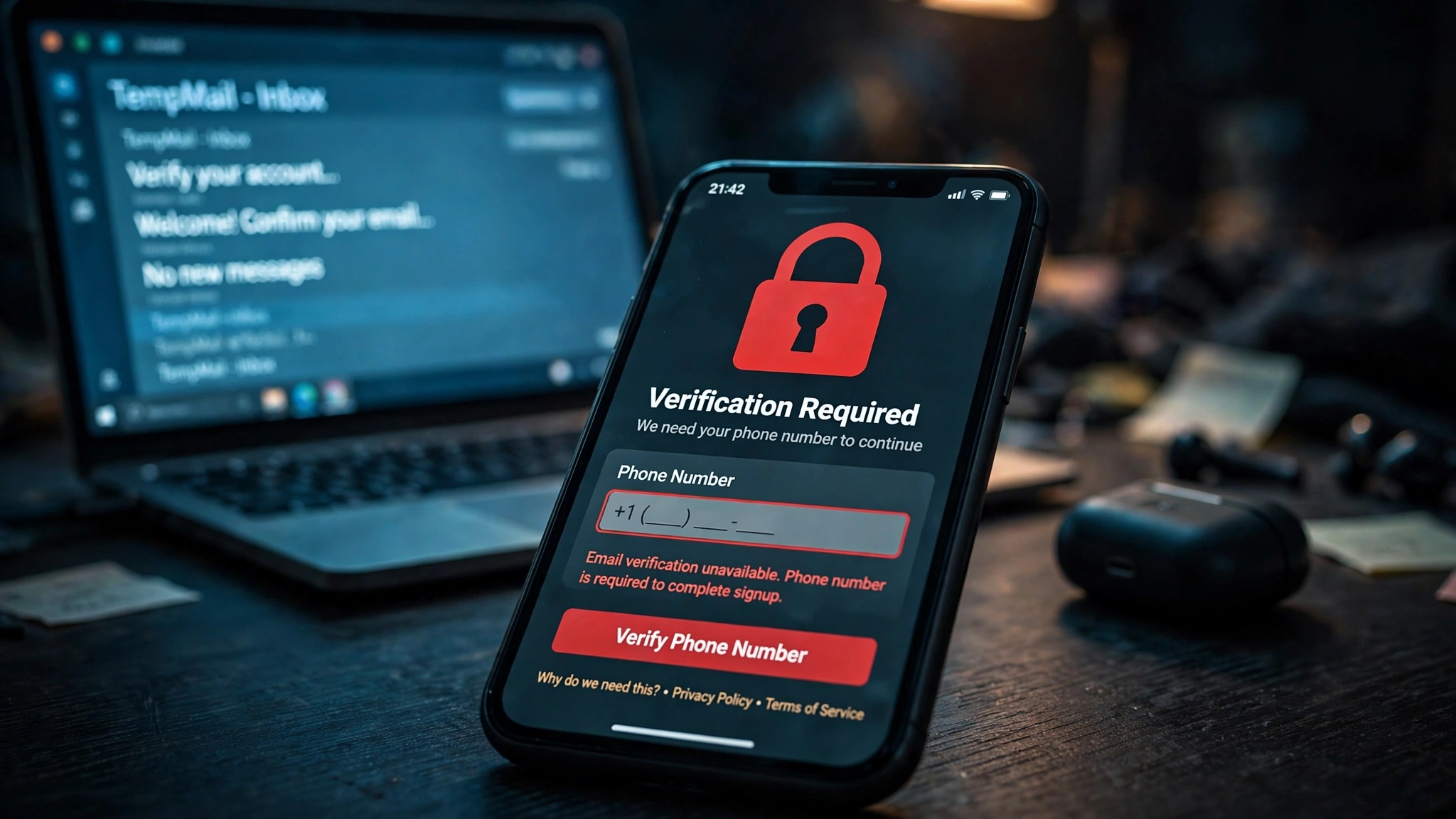
Then you hit the big ones. The frontier-model chatbots, the serious image platforms, the coding assistants with real free tiers. You paste your temp address, the code arrives, you feel clever — and then a second screen appears: verify your phone number.
This is where the burner plan dies, and it dies for a reason no email trick can fix. Phone verification exists precisely to stop what you are doing. One phone number, one account. A temp email cannot receive an SMS, and the platforms that require this step do not care how good your email game is.
When we checked the major AI platforms, the pattern was consistent: email gets you through the front door, but the phone number is the real key. Some tools ask for it at signup. Others let you in with email alone and then demand it the moment you touch anything valuable — API keys, higher limits, image generation. The gate always appears before the thing you actually wanted.
There is a workaround people try: virtual phone numbers and SMS-receiving services. I will be blunt — it is a worse plan than the temp email was. Those numbers are recycled and heavily flagged, and platforms blocklist virtual-number ranges the same way they blocklist disposable email domains. When it fails, you have burned time on a workaround for a workaround.
The takeaway is simple: if the tool asks for a phone number, the temp email was never the obstacle. Use your real email, verify the phone, and decide whether the tool is worth it on its actual merits.
Test three: the credit-card trial — where it fails by design
The third test is the "free trial" that asks for a card upfront. Plenty of AI tools do this: 7 days free, 14 days free, card required, cancel anytime. The temp email sails through the email field — and then the card field stops everything cold.
This one fails by design, not by accident. A card is identity, billing, and a charge waiting to happen, all in one. No disposable email service can conjure a valid card, and the shady ones that claim to are selling you fraud, not convenience. Virtual cards from your bank are a legitimate separate topic, but they are not a temp-email topic — the email was never the hard part of this signup.
Here is what I actually think about card-gated trials: they are the one place where the "try everything free" instinct should make you pause for a different reason. The risk is the forgotten cancellation. A temp inbox makes that worse — the "your trial ends in 3 days" warning goes to an inbox that expires in 10 minutes. If you use a temp email on a card trial, you are setting a trap for your future self.
The ban wave: what happens when a platform catches a burner
Now the part nobody talks about, and the part that actually costs people something.
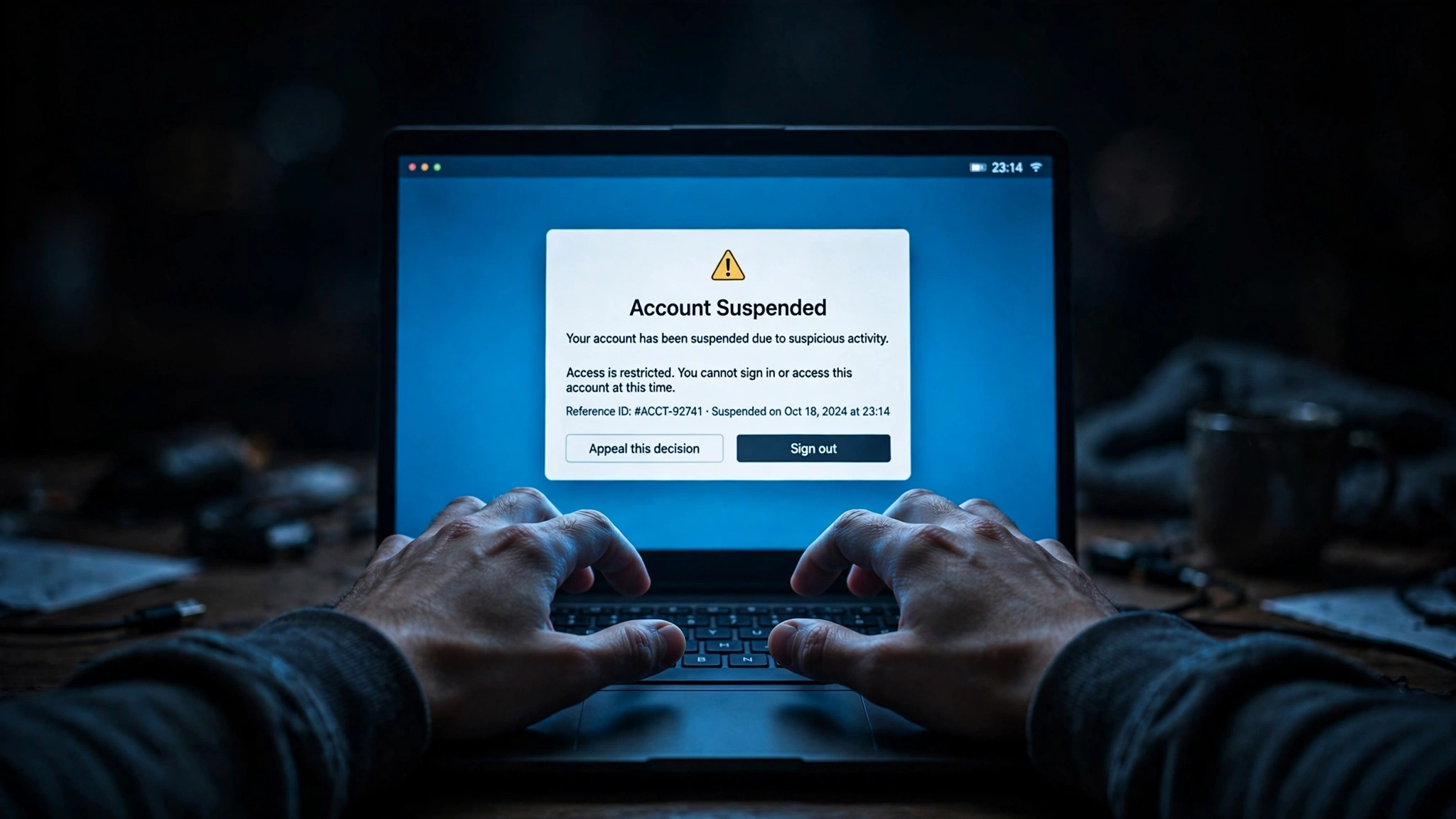
AI platforms do not just block disposable domains at signup. They also hunt them afterward. The pattern, pieced together from platform terms and user reports, goes like this: you sign up with a burner, everything works for days or weeks, you build up prompt history, saved generations, maybe an API key with credits on it — and then the account gets flagged. Sometimes it is a routine sweep against disposable domains. Sometimes the trigger is something else (unusual usage, a shared IP) and the burner domain is what turns a review into a termination.
When that happens, the consequences are asymmetrical in the worst way. You lose the prompt history, the saved work, the API key and whatever credits sat on it. And you cannot appeal, because the appeal process sends a verification link to the email on file — an inbox that no longer exists. The account is not just suspended. It is unrecoverable.
This is the same failure mode as every other temp-email trap, but the stakes are higher because AI tools are where people now store actual work. A forum login lost to an expired inbox is annoying. A month of prompts, fine-tuned settings, and generated assets, locked behind a dead address, is a real loss.
My opinion, stated plainly: never use a temp email on an AI tool where you will create anything you would miss. The free credits are not free if the price is your work.
Why the platforms fight this hard — the numbers are ugly
It is worth understanding the other side's math, because it explains why this arms race only escalates.
Fidro's 2026 data put disposable-email usage at roughly 12% of all signups — and tied disposable addresses to fraud rates above 70% on fintech platforms. Free-tier abuse is the specific nightmare: one person, fifty accounts, fifty rounds of free credits, sometimes resold. That is not a hypothetical. It is the business model of entire gray-market operations, and AI compute is expensive — every abused free tier is real GPU money burned.
The detection industry has scaled to match. Real-time disposable-domain APIs now answer "is this a burner?" in milliseconds at signup, and 2026 benchmarks show the best detectors catching effectively all known providers while the average catches about 59%. A month-old static blocklist decays to roughly 43% accuracy — which is why serious platforms use live APIs, and new temp domains get flagged within hours of appearing.
In May 2026, RiskMail.io launched a detection API built specifically around fake signups, free-trial abuse, and repeated account creation. Read that as a signal: an entire product category now exists to stop exactly the playbook this post describes. The platforms are not guessing. They are instrumented.
The three cases where a temp email is the right tool
None of that means temp email has no place in the AI world. It has three excellent ones.
One: developer testing. If you are building on an AI API or testing a signup flow, you need fresh addresses constantly. Temp inboxes are the standard tool for this — QA engineers have used them for a decade. Low stakes, high volume, nothing to lose.
Two: the side-by-side comparison. You want to try five image generators this weekend and pick one. Five temp addresses, five sets of free credits, zero inbox consequences. On Sunday night you pick a winner and sign up properly with your real email. The burners did their job: they kept the experiment clean.
Three: demos and classrooms. Showing a tool in a workshop or letting students try something without collecting their data. The temp inbox is the privacy-respecting choice — no attendee's real address ends up in a marketing database.
Notice what all three have in common: the relationship was always going to be short, nothing valuable lives in the account, and nobody needs to recover it later. That is the temp-email shape. Match the tool to the shape and it works beautifully.
The playbook: trying AI tools without getting burned
Here is the decision flow I give people, in order:
1. Sort the tools into two piles: testers and keepers. Testers get temp emails. Keepers — anything you will use weekly, anything holding your work — get your real email from the start. Decide the pile before you sign up.
2. Check for the phone gate before you invest time. If the signup asks for a phone number, stop optimizing the email. The email was never the gate. Either commit with your real address or walk away.
3. Never put a card on a temp-email account. The reminder emails about trial endings go to an inbox with a 10-minute lifespan. Set a phone reminder instead, or better, do not start card trials with addresses you cannot monitor.
4. Export anything you make. If a tester tool produces something good — a great image, a useful prompt chain, a working API snippet — save it outside the account immediately. Assume the account can vanish. Because it can.
5. Remember the inbox clock. Temp inboxes expire — some in minutes, some in days, a few in weeks. Never use one where you might need a password reset, a security alert, or a "we noticed unusual activity" email next month. If future-you might need the inbox, present-you needs a real address.
That is the whole playbook. It is not anti-temp-email — it is pro-using-it-where-it-wins.
FAQ
Can I use a temp email for ChatGPT or Claude? The big frontier platforms gate signups behind phone verification, so a temp email alone does not get you a working account — the phone number is the real barrier. Smaller AI tools with email-only signup are a different story, and that is where temp addresses work fine.
Will I get banned for using a disposable email on an AI tool? It happens. Platforms run post-signup sweeps against disposable domains, and a flagged account can be suspended with your prompts, history, and credits inside it. Appeals go to the email on file — which, for a temp inbox, no longer exists. Do not keep anything valuable in a burner-signed account.
Do AI tools actually detect temp emails? Yes, and better every year. Real-time detection APIs check domains at signup in milliseconds, and 2026 benchmarks show the best catching effectively all known providers. New temp domains get flagged within hours. Assume the platform knows.
Is it illegal to use a temp email to get free AI credits twice? Using a temp email is not illegal by itself, but deliberately evading a platform's one-per-person limit can violate its terms of service — which is a contract issue, not a criminal one, until fraud enters the picture. The full breakdown of where the line sits is here.
What is the safest way to try a new AI tool? Temp email for the first look, real email the moment you decide to keep it. Export anything you create, never attach a card to a burner account, and check whether the signup needs a phone number before you waste time optimizing the email field.
Can a temp email receive the verification code from an AI tool? Usually yes, if the tool only needs email verification. When codes do not arrive, it is almost always a delivery-timing problem (greylisting, short code expiry), not a block. Fresh inbox, one retry, then move on.
The verdict
A temp email is a great scout and a terrible settler. Send it ahead to test the terrain — the small tools, the beta toys, the weekend comparison shootout. But when you find the AI tool you will actually use, sign up like a grown-up: real email, verified phone, work you can recover.
The free credits were never the prize. The prize is a tool you trust with your work — and trust runs both directions.