



The Tax Abatement and Relief Office Scam Is Fooling Thousands — Here's What You Need to Know
The tax abatement and relief office scam is a fraudulent scheme where criminals pose as fake government tax agencies, calling or texting taxpayers to claim they owe back taxes — or qualify for special relief programs. The goal is to steal your money, your personal data, or both.
Is that call from a "Tax Resolution Team" or "Tax Abatement Office" real?
Almost certainly not. Here's the quick answer:
- The IRS never calls you first. Its first contact is always a mailed letter.
- Fake agency names like "Tax Mediation Support Agency," "Office of Tax Abatement Mediation," and "Taxpayer Abatement Assistance Office" are not real government offices.
- If someone calls unsolicited about tax debt or relief, hang up immediately.
- The IRS will never demand payment via gift cards, wire transfers, or cryptocurrency.
- You can verify your real tax status safely at IRS.gov or by calling 1-800-829-1040.
These scams are surging in April 2026. Robocall campaigns are blasting millions of Americans with polished, professional-sounding voicemails. One consumer reported receiving 10 to 12 of these calls every single day. The calls reference real-sounding programs, use D.C. area codes, and even drop names like "Camille Rhodes" or "Taylor Carson from the tax review office."
They are designed to make your stomach drop.
Tax anxiety is universal. Scammers know that. Even people who owe nothing feel a spike of panic when a calm, official-sounding voice says their account has been "flagged for a final stage review." That fear is the weapon.
The financial and identity theft risks are serious. Victims have lost thousands of dollars in upfront fees and had their Social Security numbers harvested for ongoing fraud. Understanding how this scam works is the fastest way to protect yourself.
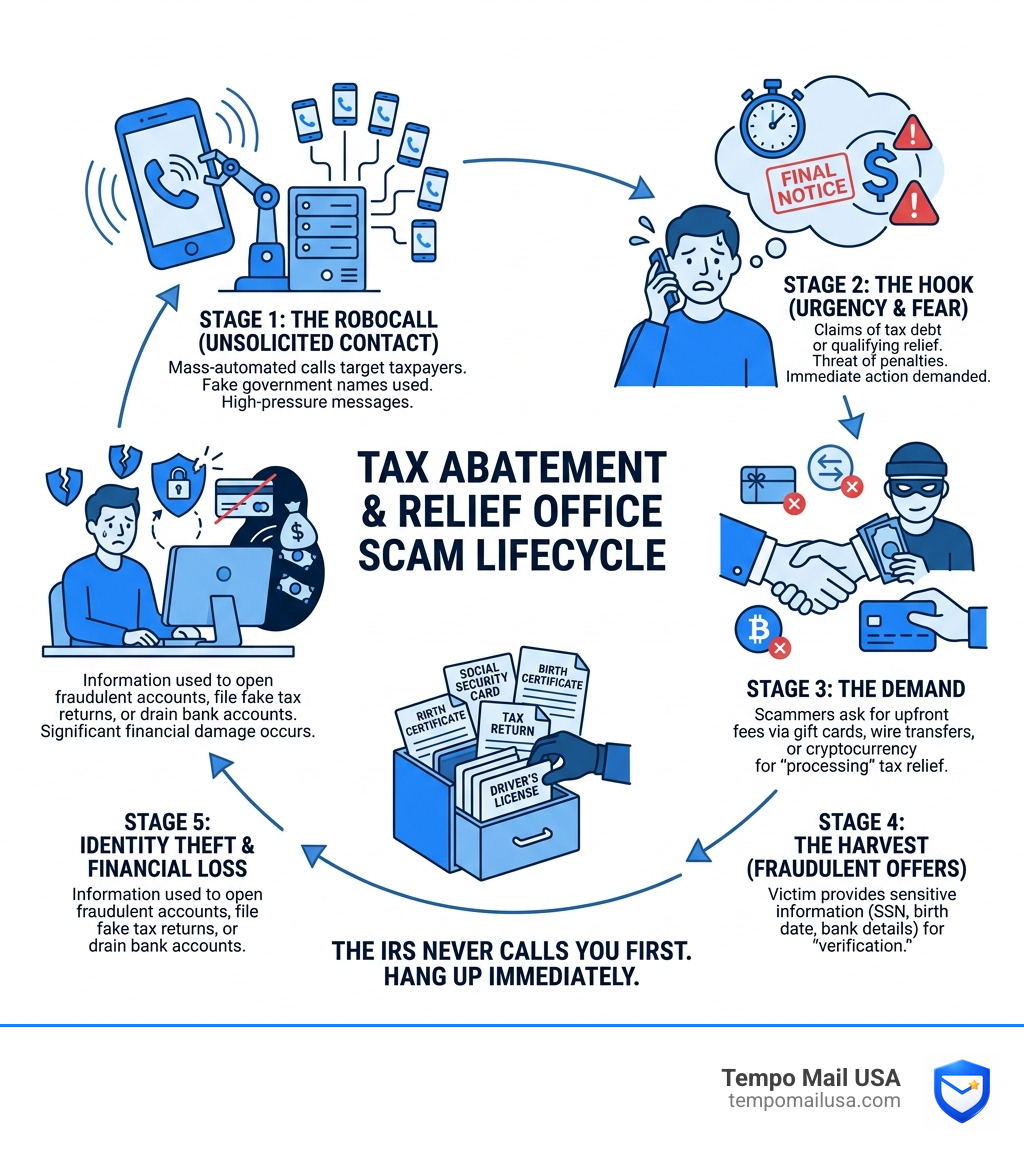
Anatomy of the Tax Abatement and Relief Office Scam
To the untrained ear, the tax abatement and relief office scam sounds like a legitimate government outreach program. We’ve seen these operations evolve into sophisticated "sales floors" that mimic real corporate offices. They don't just call; they use a multi-layered approach to build a facade of authority.
The scam typically begins with a robocall or an automated voicemail. These callers use spoofed numbers—often from Washington, D.C. or your local area code—to increase the likelihood that you’ll pick up. If you don't answer, they leave a detailed, high-pressure message. Names like "Camille Rhodes," "Taylor Carson," or "Laura Christie" are frequently used to give the "agent" a human face.
According to research into Tax Abatement Scam Calls, these criminals often claim to be from the "Tax Resolution Team" or the "Tax Review Unit." These are not real IRS departments. They are generic, official-sounding titles designed to avoid legal scrutiny while still sounding important enough to trigger your "fight or flight" response.

Common Scripts Used by the Tax Abatement and Relief Office Scam
The scripts are the backbone of this fraud. They are carefully written to create a sense of "unverifiable uncertainty." Instead of accusing you of a specific crime, they use ambiguous language that makes you wonder if you missed a form or a deadline.
Common phrases include:
- "Your account has been flagged for a final stage review regarding missed filings."
- "We are calling from the Tax Mediation Support Agency regarding new 2026 relief opportunities."
- "This is our only attempt to reach you before your file is transferred to the enforcement division."
- "You may qualify for an inflation refund or penalty abatement under new proprietary programs."
The goal of these scripts, as noted in the investigation of Tax Mediation and Abatement Scam Calls, is to get you to call back. Once you do, you are connected to a "senior officer" who will attempt to harvest your Social Security number and demand "enrollment fees" or "settlement payments."
Fake Agencies and Impersonation Tactics
Scammers create a "word salad" of official terms to invent agencies that don't exist. You might receive a call or even a deceptive letter in the mail claiming to be from the:
- Taxpayer Abatement Assistance Office (often linked to the number 888-471-0706)
- Domestic Judgment Registry
- Tax Lien Group
- US Tax Consultants
- Tax Settlement Center
By using terms like "Mediation," "Abatement," and "Assistance," they mimic the language of legitimate tax resolution services. Many users now rely on advanced security tools and VPN protection to prevent these attacks and shield their digital footprint from the data brokers who sell "lead lists" to these scam centers.
Red Flags and How the IRS Actually Contacts You
The easiest way to spot a tax abatement and relief office scam is to know how the real IRS operates. The Internal Revenue Service (IRS) is a bureaucracy, and bureaucracies love paper.
The Golden Rule: The IRS will almost always contact you via the U.S. Postal Service first. They do not initiate contact by phone, email, text message, or social media to request personal or financial information. If you haven't received a stack of letters in your physical mailbox, any "urgent" phone call you receive is a fraud.
Even in cases where the IRS uses private collection agencies, there is a strict protocol. As explained in the IRS guide on how to know if a private collection agency is legit, you will receive a letter from the IRS first, followed by a letter from the agency itself. Both will contain a unique taxpayer authentication number.
IRS vs. Scammers: A Comparison Table
| Feature | Legitimate IRS / Authorized Agency | Tax Abatement Scam |
|---|---|---|
| First Contact | Official letter via USPS | Unsolicited phone call or text |
| Payment Method | IRS.gov/payments, check to "U.S. Treasury" | Gift cards, Crypto, Wire transfer |
| Tone | Formal, procedural, offers appeal rights | Threatening, urgent, aggressive |
| Pressure | Provides time to respond/appeal | Demands immediate action "today" |
| Verification | References specific tax years and IDs | Uses vague "missed filings" claims |
Identifying a Tax Abatement and Relief Office Scam Call
If you are on the phone and the caller does any of the following, hang up immediately:
- Demands payment via unusual methods: The IRS never asks for iTunes cards, Google Play cards, or Bitcoin.
- Threatens immediate arrest: Real tax disputes involve notices, audits, and appeals. The police aren't coming to your door because of a phone call.
- Asks for upfront fees to "pre-qualify" you: Scammers often demand $500 to $5,000 just to "review your case" for a program you probably don't qualify for.
- Claims to have a "no-wait proprietary line": This is a common lie used to make them sound like they have special access that you don't.
The FTC is clear on this: Hang up on unexpected calls saying you owe back taxes. Those are scams, period.
Why These Scams Sound Legitimate
Scammers are excellent psychologists. They use "D.C." area codes (like 202 or 771) to appear as though they are calling from the capital. For instance, the 771-222-3150 Tax Abatement Mediation Scam has been highly active, using a professional tone that mimics a government bureaucrat.
They also reference the current year—2026—and mention "newly approved" relief programs. This exploits the fact that tax laws do change, making it plausible that a "new" program might exist. They count on your desire to save money and your fear of the "tax man" to bypass your critical thinking.
Protecting Your Identity and Financial Data
Your personal information is the "fuel" for these scams. Scammers often get your phone number and email from data breaches or public records. Once they have you on the line, they want the "crown jewels": your Social Security number, date of birth, and bank account details.
To stay safe, we recommend a multi-layered defense. This includes using identity theft protection services and VPN protection to secure your connection. A high-quality VPN like NordVPN can help prevent trackers from building a profile on you that scammers eventually buy.

What to Do if You’ve Already Engaged
If you’ve already spoken to a scammer or, worse, shared information or money, don't panic. Take these steps immediately:
- Freeze Your Credit: Contact Equifax, Experian, and TransUnion to place a credit freeze. This prevents scammers from opening new accounts in your name.
- Notify Your Bank: If you provided card details or bank info, call your financial institution's fraud department.
- Run a Security Scan: If you clicked any links or downloaded "paperwork," use a tool like Malwarebytes to check for spyware or remote access trojans.
- Document Everything: Save the phone numbers, the names used, and the times of the calls. This is vital for the investigation into fake tax abatement offices.
How to Choose the Right Protection
The best defense is a "PII Firewall." At Tempo Mail USA, we believe your real email address should be a closely guarded secret. By using secure email aliases, you can sign up for services without exposing your primary identity. If an alias starts receiving scam tax emails, you simply delete the alias—cutting the scammer's line of communication instantly.
Additionally, consider:
- Antivirus software: Top internet security tools in 2026 now include "scam protection" that flags known fraudulent numbers.
- Call-blocking apps: Many mobile carriers offer free services to block "Scam Likely" calls.
- Two-Factor Authentication (2FA): Always enable 2FA on your tax accounts and bank portals.
Legitimate Tax Relief and Reporting Procedures
While the tax abatement and relief office scam is fake, legitimate tax relief does exist. However, it is never offered through an unsolicited robocall.
Real programs include:
- Offer in Compromise (OIC): A program that allows you to settle your tax debt for less than the full amount you owe.
- First Time Penalty Abatement: If you have a clean history but messed up one year, the IRS may waive the penalty.
- Taxpayer Advocate Service (TAS): An independent organization within the IRS that helps taxpayers resolve problems.
For a deep dive into real options, see our guide on Tax Abatement Relief Office Explained: Programs and Benefits.
Where to Report Fraudulent Activity
Reporting these calls helps the government track and shut down scam centers.
- TIGTA: Report IRS impersonation to the Treasury Inspector General for Tax Administration at tigta.gov.
- FTC: Use ReportFraud.ftc.gov to alert the Federal Trade Commission.
- IRS: Forward phishing emails to phishing@irs.gov.
- State Authorities: If you receive a deceptive letter targeting Pennsylvania taxpayers or any other state, contact your local Department of Revenue.
Verifying Your Real Tax Status Safely
Never use a phone number provided by a caller. To check if you actually owe money:
- Go to IRS.gov: Create or log in to your IRS Online Account. It will show your balance, payment history, and any digital copies of notices sent to you.
- Call the Official Hotline: Dial 1-800-829-1040 for individual tax questions.
- Hire a Professional: Talk to a credentialed CPA or an Enrolled Agent. These professionals have "Circular 230" credentials and are authorized to represent you before the IRS.
Frequently Asked Questions about Tax Scams
Does the IRS ever call taxpayers without sending a letter first?
No. The IRS initiates all contact through official correspondence delivered by the U.S. Postal Service. They will never call you out of the blue to demand immediate payment or threaten you with jail time. If you get a call and haven't received a letter, it is a scam.
Can a private collection agency call me about tax debt?
Yes, but only after you have received multiple notices from the IRS and a specific letter from the agency itself. These agencies are highly regulated. They will never ask for gift cards and will always direct you to pay via IRS.gov/payments.
What is an Offer in Compromise (OIC) mill?
An "OIC mill" is a company that uses aggressive marketing to promise they can settle your tax debt for "pennies on the dollar." They charge massive upfront fees but often fail to deliver because most people don't qualify for the program. You can check your own eligibility for free using the IRS Offer in Compromise Pre-Qualifier tool.
Conclusion
The tax abatement and relief office scam relies on a mixture of technical trickery and psychological pressure. By spoofing D.C. numbers and using professional scripts, these criminals aim to steal your hard-earned money and your identity.
In 2026, digital hygiene is no longer optional. Protecting your PII (Personally Identifiable Information) is the best way to ensure you never end up on a scammer's "sucker list." At Tempo Mail USA, we provide the PII Firewall you need to stay anonymous online. By using our secure email aliases, you shield your real identity from data brokers and hackers alike.
Don't let tax anxiety lead to a financial disaster. Stay informed, use secure tools, and always verify through official channels. Visit tempomailusa.com today to start building your digital defense.