


Fake Sports Direct Sites Are Stealing Money Right Now — Here's What You Need to Know
Sports direct scam websites are actively targeting UK shoppers in 2026, using cloned storefronts, jaw-dropping fake discounts, and social media ads to steal payment details and personal information.
If you've landed here because something felt off about a Sports Direct deal you saw online, here's the short answer:
Is it a Sports Direct scam? Check these fast:
- Official site only: The real Sports Direct website is sportsdirect.com — nothing else
- Known fake domains to avoid: sportsdirectuk.live, sportsbrands.shop, sportsdirectgb.com
- Price too good to be true? A Bluefin paddleboard for £29.99 or Uggs for £19 = almost certainly a scam
- Already entered payment details? Call your bank immediately and request a chargeback
- Where to report it: Action Fraud (UK) or the National Cyber Security Centre (NCSC)
These aren't isolated incidents. Victims across Reddit, Trustpilot, and Facebook have reported losing between £40 and £71 on fake orders — with some hit by recurring daily charges on their cards long after the initial purchase. One Reddit user's sister faced repeated £150 payment attempts after ordering from a cloned site. Another shopper went into a real Sports Direct store to ask about their order, only to be told it simply didn't exist in the system.
The scam follows a predictable pattern: a flashy social media ad, a website that looks almost right, a convincing checkout page — and then silence. No delivery. No refund. No response.
What makes this particularly dangerous is how polished these fake sites have become. They copy Sports Direct's branding pixel-for-pixel, list real products at absurd discounts, and use Cloudflare proxies to mask their true origins — often tracing back to recently registered domains in China.
And if you're someone who values your privacy online, the risks go well beyond losing £50 on trainers that never arrive. Your name, address, email, and card details are now in the hands of organised fraudsters.
This guide breaks down exactly how these scams work, how to spot them before it's too late, and what to do if you've already been caught out.
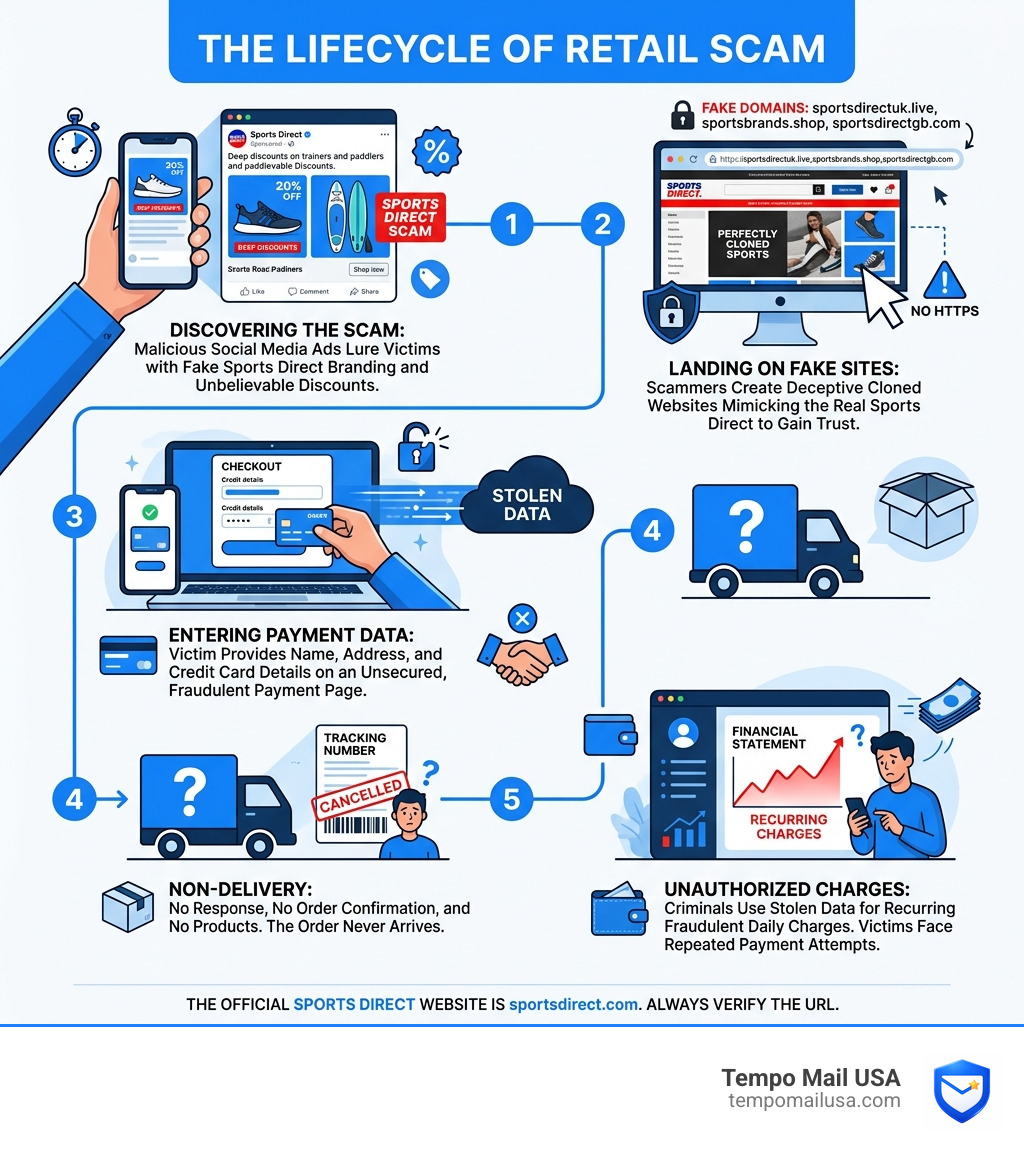
The Anatomy of the Sports Direct Scam in 2026
The sophistication of the sports direct scam has reached an all-time high in April 2026. Fraudsters are no longer just making "cheap" websites; they are engineering high-fidelity clones that mimic the user experience of the official site perfectly.
The official domain is sportsdirect.com. Anything else is a red flag. We have seen a surge in malicious domains such as sportsdirectuk.live, sportsbrands.shop, and sportsdirectgb.com. These sites often use "Sports Direct" in the name to trick your brain into a false sense of security. According to research on the SportsDirectGB.com Scam: A Fake Sports Direct Website, these platforms are part of massive scam networks, often registered in China.
When we look at the WHOIS data for these sites, the patterns are identical: the domains are usually less than 30 days old, registered for only one year, and use Cloudflare proxies to hide the actual server location. This "rinse and repeat" model allows scammers to burn one domain once it gets too many negative reviews and launch another within hours.
Why the £29.99 Bluefin Paddleboard is a Sports Direct Scam
One of the most viral baits used in this scam involves the high-end Bluefin paddleboard. Normally retailing for hundreds of pounds, these scam sites list them for a flat £29.99. This is a classic "too good to be true" scenario.
The scammers use price anchoring—showing a massive "original" price slashed by 90%—to trigger an impulsive "buy now" response in shoppers. If you see a premium brand like Bluefin or Ugg offered at a 90% discount on a site that isn't the official sportsdirect.com, it is 100% a fraudulent bait-and-switch operation.
Social Media as a Fraud Vector
Social media platforms have unfortunately become the primary engine for the sports direct scam. We've observed that Facebook, Instagram, TikTok, and Snapchat are flooded with sponsored posts featuring "Warehouse Clearances" or "Closing Down Sales."
The problem? These platforms often prioritize ad revenue over rigorous verification. Scammers take advantage of this by running ads that look like official promotions. Always look for the blue tick (verified badge) on the social media profile running the ad. If the page has 12 followers and was created yesterday, close the tab immediately.
Red Flags: Spotting Fake Deals and Cloned Domains
To help you stay safe, we’ve put together a quick reference guide to distinguish the real deal from the fakes.
| Feature | Official Sports Direct | Scam Clone Sites |
|---|---|---|
| Domain | sportsdirect.com | .shop, .live, .xyz, or "gb-sale" additions |
| Prices | Competitive, seasonal sales | Unrealistic (90% off everything) |
| Currency | GBP (£) for UK users | Often defaults to USD or Euro incorrectly |
| Contact Info | Full help centre and address | None, or a generic Gmail/Outlook email |
| Reviews | Thousands of mixed reviews | Zero reviews or fake "5-star" widgets |
Before you even think about entering your card details, ensure your digital perimeter is secure. Using tools like NordVPN can help mask your IP and provide an extra layer of encryption, but even the best VPN can't stop you from voluntarily handing over your CVV to a scammer.
Identifying Malicious Website Design
Scammers are lazy in specific ways. While the homepage might look great, the "About Us," "Terms and Conditions," and "Privacy Policy" pages are often copied verbatim from other scam sites. Look for:
- High-pressure tactics: Fake countdown timers saying "Sale ends in 05:00 minutes."
- Non-functional links: Social media icons that just refresh the page instead of going to a profile.
- Poor Grammar: While getting better, many of these sites still feature "Engrish" or odd phrasing in the checkout process.
Domain Age and WHOIS Red Flags
Knowledge is power. If you are suspicious, use a WHOIS lookup tool. A legitimate multi-billion dollar retailer like Sports Direct will have a domain registered decades ago. A scam site like sportsbrands.shop was likely created 18 days ago. If the registration is only for one year and the owner's info is hidden behind a privacy wall in a high-risk jurisdiction, run for the hills.
The Hidden Risks: Beyond Financial Loss
Many people think, "It's only £30, I'll take the risk." This is a dangerous mistake. The sports direct scam isn't just about the initial transaction; it's an entry point for identity theft.
When you "buy" from a fake site, you are handing over your Full Name, Home Address, Phone Number, and Credit Card details. This is a goldmine for fraudsters. They can use this PII (Personally Identifiable Information) for:
- Card Cloning: Creating physical copies of your card.
- Credential Stuffing: Trying your email and password on other sites like Amazon or PayPal.
- Identity Theft: Opening credit lines in your name.
We highly recommend reading up on identity theft steps to protect yourself to understand how deep this rabbit hole goes. If you are worried your data has already been leaked, checking the best identity theft protection services in the usa can help you set up professional monitoring.
Post-Purchase Fraud Tactics
The scam doesn't always end at checkout. Victims have reported receiving "tracking numbers" that never update. In some cases, to avoid immediate bank flags, scammers send a "random cheap item"—like a pair of plastic sunglasses or a cheap ring—instead of the trainers you ordered. This allows them to claim to the bank that "the item was delivered," making your chargeback harder to win.
Even worse, some sites like sportsbrands.shop have been caught attempting daily "subscription" drains of £150 or more from victims' accounts days after the initial purchase.
Immediate Recovery: What to Do After a Sports Direct Scam

If you realize you've been targeted by a sports direct scam, every minute counts. Do not wait for the "delivery" that isn't coming.
- Call Your Bank Immediately: Tell them you have been a victim of a fraudulent website. Ask them to cancel your card and issue a new one. Request a chargeback (for debit/credit cards) or a Section 75 claim (for credit card purchases over £100).
- Report to Action Fraud: In the UK, this is the central point for reporting cybercrime. You can also report the site to the National Cyber Security Centre (NCSC).
- Check the Official Help Centre: The real Sports Direct Help Centre provides specific guidance for victims of impersonation.
- Report to the FTC: If you are shopping from the US, make sure you know how to report fraud to ftc the right way.
Securing Your Compromised Accounts
If you used the same password on the scam site as you do for your email or banking, you are in a "code red" situation.
- Change Passwords: Immediately update your passwords for all sensitive accounts.
- Enable 2FA: Turn on Two-Factor Authentication everywhere.
- Check "Have I Been Pwned": Use this tool to see if your email has been associated with recent data breaches.
- Freeze Your Credit: If you suspect identity theft, contact credit bureaus to place a freeze on your file.
Proactive Defense: Securing Your Digital Identity
In 2026, the best way to deal with a sports direct scam is to ensure the scammers never get your real data in the first place. At TempoMailUSA, we believe in a "PII Firewall" approach.
By using a temporary email alias for retail sign-ups, you shield your primary email from being sold on the dark web. If a site turns out to be a scam, you simply delete the alias, and the scammers lose their connection to you. Combined with virtual credit cards (which allow you to set a spending limit of £1), you can make online shopping virtually "scam-proof."
How to Protect Your Data from Future Sports Direct Scams
- Use the Official App: Shopping through the official Sports Direct app (downloaded from the Apple App Store or Google Play) is much safer than clicking links in social media ads.
- Verify Social Badges: Never buy from a social media ad unless the profile has a verified blue tick.
- PII Firewall: Use TempoMailUSA aliases for every new store you try. This keeps your real identity behind a secure proxy.
- Identity Monitoring: For long-term peace of mind, look into the best identity theft protection services top picks to catch any unauthorized use of your data early.
Frequently Asked Questions about Sports Direct Scams
What is the official Sports Direct website?
The only official website for Sports Direct is sportsdirect.com. Any variation, such as those ending in .shop, .live, or including extra words like "uk-sale" or "gb-direct," is a fraudulent clone designed to steal your information. Always type the address directly into your browser rather than clicking a link.
Can I get a refund if I bought from a scam site?
If you paid via credit or debit card, contact your bank immediately to initiate a chargeback or a Section 75 claim. While the scammers themselves will not provide a refund (and will likely ghost your emails), your financial institution can often recover the funds if the fraud is reported promptly. Do not wait more than 30 days to report it.
How do I report a fake Sports Direct advertisement?
You should report the ad directly to the social media platform (Facebook, Instagram, or TikTok) by clicking the three dots in the corner of the post. After that, submit the URL to the National Cyber Security Centre (NCSC) or Action Fraud. Reporting helps take these sites down faster to protect other consumers.
Conclusion
The sports direct scam is a reminder that in the digital age, if a deal looks too good to be true, it almost certainly is. These fraudsters are professional, organized, and relentless. However, by staying vigilant, checking domain ages, and using privacy-first tools, you can shop with confidence.
At TempoMailUSA, our mission is to provide you with the ultimate PII firewall. By using our temporary email aliases, you ensure that even if you accidentally stumble onto a malicious site, your real identity remains protected. Stay safe, verify every link, and let's keep the scammers out of our pockets.