
Plaid Verification Code Text You Didn't Request: What It Means and What to Do in the Next 10 Minutes
Your phone buzzes. A text with a six-digit code from Plaid, an app you didn't open, for a bank connection you never started. You didn't request it. Nobody in your house did either. So who did — and what do they want?
Short answer: most of the time, nobody wanted anything from you at all. A stranger mistyped their phone number while linking their own bank account, and your number got the code meant for them. But "most of the time" is not "always," and the difference between the harmless version and the dangerous one is exactly what this article sorts out — in about ten minutes, with no jargon and no panic.
I checked Plaid's own help center pages for this piece, because this is one of those topics where the company's own words matter more than any blogger's summary. Everything below that I attribute to Plaid comes from its consumer help center, not from a roundup that copied it third-hand.
First, read the text like a bouncer, not a victim
Before you decide what the message means, check whether it is even from Plaid. A real Plaid verification code arrives in one of two ways, and both have fingerprints you can check in seconds.
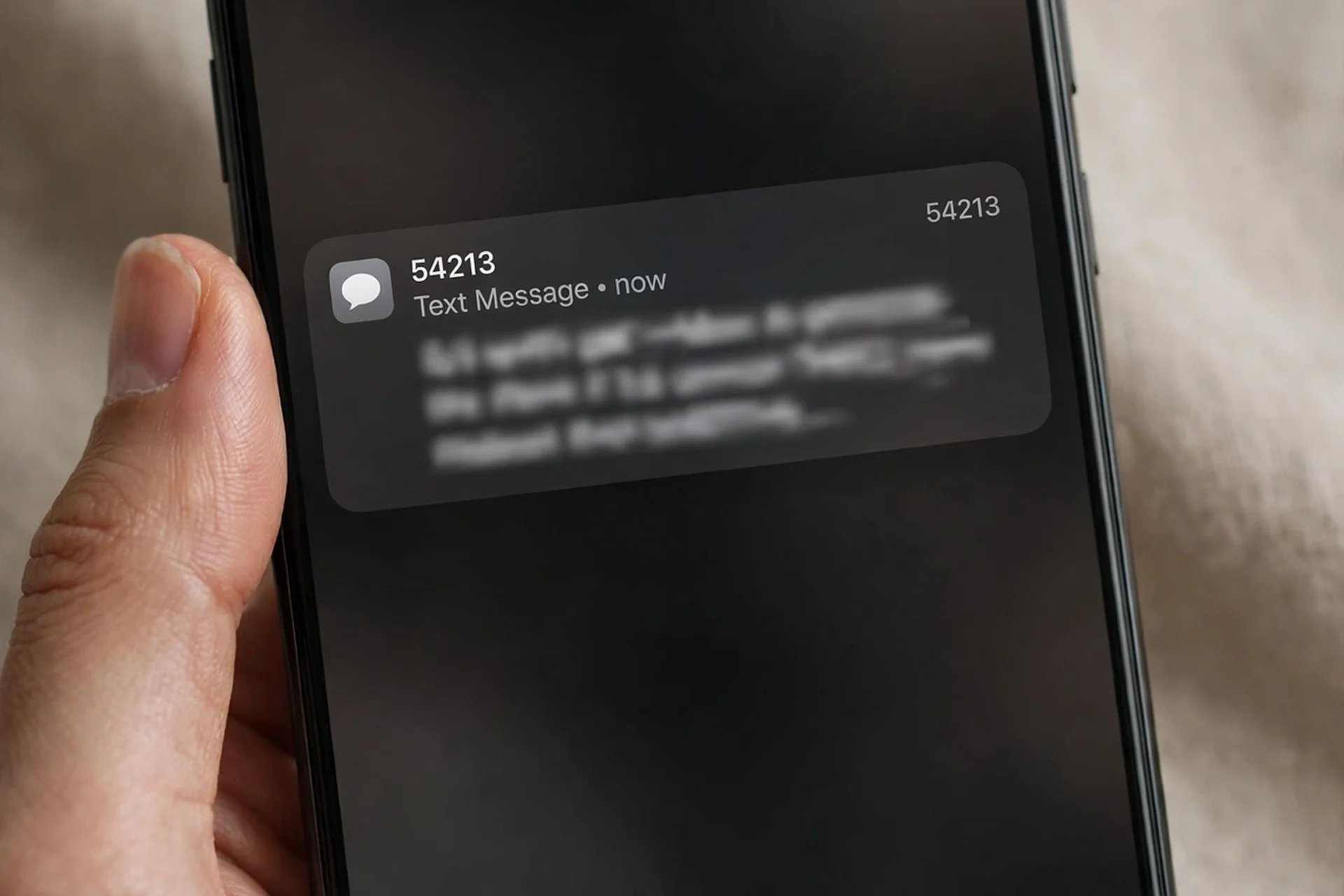
A text comes from the short code 75243 — the digits spell PLAID on a phone keypad. An email comes from noreply@plaid.com and carries a numeric one-time passcode. The message itself is short and boring: a code, a line telling you not to share it, and nothing asking you to do anything. No link you must click, no threat, no countdown timer, no "your account will be locked" language.
That boring quality is the tell. Real verification messages are dull by design. The code is the whole point of the message — it exists so that the person linking a bank account can prove they control the phone number or inbox on file. If the text you got is trying to excite you, scare you, or rush you, it is not behaving like a Plaid message, even if it uses Plaid's name.
One more check worth doing right now: look at the sender, not the display name. Phones show "Plaid" or a short code and people trust the label. Scammers know this. On most phones, tapping the message details shows the actual sending number. If it is a full ten-digit number, or a short code that is not 75243, treat the message as unverified — which is different from treating it as a proven scam. Unverified just means you don't act on it.
The two reasons Plaid itself gives you
Plaid's help center is unusually direct about this. It says an unrequested one-time passcode means one of two things.
The first is a mistyped phone number. Someone else was connecting their own bank account to an app, typed their number wrong by a digit or two, and the code landed on your phone instead. Plaid says this is the likely cause for unexpected texts specifically, and that matches how the numbers work: a mistyped digit is random, and your number is simply the one the typo produced. There is no attacker, no breach, and nothing to fix on your end. The code dies on its own — one-time passcodes expire within minutes, and a code you never enter is just a dead string of digits.
The second is that someone tried to use your banking information without permission. That is the one to take seriously. If a person has your bank login details, they may try to link your account to an app, and the verification code is the step that stops them — because the code goes to your phone, not theirs. In that scenario the text is not the attack. It is the alarm. The attack was the login attempt that came before it.
So the message itself never tells you which of the two you are dealing with. The context does. That is what the next section is for.
The 10-minute triage: three branches, pick yours
Don't do everything. Do the branch that matches your situation, then stop. Most people are in branch A and their work is done in under a minute.
Branch A: one code, nobody follows up. You got a single text, nobody calls, nobody texts back asking for the code, and you haven't linked any bank account recently. Do nothing. Don't reply, don't click anything in the message, don't call the number back, don't enter the code anywhere. Delete the text if it bothers you. This is the mistyped-number case, and it resolves itself. If a second code arrives days later from the same kind of event, you are still in branch A — a mistyped number can repeat, because the person who has your number wrong keeps using it.
Branch B: codes keep coming, several in a day or across days. Repetition changes the odds. One mistyped digit is chance; a cluster of codes is a pattern, and patterns deserve ten minutes of checking. Open your banking app — from your home screen, not from any link in a message — and scan recent activity for logins, linked apps, or transfers you don't recognise. If anything looks off, call your bank on the number on the back of your card and say exactly this: "I received verification codes I didn't request, and I want to check for unauthorised linking attempts." Then change your online banking password from a device you trust, and turn on every alert your bank offers: login alerts, new-device alerts, transfer alerts. A verification code is only the second factor — the first factor, your password, is what someone was testing, and that is the thing to harden.
Branch C: someone asks for the code. A text follows saying "sorry, I sent my code to your number by mistake, can you send it to me?" Or a call arrives from someone claiming to be your bank's fraud team, asking you to read the code aloud so they can "verify your identity." This is the scam, and it is the only branch where the code itself is the target. Hang up. Don't reply. Don't argue with the texter. The code is the key to an account — with it, the person on the other end can finish a login, reset a password, or move money. Plaid's own rule, stated plainly in its help center: Plaid Support will never ask you to read your one-time passcode over the phone, by text, or by email. Anyone who asks is not Plaid, whatever they call themselves.
If you are torn between branches, use this rule of thumb: a single code with silence after it is a typo; repeated codes are a signal to check your bank; a request for the code is an attack in progress. That covers nearly every real case I have seen described in Plaid's support threads and in scam reports.
The follow-up scam that turns one text into an account takeover
Branch C deserves a closer look, because it is cleverer than it looks. The scam does not start with a fake message. It starts with a real one.
Here is how it usually runs. A scammer triggers a genuine login or signup on a service that sends a code to your number — sometimes by entering your number on a Google Voice signup, sometimes by starting a bank login with a password they already have from an old data breach. Your phone buzzes with a legitimate code from a legitimate sender. Seconds later, the scammer messages or calls you: "Hi, I accidentally sent my verification code to your number, can you forward it?" Or the fake fraud-team version: "We detected suspicious activity, please read the code to confirm you are the account holder."
The trick works because the code is real, so the text looks real, so the person asking for it sounds plausible. But the code was never theirs. It was sent to your number because it belongs to your account, and handing it over finishes the login the scammer started. With a Google Voice code, they get a phone number linked to yours to run further scams. With a bank or email code, they get inside the account itself. The whole con fits inside one text message, which is why it is so common — and why the advice is so short: never read a code to anyone who contacts you. Not your bank, not Plaid, not a stranger who sounds embarrassed. Real support teams never need your code, because they have their own way in.
Real vs. fake in 20 seconds: four checks
When a Plaid message arrives and you want to verify it before deciding, run these four checks. They take less than half a minute combined.
First, the sender. Texts come from 75243. Emails come from noreply@plaid.com. Anything else is not a verified Plaid message, whatever the display name says.
Second, the links. If the message contains a link, the domain should be my.plaid.com, secure.plaid.com, or verify.plaid.com. A link to any other domain — especially one that looks almost right, with an extra word or a different ending — is a red flag. And if you didn't request the code, the safest move is not to click any link in the message at all. Open the app or site yourself instead.
Third, the ask. A real Plaid message never asks you to share the code, reply with it, or read it to anyone. It also never asks for payments or card numbers — Plaid says so explicitly in its help center. A message that asks for anything beyond "here is your code" is not behaving like Plaid.
Fourth, the context. Did you, in the last few minutes, try to connect a bank account to an app? If yes, the code is almost certainly yours and expected. If no, it is either a typo or a test of your defences, and the triage branches above tell you which.
None of these checks requires any tool or app. The reason I list them is that most people do the opposite: they stare at the code itself, as if the digits contain the answer. They don't. The sender, the link, the ask, and the timing contain the answer.
What to do with the code — and what never to do
The code has a short life. One-time passcodes expire within minutes, and once expired they are useless to everyone, including you. So there is no urgency to "use" an unrequested code and no benefit to keeping it. The right handling is simple.
Do not share it with anyone, in any channel — not by text, not by phone, not by email, not in a support chat you didn't open yourself. Do not enter it on a website you reached by clicking a link in the message. Do not reply to the text, not even to say "wrong number" — replying confirms your number is live and monitored, which is useful information to a scammer. Do not call the number back. If the message came by email, don't click "verify" or "confirm" links inside it; check your bank directly instead.
What you can do is useful and boring: check your bank accounts for activity you don't recognise, make sure your banking password is unique and not reused anywhere else, and turn on login alerts if you haven't. If you manage one-time codes across several services, an OTP scanner or authenticator app is a cleaner home for them than your SMS inbox — but that is a habit upgrade, not emergency surgery, and it can wait until the ten minutes are over.
One more thing people get wrong: they assume that because they didn't request the code, their phone number must have been leaked in a breach. It might have been, but a mistyped digit is the simpler explanation, and simple explanations win most of the time. Save the breach investigation for branch B — repeated codes — where the evidence actually points that way.
How to report it so it stops
If the texts repeat, or someone asked for the code, reporting helps — both you and the next person whose number gets mistyped. Plaid has a specific path for this, and it is worth following exactly, because the generic contact form will just send you back to it.
Go to the Plaid Help Center and open the Plaid Support Assistant chat. Choose "Unexpected message from Plaid," then "A text message (SMS)," then "I received a text from Plaid with a code I didn't ask for." Fill in your details, including the phone number that received the text, and submit. You will get an email confirmation that the ticket was sent. If your code arrived by email instead of text, the same flow applies, and your OTP email includes a unique 15-character Support ID that Plaid can use to trace the message — include it in your report if you have it.
Two reports outside Plaid are also worth the minute they take. Forward the spam text to 7726 (which spells SPAM on a phone keypad) so your mobile carrier can investigate the sender. And if someone tried to get the code from you, or money moved, report it at reportfraud.ftc.gov — the FTC's fraud report goes into the database that law enforcement and consumer-protection agencies actually use.
What reporting does not do is block the mistyped number. If a stranger keeps entering your number, Plaid can investigate, but it cannot fix someone else's typing. The reports matter most when there is a real person on the other end trying something, because that is when a paper trail turns into action.
Where temp mail fits — and the one place it never does
This is a temp-mail blog, so the honest question is whether a disposable inbox would have helped here. The answer is no — and the reason is the point of the whole article.
Plaid verification is tied to your real phone number and your real bank. The code goes to the number on file with your bank, and the email goes to the inbox your bank has. A temporary email address can't receive that SMS, and it shouldn't be anywhere near a bank linking flow: if you link a bank account through an inbox you don't control in a week, the recovery emails, fraud alerts, and statements that keep that account safe go to an address that no longer exists. A burner email is a great tool for trying an app before you trust it; it is a terrible tool for the financial connection underneath that app.
Where temp mail does fit is one step earlier. Finance apps — budgeting tools, investing apps, payment apps — ask for an email before they ever ask for your bank. If you want to try one without handing over your real inbox, sign up with a disposable address from a free temp mail inbox first. You get to see the app, test the features, and decide whether it's worth your real details. Then, when you choose to connect your bank, you switch to your real email and real number — because that is the step where verification has to reach you, reliably, for years.
The same logic applies to how to verify email address checks in general: use throwaway addresses for exploration, real addresses for anything tied to money, identity, or recovery. The Plaid code on your phone is a reminder of which side of that line you're on.
FAQ
I got a Plaid code but I don't even use Plaid. Is my bank account hacked?
Not necessarily, and probably not. Plaid works behind the scenes — apps like Venmo, Cash App, and many budgeting and investing apps use it to connect to banks, so you can receive a Plaid code without ever having heard of Plaid. A single code most likely means someone mistyped their number. Check your bank activity, and only escalate if codes repeat or someone asks for the code.
How long is a Plaid verification code valid?
One-time passcodes expire within minutes. An unrequested code you never enter simply dies on its own. There is no need to "cancel" it and no way for someone else to use it after it expires.
Can someone get into my bank account with just the code?
The code alone is not enough — it is the second factor, and the attacker still needs the first factor, usually your bank login. But if they already have your password from a data breach, the code is the last thing standing between them and your account. That is why you never share it, and why repeated codes are a reason to change your banking password.
What number does Plaid text from?
The short code 75243, which spells PLAID. Emails come from noreply@plaid.com. If the sender is anything else, treat the message as unverified.
Should I reply STOP to the Plaid text?
Don't reply to a text you didn't expect. Replying confirms your number is active. If the message is genuinely from Plaid's short code, deleting it is enough. If it keeps repeating, report it through the Plaid Help Center's Support Assistant chat instead.
I gave the code to someone before realising it was a scam. What now?
Act fast. Change the password on the account the code protected, starting with your bank and your email — your email is the recovery path for almost everything else. Check recent activity on both, turn on login alerts, and call your bank on the number on your card to flag the incident. Then report it at reportfraud.ftc.gov.
Can I use a temp email for Plaid verification?
No. Plaid sends its email codes to the address your bank has on file, and its texts to your real phone number. A disposable inbox can't receive either, and using one for bank linking would cut you off from recovery emails and fraud alerts. Use temp mail for trying finance apps; use your real details for the bank connection itself.
The bottom line
A Plaid verification code text you didn't request is, most of the time, a stranger's typo — a digit off, a code on the wrong phone, nothing to do. Sometimes it is an alarm: someone tested your bank login and the code is what stopped them. And sometimes it is bait: a real code followed by a fake request for it, which is the moment a boring text becomes a live scam.
The way to tell them apart isn't the code. It's the pattern around it — one code or many, silence or a follow-up, a sender you can verify or one you can't. Check the sender, don't share the code, and let repetition decide whether you spend ten minutes with your bank. That is the whole protocol, and it covers every version of this text you are likely to get.
---
Need a disposable temporary email?
Protect your real inbox from spam and promotional clutter instantly and free.
Received a suspicious email, text, or charge alert?
Verify whether the sender domain is disposable, spoofed, or unverified before clicking links.