

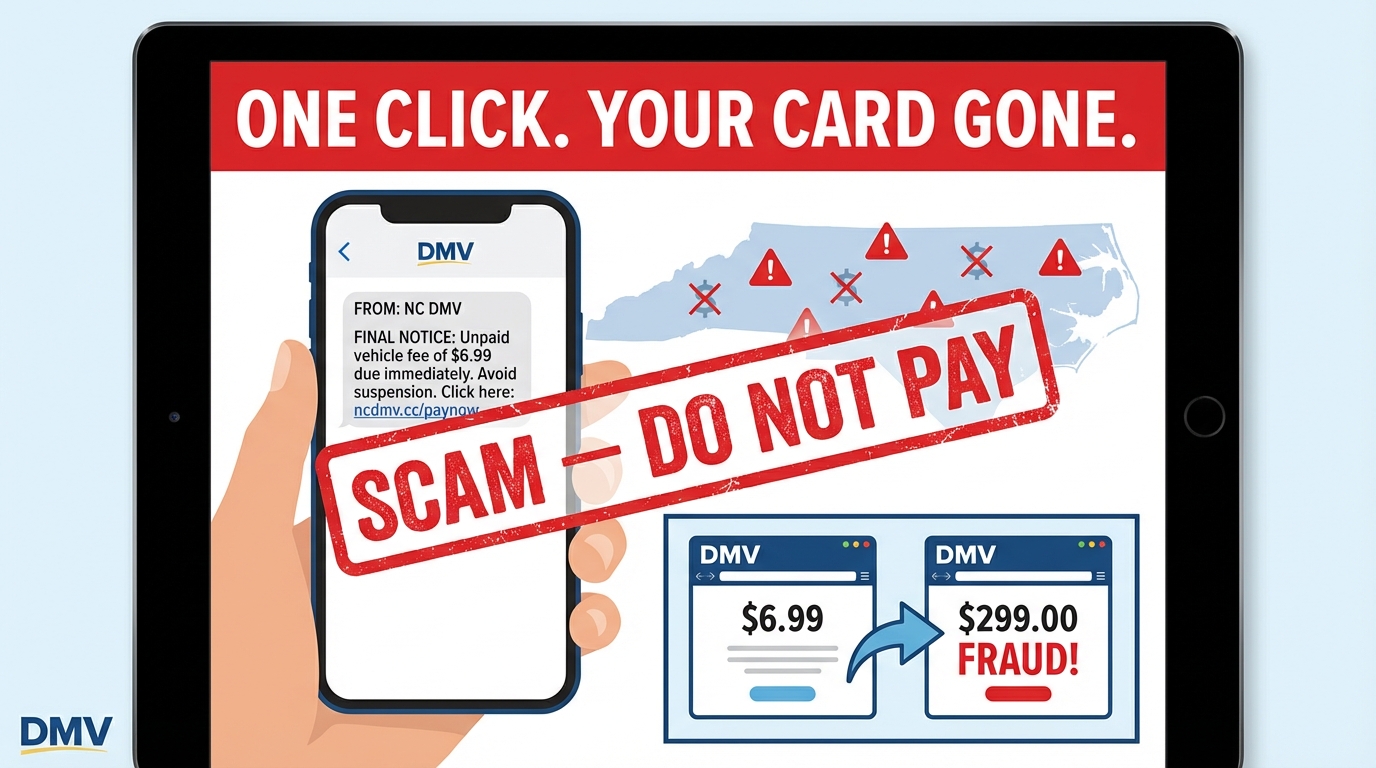

The NC DMV Scam Text Is Targeting North Carolina Drivers Right Now
If you received an nc dmv scam text claiming you have an unpaid traffic ticket, you are not alone — and you should not click anything.
Here is what you need to know immediately:
- It is fake. The NC DMV will never request payment or threaten you via text message.
- Do not click the link. The URL may look official but leads to a phishing site designed to steal your card details and personal information.
- Do not pay anything. Penalties like a "35% toll booth service fee" or credit score damage mentioned in these texts do not exist under North Carolina law.
- Report it. Forward the text to 7726 (SPAM), then report it at ncdoj.gov/report-robocalls or call 1-877-5-NO-SCAM.
- Verify directly. If you are unsure whether you have a real DMV issue, call NCDMV at (919) 715-7000.
North Carolina's Attorney General and NCDMV Commissioner have both issued public warnings about a growing wave of these fraudulent messages. The scam texts impersonate the NC Division of Motor Vehicles, threaten license suspension or prosecution, and pressure recipients to pay immediately through a fake website.
As Attorney General Jeff Jackson put it plainly: "This message is a scam."
The texts often reference a nonexistent law — "North Carolina Administrative Code 15C-16.003" — to sound official. The links mimic government websites but use suspicious domains ending in .cc (the country code for the Cocos Islands near Australia), not a real .gov address.
The NC Department of Justice is receiving a rising volume of complaints, and both state and federal agencies are urging residents to stay alert.
The Surge of the NC DMV Scam Text in 2026
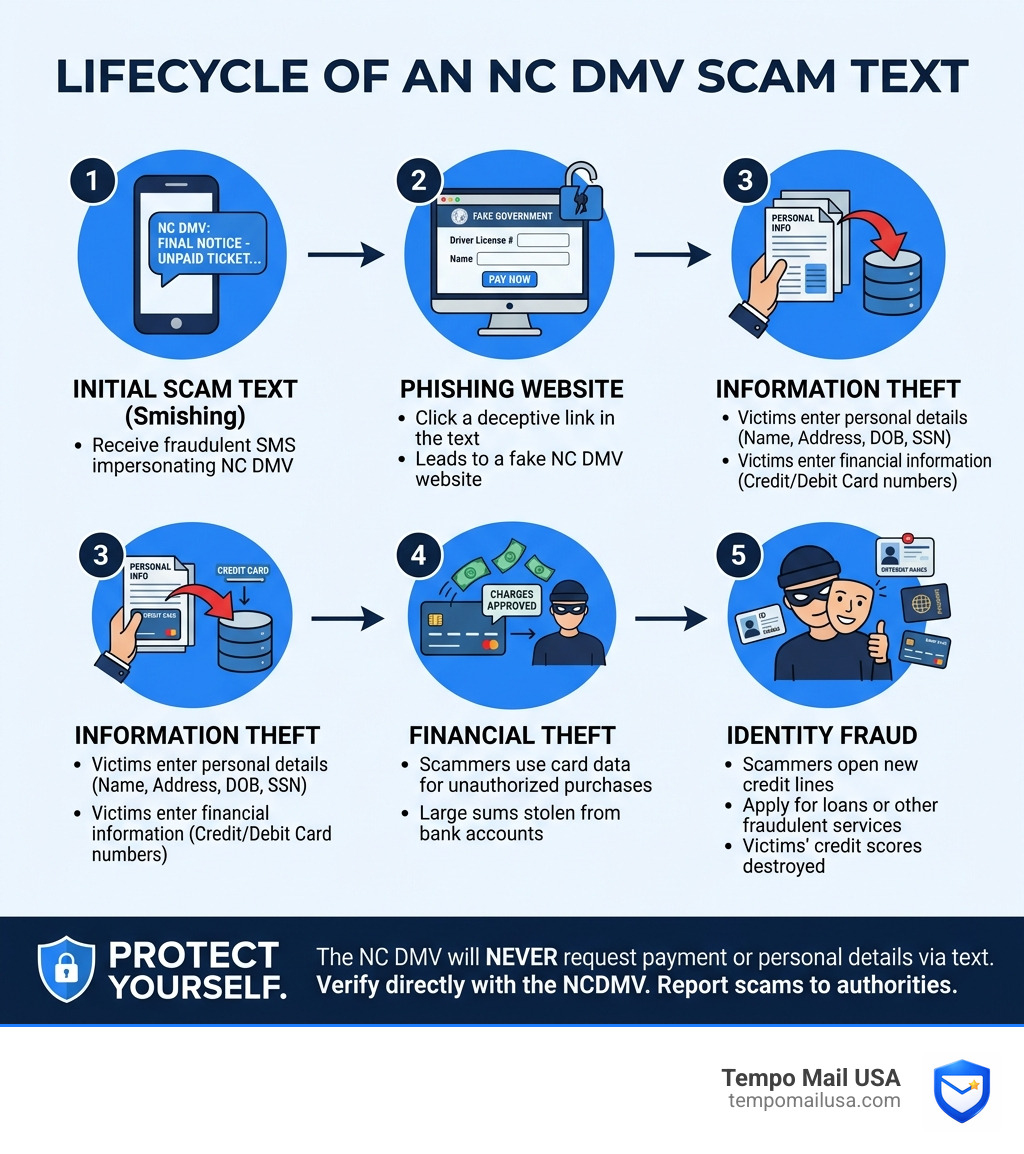
As we move through April 2026, the volume of fraudulent messages hitting North Carolina phones has reached a fever pitch. This isn't just a handful of random messages; it is a coordinated, high-volume "smishing" (SMS phishing) campaign. The North Carolina Department of Justice (NCDOJ) has noted a significant spike in complaints, leading to urgent warnings from state leadership.
Attorney General Jeff Jackson and NCDMV Commissioner Paul Tine have been vocal about this threat. They’ve pointed out that these scammers are essentially using a "playbook" adapted from recent toll road scams. By impersonating a government agency like the NCDMV, criminals tap into a deep-seated fear: the loss of driving privileges.
According to the official NCDMV Warns About Surge in Text Scams press release, these messages are designed to bypass your logical defenses by creating a sense of immediate crisis. This isn't just happening in the Tar Heel State, either; similar waves of fraud are crashing against shores nationwide, as detailed in our guide on DMV Scam Text Alert: Fake Messages Spreading Across the US.
Common Variations of the NC DMV Scam Text
Scammers are nothing if not creative—or at least, they are good at iterating on what works. While the core message usually involves an "unpaid ticket," the nc dmv scam text can take several forms:
- The "Final Notice" Tactic: These texts often start with bold lettering like "FINAL NOTICE" or "URGENT," followed by a specific date. The goal is to make you feel like the time for talk is over and the time for payment is now.
- The Toll Fee Pivot: Borrowing from EZ-Pass and NC Quick Pass scams, some messages claim you have outstanding toll violations that have now been handed over to the DMV for enforcement.
- The Suspension Threat: These are the most aggressive. They claim that if a small fine (often around $6.99) isn't paid within 12 hours, your vehicle registration or driver’s license will be suspended for 30 days.
- The Citation Alert: A more general message claiming you have a "Traffic Citation" waiting in the system. You can read more about these specific variations in our article on Traffic Citation Text Scam: Fake Ticket Messages.
Why the NC DMV Scam Text Targets North Carolina Residents
You might wonder, "How do they know I live in North Carolina?" The truth is, they often don't. These scams frequently use "mass blasting" techniques, sending thousands of messages to phone numbers within specific NC area codes (like 919, 980, or 336).
However, the reason they are so effective is "localized fear." We all interact with the DMV. We all worry about accidentally missing a ticket or a registration renewal. By using local branding and referencing specific (albeit fake) state codes, the scammers make the threat feel personal and legitimate. Whether it's a fake ticket or a Parking Violation Scam Text, the objective is always the same: to get you to stop thinking and start clicking.
Identifying Red Flags and Fake Legal Codes
To protect ourselves, we need to be able to spot a fake from a mile away. The NCDMV and the Attorney General have highlighted several specific red flags that appear in almost every nc dmv scam text.
| Feature | Official NCDMV Communication | NC DMV Scam Text |
|---|---|---|
| Delivery Method | Physical mail or official email (if opted-in) | Unsolicited SMS/Text Message |
| Link Domain | .gov or .gov/dmv | .cc, .top, .online, or .xyz |
| Payment Request | Secure portal (MyNCDMV) | Immediate link in text |
| Legal References | Accurate NC General Statutes | Fake codes (e.g., 15C-16.003) |
| Threat Level | Formal legal process/notifications | Immediate suspension/prosecution |
One of the biggest giveaways is the domain name. As noted by the Attorney General Jackson Warns North Carolinians About New Wave of DMV Text Scams - NCDOJ, these scammers often use the ".cc" top-level domain. This is the country code for the Cocos Islands. While it might look like a typo for ".com," no legitimate North Carolina government agency will ever use a Cocos Islands domain for official business.
The Myth of Administrative Code 15C-16.003
The most clever part of the nc dmv scam text is the reference to "North Carolina State Administrative Code 15C-16.003." It sounds official, doesn't it? It has the right structure and the right "vibe" for a legal citation.
But here is the catch: This code does not exist.
Scammers use "authority borrowing." By citing a specific law, they hope you’ll assume they are legitimate and that you are in actual legal trouble. It’s a credibility booster designed to shut down your critical thinking. If you see this number—15C-16.003—you are looking at a fraud. Period.
Non-Existent Penalties and Toll Fees
The scammers also make up penalties that simply aren't part of North Carolina law. Have you ever heard of a "35% service fee at toll booths"? Neither has the NCDMV. They also frequently threaten that your credit score will be damaged if you don't pay a traffic fine immediately. While unpaid debts can eventually impact credit, the DMV does not report minor traffic tickets to credit bureaus as an immediate enforcement tactic. These are "consequence stacking" methods meant to increase your anxiety.
The Hidden Dangers: Beyond a Simple Phishing Link
It’s easy to think, "What’s the harm in just looking at the website?" In cybersecurity, looking is often enough to get you into trouble. Clicking that link is the first step in a dangerous journey.
Financial Risks of Entering Payment Details
The most immediate goal of the nc dmv scam text is to get your credit card information. The fake website usually looks very professional, mimicking the NCDMV’s actual layout. When you enter your card details to pay that "small $6.99 fine," you aren't paying a ticket. You are giving a criminal:
- Your full name and address.
- Your credit card number and CVV.
- Your expiration date.
Once they have this, they often start with "test charges"—small, inconspicuous amounts to see if the card works. If it does, they move on to larger fraudulent purchases or sell your "live" card data on dark web marketplaces.
Long-term Identity Theft Implications
The danger doesn't stop at your bank account. These phishing sites often ask for "verification" info, like your Social Security number or your driver's license number. This is a goldmine for identity thieves. With this data, criminals can:
- Engage in "synthetic identity theft," where they combine your real PII (Personally Identifiable Information) with fake data to open new lines of credit.
- Clone your driver's license to commit other crimes.
- Sell your profile to data brokers who specialize in "fullz" (complete sets of identity data).
How to Protect Your Identity and Financial Data
In an era where our phone numbers are essentially public records, we have to build our own digital defenses. We recommend a multi-layered approach to security.
First, always use multi-factor authentication (MFA) on your financial and email accounts. Even if a scammer gets your password, MFA provides a secondary wall they can't easily climb. Second, consider using NordVPN when browsing. While a VPN won't stop you from typing your card into a fake site, it can help block known malicious domains and provide an extra layer of encryption for your mobile data.
Implementing a PII Firewall with Tempo Mail USA
One of the best ways to stop these scams before they start is to practice data minimization. Scammers get your phone number and email because we give them out to every app, website, and "rewards program" we encounter.
At Tempo Mail USA, we believe in the "PII Firewall" concept. Instead of giving your real, permanent email address to a service that might eventually be breached (leaking your data to scammers), you use a temporary email alias. This acts as a secure proxy. If that service starts sending spam or gets hacked, your real identity remains safe and your primary inbox stays clean. It's a smart, expert-level privacy habit that keeps your personal data out of the hands of the people sending the nc dmv scam text.
Verification Without the Risk
If you ever receive a message that makes you jump, take a breath and verify it independently. Never use the contact info provided in the text. Instead:
- Call the NCDMV directly at (919) 715-7000.
- Visit the official website by typing
ncdot.govdirectly into your browser. - Use the MyNCDMV app, which is the official, secure mobile portal for North Carolina drivers.
Immediate Steps if You’ve Been Targeted
If you receive an nc dmv scam text, don't panic, but do take action. The more we report these, the better the authorities can track and shut down the infrastructure the scammers are using.
- Stop and Drop: Do not reply. Do not click the link. Do not "text STOP to opt-out" (this just confirms your number is active).
- Report to your Carrier: Copy the message and forward it to 7726. This is a carrier-wide service that helps block spam numbers across all major networks.
- Screenshot and Block: Take a screenshot of the message for your records, then block the sender's number.
- Delete: Once reported, get that message off your phone to avoid accidental clicks later. You can find more detailed instructions on this process at NC DMV Text Scam - The FAKE North Carolina DMV "Final Notice" Texts.
Reporting to North Carolina Authorities
The NCDOJ wants to hear from you. You can file a report with the Consumer Protection Division at ncdoj.gov/report-robocalls. This helps the Attorney General build cases against the groups running these operations. You should also report the scam to the Federal Trade Commission (FTC) at reportfraud.ftc.gov.
Recovery Actions for Compromised Users
If you’ve already clicked the link or, worse, entered your payment details, you need to move fast:
- Call Your Bank: Tell them you’ve been the victim of a phishing scam. They will likely cancel your current card and issue a new one.
- Freeze Your Credit: Contact the three major bureaus (Equifax, Experian, and TransUnion) to place a credit freeze. This prevents anyone from opening new accounts in your name.
- Change Passwords: If the fake site asked for any login credentials, change those passwords immediately.
- Run a Malware Scan: If you clicked a link, it’s possible a "drive-by download" occurred. Use a reputable antivirus tool to ensure your phone hasn't been infected with spyware.
Frequently Asked Questions about NC DMV Scam Texts
Does the NC DMV ever request payments via text message?
No. The North Carolina Division of Motor Vehicles (NCDMV) has explicitly stated they never request payments, personal information, or threaten license suspension via unsolicited text messages. All official financial transactions are handled through secure, official portals like MyNCDMV or in-person at DMV offices. If you get a text asking for money for the DMV, it is 100% a scam.
What is North Carolina State Administrative Code 15C-16.003?
This code section does not exist. Scammers include references to "Administrative Code 15C-16.003" to create a false sense of legal authority and urgency. It is a fabricated legal citation used as a "credibility booster." If you see this specific code in a text message, it is a guaranteed indicator of a scam.
What should I do if I already clicked the link and entered my card info?
Immediately contact your bank or credit card issuer to report the fraud and cancel your card. You should also place a fraud alert or credit freeze on your credit reports via Equifax, Experian, and TransUnion. Finally, monitor your bank statements closely for any unauthorized transactions and report them to your financial institution immediately.
Conclusion
The nc dmv scam text is a sophisticated attempt to exploit our trust in government institutions. By creating a false sense of urgency and threatening our ability to drive, scammers hope to catch us off guard. However, by recognizing the red flags—like the fake ".cc" domains and the non-existent "Code 15C-16.003"—we can stay one step ahead.
Digital hygiene is your best defense. Whether it's using a secure VPN, reporting spam to 7726, or protecting your primary email with a proxy from Tempo Mail USA, taking proactive steps today can save you from a massive headache tomorrow. Stay alert, North Carolina!