
Maya and Henry Jewelry Scam: Fake Store Exposed & How It Tricks Buyers

Why the Maya and Henry Jewelry Scam Is Catching So Many Shoppers Off Guard
The maya and henry jewelry scam is a fraudulent online retail operation that tricks shoppers into paying for quality jewelry, then delivers cheap imported goods — or nothing at all.
Quick answer: Is Maya & Henry Jewelry legitimate?
- No. Sites like mayahenrys.com and maya-henry.com show strong evidence of being scam operations
- Mayahenrys.com has a 2.1/5 TrustScore on Trustpilot, with 100% of its reviews being 1-star
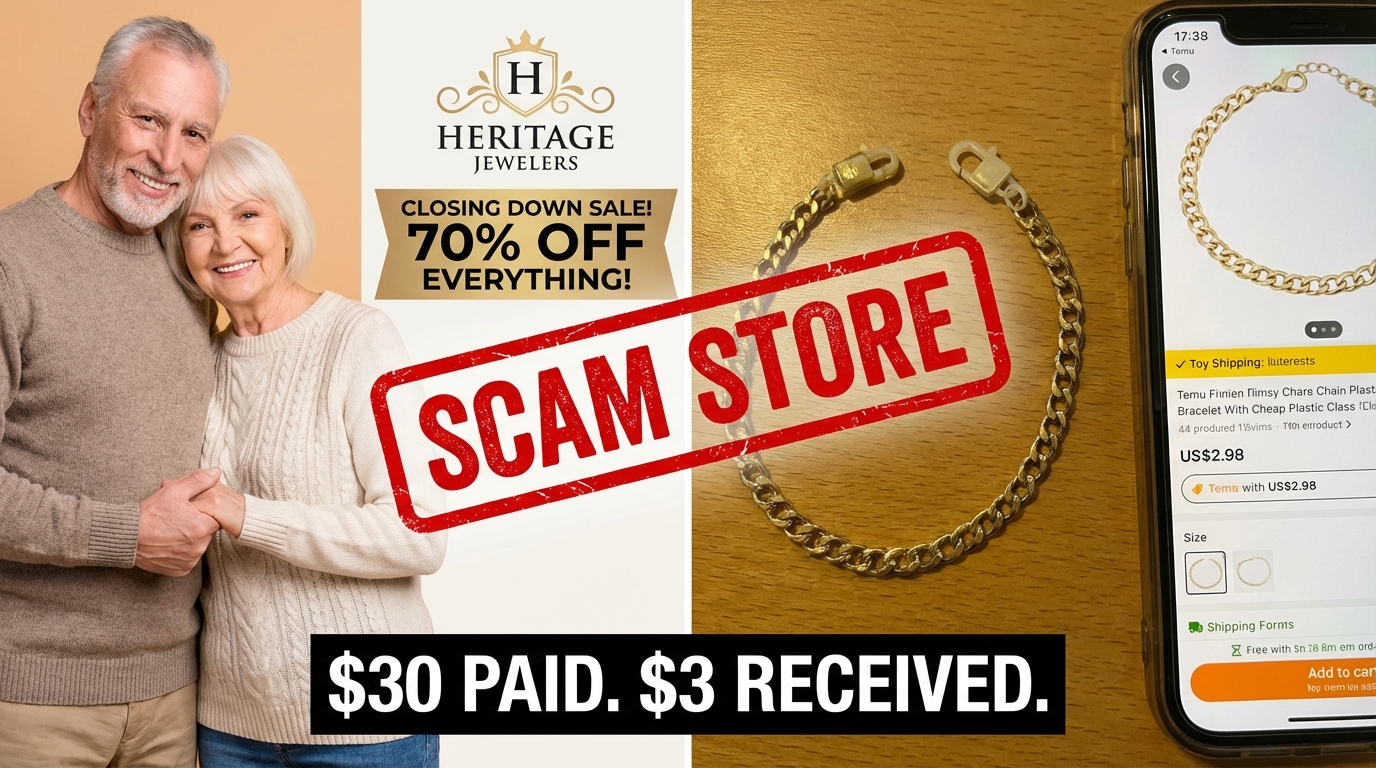
- Customers report paying £30+ for items worth under £4 on Temu
- The domain was registered in 2025, despite claims of being a 33-year-old family business
- Products are sourced from Chinese mass-market platforms like AliExpress and Temu, then resold at inflated prices
- Many buyers report receiving nothing at all, with refund requests ignored
These sites typically run emotional ads on Facebook, YouTube, and TikTok featuring a fictional elderly couple — "Maya and Henry" — claiming to be retiring and liquidating their handmade jewelry collection at 80% off. It's a compelling story. And it's almost certainly fake.
One reviewer summed it up bluntly after receiving a bracelet: they paid £33 and found the identical item on Temu for £3.89.
For anyone who values protecting their personal and financial data online, this kind of scam is a double threat — not just to your wallet, but to your privacy.
Anatomy of the Maya and Henry Jewelry Scam
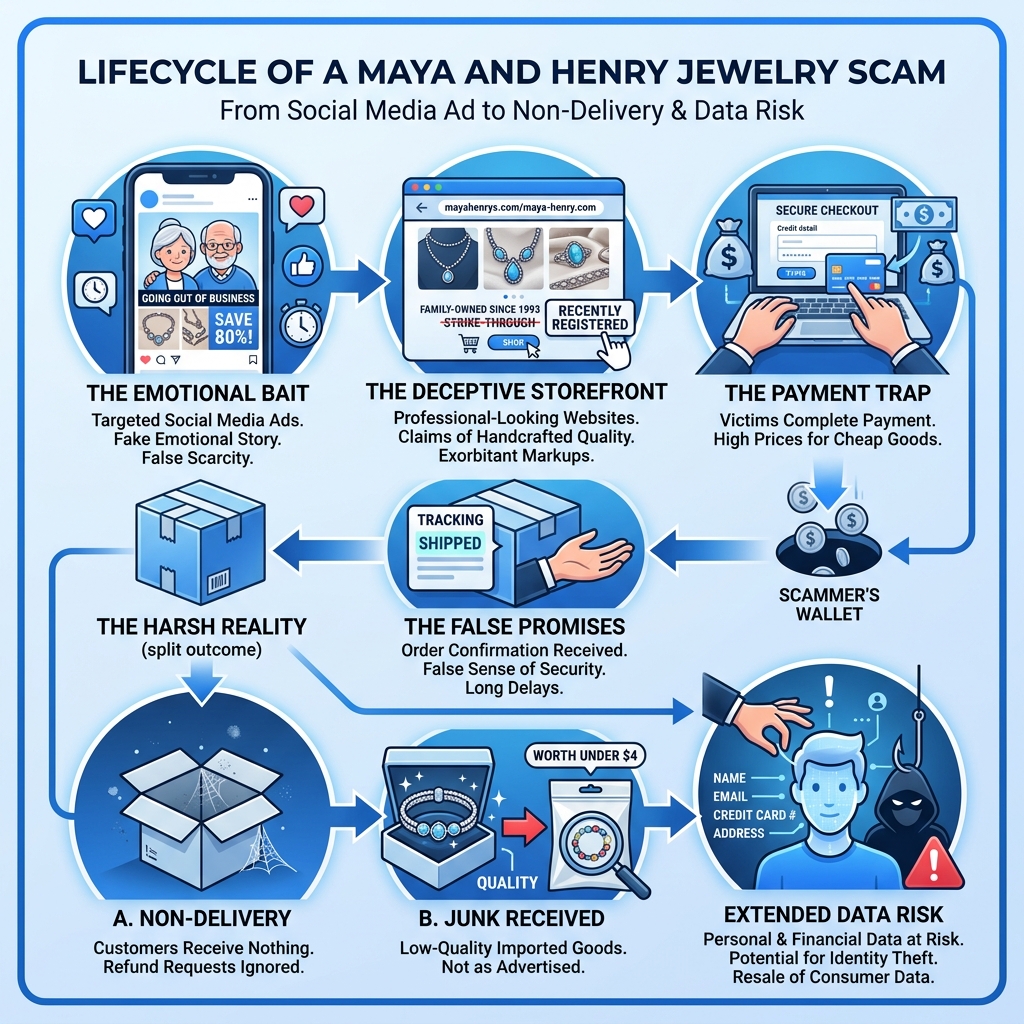
To understand how the maya and henry jewelry scam works, we have to look at the "bait." Most victims don't stumble upon these websites by accident; they are lured in by highly targeted social media advertisements. These ads are designed to pull at your heartstrings while simultaneously triggering a "fear of missing out" (FOMO) through massive discounts.
The scam operates through a network of interchangeable websites. When one domain gets too many negative reviews or is flagged by payment processors, the scammers simply migrate to a new one, such as maya-henry.com, mayahenrys.com, or maya-henry-jewelry.com. This rebranding cycle allows them to stay one step ahead of consumer protection agencies.

According to investigations into the Maya & Henry Jewelry Scam Store: What You Need To Know, these sites are often part of larger China-based scam networks. They use a professional-looking e-commerce "veneer" to hide the fact that they have no physical inventory, no workshop, and no intention of providing high-quality goods.
The Fake Narrative Behind the Maya and Henry Jewelry Scam
The "hook" of this scam is a classic emotional play. The ads often feature a video or images of a sweet-looking elderly couple. The story claims that Maya and Henry have run a family jewelry business for 33 years and are now retiring. Because they are "closing down," they are allegedly selling off their "handmade, solid gold" jewelry at 80% or 90% off.
However, eagle-eyed shoppers have noted several inconsistencies:
- AI-Generated Content: Some videos use AI-generated voices or deepfake technology. One reviewer noted the narrator had a British accent while the brand claimed to be an American family business.
- Stolen Identities: The "couple" in the photos are often models or actors whose images have been scraped from stock photo sites or unrelated news articles.
- Impossible Math: A business cannot survive for 33 years and then suddenly sell solid gold for $20. The price of gold is a global commodity; selling it at 90% off would mean the business is losing massive amounts of money on every single sale.
From Social Media Ads to Non-Delivery
The maya and henry jewelry scam thrives on platforms like Facebook, YouTube, and TikTok. These platforms allow scammers to target specific demographics—often elderly users who may be less familiar with modern dropshipping red flags.
Once you click the ad, you are met with high-pressure tactics:
- Urgency Timers: "Sale ends in 12:00 minutes!" or "Only 3 items left in stock!"
- Fake Social Proof: Pop-ups claiming "Sarah from New York just bought a tennis bracelet!"
- Ghosting: After you enter your credit card details and complete the purchase, you might receive a professional-looking order confirmation. But then, the trail goes cold. Emails to customer support go unanswered, or you receive automated replies promising that your "handmade" item is still in production.
Analyzing the Red Flags: Why Mayahenrys.com is Fraudulent
When we dig into the technical data of these sites, the "33-year-old family business" story falls apart instantly. Verification of domain age is one of the most powerful tools in your arsenal.
| Claim | Verifiable Fact |
|---|---|
| 33 Years in Business | Domain registered in late 2024 or early 2025 |
| Handmade in USA/Italy | Items ship from mainland China |
| Solid 18k Gold | Cheap base metal or "gold-plated" plastic |
| Thousands of Happy Customers | 100% 1-star ratings on independent review sites |
The Maya Henry Reviews | Read Customer Service Reviews of maya-henry.com reveal a consistent pattern of deception. While the scammers try to bury negative feedback with fake positive reviews, the genuine experiences are harrowing.
Trustpilot Ratings and the Maya and Henry Jewelry Scam
Trustpilot is often the first place shoppers go to check a site's legitimacy. For mayahenrys.com, the results are damning: a TrustScore of 2.1 out of 5, with nearly every single verified review being 1-star.
Why is the score not a 1.0? Scammers often use "review farms" to post hundreds of fake 5-star ratings. These reviews are usually short, generic ("Great service!", "Love my ring!"), and posted in large batches. In contrast, the 1-star reviews are detailed, describing skin rashes from cheap metals, shipping delays of over two months, and the discovery of identical items on Temu for a fraction of the price.
Identifying Stolen Content and Anonymous Ownership
A major red flag for the maya and henry jewelry scam is the lack of transparency. If you look at the "About Us" or "Legal" pages on these sites, you'll often find they are carbon copies of other known scam sites. They use the same phrasing, the same typos, and the same vague return policies.
Furthermore, these sites almost never list a physical business address. If they do, it's often a residential home or a vacant lot. They hide their ownership details using WHOIS privacy services, making it impossible to know who is actually running the site. This is a classic hallmark of a Phishing Scam where the goal is to harvest your data and money without any accountability.
Common Tactics: Cheap Imports and Inflated Prices
The most common outcome of the maya and henry jewelry scam isn't actually "nothing"—it's the delivery of "trash." This is known as a bait-and-switch. You think you're buying a $500 gold necklace for $50, but you receive a $2 piece of copper-plated plastic that turns your neck green within an hour.
According to the Maya & Henry Jewelry Store Review: Legit Or Scam? Read This Before Shopping! – Infoquu, these items are mass-produced in factories in China and dropshipped directly to the consumer. The scammers never even touch the product. They simply act as a middleman with a 1,000% markup.
The "Closing Down" Loophole
Have you ever noticed that some stores seem to be "closing down" for years? The maya and henry jewelry scam uses this psychological trigger to bypass your critical thinking. By claiming they are retiring, they provide a "logical" reason for why the prices are so low.
"Oh, they aren't scammers," a victim might think, "they're just an old couple who wants to clear their stock." This narrative lowers your guard. In reality, the "sale" never ends. The countdown timer resets every time you refresh the page.
Payment Exploitation and the PayPal Loophole
Scammers have become experts at gaming the systems designed to protect us. One particularly nasty tactic involves a "PayPal loophole." The scammer will ship a small, worthless item (like a plastic bead) to a random address in your same zip code.
When you file a dispute with PayPal or your bank, the scammer provides the tracking number showing "Delivered to your city." Because the automated system sees a delivery confirmation for your area, it may automatically close the case in the scammer's favor. This is why it's critical to monitor for Paypal Scam Emails and understand that a tracking number doesn't always equal a legitimate delivery.
How to Recover and Protect Your Identity
If you've already fallen for the maya and henry jewelry scam, don't be embarrassed. These people are professionals who spend all day figuring out how to trick honest people. The important thing is to act quickly to minimize the damage.
The first step is gathering evidence. Save copies of your order confirmation, screenshots of the advertisement you saw, and any communication (or lack thereof) with the store. You will need these when you contact your financial institution.
Immediate Steps After a Maya and Henry Jewelry Scam Purchase
- Contact Your Bank: Call the number on the back of your card immediately. Tell them you have been a victim of an "online shopping scam" or "non-delivery of goods." Request a chargeback.
- Cancel Your Card: If you entered your CVV and expiration date on a site like mayahenrys.com, your card is now "compromised." Scammers often sell these card details on the dark web months after the initial purchase. Get a new card with a new number.
- Report the Fraud: File a report with the FTC at reportfraud.ftc.gov or, if you're in the UK, with Action Fraud. This helps authorities track the network and eventually shut down the domains.
- Secure Your Accounts: If you used the same password for the scam site as you do for your email or bank, change it immediately. Enable Two-Factor Authentication (2FA) on all sensitive accounts. You can learn more about this in our guide on how to report phishing emails.
Using Privacy Tools to Prevent Future Fraud
The best way to deal with a scam is to never let them have your real information in the first place. This is where we at Tempo Mail USA come in. When you shop at a new or unfamiliar online store, you are taking a risk with your Personal Identifiable Information (PII).
By using a temporary email alias from Tempo Mail USA, you create a secure "firewall" between your real identity and the merchant.
- Privacy Protection: If the site turns out to be a scam, they only have your alias, not your primary email address.
- Spam Prevention: Scammers often sell their "sucker lists" (emails of people who actually bought something) to other fraudsters. If you use an alias, you can simply delete it and stop the influx of Docusign scam warnings or other phishing attempts.
- Data Breach Security: Even if a store is legitimate, they can still be hacked. Using an alias ensures your real email isn't leaked in a database breach.
Learning how to spot phishing emails is your first line of defense, but privacy tech is your safety net.
Frequently Asked Questions about the Maya and Henry Jewelry Scam
Is the jewelry from Maya and Henry real gold?
Based on hundreds of customer reviews and metallurgical tests reported by victims, the answer is almost certainly no. Most items are made of base metals like brass or zinc with a very thin "flash" of gold-colored plating. Many customers report the jewelry tarnishing, turning skin green, or failing a simple magnet test (real gold is not magnetic; many of these cheap alloys are).
Why does the "closing down" sale never end?
Because it's not a real sale. It is a psychological manipulation tactic designed to create urgency. The "retirement" of Maya and Henry is a fictional story used to explain away prices that are too good to be true. In reality, the site is a permanent storefront for cheap Chinese imports.
Can I get a refund if I was scammed?
Getting a refund directly from the scammers is nearly impossible. They may offer you a "20% partial refund" if you agree to keep the cheap item, or they may tell you that you have to ship the item back to China at your own expense (which often costs more than the item itself). Your best bet for a full refund is a chargeback through your credit card provider or PayPal.
Conclusion
The maya and henry jewelry scam is a reminder that the digital world requires a high level of "digital hygiene." While the ads are heartwarming and the prices are tempting, the reality is a cold, calculated operation designed to separate you from your money and your data.
By staying informed, looking for red flags like 2025 domain registrations and stolen imagery, and using privacy tools like Tempo Mail USA, you can enjoy the convenience of online shopping without the risk. Always remember: if a deal looks like a once-in-a-lifetime retirement sale from a couple you've never heard of, it's probably just a scammer looking for their next target.
Stay safe, shop smart, and protect your privacy.
Need a disposable temporary email?
Protect your real inbox from spam and promotional clutter instantly and free.
Received a suspicious email, text, or charge alert?
Verify whether the sender domain is disposable, spoofed, or unverified before clicking links.