



Why Spectrum Scam Calls Are Targeting Millions of Customers
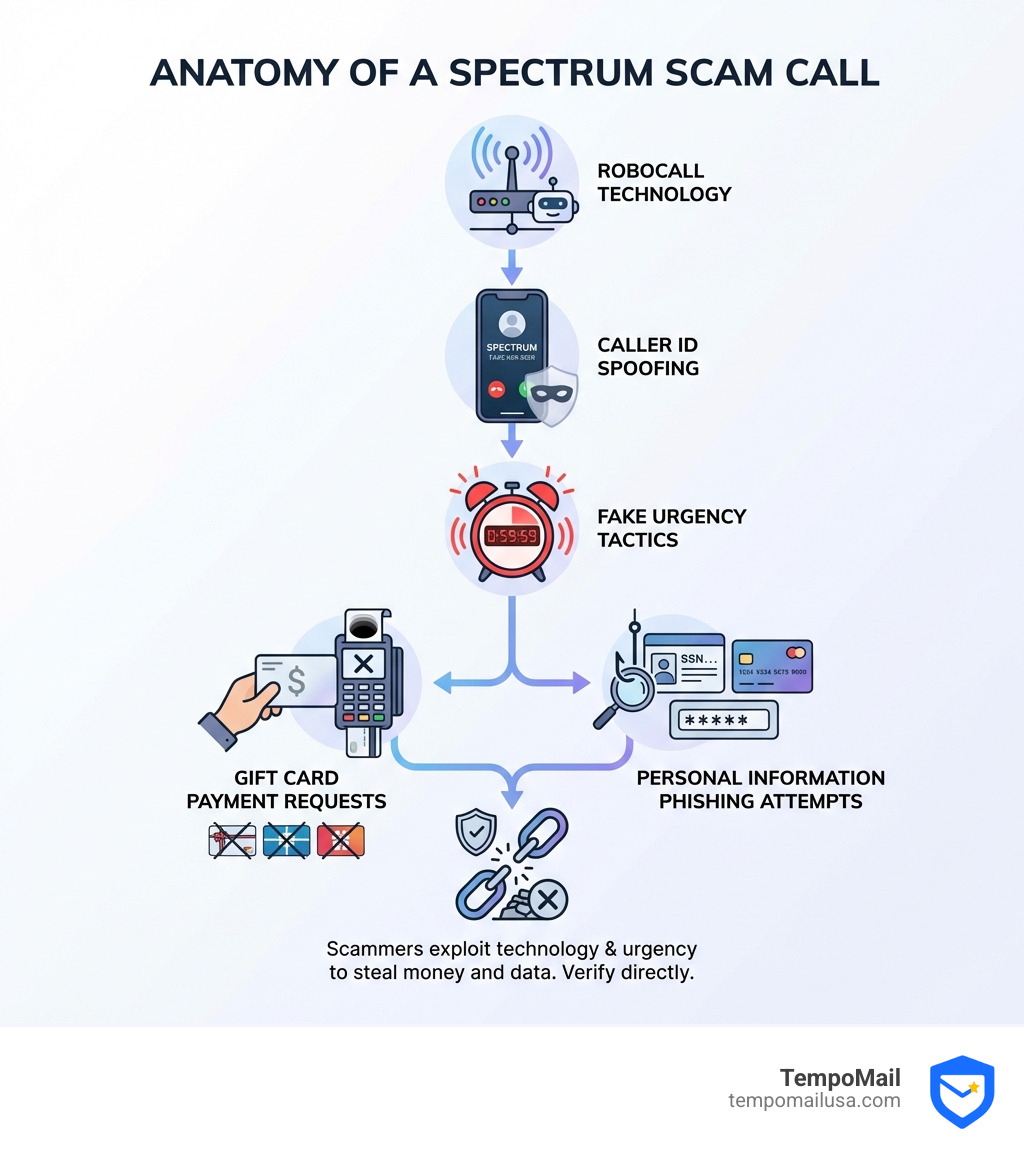
Spectrum scam calls are phishing attempts where fraudsters impersonate Spectrum customer service representatives to steal money and personal information from unsuspecting customers. These scammers typically claim you're about to lose a 50% discount on your bill and pressure you to pay immediately using untraceable methods like gift cards.
Key warning signs of Spectrum scam calls:
- Caller claims you're losing a 50% discount you never had
- Demands immediate payment via gift card or wire transfer
- Creates artificial urgency with fake deadlines
- Asks for Social Security numbers or banking information
- Uses caller ID spoofing to appear legitimate
- Requests prepayment for several months of service
- Threatens service termination if you don't act now
Unfortunately, spam calls are increasing due to robocall technology, and scammers have been running these schemes for years by pretending to be different cable companies. The "Spectrum discount" variation specifically targets customers' desire to keep their internet bills low—a vulnerability that fraudsters exploit ruthlessly.
When you call back a scam number, you'll likely reach someone claiming to be Spectrum customer service who insists the only way to keep your discount is through immediate gift card payment. This is always a scam. Legitimate companies never request payment through gift cards, and banks, courthouses, or government agencies will never call requesting your personal banking information or Social Security number.
These phishing attacks always include some kind of "deadline," which is one of the most obvious red flags that something isn't right. Bad actors have perfected caller ID spoofing—deliberately falsifying the information transmitted to your caller ID display—making these scams harder to spot at first glance.
I'm Mohammad Waseem, and through my work building privacy-focused platforms and testing security tools, I've analyzed countless spectrum scam calls and their evolving tactics to help users protect their personal information. This guide will show you exactly how to identify these scams before they cost you money or compromise your identity.
Understanding the 'Spectrum Discount' Scam
The most prevalent variation of spectrum scam calls involves a too-good-to-be-true offer: a 50% discount on your monthly bill. We've seen this tactic used across the country, where fraudsters contact people—usually via an automated phone call—to alert them that they are at risk of losing a massive discount.
The scam works through a calculated process of prepayment fraud. Once the scammer has you on the line, or once you call back the number provided in a voicemail, you are connected to a fake representative. This individual will confirm that you have been "selected" for a promotion but claim that to "lock in" the rate, you must prepay for several months of service—usually six to twelve months.
The kicker? They will insist that this payment be made using gift cards (like Target, eBay, or Amazon cards). They might even direct you to a local retail store to purchase these cards while staying on the phone with you. This is a massive red flag. Legitimate companies have sophisticated billing systems and will never ask you to go to a pharmacy to buy a gift card to pay your internet bill.
According to research on ‘Spectrum Discount’ Calls Are a Scam—Here’s How to Spot Real Savings, bad actors have been running these sketchy schemes for years, regularly pretending to be with different cable companies or streaming services to maximize their chances of duping customers. They rely on the fact that internet prices are rising, and most people are eager to find ways to save money.
7 Red Flags of Spectrum Scam Calls
To protect ourselves, we need to recognize the "tells" that scammers leave behind. While robocall technology has made these calls sound more professional, certain behaviors are exclusive to criminals.
- Neighbor Spoofing: Scammers can change caller ID to make a call look like it’s from a local area code. If the caller’s area code and first three numbers match your own, it’s likely a scammer using "neighbor spoofing" to increase the likelihood that you'll pick up.
- The "Can You Hear Me?" Trick: If an unknown caller asks, "Can you hear me?" or "Do you pay most of the bills in your home?", say nothing and hang up. They may be trying to record you saying "Yes" to authorize fraudulent charges later.
- Requests for Social Security Numbers: Legitimate service providers already have your account details. If a caller asks for your SSN or full banking details to "verify" a discount, it is a phishing attempt.
- Wire Transfer Demands: Scammers prefer wire services because once the money is sent, it is nearly impossible to recover.
- Gift Card Payments: This is the single biggest indicator of a scam. No legitimate utility or telecommunications company accepts gift cards as a form of payment.
- High-Pressure Deadlines: Phishing attacks always include some kind of “deadline.” If they say the offer expires in the next hour, they are trying to bypass your critical thinking.
- Unsolicited "Thank Yous": Sometimes scammers will thank you for a prior donation or payment you never made, hoping you'll engage to "correct" the record.
If you find yourself wondering Why Am I Getting So Many Spam Calls?, it’s often because your phone number has been leaked in a data breach or sold by a third-party aggregator.
Identifying Phishing and Vishing Tactics in Spectrum Scam Calls
In cybersecurity, we use the term "vishing" (voice phishing) to describe these spectrum scam calls. Unlike a standard email scam, vishing uses the human voice to create a sense of trust or fear.
Fraudulent voicemails are a common entry point. You might receive a message that sounds perfectly professional, complete with hold music and a "representative ID number." These messages often claim there is an "urgent issue" with your account or a "limited-time promotion" that requires an immediate callback.
Scammers often target well-meaning people who want to provide aid to those affected by natural disasters or pandemics. During these times, they may pivot their scripts to offer "COVID-19 relief discounts" or "disaster recovery credits." If you're unsure what a call means, you should check out What Does Potential Spam Call Mean? Get the Facts to better understand how your carrier labels these threats.
Common Scripts Used in Spectrum Scam Calls
Scammers follow a script designed to manipulate your emotions. Here is a comparison of how a scam call typically sounds versus a legitimate interaction with Spectrum.
| Feature | Scammer Script | Legitimate Spectrum Call |
|---|---|---|
| Opening | "Your 50% discount is expiring today. Call now to save it." | "We're calling to follow up on your recent service appointment." |
| Verification | "Please provide your full Social Security number to continue." | "Please provide the last 4 digits of your account or your security code." |
| Payment Method | "Go to the store and buy a $300 Target gift card to prepay." | "You can pay via our secure app, website, or over the automated phone system." |
| Urgency | "If you don't pay in 30 minutes, your internet will be cut off." | "Your bill is past due. Please make a payment at your earliest convenience." |
| Contact Info | "Call this specific 1-800 number (not listed on your bill)." | "You can reach us at the number listed on your monthly statement." |
The "retention department" impersonation is particularly clever. They know that savvy customers often call the retention department to negotiate lower rates. By pretending to be from that department, they lead you to believe you’ve already won the negotiation. To stay safe, you should read Stop Spam Calls: How to Protect Yourself.
What to Do if You Receive a Suspicious Call
If you pick up the phone and hear a script about a 50% discount or a threat to terminate your service, follow these steps immediately:
- Hang Up: Don't try to outsmart the scammer or engage in conversation. Any engagement confirms that your number is "active," which will only lead to more calls.
- Block the Number: Use your phone’s built-in blocking features. For those on Apple devices, learning How to Get Rid of Spam Calls on iPhone can significantly reduce the noise.
- Check Your Official Account: Log into the official Spectrum website or mobile app. If there is a real problem with your bill, it will be listed there.
- Call the Official Number: Only use the customer service number printed on your actual paper bill or the official Spectrum.net website. Avoid using Google search to find customer service numbers, as scammers sometimes pay for ads to place fake support numbers at the top of search results.
- Use Call Guard: Spectrum offers a feature called Call Guard for wireline customers that automatically detects and labels high-risk calls. You can find more info on How to Avoid and Block Robocalls.
How to Secure Legitimate Spectrum Discounts Safely
We all want to save money, and the good news is that you can get legitimate discounts from Spectrum—you just have to do it the right way.
To secure a real discount, call the official Spectrum customer service line and ask to speak with the Retention Department. This department's job is to keep customers from switching to competitors. Be polite but firm; mention that your current bill is becoming difficult to manage and ask if there are any new promotions or "loyalty discounts" available for your account.
Legitimate discounts will be applied directly to your monthly statement. You will never be asked to "prepay" for a discount using a third-party payment method.
For those looking for technical help in managing these interruptions, check out the Stop Spam Calls Now: Top Free Blocker App for Android Users guide. By using legitimate tools, you can filter out the noise and focus on actual savings.
Frequently Asked Questions about Spectrum Scams
What happens if I call back a scam number?
If you call back a number from a spectrum scam calls voicemail, you will be connected to a fraudulent call center. These centers are designed to sound professional. The risk is twofold: first, they will try to pressure you into a high-payment scam involving gift cards. Second, they will attempt to collect "verification" data—your birthdate, SSN, or address—which can be used for identity theft. Furthermore, by calling back, you signal to the scammers that you are a "live lead," which may result in your number being sold to other criminal groups.
Where can I report Spectrum scam calls?
Reporting these calls is vital for helping authorities track down the infrastructure used by scammers. You should report incidents to:
- The FTC: Visit FTC.gov/complaint to file a formal report.
- The FCC: File a report to help the government track robocall patterns.
- Spectrum: Use the Spectrum.net Scam and Fraud Alerts page to report the specific number that called you.
- Local Law Enforcement: If you have actually lost money, you should file a police report.
Does Spectrum ever ask for payment via gift cards?
Absolutely not. This is a hard rule. No reputable telecommunications company, utility provider, or government agency will ever ask for payment via gift card, cryptocurrency, or wire transfer. These methods are preferred by scammers because they are untraceable and cannot be reversed. Legitimate Spectrum payments are made through their website, the My Spectrum app, over the phone using their automated system, or via mail with a check.
Conclusion
Navigating the digital world requires a new kind of vigilance. Spectrum scam calls are just one facet of a larger problem where our personal data is used against us. Scammers rely on the fact that our phone numbers and emails are often tied directly to our real-world identities, making us easy targets for high-pressure phishing.
At TempoMail USA, we believe the best way to stop a scam is to prevent the scammer from ever getting your information in the first place. We operate in the cybersecurity and privacy industry, providing identity proxying services that act as a firewall for your life. By generating secure aliases, we protect your Personally Identifiable Information (PII) from being harvested by the very services that eventually leak your data to scammers.
Think of us as a digital shield. When you use our secure aliases, you're not giving out your real phone number or email to every service that asks for it. This significantly reduces your footprint and makes it much harder for robocallers to find you. Protecting your digital identity is the first step toward a spam-free life.
Protect your digital identity with TempoMail USA and take control of your privacy today. Stay safe, stay skeptical, and never pay for a "discount" with a gift card!