

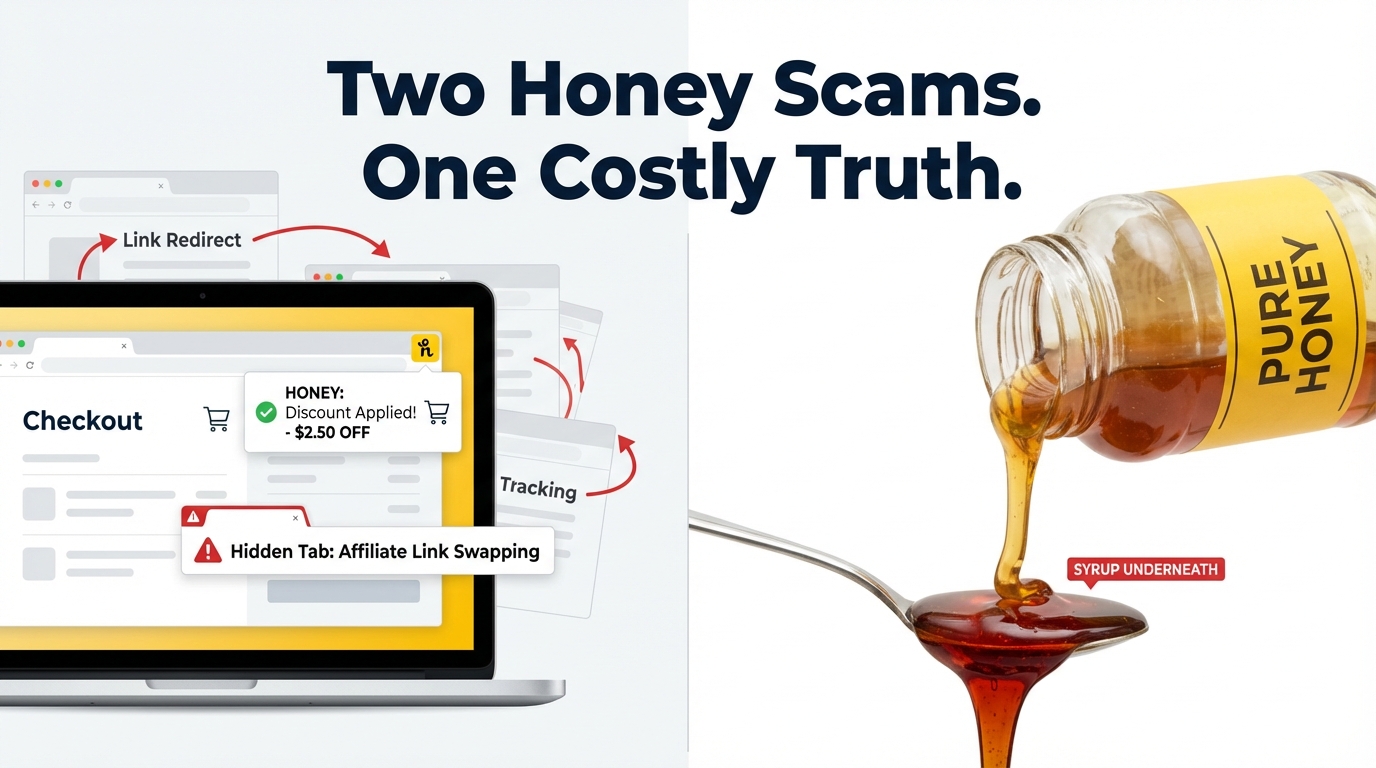

Two Very Different "Honey Scams" You Need to Know About
The term honey scam actually refers to two completely separate — but equally important — problems happening right now.
Here is a quick breakdown:
| Type | What It Is | Who It Affects |
|---|---|---|
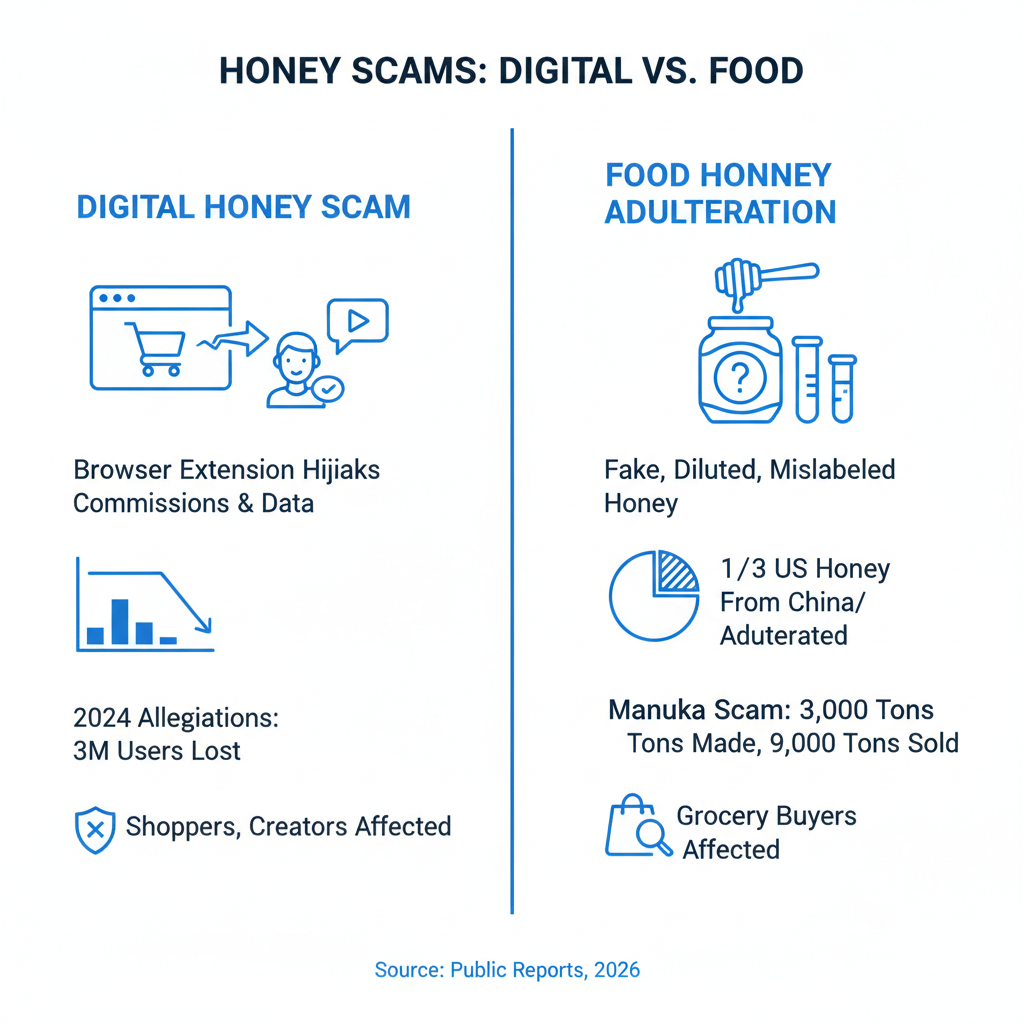
| Digital Honey scam | PayPal's Honey browser extension allegedly hijacking affiliate commissions and collecting user data | Shoppers, content creators, online publishers |
| Food honey scam | Fake, adulterated, or mislabeled honey sold in stores and online | Anyone buying honey at a grocery store or online |
Both are real. Both cost people money. And both are worth understanding before you get caught out.
The digital side exploded in late 2024 when YouTuber MegaLag published an investigation accusing the Honey browser extension — owned by PayPal — of secretly swapping out affiliate links at checkout. The result? Content creators lost commissions they had rightfully earned, and users missed out on better discount codes. Within two weeks of the allegations going public, Honey lost approximately 3 million of its 20 million users.
On the food side, the problem is older but just as widespread. Research suggests that up to one third of honey sold in the U.S. may originate from China, and a significant portion of that has been adulterated with cheap sugar syrups. Fake Manuka honey is especially rampant — New Zealand's Manuka industry produces around 3,000 tons per year, yet reported global sales reach roughly 9,000 tons. That math does not add up.
There is also a third wrinkle: a product called "Honey 2.0" — a food product with no connection to the PayPal extension — has been deliberately named to piggyback on search traffic from the browser extension controversy, adding another layer of confusion for consumers.
This guide cuts through all of it.
The Digital Honey Scam: How the Browser Extension Works
The PayPal Honey browser extension has long been marketed as a "must-have" tool for savvy shoppers. The promise is simple: install the extension, and it will automatically find and apply the best coupon codes at checkout. For years, it was the darling of the internet, fueled by massive marketing partnerships with mega-influencers like MrBeast and even sponsorships with NBA teams like the LA Clippers.
However, the mechanics behind this "free" service have come under intense scrutiny. Honey operates within affiliate marketing. When you click a link from a blogger or a YouTuber to buy a product, that creator usually gets a small commission. This is tracked via "cookies" in your browser. Honey’s business model relies on inserting its own affiliate cookie so that it gets the commission instead of the person who actually recommended the product to you.
While this is a common industry practice known as "last-click attribution," allegations have surfaced that Honey goes much further, using deceptive tactics to ensure it always wins the commission, even when it provides no value to the consumer. This isn't just a simple tech glitch; it’s a systematic approach to rerouting money. If you're interested in how other digital platforms might be misleading users, you can read the complete guide to AI.com and whether it is a scam.
Allegations of Affiliate Hijacking and Cookie Swapping
The controversy reached a boiling point following a deep-dive investigation by YouTuber MegaLag. The core of the honey scam allegation involves "cookie swapping" or "cookie stuffing."
According to the investigation, Honey uses a technique where it opens a tiny, nearly invisible browser tab during the checkout process. This tab loads Honey’s own affiliate link, effectively overwriting any previous cookies from other creators. Because most affiliate networks use a "last-click" model—where the last referral link clicked gets 100% of the credit—Honey essentially "steals" the commission at the very last second.
This practice has a devastating impact on influencers and small publishers. A creator might spend hours reviewing a product, only for Honey to swoop in at the finish line and take the paycheck. Even more concerning were reports that Honey would sometimes ignore valid 50% off codes that were publicly available, instead applying a much smaller discount (or none at all) just to ensure its affiliate cookie was set.
This behavior has led many to question the ethics of "free" extensions. As the saying goes, "if you aren't paying for the product, you are the product." For more on similar platforms that have faced skepticism, check out our article on whether Freecash.com is a scam.
The Impact of the PayPal Honey Scam Controversy
The fallout from these allegations was swift and severe. Trust is the currency of the internet, and Honey’s bank account started running dry. By the end of 2025, Honey had lost approximately 8 million users on the Chrome Web Store alone.
The controversy didn't just stay on YouTube; it moved into the courtrooms and the offices of big tech regulators.
- Google's Response: In response to the outcry, Google updated its Chrome extension policies. The new rules specifically prohibit extensions from claiming affiliate commissions if they do not provide a clear, manual interaction or a legitimate discount to the user.
- Lawsuits: High-profile content creators, including Legal Eagle and GamersNexus, became involved in class-action lawsuits against PayPal. They allege that Honey's practices constitute "unjust enrichment" and "intentional interference" with their business contracts.
- Regulatory Eyes: Even the U.S. Food and Drug Administration research on honey highlights how "economically motivated adulteration" is a problem in the physical world, mirroring the "digital adulteration" critics say Honey performed on the affiliate market.
The "Honey 2.0" and Food Adulteration Crisis
While the tech world was reeling from the PayPal scandal, a different kind of honey scam was quietly spreading through pantries across the country. This is known as "Economically Motivated Adulteration" (EMA).
The most recent offender is a product marketed as "Honey 2.0." This product is a masterclass in deceptive SEO. By using the "2.0" tech-style naming, the scammers hijacked search traffic from people looking for the Honey browser extension. However, what they delivered was far from "sweet."
Testing by Dr. Torres’ team on "functional honey" products—including those marketed as Honey 2.0—found that 36 out of 41 products failed basic purity screenings. Many were found to be mostly high-fructose corn syrup (HFCS) or cane sugar, with very little actual honey produced by bees. You can read more about this specific Honey 2.0 exposure and why you should stop falling for it.
Identifying Fake Manuka and the Global Honey Scam
The most expensive honey in the world, Manuka honey, is also the most frequently faked. Because it commands premium prices (often $50+ per jar), it is a "golden opportunity" for scammers.
The statistics are staggering:
- Production vs. Sales: New Zealand produces 3,000 tons of Manuka annually, but 9,000 tons are sold globally. This means two-thirds of Manuka honey is fake.
- Honey Laundering: To bypass U.S. import restrictions on cheap, low-quality honey from China, scammers often "launder" the honey. They ship it to a third country (like India or Vietnam), relabel it, and then send it to the U.S. as "pure" honey.
- Ultra-Filtration: About 75% of honey sold in supermarkets has been "ultra-filtered." This process removes all pollen. While it makes the honey look clear and prevents crystallization, it also makes it impossible to track where the honey came from, allowing scammers to hide the fact that it’s actually cheap Chinese syrup.
This level of deception is not unique to the food industry. We've seen similar patterns of misleading marketing in fast fashion; for instance, see our in-depth guide to Shein safety and scam risks.
How to Avoid the Food-Based Honey Scam
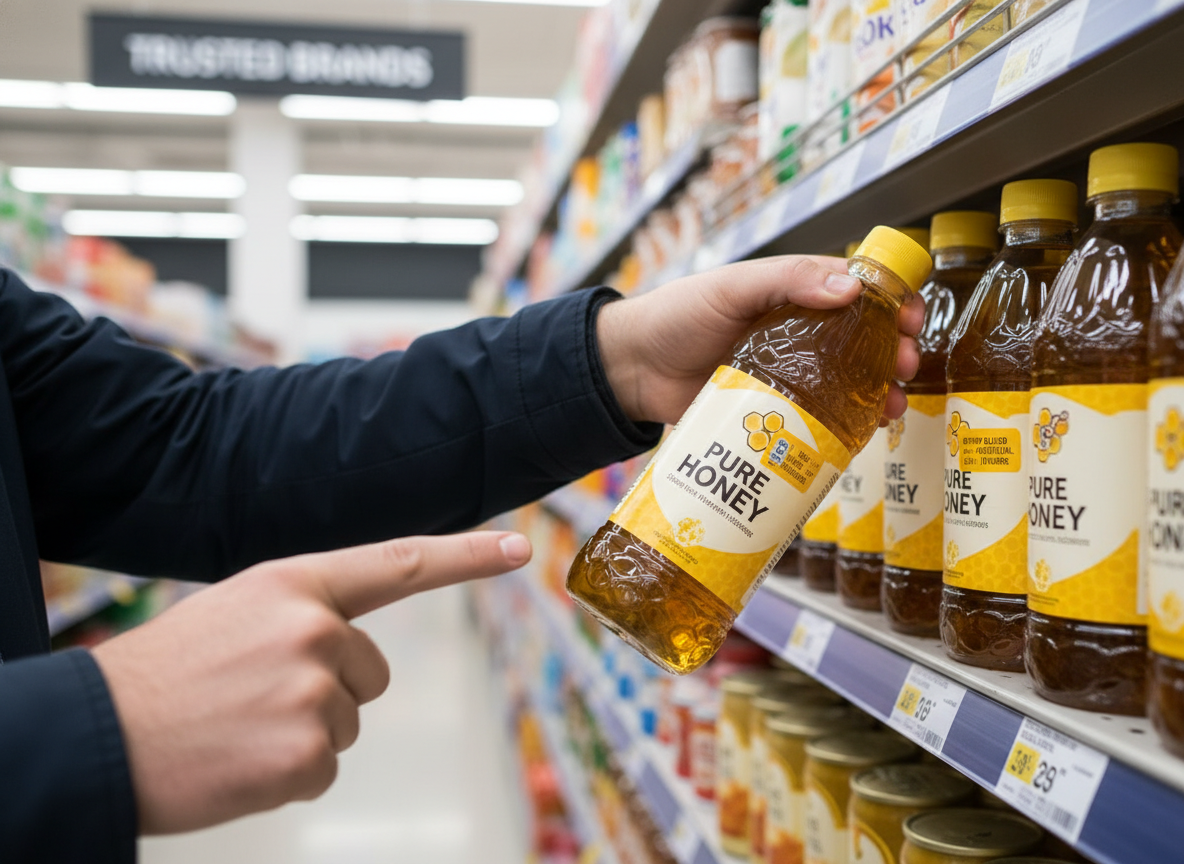
Protecting yourself from the food-based honey scam requires a bit of detective work. You cannot always trust the "Pure Honey" label on the front of the bottle, as these terms are largely unregulated in the U.S.
Here are our top tips for finding the real deal:
- Check the Ingredients: It should say "Honey" and nothing else. If you see "corn syrup," "cane sugar," or "sweeteners," put it back.
- Look for Crystallization: Real honey eventually turns solid and grainy. If your honey has been sitting in the cupboard for a year and is still perfectly liquid, it’s likely been adulterated or ultra-filtered.
- Buy Local: The best way to ensure purity is to buy directly from a beekeeper at a farmers' market. Local honey also contains local pollen, which may help with seasonal allergies.
- True Source Certification: Look for the "True Source Honey" seal, which indicates the honey has been voluntarily audited for transparency and origin.
Legal Battles and Industry Responses
The legal landscape for the digital honey scam is still shifting. PayPal has defended its practices, stating that it follows standard affiliate marketing rules. However, under pressure, they did disable certain "evasion codes" within the extension that were allegedly designed to hide Honey's activities from affiliate networks.
| Claim | Reality |
|---|---|
| "Finds every working code" | Often suppresses better codes to protect affiliate deals |
| "Saves you money" | May lead to higher prices by overriding better creator-exclusive codes |
| "Privacy first" | Collects extensive data on browsing and shopping habits |
| "Free to use" | Costs you in privacy and costs creators in commissions |
The class-action lawsuits, such as Latina Tradwife v. PayPal Holdings, continue to move through the courts. These cases are pivotal because they will define whether a browser extension has a "fiduciary duty" to the user or if it can prioritize its own profits at the user's expense. If you're interested in other legal investigations into data-heavy companies, read our truth about the Luce Research scam.
Frequently Asked Questions about Honey Scams
Is the Honey extension safe to use?
Technically, the extension is "safe" in that it won't install a virus on your computer. However, from a privacy perspective, it is invasive. It requires permission to "read and change all your data on the websites you visit." This allows PayPal to track your shopping habits, even if you don't use a coupon. If you value your digital footprint, using a tool like Tempo Mail USA to create aliases can help shield your real identity from these types of trackers.
How can I tell if my honey is real or fake?
Beyond checking for crystallization, you can try the Water Test. Drop a spoonful of honey into a glass of water. Real honey is dense and will sink to the bottom in a lump. Fake or adulterated honey will start to dissolve almost immediately. Also, be wary of "bargain" prices. If a jar of "Manuka" honey is only $10, it is almost certainly a scam.
What happened to the Honey user base?
The "MegaLag effect" was real. Honey lost approximately 15% of its user base in the immediate aftermath of the scandal. While it still has millions of users, its reputation among the tech-savvy community and content creators has been severely damaged. Many users have switched to more transparent alternatives or simply started searching for codes manually to ensure their favorite creators get the commission.
Conclusion
Whether it's a digital tool "adulterating" your checkout process or a shady supplier diluting your breakfast, the honey scam reminds us that we must stay vigilant. In both cases, the scam relies on the consumer being too busy to check the "fine print"—whether that's a browser's cookie log or a food's country of origin.
At Tempo Mail USA, we believe your privacy and identity are your most valuable assets. Just as you should be careful about what you put into your body, you should be equally cautious about what you "install" into your digital life. Using temporary email aliases and identity shielding tools acts as a PII (Personally Identifiable Information) firewall, ensuring that even if a service you use is caught in a controversy, your real identity remains protected.
Stay sweet, stay safe, and always read the label.