


Why Endpoint Protection Machine Learning Is Now a Front-Line Defense
Endpoint protection machine learning is the use of AI-trained models to detect, block, and respond to cyber threats on devices like laptops, phones, servers, and IoT — before damage occurs. Here's a quick snapshot of what you need to know:
- What it does: Replaces static virus signatures with adaptive models that learn from behavior patterns
- Why it matters: Traditional antivirus misses zero-day threats, fileless malware, and advanced persistent threats (APTs)
- How it works: ML analyzes billions of data points to flag anomalies — like a user suddenly accessing sensitive files at 2 a.m.
- Key benefit: AI-based security systems identify threats correctly up to 90% of the time, outperforming older methods
- Who needs it: Any organization or individual whose devices connect to the internet — which is everyone
Every device you own is a potential entry point for attackers. Laptops, phones, smart home gadgets — they're all targets.
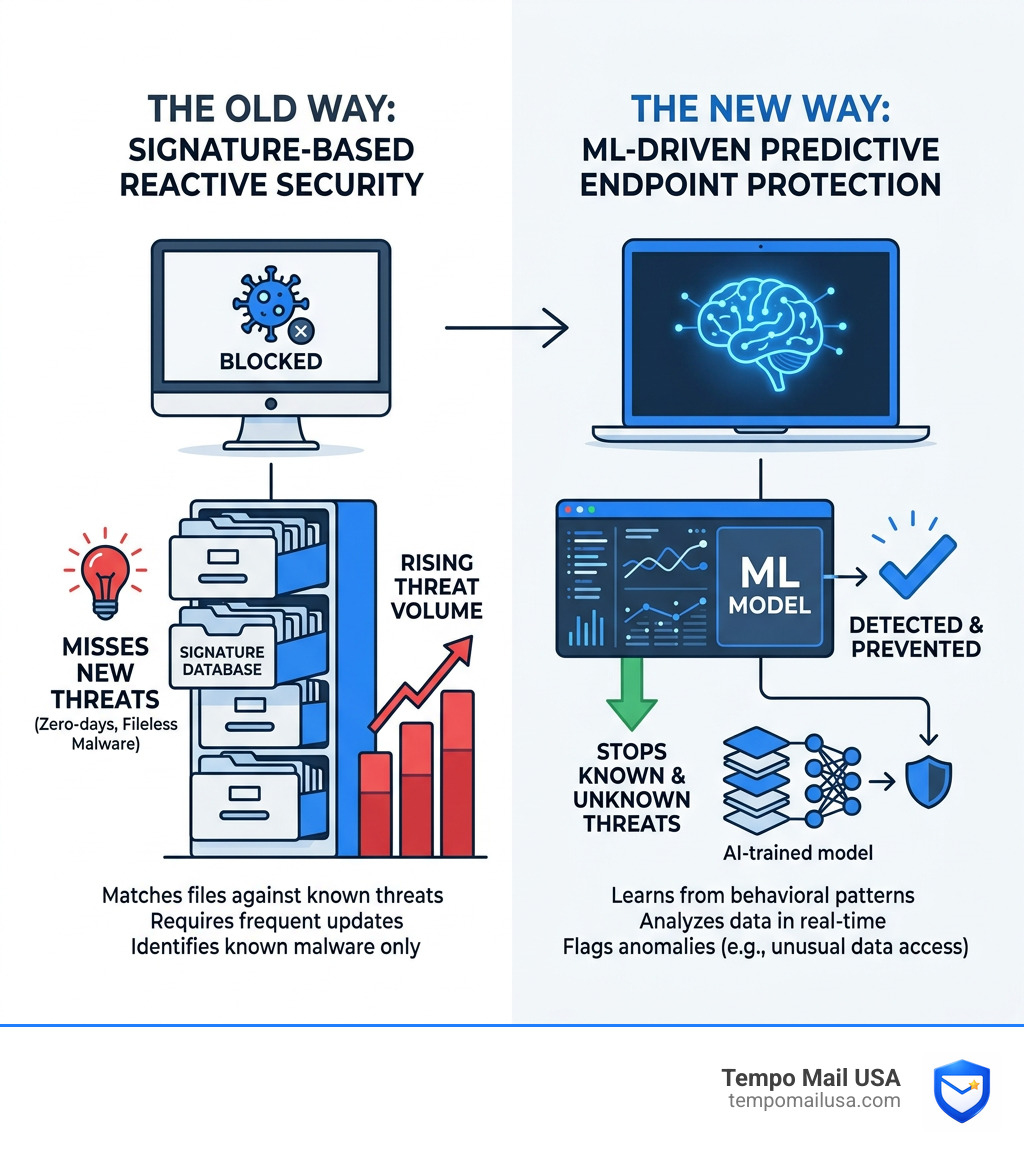
For years, antivirus software tried to keep up by matching files against a database of known threats. But that approach has a fatal flaw: it only works if the threat has been seen before.
The numbers tell the story. The number of known vulnerabilities (CVEs) more than doubled from roughly 18,000 in 2020 to over 40,000 by 2024. No signature database can keep pace with that.
That's where machine learning changes the game. Instead of asking "have I seen this before?", ML-powered endpoint protection asks "does this behavior look dangerous?" It monitors patterns — what files a process touches, what network connections it opens, when and how users access data — and raises an alert when something feels off.
This shift from reactive to proactive defense is what makes modern endpoint protection fundamentally different.
For privacy-conscious users especially, this matters. A breach doesn't just expose passwords — it exposes your real identity, your email address, your financial data. Understanding how ML-based endpoint protection works helps you make smarter decisions about every tool in your security stack.
The Evolution of Endpoint Protection Machine Learning
To understand where we are, we have to look at where we started. In the 1980s, security was simple: a "virus" was a specific piece of code. Antivirus software worked like a digital "Most Wanted" poster. If a file matched a known signature, it was blocked. If it didn't, it sailed right through.
By the early 2000s, hackers got clever. They started using "polymorphic" malware—code that changes its own appearance every time it replicates. This made static signatures nearly useless. The industry responded with Heuristic Analysis, which looked for suspicious characteristics, but it was still largely reactive and prone to high false-positive rates.
The real shift happened with the birth of the Endpoint Protection Platform (EPP) and Endpoint Detection and Response (EDR). These weren't just scanners; they were full-scale monitoring systems. Today, we have moved into the era of XDR (Extended Detection and Response), where endpoint protection machine learning doesn't just live on your laptop—it integrates data from the network, the cloud, and email systems to create a unified shield.
This evolution is why enterprise cybersecurity software why businesses need it has become a non-negotiable part of modern IT. We've moved from "scanning files" to "analyzing intent."

Core Technologies in Predictive Threat Detection
How does a machine actually "learn" to spot a hacker? It isn't magic; it's math. At the heart of endpoint protection machine learning are two primary types of training models:
- Supervised Learning: This is the most common method for malware detection. We feed the system millions of examples of "bad" files and "good" files. The ML engine learns the subtle traits that define a threat. Because the data is labeled, the system can be fine-tuned to reduce those annoying false positives that plague older systems.
- Unsupervised Learning: This is where the system looks at raw, unlabeled data to find hidden patterns. It’s excellent for finding "the odd one out." If 99% of your devices behave one way and one device starts acting differently, unsupervised learning flags it as an anomaly.
Comparison: Signature-Based vs. Machine Learning
| Feature | Signature-Based (Legacy) | Machine Learning (Modern) |
|---|---|---|
| Detection Method | Exact file matching | Pattern and trait recognition |
| Zero-Day Protection | None (requires an update) | High (predicts unseen threats) |
| Update Frequency | Daily or hourly | Periodic model retraining |
| Performance | Low CPU, high disk I/O | High CPU, low disk I/O |
| False Positives | Very Low | Low to Moderate (improving) |
For a deeper dive into these mechanics, we recommend reading A Primer on Machine Learning in Endpoint Security to see how these models are built from the ground up.
Behavioral Analysis and Endpoint Protection Machine Learning
One of the coolest things about modern security is Behavioral Analysis. Imagine a user who typically only accesses Word documents during business hours. Suddenly, at 3 a.m. on a Sunday, their account starts encrypted thousands of files and communicating with an unknown IP address in a foreign country.
A signature-based system might see the encryption tool as "legitimate software" and do nothing. But endpoint protection machine learning recognizes the anomaly. It builds a baseline of what "normal" looks like for every user and every device. When behavior deviates from that baseline, the system can automatically isolate the device from the network. This is the primary way we stop zero-day exploits—threats that have no known patch yet. To understand how AI is taking over these manual tasks, check out the ins and outs of AI replacing cybersecurity.
Neural Networks and Endpoint Protection Machine Learning
If behavioral analysis is the "brain," Neural Networks are the "nervous system." Inspired by the human brain, deep learning neural networks process data in layers. They are particularly good at catching fileless malware—malicious scripts that run entirely in a computer's memory without ever saving a file to the hard drive.
Because fileless attacks leave no "footprint," traditional antivirus is blind to them. Neural networks, however, can monitor the "Advanced Memory" of a system, spotting the tiny, suspicious ripples in memory usage that indicate an Advanced Persistent Threat (APT) is at work. This is a massive leap forward in Advancements in Predictive Threat Detection that keeps us safe even when hackers aren't using traditional files.
Key Advantages of ML-Driven Security
Why should you care about the "ML" label on your security software? It isn't just a marketing buzzword. It provides real-world benefits that save time, money, and sanity:
- Reduced False Positives: Nothing kills productivity like a security tool that blocks a harmless Excel sheet. By using supervised learning and "predictive risk scoring," ML engines can distinguish between a legitimate administrative tool and a malicious hacking script.
- Detection Speed: Humans take hours to analyze a suspicious file. ML takes milliseconds. In ransomware, those seconds are the difference between one infected laptop and an entire company being locked out.
- Automated Response: Modern EDR tools don't just alert you; they act. They can kill a process, quarantine a file, or roll back a system to its pre-infected state automatically.
- Scalability: With billions of devices online, we can't hire enough security analysts to watch every screen. ML allows us to protect millions of endpoints simultaneously with minimal human intervention.
These advantages are similar to why people use best phishing detection tools for ultimate security—it’s about using technology to catch what the human eye misses.
Frequently Asked Questions about ML Security
How does machine learning handle fileless malware?
Fileless malware is a "ghost" attack. It uses legitimate tools like PowerShell to run malicious commands in the RAM. Endpoint protection machine learning handles this by monitoring behavioral baselines. It looks at the intent of the commands being run. If a script is trying to scrape passwords from memory, the ML engine recognizes that this is not a "normal" use of PowerShell and terminates the process immediately. This is vital as CVE growth statistics show that hackers are moving away from simple files toward these stealthier methods.
Is traditional antivirus still necessary?
We like to think of it as a "layered defense." While ML is the star of the show, traditional signature-based methods are still useful for catching the "low-hanging fruit"—the millions of old, known viruses that are still floating around the web. Most modern solutions use a hybrid model: they use signatures for speed on known threats and ML for everything else. This multi-layered technology ensures that your CPU isn't working harder than it needs to.
What are the limitations of ML in security?
ML is powerful, but it isn't perfect. One major concern is Model Poisoning or Adversarial AI, where hackers try to "teach" the ML model that a certain type of malware is actually safe. There is also the "black box" problem—sometimes an AI blocks something, but it can't explain why. This is why the industry is moving toward Explainable AI (XAI), which provides security teams with a clear rationale for every detection. Finally, data privacy remains a concern; sending endpoint telemetry to the cloud for analysis must be done securely to protect user PII.
Conclusion
The battle for the "edge" of our networks is constant. As cybercriminals become more sophisticated, our defenses must evolve from static walls to living, breathing systems. Endpoint protection machine learning represents that evolution—a shift toward predictive risk scoring and real-time threat intelligence.
At Tempo Mail USA, we understand that security is only one half of the coin; the other half is privacy. While ML protects your devices from malware, our temporary email aliases act as a PII firewall, shielding your real identity from the services you use. By combining advanced endpoint protection with identity-shielding tools, you create a comprehensive defense for your digital life.
Don't let your primary email address or your personal devices be the weak link in your security chain. Stay proactive, stay informed, and secure your digital identity at tempomailusa.com.