


Why Enterprise Cybersecurity Software Is Critical
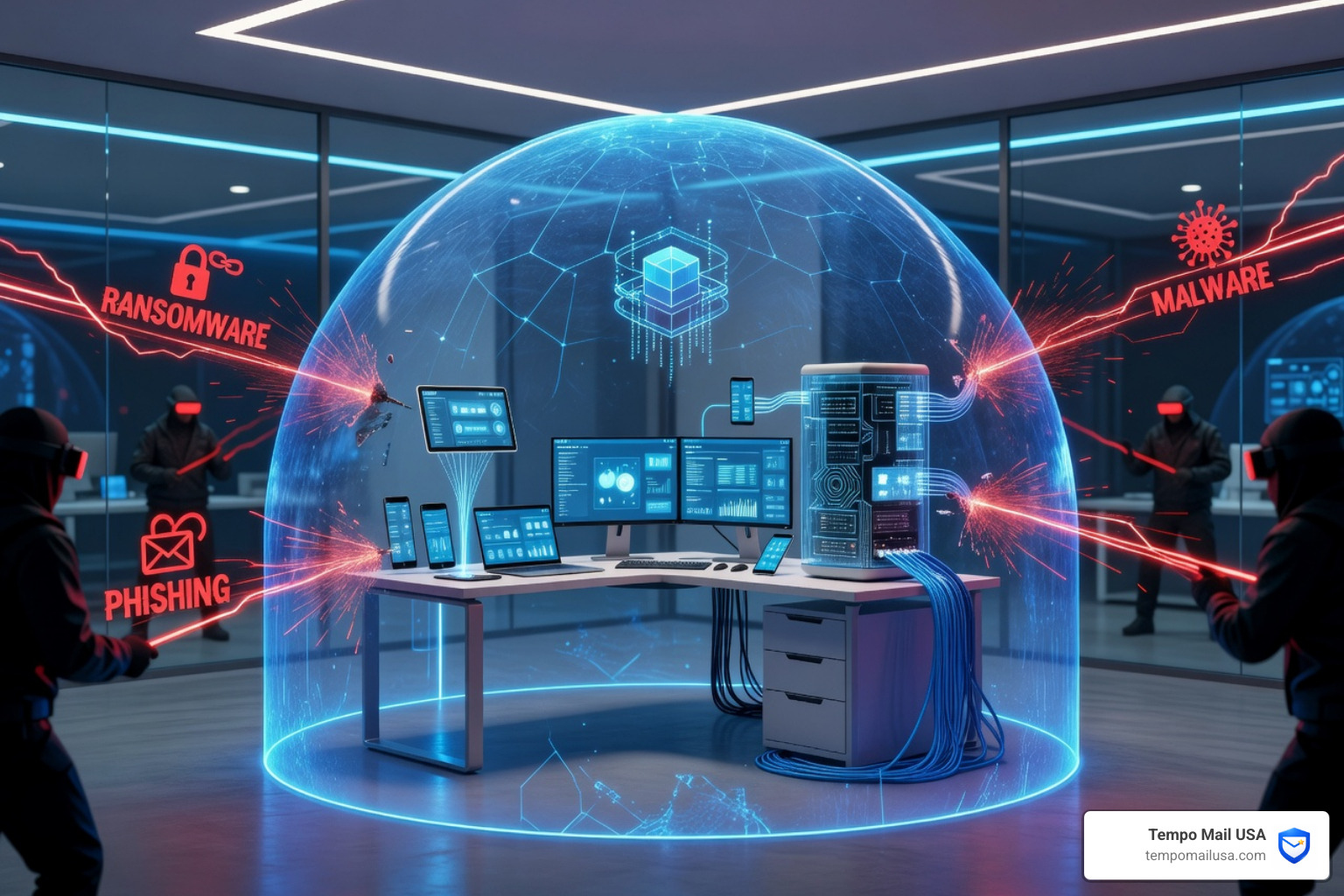
Enterprise cybersecurity software is the collection of tools and platforms organizations use to protect their digital assets, networks, endpoints, and data from cyberattacks.
Here's a quick breakdown of what it covers and why it matters:
- What it is: Integrated software solutions that defend against threats like ransomware, phishing, data breaches, and insider attacks
- Who needs it: Any organization handling sensitive data, customer records, or critical operations
- Core functions: Endpoint protection, network security, cloud security, email security, identity management, and vulnerability management
- Why now: The average cyberattack costs millions of dollars, and attacks are happening faster and across more vectors than ever before
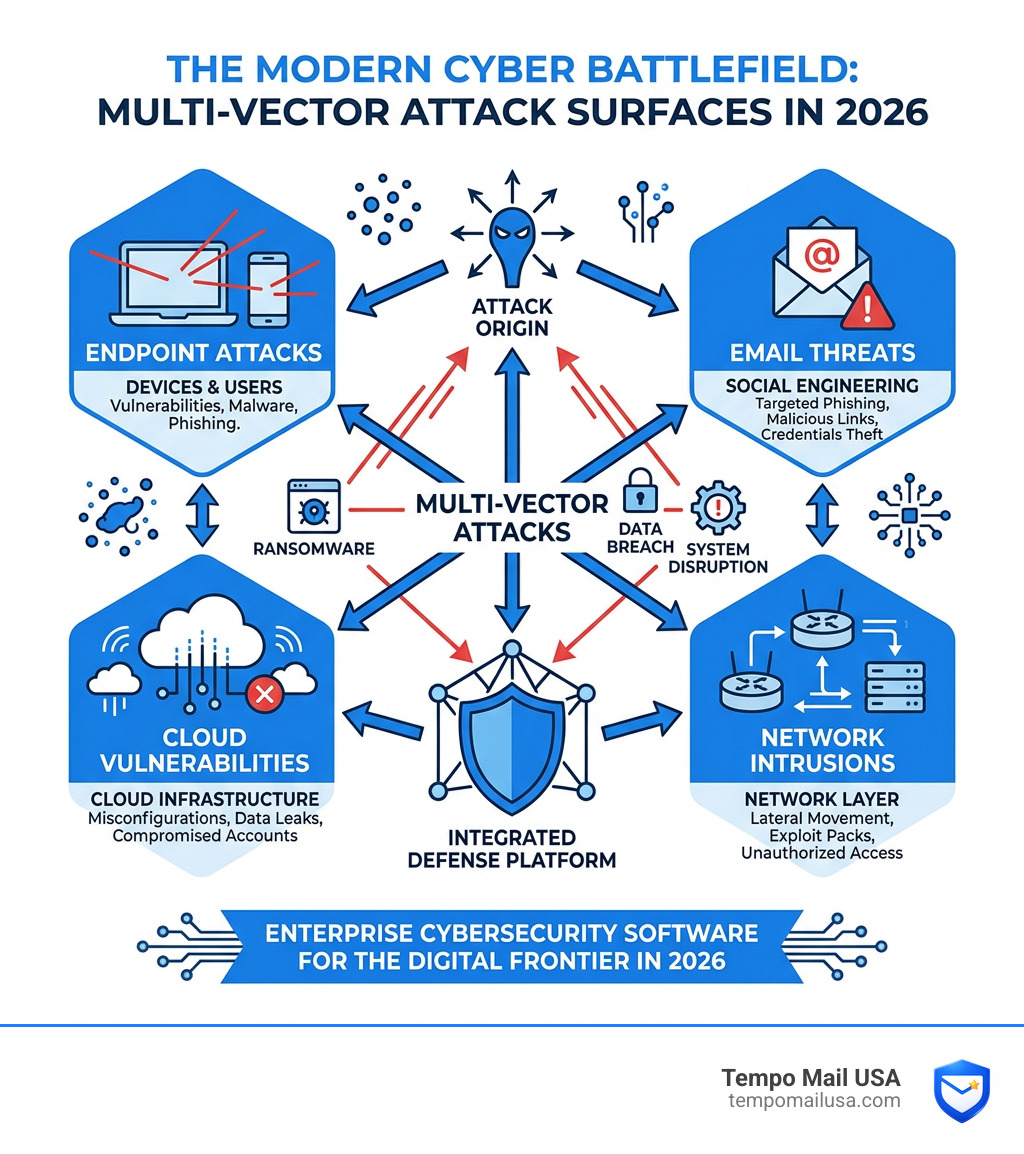
Cyberthreats have never been more complex. Today, 84% of attacks span multiple vectors — not just your endpoints, but your email, cloud apps, identities, and network simultaneously.
The days of a simple antivirus tool being "enough" are long gone.
Modern enterprises face a battlefield where ransomware evolves faster than traditional defenses can keep up with, employees are targeted through increasingly convincing phishing attempts, and even trusted applications can be weaponized. One moment of negligence — like an employee making cloud storage accidentally public — can expose millions of records.
The financial and operational stakes are enormous. A successful breach doesn't just cost money. It disrupts operations, damages reputation, and can trigger serious regulatory consequences under frameworks like HIPAA, PCI DSS, and NIST.
This guide explains how enterprise cybersecurity software works, what to look for in a platform, and how to build a security posture that actually holds up in 2026.
The Strategic Importance of Enterprise Cybersecurity Software
In 2026, cybersecurity is no longer just an "IT problem"—it is a core business strategy. When we talk about enterprise cybersecurity software, we are talking about the digital immune system of a corporation. Without it, the "body" of the business is exposed to infections that can halt production, drain bank accounts, and destroy years of brand equity in minutes.
The primary goal of these platforms is to manage the various impacts of cyberattacks. This includes ensuring data security, maintaining business continuity so operations don't grind to a halt during a ransomware event, and achieving regulatory compliance. Beyond the technical side, effective security is about reputation management. Customers trust us with their most private information; if we lose that data, we lose their trust forever.
To understand the "how" of defense, we must look at the "how" of the attack. Professional threat actors use sophisticated tactics, techniques, and procedures (TTPs) to infiltrate digital infrastructure. They don't just "hack" a computer; they conduct reconnaissance, gain initial access (often through a simple email), move laterally through the network, and eventually exfiltrate data or deploy encryption.
Common Threats Facing Modern Enterprises
The threat landscape is a moving target. While some old classics remain, they have evolved into more dangerous forms:
- Ransomware: This remains a top-tier threat. Modern ransomware doesn't just lock your files; it often involves "double extortion," where attackers steal data first and threaten to leak it if the ransom isn't paid.
- Phishing: Email remains the number one threat vector. Attacks have become incredibly convincing, often using AI to mimic the tone and style of internal communications.
- Insider Threats: These can be malicious (an unhappy employee) or accidental (a contractor using an insecure device). Either way, the damage comes from inside the perimeter.
- Zero-Day Exploits: These are attacks that exploit vulnerabilities that are not yet known to the software vendor. Because there is no patch available, traditional defenses often miss them.
- Data Exfiltration: The silent theft of intellectual property or PII (Personally Identifiable Information).
The most alarming statistic we see today is that 84% of attacks span multiple vectors. An attacker might start with a phishing email, use those credentials to log into a cloud app, and then drop malware onto an endpoint. If your security tools don't "talk" to each other, you’ll only see pieces of the puzzle, never the whole picture.
Core Components of a Modern Security Architecture
To fight back, we need an architecture that is as integrated as the attacks are. A modern enterprise security architecture is designed to cover the entire attack surface. It shouldn't have a single point of failure. Instead, it should utilize defense in depth—layering multiple security controls so that if one fails, others are there to catch the threat.
Key architectural principles include:
- Network Segmentation: Dividing the network into smaller zones to prevent an attacker from moving freely if they get inside.
- Redundancy and Resilience: Ensuring that if a system is compromised, there is a backup or a way to maintain operations.
- Centralized Management: Managing everything from a single console to avoid "dashboard fatigue."
Unified Platforms vs. Siloed Security Tools
In the past, companies bought "best-of-breed" tools for every niche. One tool for email, one for the firewall, one for endpoints. This created "silos" where data was trapped. Today, the trend is toward unified, centrally-managed platforms.
| Feature | Siloed Tools | Unified Platforms |
|---|---|---|
| Visibility | Fragmented; "Blind spots" between tools | Holistic; 100% asset coverage |
| Response Time | Slow; requires manual correlation | Rapid; often automated within seconds |
| Management | Multiple consoles; high overhead | Single console; streamlined operations |
| Accuracy | High false positives | Six Sigma accuracy (99.99966%) |
Core Functional Modules of Enterprise Cybersecurity Software
What actually goes into these platforms? Most leading enterprise cybersecurity software suites include these core modules:
- Endpoint Protection (EPP/EDR): This secures the "front line"—laptops, mobile devices, and servers. Top-tier solutions now achieve 100% detection in MITRE ATT&CK evaluations.
- Cloud Security: As we move to the cloud, we need tools that can secure "peacetime" configurations (preventing misconfigurations) and "wartime" threats (active attacks on cloud workloads).
- Email Security: Since email is the #1 vector, seguridad de correo electrónico is non-negotiable. It must be able to outsmart AI-assisted phishing.
- Identity and Access Management (IAM): This ensures that only the right people have access to the right data.
- Vulnerability Management: This isn't just about finding bugs; it’s about prioritizing them. Modern platforms process trillions of data points to tell you which 1% of vulnerabilities actually pose a risk.
Centralized Management and Monitoring
The "brain" of your security stack is the management console. A single source of truth allows for data normalization—taking data from different sources and making it readable by a single AI engine. This drastically improves response efficiency. For example, some platforms can now cut response times by 98%, turning a weeks-long investigation into a matter of minutes.
Emerging Technologies: AI, Automation, and Zero Trust
We are currently in the era of "Agentic AI" in cybersecurity. This isn't just basic automation; it’s about AI agents that can think, prioritize, and act autonomously to de-risk a business.
How AI and Automation Power Enterprise Cybersecurity Software
AI is the only way to handle the sheer scale of modern data. Leading platforms now process 9+ trillion data points and 2+ trillion security events per year. No human team can do that.
AI-native platforms provide:
- Automated Triage: Closing or escalating incidents within 30 seconds.
- Natural Language Control: Allowing security teams to build and deploy security agents using simple natural language instead of complex code.
- Manual Work Reduction: Some organizations report a 75% reduction in manual work after implementing AI-driven orchestration.
- Autonomous Risk Management: AI can verify if a vulnerability is actually "exploitable" in your specific environment before you waste time patching it.
Implementing Zero Trust Architecture
The old security model was "trust but verify." The new model is Zero Trust: "Never trust, always verify."
A Zero Trust platform operates on several key pillars:
- Least Privilege: Users only get the bare minimum access they need to do their jobs.
- Continuous Monitoring: Just because a user logged in safely an hour ago doesn't mean they are safe now.
- Deny-by-Default: Instead of trying to list every "bad" file (which is impossible), we use allowlisting. We block everything by default and only allow trusted, known applications to run.
- Ringfencing: This goes a step further by containing trusted applications. Even if a "safe" app like PowerShell is exploited, Ringfencing prevents it from talking to your files or the internet in ways it shouldn't.
If you're looking to dive deeper into this philosophy, you can Register for ZTW, March 4-6, Orlando, FL to learn from the world's leading Zero Trust experts.
Best Practices for Implementation and Compliance
Deploying enterprise cybersecurity software isn't a "set it and forget it" task. It requires a disciplined approach to implementation and a commitment to best practices.
- Map to Frameworks: Use established frameworks like NIST, CIS, or ISO 27001 to guide your strategy. This ensures you don't have gaps in your defenses.
- Multi-Factor Authentication (MFA): This is the single most effective way to prevent account takeover attacks.
- Employee Training: Your people are your greatest asset—and your greatest risk. Regular awareness training is essential to stop phishing.
- Prompt Patching: Vulnerabilities are the open doors of the digital world. Use automated tools to find and fix them immediately.
- Data Resilience: Always assume a breach could happen. This is why Why Rapid Recovery is Safer than Paying the Ransom is a core tenet of modern security. If you can recover your data from a clean backup in minutes, the attacker loses their leverage.
Evaluating and Selecting the Right Software
When choosing a vendor, don't just look at the marketing. Look at industry validation. Reports like the Gartner Magic Quadrant for Endpoint Protection Platforms (EPP) provide an objective look at who is leading the market in both vision and execution.
Consider the ROI (Return on Investment). While enterprise software is an expense, a single breach can cost millions. Calculate the potential "cost of inaction." Furthermore, consider Managed Detection and Response (MDR) services. If you don't have a 24/7 in-house security team, an MDR provider can act as your "Cyber Hero" team, offering lightning-fast response times (sometimes within 60 seconds) around the clock.
To see how these systems work in practice, we recommend you sign up for a free demo of a unified platform or See the report on how top-tier protection performs in the real world.
Frequently Asked Questions about Enterprise Cybersecurity Software
What are the primary costs and ROI considerations for deployment?
The cost of enterprise cybersecurity software varies based on the number of devices (endpoints), the volume of data processed, and the level of managed services required. However, the ROI is usually found in three areas:
- Risk Reduction: Avoiding the multi-million dollar cost of a breach.
- Operational Efficiency: Reducing manual work by up to 75% through automation.
- Consolidation: Replacing 10 siloed tools with one unified platform often lowers licensing and training costs.
How does Managed Detection and Response (MDR) complement in-house tools?
MDR provides the human expertise that software alone cannot. While the software detects threats, MDR "threat hunters" analyze the data, investigate suspicious patterns, and take immediate action to neutralize attacks. It's like having an elite SWAT team on call 24/7/365 to back up your local security "police force."
How can enterprises achieve compliance with NIST and HIPAA using software?
Modern security platforms include built-in compliance modules. These tools automatically audit your environment against regulations like HIPAA (for healthcare) or PCI DSS (for payments). They provide the audit logs, encryption reports, and access controls required to prove to regulators that your data is secure. For those in the government sector, look for platforms with FedRAMP High authorization.
Conclusion
Mastering enterprise cybersecurity software in 2026 is about moving from a reactive "wartime" footing to a proactive "peacetime" posture. By unifying your data, leveraging the power of Agentic AI, and strictly adhering to Zero Trust principles, you can transform your security team from "firefighters" into strategic orchestrators.
At Tempo Mail USA, we understand that the first step in any security strategy is protecting your identity. Our temporary email aliases act as a PII firewall, shielding your real identity from services and reducing your personal attack surface. In an age where 84% of attacks start with a single vector like email, protecting your primary inbox is a critical best practice.
Are you ready to harden your defenses and secure your organization's future? Start by simplifying your security stack and focusing on what matters: visibility, speed, and control.