Emergency Alert System Test Today at 2:20 PM: What Happens, Why Your Phone Stays Silent, and the Fake Texts Already Going Around
Emergency Alert System Test Today at 2:20 PM: What Happens, Why Your Phone Stays Silent, and the Fake Texts Already Going Around
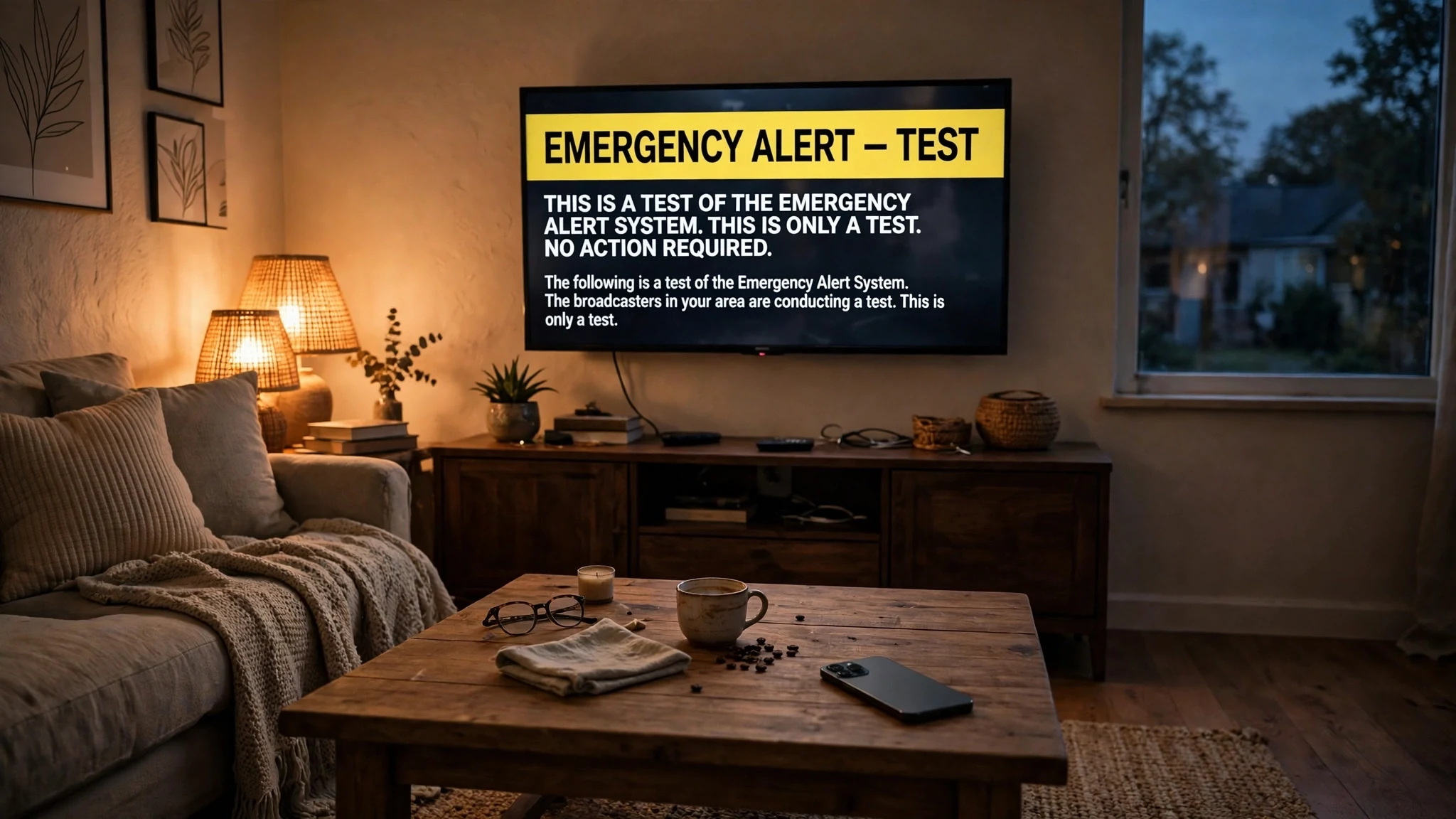
At 2:20 this afternoon, every television and radio station in the United States will stop what it is doing for about a minute. You will hear the tones — the harsh, two-note attention signal everyone recognises instantly — and then a voice will say this is only a test, and no action is required.
That is the entire event. It is a routine, legally required check of the Emergency Alert System, announced two months ago. And it is also, right now, the sixth-most-searched term in the country, sitting at the centre of a viral story about a 90-day nationwide blackout that does not exist — a story built from real pieces glued together wrong, and finished off with fake videos of the president selling cryptocurrency. The blackout is not the danger today. The texts are.
Here is the short version, because the short version is what you need before 2:20: the test is real, it is on TV and radio only, and your phone will not make a sound. If a text message arrives on your phone today claiming to be part of the test, or warning you about a blackout, or offering a way to opt out of future alerts — it is fake. Do not tap its link. Do not reply STOP. Forward it to 7726 and delete it. Everything below is how I know, what the test actually does, how the rumour was assembled, and the five-second check that settles any alert message you ever receive.
What Happens at 2:20 p.m.
The test is run by the Federal Emergency Management Agency, working with the Federal Communications Commission. I opened FEMA's test page this morning while writing this, and the wording is plain: "FEMA, in coordination with the Federal Communications Commission (FCC), will conduct a nationwide test of the Emergency Alert System (EAS) at approximately 2:20 p.m. Eastern Time, Tuesday, November 17, 2026." The FCC announced it publicly on September 16, in Public Notice DA 26-989 — two months before the date, in a document anyone could read. Nothing about today was sprung on anyone.
The message itself is fixed in advance, and FEMA publishes it verbatim: "This is a nationwide test of the Emergency Alert System, issued by the Federal Emergency Management Agency. This is only a test. No action is required by the public." The FCC's version adds the window the message is technically valid for — "covering the United States from 2:20 to 2:50 hours ET" — which is not how long it lasts. The interruption is about a minute. The tones play, the message reads, programming resumes. The message goes out in English and Spanish, and it includes the standard alert tones so that people who are deaf or hard of hearing get the same warning.
The time is the same moment everywhere, so your local time depends on where you live: 2:20 p.m. Eastern, 1:20 p.m. Central, 12:20 p.m. Mountain, 11:20 a.m. Pacific, 10:20 a.m. in Alaska, 9:20 a.m. in Hawaii. If a real emergency or severe weather gets in the way, the test moves to the backup date — Thursday, December 3, at the same time. That backup date was set in the same September announcement, not improvised this week.
This is the first nationwide test of the system since October 2023, and the gap is not a mystery. Federal law requires FEMA to test the national public warning system at least once every three years, precisely so that problems are found on a quiet day instead of during a real emergency. The system itself has been running since January 1, 1997, when it replaced the Cold War-era Emergency Broadcast System. It is coordinated by FEMA, the FCC, and the National Oceanic and Atmospheric Administration, and it runs through thousands of radio stations, television stations, cable systems, and satellite providers under a framework called IPAWS, the Integrated Public Alert and Warning System. Its most distinctive feature is the part you hear first: the SAME header, a digitally encoded burst of tones that tells receiving equipment what kind of alert it is and which counties it applies to.
One fact about the system is worth knowing, because the rumour mill pretends otherwise: the presidential-level alert — the one that would let the president address the entire country at once — has never been used for a real national emergency. It has only ever been tested. The system exists as a last resort, and the last resort has never arrived.
Your Phone Stays Silent. That Silence Is the Whole Story.
Here is the detail most people searching for this term have wrong, and it is the detail that matters most. Today's test is a test of the Emergency Alert System — the broadcast system, the one that runs through television and radio. It has no Wireless Emergency Alert component. Your phone will not go off. FEMA said so explicitly in an October 28 post: "The test will air on radio and TV only and will not be sent to mobile phones. No action is needed from the public."
That is different from the last nationwide test, in October 2023, which did go to phones. Millions of people remember that one because their phone blared at 2:20 p.m. and they were not expecting it. If your mental model of "the national alert test" is the 2023 one, you will be waiting for a sound that is not coming today — and that mismatch is exactly what the scammers are counting on.
The two systems are related but they are not the same thing, and the difference is the whole scam. The Emergency Alert System pushes messages through broadcasters. Wireless Emergency Alerts push messages to phones through cell broadcast — a signal sent to every phone connected to towers in an area, not a text message sent to your number. A real wireless alert arrives as a system-level banner with a loud, distinctive tone, and it does not come from a phone number you can reply to. A text message that says "EMERGENCY ALERT" and carries a link is not a wireless alert. It is an SMS from a stranger, wearing a costume.
So remember one sentence for today: no phone alert is scheduled. Any alert message that arrives on your phone today, about the test or about a blackout, is not part of the test. It cannot be, because the test does not touch phones. That single fact settles every message you receive today before you have read past its first line.
The 90-Day Blackout, Taken Apart
The rumour is not one lie. It is a collage — five real things, each true on its own, glued together into something none of them says. That is why it spreads so well: every piece survives a quick check, and the conclusion feels earned. Here are the pieces, separated.
The real date. The test really is today, and the FCC really did announce it on September 16. The rumour needed a fixed day to attach itself to, and a government test on the public record supplied one. A scheduled test is not a warning. It is the opposite: a system being checked while nothing is wrong.
The real 90 days. On September 30, Defense Secretary Pete Hegseth announced a Pentagon initiative called FORTRESS America — Federal Operations for Resilience, Troop Resources, Energy, Supply, and Survivability. Its goal is for large American military bases to be able to run for 90 days without outside electricity, fuel, or water. That is a real programme, and the 90-day figure is real. What it is not is a plan to switch off civilian power. It is about bases surviving a disruption, not about causing one. Snopes, which looked into the programme separately, called it mostly true — the programme exists — while noting it could not independently confirm the 90-day figure in an official document.
The fake videos. Clips circulating on Facebook, Instagram, and TikTok appear to show President Trump announcing a 90-day blackout. Snopes rated them fake on November 10. The footage is real and the words are not: AI was used to alter the lip movements and audio of remarks Trump made on November 2 at the Lincoln Memorial Reflecting Pool — where he was talking about Democratic candidates — and at a press gaggle in Palm Beach on November 7, where he was talking about Russia, Ukraine, and Iran. A third clip borrows the setting of a 60 Minutes interview from April. The videos end the same way every time: a pitch to buy a cryptocurrency token with a name like "United States Power Reserve" or "United States Asset Reserve" before the lights go out. The detail about the tokens is the giveaway about motive. The blackout is the advertisement; the token is the product.
The cartoon. A 2023 episode of The Simpsons, "It's a Blunderful Life," shows Springfield losing power, and a post on X around November 1 told people to watch its last fifteen seconds and get ready for a "Great Blackout" on November 17. The episode aired on November 19, 2023, its blackout is caused by a storm, and its "six days before Thanksgiving" detail fits 2023, not 2026. A three-year-old cartoon was re-captioned.
The real outages. This week genuinely did break things. United Airlines resolved a technology outage on Monday that delayed 645 flights — a fifth of its schedule — and cancelled 25, after a weight-and-balance system stopped working; the airline said there was no indication of a cybersecurity link. Three days earlier, a malfunction in the Federal Aviation Administration's network caused a nationwide ground stop. And yesterday, the bank outage that dominated searches — Chase blaming a software bug — had a million people wondering whether their money was safe. None of those events is connected to the others, and none of them is connected to the alert test. But stacked together in a feed, they feel like a pattern, and a pattern is all a rumour needs.
What has not happened is the part that would make the rumour true. CISA, the Federal Reserve, and the FDIC have issued no warning of a shutdown, a bank-balance wipe, or a three-month lockdown. No federal agency, utility, or grid operator has announced a blackout. FEMA said on Monday that there is "no secret emergency" and no blackout connected to the test. PolitiFact debunked one of the viral videos. France 24 found crypto accounts claiming the test was cover for a cyberattack on banks, urging followers to pull their savings and buy crypto instead — the same sales pitch as the fake videos, wearing a different coat.
The Texts Riding In on the Test
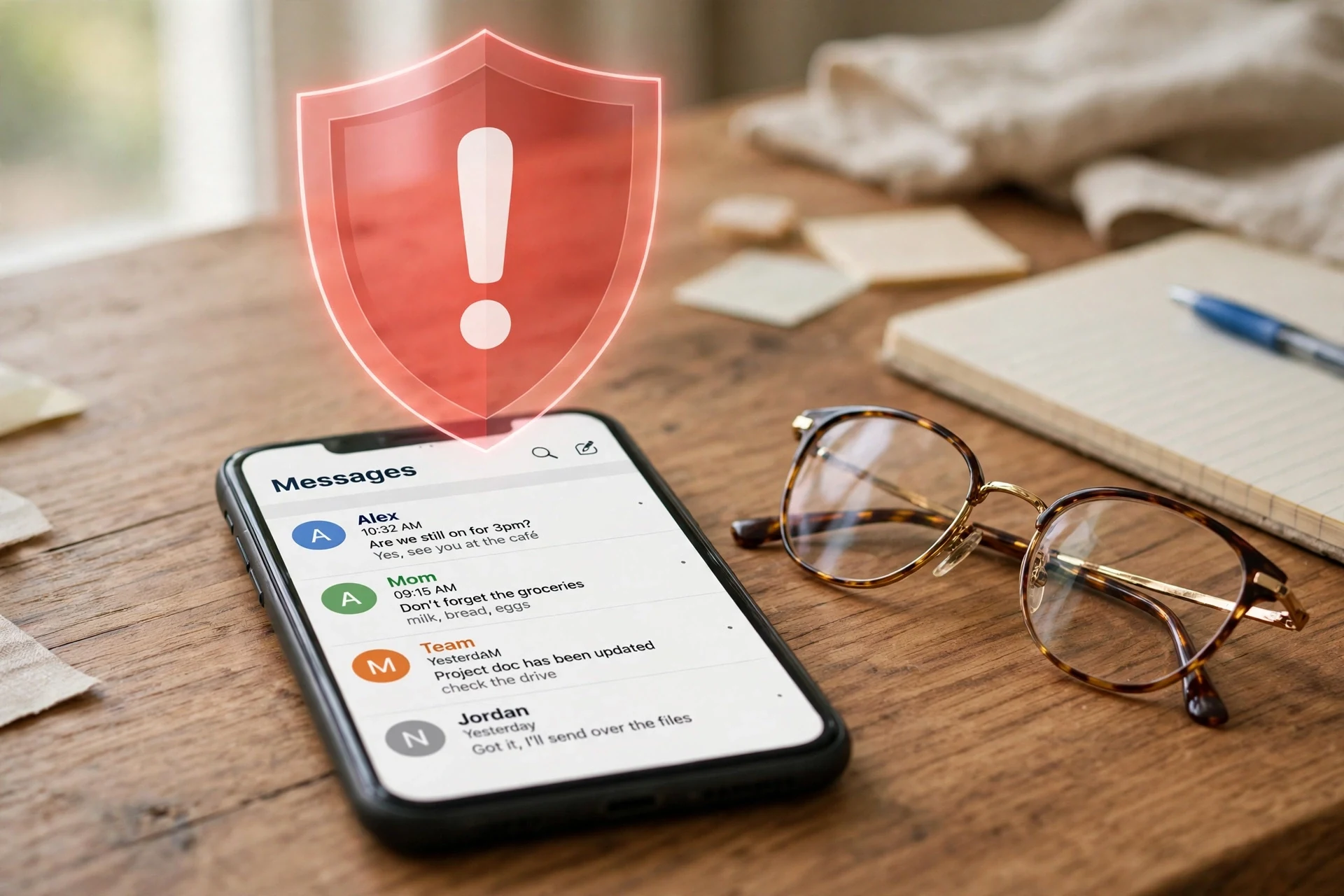
The blackout story is false. The texts using it are real, and they are the part of today that can actually cost you something.
This is not hypothetical. On September 23, a spokesperson for the St. Lucie County Sheriff's Office in Florida, Capt. Andrew Bolonka, received a text that called itself an "automated nationwide alert," told him to stop what he was doing, and directed him to a supposed secure link. The sheriff's office warned the public the next day, calling the message "extremely deceptive." The part that caught Bolonka's attention was the ending: the message carried a "stop=end" notation, made to look like an opt-out instruction. Replying STOP does not opt you out. It tells the sender the number is live and owned by a person who reads their texts — and then your number gets sold to other scammers. The link, had he tapped it, could have exposed his device to malware and harvested stored personal information, including banking details.
The same play is running today, dressed for the occasion. Reports this morning warn of texts asking people if they want to "opt out" of future alert tests, with a link to do it. There is no opt-out link. Clicking it hands the scammers what they want. Other versions will offer "live updates" on the blackout, or a "verification" step for your FEMA registration, or early access to emergency aid. Every one of them follows the same script: borrow the authority of a government system, add urgency, attach a link.
Know the rules that real agencies follow, because the rules are the test. FEMA never charges for disaster assistance, home inspections, or help with an application — anyone who wants a fee to help you qualify for FEMA funds is a scammer, and real applications go through DisasterAssistance.gov or the FEMA Helpline at 1-800-621-3362. FEMA only contacts people who have contacted the agency or applied for assistance, and it never sends texts demanding money or personal information. A real FEMA inspector wears an official badge and never asks for bank information or your nine-digit registration number. The Federal Trade Commission's advice for any unexpected text is the same advice I give for any unexpected email: do not click the link, do not reply, and check with the organisation through a website or phone number you already know is legitimate.
If a text like this reaches you today, the correct response takes thirty seconds: do not tap anything, do not reply, forward the message to 7726 — which spells SPAM on a phone keypad — and then delete it. You can also report it to the FTC at ReportFraud.ftc.gov, and fraud involving FEMA aid goes to StopFEMAFraud@fema.dhs.gov or the Department of Homeland Security's inspector general hotline at 1-800-323-8603. Reporting matters more than it feels like it does. The September text reached a sheriff's spokesperson because his number was on a list somewhere; lists only die when they stop paying.
Real Alert or Fake: The Five-Second Check
Every alert message you ever receive can be settled with five questions, in order. The first one that fails ends the test.
1. Was an alert scheduled for your phone? Today, no. The test is TV and radio only. On any other day, check the source before the message: FEMA's test page, your state's emergency management agency, or the news. If nothing is scheduled and your phone lights up with an "emergency alert" text, it is fake.
2. Does it ask you for anything? A real alert never asks for money, a password, a verification code, a Social Security number, or a tap on a link to "confirm" something. An alert tells you something. A scam asks you for something. The moment a message asks, it has failed the test — no matter how official the logo looks.
3. Where did it come from? A real wireless alert arrives as a system banner from your carrier's cell broadcast, not as an SMS from a phone number. It does not come with a reply thread. If the message sits in your normal texting app, from a number, with a link — that is a person, or a machine pretending to be one.
4. Does it survive a check without the link? Open your browser yourself and type the agency's address — fema.gov, your county emergency management page, your local news station. If the warning is real, it will be there, in the open, without needing the link in the message. If the only copy of the story is inside the message, there is no story.
5. Did it try to make you reply STOP? The "stop=end" trick from the September text is worth remembering on its own. A legitimate bulk sender's opt-out does not arrive inside a message pretending to be the government. Replying STOP to a scam text confirms your number is active and gets it resold. Silence is the correct reply; 7726 is the correct destination.
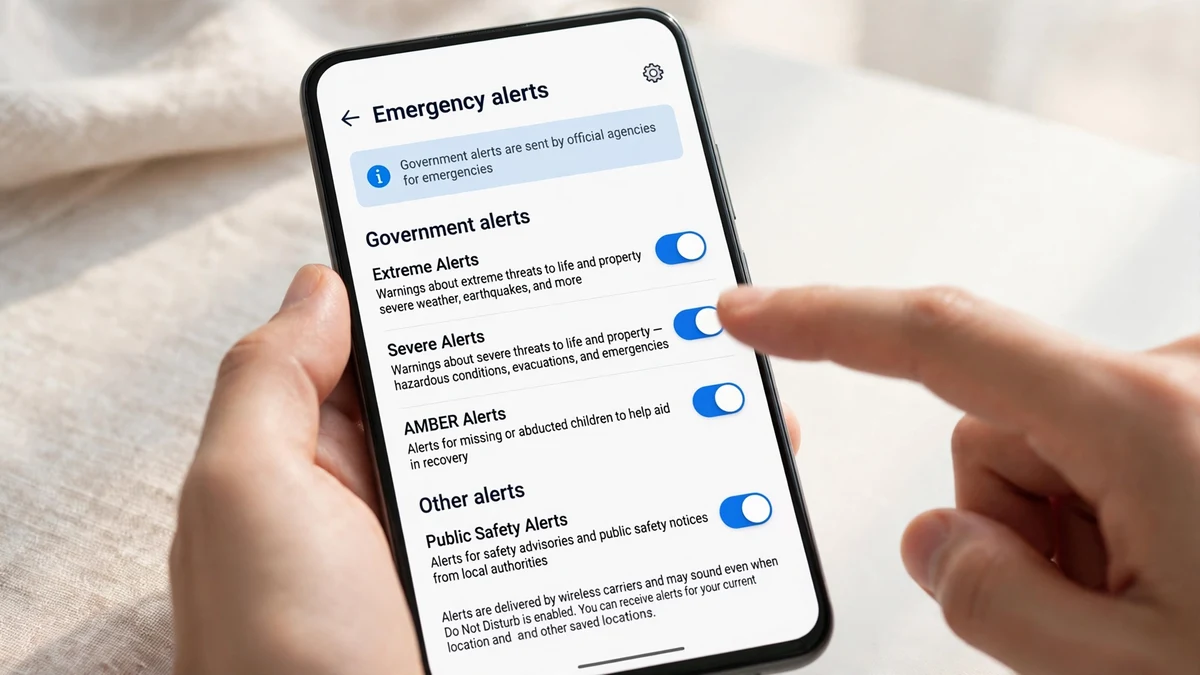
One more practical step, while today has your attention: check that your phone is set to receive real wireless alerts, so that the next genuine one reaches you. On an iPhone, that is Settings, then Notifications, then scroll to Government Alerts at the bottom. On Android, it is usually under Settings, then Safety and emergency, then Wireless emergency alerts — the exact path varies by manufacturer. If those toggles are on, a real alert will find you without any text, link, or app. That is the whole point of the system: it reaches you without anyone needing your number.
Why Your Inbox Is Where This Ends Up
Here is the part of this story that belongs on this site, and the reason I am writing about an alert test on a site about temporary email. The rumour did not find its audience by accident. It found the addresses, phone numbers, and feeds that people had handed out — to newsletters, to free trials, to "alert signup" forms, to one-off downloads — and it walked straight in through them. The fake Trump videos were pushed by clusters of accounts posting the same scripted reels. The crypto tokens were pitched to people whose contact details were already for sale. The September text reached a sheriff's spokesperson because his number was on a list. Lists are the infrastructure of every scare story, and your real address is what gets you onto them.
I covered the same machinery this morning, from a different direction: a text claiming your Apple ID was locked, asking you to sign in from a link. The pattern is identical — borrow authority, add a deadline, attach a link — and the 60-second check I wrote for that one still applies, word for word. Real account problems show up inside your device's settings, not in a message with a link in it. The same is true of real emergencies: they show up on the broadcast system and on the agency's own pages, not in a text from a number you have never seen.
The bank outage yesterday is the other half of the same lesson. That post debunked the November 17 blackout rumour on its first day, and the wave of fake "bank security" emails that rode in behind the outage is the same wave, wearing a different uniform. And the reason those emails find their targets is the same reason the texts do: the leaked address lists published this week — hundreds of thousands of addresses from a market research firm, a retailer, and a marketing company — are already circulating, and they will still be circulating next month.
The defence is not complicated, and it is the same one I keep coming back to: stop handing your permanent address to things that do not need it. Newsletters, free trials, one-off downloads, forum accounts, and "sign up for alerts" forms are exactly the kind of signup a disposable address exists for. The generator on the homepage takes seconds and needs no signup, and it keeps your real inbox off the lists that the next rumour will buy. Your real address is for your bank, your government accounts, and anything where losing access means losing money. Everything else gets the address you can throw away — because the next scare story will be looking for the address you kept.
Frequently Asked Questions
What time is the emergency alert test today? About 2:20 p.m. Eastern on Tuesday, November 17, 2026 — 1:20 p.m. Central, 12:20 p.m. Mountain, 11:20 a.m. Pacific. It lasts about a minute on television and radio, in English and Spanish. If severe weather or a real emergency intervenes, the backup date is Thursday, December 3, at the same time.
Will my phone go off during the test? No. Today's test covers the Emergency Alert System only — television, radio, cable, and satellite. No Wireless Emergency Alert goes to phones. The last nationwide test that included phones was in October 2023. If your phone stays quiet at 2:20, nothing is broken; that is the plan.
Is there really a 90-day blackout starting on November 17? No. There is no evidence for it, and no federal agency, utility, or grid operator has announced one. The rumour stitches together a real test date, a real Pentagon programme about military bases running 90 days on their own power, AI-altered videos of the president that Snopes rated fake on November 10, and a 2023 Simpsons episode. FEMA said on Monday there is "no secret emergency" connected to the test.
I got a text about the emergency alert test with a link. Is it real? No. Today's test sends nothing to phones, so any "emergency alert" text you receive today is not part of it. Do not tap the link and do not reply STOP — replying confirms your number is live. Forward the message to 7726, delete it, and report it to the FTC at ReportFraud.ftc.gov if it asked for money or personal information.
What does a real Wireless Emergency Alert look like? It arrives as a system-level banner with a loud, distinctive tone, sent by cell broadcast to phones in an area — not as an SMS from a phone number, and not with a reply thread. It tells you something; it never asks you for money, a password, or a tap on a link to verify yourself. If a message asks, it is a scam, however official it looks.
How is the Emergency Alert System different from Wireless Emergency Alerts? The Emergency Alert System is the broadcast system — radio, television, cable, and satellite — coordinated by FEMA, the FCC, and NOAA under IPAWS. Wireless Emergency Alerts are the phone system, delivered by cell broadcast through mobile carriers. Both sit under the same IPAWS framework, but they are different channels, and today's test uses only the broadcast one.
What should I do if I already clicked a fake alert link? Assume it was malicious and work the list: disconnect the device from the internet, run a full scan with your security software, and do not type any new passwords or make payments on that device until the scan is clean. Then change the passwords for your email account first — email is the key to every reset link you own — and then for banking and shopping, from a different device you trust. If you entered payment details, contact your bank.
The test will be over in a minute. The rumour will take longer to die, because rumours always do — but it has already been answered by the only sources that matter: the agencies that run the system, the fact-checkers who traced the videos, and the silence of every official channel that would have to be shouting if a blackout were real. Your phone will stay quiet at 2:20. Let it. The quiet is the proof that the system works, and the texts are the proof that someone is selling the noise.
Need a disposable temporary email?
Protect your real inbox from spam and promotional clutter instantly and free.
Received a suspicious email, text, or charge alert?
Verify whether the sender domain is disposable, spoofed, or unverified before clicking links.