
Bank Outage: Chase Blamed a Software Bug, Your Money Is Still There — and the Scammers Are Already Emailing
Bank Outage: Chase Blamed a Software Bug, Your Money Is Still There — and the Scammers Are Already Emailing
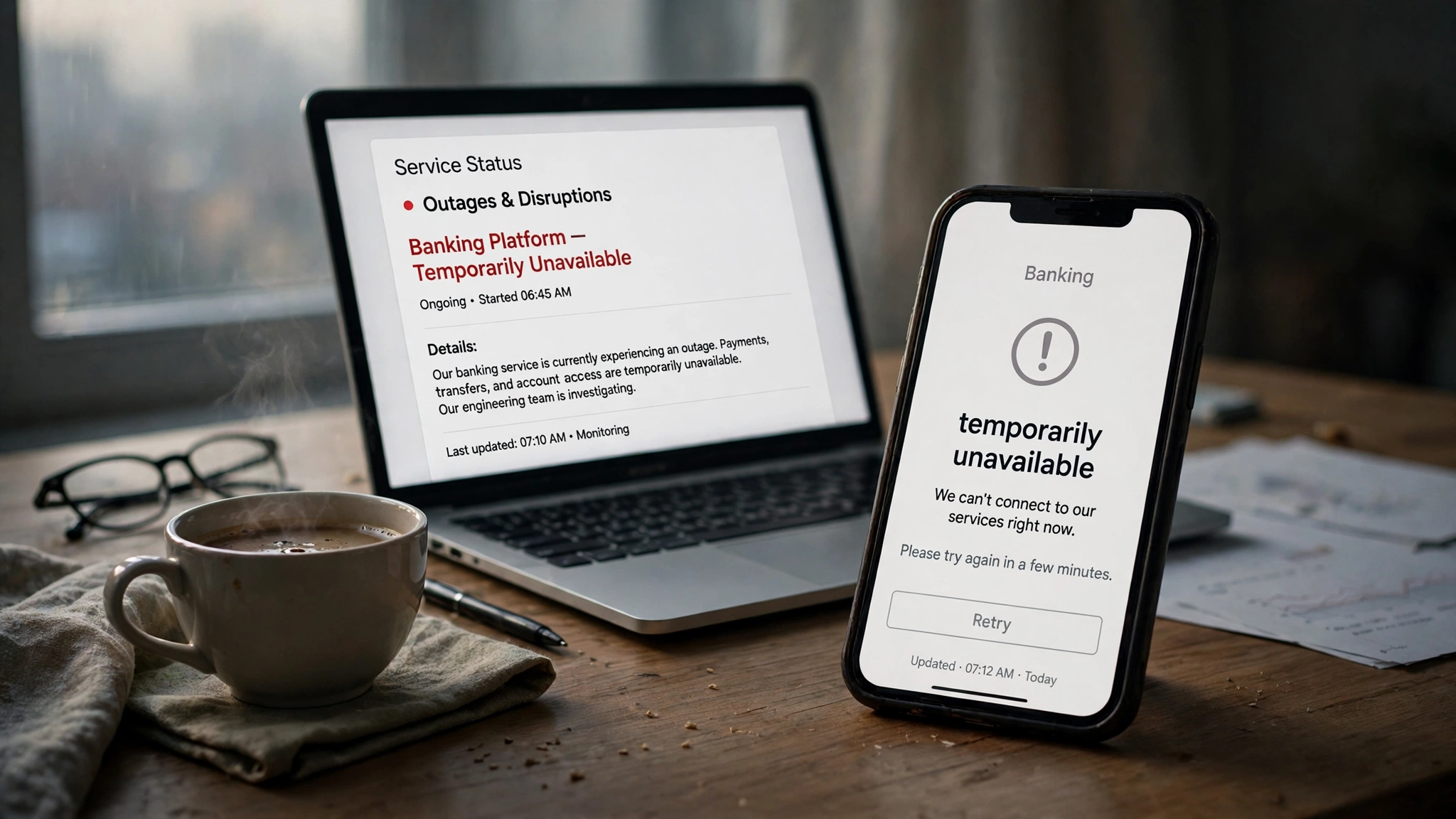
On Monday morning, November 16, 2026, people opened their Chase app and hit a wall. Balances would not load. Zelle payments sat unsent. The Downdetector graph for Chase went vertical, and by the afternoon "bank outage" was the second-most-searched term in the United States — over a million searches, up 1,000%, according to the Google Trends check I ran at 04:25 IST on November 17. Bank of America, Wells Fargo and US Bank customers were reporting problems of their own, and a wilder story was already spreading underneath it all: that this was the start of a November 17 blackout, that balances would be wiped, that the internet would go dark for three months.
Here is the short version, because the short version is what matters when your bank app will not open: the outage was real, it was a software bug, and it was not a hack. Your money was still there. The November 17 blackout story is a rumour with no evidence behind it. And the part that can actually cost you money is not the outage at all — it is the wave of fake "bank security" emails and texts that rides in behind every outage like this one. This article is about all three, in that order, because getting them mixed up is exactly how people get scammed on the worst possible day.
What broke, in the order it broke
The first reports landed on Monday morning, November 16. Chase customers found transactions running slower than usual, online banking stalling, and in some places branches and ATMs affected too — Neowin reported problems at physical branches in New York City, Chicago, Maryland and Pennsylvania alongside neighbourhood ATMs. By 2 p.m. Eastern, more than 4,700 problem reports about Chase had been filed on Downdetector; later counts put the peak above 19,000. Reports for Bank of America and Wells Fargo ran into the thousands as well, and Zelle payments between banks started delaying — which is how one bank's bad morning becomes four banks' bad afternoon.
Chase said what it said quickly, and what it said matters more than the outage itself. In a statement quoted by NBC News, JPMorgan Chase said it had "experienced a temporary issue related to a software bug in on-premise hardware systems." A person familiar with the matter told NBC it was a "technical bug, not a cyber issue," and CNBC's source said there was no indication bad actors were involved and no sign of a single bug hitting multiple banks at once. The bank's public line to customers was plainer: "Due to a technical issue, some transactions are taking longer than usual to complete, but customers still have access to their accounts and funds. We are working to resolve this as quickly as possible."
Two details in that picture are worth holding onto. First, scale: Chase is the largest bank in the US, serving 86.6 million consumers and 7.4 million small businesses across roughly 5,000 branches and 15,000 ATMs. When a bank that size has a slow morning, a million people search for answers at once — that is why "bank outage" hit the top of Trends, not because the banking system was collapsing. Second, the knock-on effects were real but bounded. Zelle said its own network was operating normally and that delays came from the banks. Plaid, the middleman many apps use to connect to your bank, posted a service disruption affecting Chase connections — new connections and API calls through its system. US Bank said its systems were not directly impacted, though Zelle payments with other institutions could be delayed. And three banks people kept naming in reports — Truist, PNC and Capital One — each told reporters they had not been affected at all. A Downdetector spike is a pile of user reports, not a diagnosis, and some of those reports were wrong.
That distinction is the whole story of the outage: a real, confirmed software bug at one very large bank, plus a halo of user reports at other banks that mostly did not check out. It is not a satisfying story. It has no villain, no hack, no conspiracy. Which is precisely why the second story — the one about November 17 — took off.
The November 17 story is a different story
Somewhere underneath the real outage, a much older rumour was waiting for its moment. The claim, in its various forms: the outages on November 12 and 13 were the opening act, and on November 17 the banks would shut down, balances would be wiped, and the internet would go dark for three months. It sounds specific. It is not true, and the dates give it away.
Fact-checkers who traced the claim found it in an anonymous post dated October 31 — two weeks before any bank had a problem. The November 12–13 outages it points to as "proof" were real but unrelated: Microsoft 365 went partly down for about 21 hours starting November 12 at 18:26 UTC, because of an issue introduced during an earlier expansion of its network, and Microsoft said so itself. The US Secretary of Homeland Security publicly denied any link between the outages. No bank or regulator has warned of anything happening on November 17, and wiping every balance at once is not a thing that can technically happen — balance data is stored in several copies.
So what is actually scheduled for November 17? One thing: a nationwide test of the Emergency Alert System, run by FEMA and the FCC, at 2:20 p.m. Eastern (1:20 p.m. Central). It lasts about a minute, it runs on participating TV and radio channels, and it requires no action from the public. That is it. A test signal on the radio is not a blackout, and a one-minute alert is not the internet going dark.
I am spending this much space on a rumour because rumours are the mechanism, not the sideshow. An outage makes people anxious; a date gives the anxiety a deadline; and a deadline makes people act — move money, click links, forward warnings, "verify" accounts. Every one of those actions is something a scammer can monetise. The outage itself never touched your money. The rumour exists to get you to touch it yourself.
The second outage arrives by email
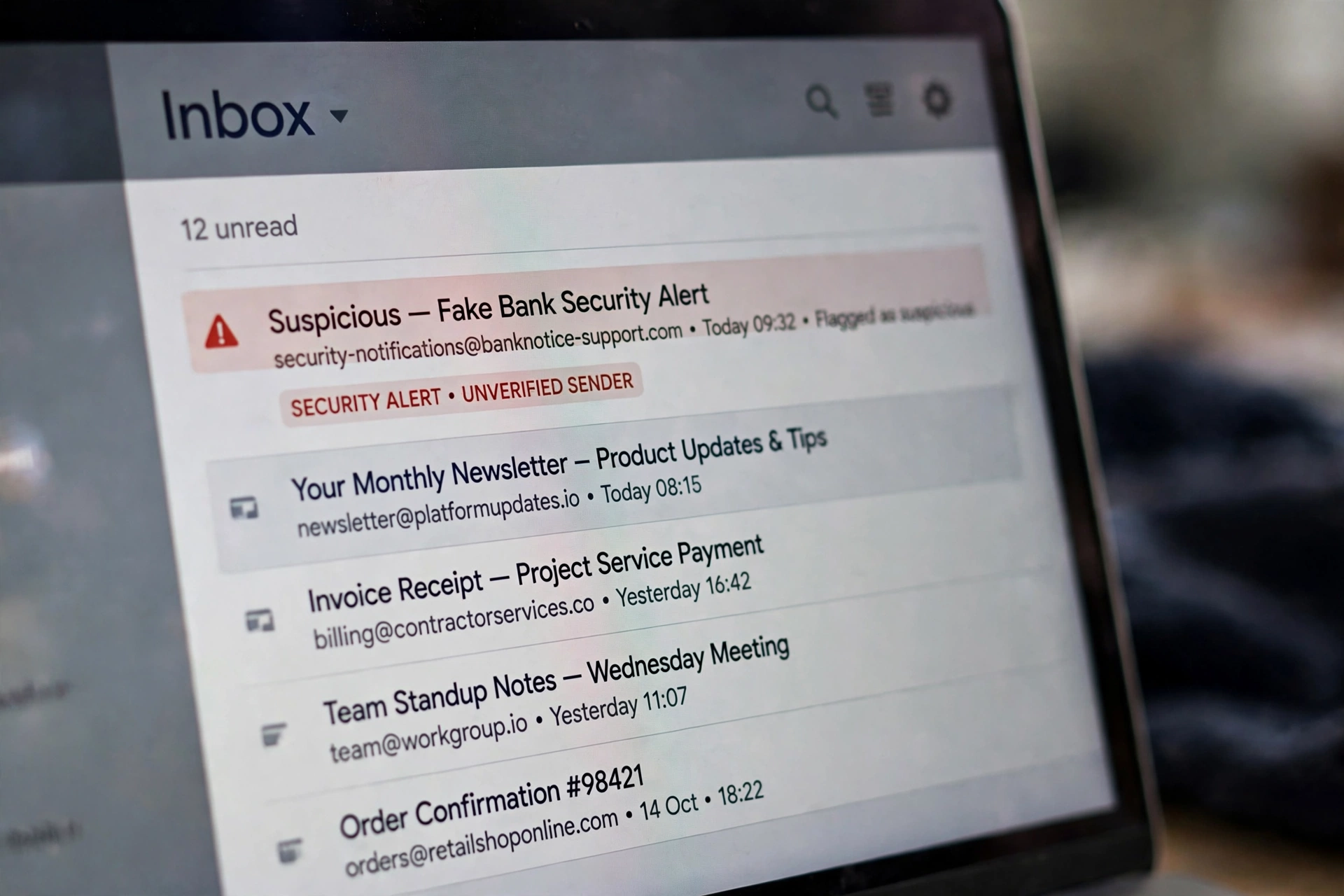
This is the part the news articles mostly skip, and it is the part this site exists to cover. Every major outage produces a second outage that never shows up on Downdetector: a flood of phishing emails and texts wearing the outage as a costume. The timing is not a coincidence. Scammers know you are worried, they know you are refreshing your banking app, and they know you are expecting a message from your bank. So they send you one.
There is already a documented example from this exact week. Security researchers at MalwareTips wrote up a "Chase Account Security Check" email scam: a message claiming Chase has locked your online banking access, with a link labelled View Details that leads to a counterfeit Chase sign-in screen on an unrelated hostname. The email talks about a one-time code sent to the mobile number on file — the language of a real security alert, copied well enough to pass a glance. The first thing the fake page asks for is your username and password. A bank logo, a password field and a footer are not evidence that Chase is operating the page; the hostname is the evidence, and in the documented example it was unrelated to Chase entirely.
That is the anatomy of the whole wave, and once you have seen it you cannot unsee it. The message invents a crisis on your account — a lock, a restriction, a failed verification — and then offers exactly one way out, right now, through its link. Urgency plus a link is the tell. Chase's own security pages say the same thing in plainer language: a legitimate bank will never ask you to move money to resolve a fraud issue, and neither banks nor police will ask you to help with a sting operation or share banking details. Chase's fraud alert texts come from five- or six-digit short codes — 72166 is one it lists — not from a random long number. And the FTC has noted that fake bank fraud alerts asking you to reply or call were the most-reported text scam of 2022, which tells you how old and how reliable this play is.
The reason it works during an outage is worth saying plainly: the outage does half the scammer's job. Normally a "your account is locked" email has to create the panic itself. On Monday, the panic was already there, supplied free by a real software bug. People who would have deleted the email on a normal Tuesday opened it, because on Monday the idea that their bank was having problems was true. The lie only has to be the second half — that this email is the way to fix it.
The 60-second check before you tap anything
You do not need a security degree to beat this. You need sixty seconds and a rule: never reach your bank through a message that arrived uninvited. Here is the check, in order.
First, close the message and open the app you already have installed, or type chase.com into your browser yourself. If the app is still struggling, that tells you the outage is still going — and it tells you without handing your password to a stranger. A link in an email is never the way in, even when the email looks right, because looking right is the one thing a phishing email is built to do.
Second, check an independent source before you believe any claim about the outage. Downdetector's Chase page shows whether other people are reporting the same problem right now; your bank's own status page or its verified social accounts say whether it has confirmed anything. I opened Downdetector's Chase page myself at 22:58 UTC on November 16, while writing this, and the outage report section was still live — which is consistent with a disruption easing rather than a system that secretly collapsed. One source is a rumour; two independent sources are a picture.
Third, read the sender address, not the display name. "Chase" in bold means nothing — anyone can set a display name. The domain after the @ is the whole test: chase.com is Chase, and banknotice-support.com is not, however official the wording around it looks. The same rule catches the fake "security alert" texts: a real fraud alert comes from a short code, and a message from a full phone number asking you to tap a link is a stranger with a costume on.
Fourth, treat any code you did not ask for as a warning, not an instruction. If a verification code lands in your inbox while you were not signing in, somebody else is trying to sign in as you. We wrote about exactly that situation in Plaid Verification Code Text You Didn't Request: What It Means and What to Do in the Next 10 Minutes — the ten-minute version is: do not enter the code anywhere, do not reply to the message, and go change the password from the real app.
Fifth, and this one is absolute: never move money because a message told you to. Not to a "safe account," not to "verify" anything, not because someone on the phone says they are from the fraud department. A real bank never asks for that, and a scammer's entire plan depends on you believing the exception. If someone claiming to be your bank wants you to move money, hang up and call the number on the back of your card.
If you already tapped
If you clicked the link and typed your password before the doubt caught up with you, do not sit on it — the window between "they have my password" and "they have my money" is measured in minutes, and everything below is about closing it.
Change your password now, from the real app or by typing the bank's address yourself — never from the link in the message. If you use the same password anywhere else, change it there too; password reuse is how one phishing email becomes five compromised accounts. Then check your recent transactions and your Zelle recipients for anything you did not send. Zelle transfers are effectively instant and effectively irreversible, which is why "your Zelle account needs an upgrade" is one of the most common fake messages in circulation — and why it is the first place to look.
Then report it through the channels that actually do something. Forward a suspicious email claiming to be from Chase to phishing@chase.com, then delete it. Forward a scam text to 7726, which spells SPAM. Report the incident to the FTC at ReportFraud.ftc.gov, and if your identity was misused, IdentityTheft.gov. And expect a follow-up: the same operators often call a day later posing as the fraud department, offering to "help" with the breach they just caused. The call is the second half of the same scam.
One more thing worth saying: a false email and a genuine fraud problem can happen in the same week, and one does not cancel the other. If you have actual evidence of unauthorised activity on your account — a transaction you did not make, a password reset you did not request — tell your bank separately, through the number on your card, regardless of what the phishing email said. Do not let the fact that the email was fake talk you out of checking whether the problem is real.
Make the next outage boring
Here is the uncomfortable truth about Monday: the outage was not the disaster. For most people it was a slow morning and a delayed payment. The disaster is the inbox that makes every outage an emergency — one address, handed to every signup form, every alert service, every "check your status" page, so that when the bank's name starts trending, your inbox is already full of messages wearing it.
The fix is structural, not heroic, and it starts with keeping your banking email separate from everything else. Your bank gets your real address and nothing else gets it. Status pages, outage trackers, coupon signups, free-trial forms — all of that goes to a disposable address. The point is not secrecy; it is blast radius. When the next outage trends, the phishing wave lands in an inbox you can delete, not the one your bank uses to reach you. Our own TempoMailUSA hands you a fresh address in seconds with a visible expiry countdown and an inbox that starts empty, which is the baseline for this kind of separation — a throwaway address for every service that does not need to know who you are.
The same habit applies to the scam-spotting itself. We have broken down the fake-message pattern before, and the pattern does not change: in Uphold Scam Email: The Fake Data Breach Message, How to Spot It, and What to Do If You Got One, the giveaway was a breach notice that arrived before any breach existed; in eToro Spam Email: Real Mail vs the Clone-Firm Scam, it was a clone firm wearing a real company's name. The Chase lock notice is the same play with a new costume. Learn the play once and you recognise it every time, whatever logo it wears next.
And one last comparison, because it settles the question people keep asking — was this a hack? A real hack looks different. Last year's GTA 6 leak, for example, was a teenager breaking into Rockstar's systems and posting stolen footage, and we covered what that teaches about email security in Rockstar Games Hacker Arion Kurtaj Pleads Guilty: What the GTA 6 Leak Teaches You About Email Security. A hack has an intruder, a target and something stolen. Monday had a bug, a slow morning and a rumour. The difference matters, because it decides what you should actually do: during a hack, you lock things down; during a bug, you wait — and you do not click the email that claims to be the fix.
The next bank outage will come. Banks are software now, and software has bad mornings. The question is not whether it happens; it is whether your inbox is ready for it. One address for your bank, throwaway addresses for everything else, and a sixty-second rule before you tap anything — that is the whole system, and it is enough.
FAQ
Is my money safe after the Chase bank outage? Yes, according to Chase itself. The bank said customers still had access to their accounts and funds while transactions ran slower than usual, and it described the cause as a software bug in on-premise hardware systems — not a cyberattack, and not a loss of funds. No bank or regulator has reported any money missing.
Was the bank outage a cyberattack? No evidence says so. Chase called it a software bug, a person familiar with the matter told NBC it was a "technical bug, not a cyber issue," and CNBC's source said there was no indication of malicious activity. The outages at other banks were mostly user reports on Downdetector, and several named banks — Truist, PNC and Capital One — said they were not affected.
Which banks were actually affected? Chase confirmed a fault of its own. Bank of America, Wells Fargo and US Bank had large numbers of user reports, and Zelle payments between banks were delayed, but only Chase and Wells Fargo confirmed an online-banking problem of their own. User reports alone do not establish a bank's outage, and some of Monday's reports did not check out.
Is there a blackout on November 17? No. The only event scheduled for November 17, 2026 is a nationwide Emergency Alert System test by FEMA and the FCC at 2:20 p.m. Eastern — about a minute, on TV and radio, with no action required. The "digital apocalypse" claim traces to an anonymous post from October 31 and has no supporting evidence.
I got a Chase security email saying my account is locked. Is it real? Almost certainly not, if it arrived during the outage and asks you to click a link. Do not click it. Open the Chase app you already have, or type chase.com yourself, and check there. Forward the email to phishing@chase.com and delete it. A real bank will never ask you to move money to fix a fraud problem.
What should I do if I clicked a fake bank link and entered my password? Change your password immediately from the real app or site, check recent transactions and Zelle recipients, and call the number on the back of your card. Forward the email to phishing@chase.com (or the text to 7726) and report it at ReportFraud.ftc.gov. Then watch for a follow-up call pretending to be the fraud department — that is the second half of the same scam.
Need a disposable temporary email?
Protect your real inbox from spam and promotional clutter instantly and free.
Received a suspicious email, text, or charge alert?
Verify whether the sender domain is disposable, spoofed, or unverified before clicking links.