



Why EDR in Cyber Security Is Now a Must-Have Defense
EDR in cyber security stands for Endpoint Detection and Response — a technology that continuously monitors devices like laptops, phones, and servers to detect, investigate, and respond to threats in real time.
Here's a quick breakdown:
| What EDR Does | Why It Matters |
|---|---|
| Monitors endpoints 24/7 | Catches threats that slip past basic defenses |
| Detects suspicious behavior | Spots attacks in progress, not just known malware |
| Automates responses | Isolates infected devices before damage spreads |
| Records forensic data | Enables root cause analysis after an incident |
| Maps to MITRE ATT&CK | Identifies attacker tactics and techniques |
Traditional antivirus waits for a known threat to show up. EDR watches for how something behaves — which means it can catch attacks that have never been seen before.
The term was coined by Gartner analyst Anton Chuvakin back in 2013. He called it "endpoint threat detection and response." The world of cybersecurity has never looked back.
Today, the EDR market is valued at $6.5 billion and is projected to reach $50.5 billion by 2034 — a sign of just how critical this technology has become.
For anyone who cares about keeping personal data private — whether you're an individual or an organization — understanding EDR is a smart first step toward real protection.
What is EDR in Cyber Security?
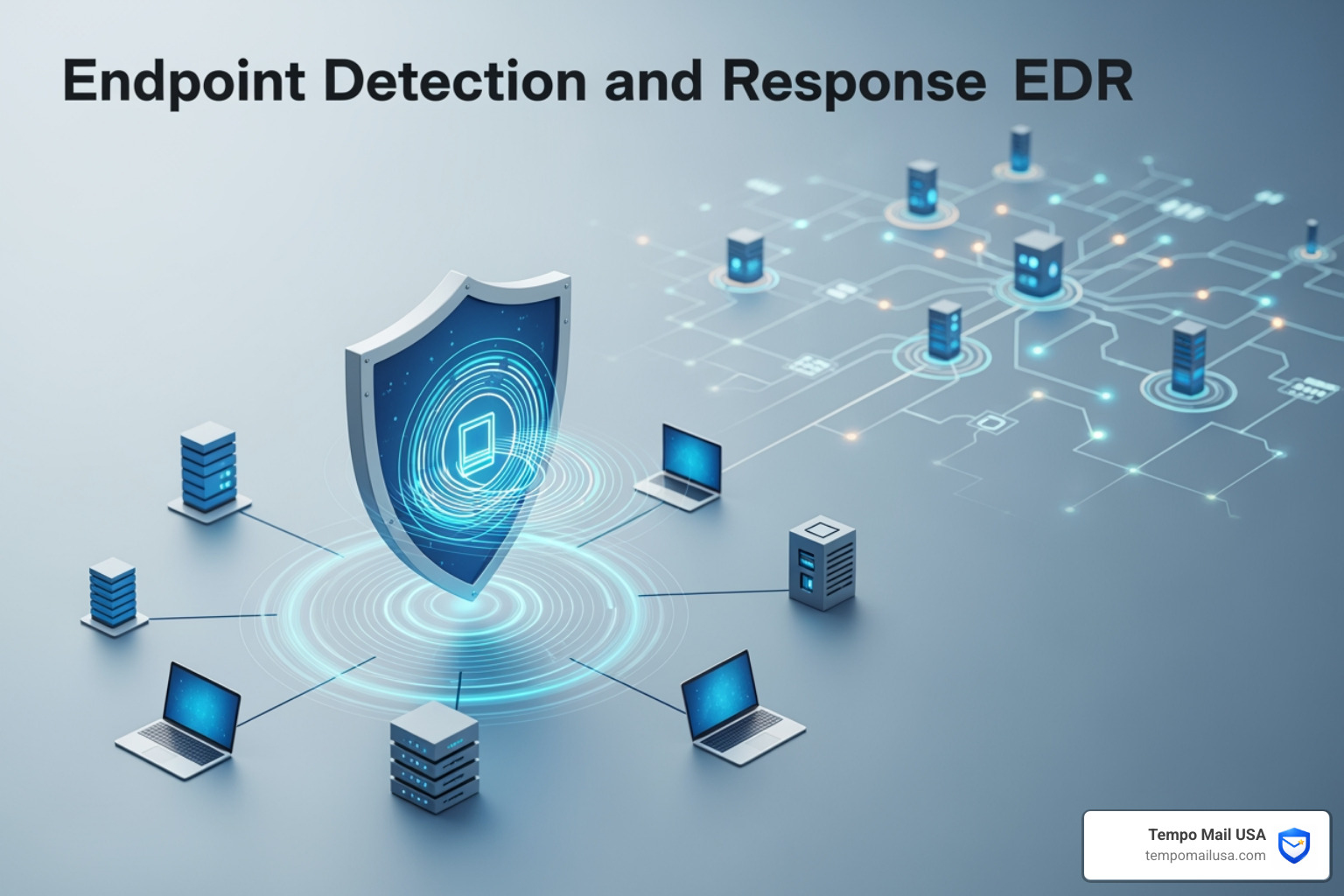
To understand EDR in cyber security, we first need to look at what it’s actually protecting. An "endpoint" is any device that connects to a network—think laptops, desktops, mobile phones, IoT devices, and even cloud servers. In the modern workplace, these endpoints are the primary targets for hackers because they are where the data lives and where users interact with the digital world.
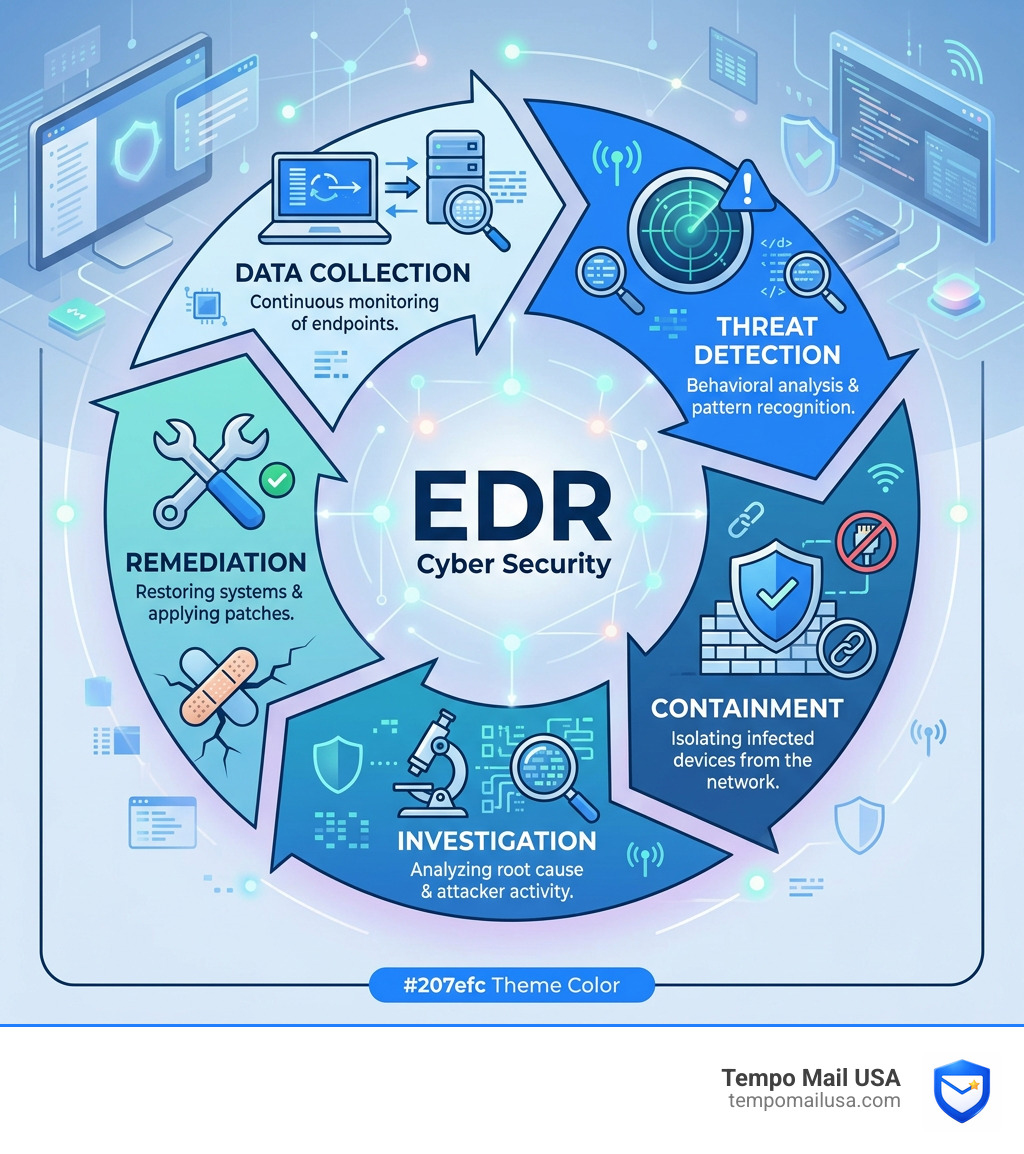
At its heart, EDR is about visibility. We like to think of it as a "DVR for your laptop." Just as a security camera records everything happening in a hallway, EDR records the "telemetry" of an endpoint. This includes process executions, registry changes, network connections, and file modifications. By collecting this data continuously, we can see exactly what happened before, during, and after a security event.
The magic happens in the central management console. This is the "brain" of the operation where all the data from every device in the organization is gathered and analyzed. Here, the system performs behavioral baselining—learning what "normal" looks like for your specific environment. If a marketing manager’s laptop suddenly starts executing PowerShell scripts and trying to connect to a known malicious IP address in the middle of the night, EDR flags it as an anomaly.
This proactive approach is bolstered by endpoint protection machine learning, which allows the software to identify patterns of malicious activity without needing a specific "fingerprint" or signature. By correlating this local data with global threat intelligence, EDR provides a comprehensive shield. For a deeper technical dive into these capabilities, you can review this Sophos EDR solution brief.
How EDR Differs from Traditional Antivirus and EPP
One of the most common questions we hear is: "I already have antivirus, why do I need EDR?" It’s a bit like comparing a locked front door to a 24/7 security guard with a radio. Both are important, but they serve very different roles.
Traditional Antivirus (AV) is largely reactive. it uses "signatures"—basically a library of known "bad" files. If a file matches a signature, it's blocked. But what happens if the attacker uses a "zero-day" threat that has no signature yet? That’s where AV fails.
Endpoint Protection Platforms (EPP) evolved to include more preventive measures, like personal firewalls and data encryption. However, EPP still focuses primarily on the "perimeter" of the device—trying to keep the bad guys out.
EDR in cyber security assumes that, eventually, someone will get in. It provides post-compromise visibility. If a threat slips past the front door (the AV/EPP), EDR is the security guard inside the building watching where the intruder goes and what they touch.
Comparison Table: AV vs. EPP vs. EDR
| Feature | Legacy Antivirus (AV) | Endpoint Protection (EPP) | EDR Solutions |
|---|---|---|---|
| Detection Method | Signatures (Known threats) | Signatures + Heuristics | Behavioral Analytics + AI |
| Primary Goal | Prevention | Attack Surface Reduction | Detection & Response |
| Visibility | Low (Only blocks files) | Moderate (Device health) | High (Continuous recording) |
| Incident Response | Manual | Basic | Automated & Forensic |
| Offline Monitoring | Limited | Moderate | High |
This "prevention-first" approach is vital because it mitigates "silent failures"—situations where a breach occurs but no alarm is triggered. By monitoring EDR-specific telemetry types like memory access and disk activity, we can catch stealthy attackers who don't use traditional files at all. To learn more about how to structure your defenses, check out these endpoint security best practices.
Core Capabilities: Detection, Containment, and Investigation
When an alert fires, an EDR solution doesn't just say "something is wrong." It provides the context needed to fix it. This is broken down into four key stages: Detection, Containment, Investigation, and Elimination.
Detection: IOCs vs. IOAs
EDR looks for two types of clues. Indicators of Compromise (IOCs) are the digital breadcrumbs left behind after an attack, like a specific file hash or a known malicious IP. Indicators of Attack (IOAs) are much more powerful—they focus on the intent and tactics of the attacker. For example, if a user downloads a legitimate tool but then uses it to harvest credentials, that is an IOA.
By mapping these behaviors to the MITRE ATT&CK framework—a global knowledge base of hacker tactics—EDR helps teams understand exactly what stage an attack is in. This level of detail is essential for cybersecurity compliance software, as it provides the audit trail required by many regulations.
Advanced Threat Detection in EDR in Cyber Security
Modern threats are slippery. Attackers use "polymorphic malware" that changes its code to avoid detection, or "fileless attacks" that exist only in a computer's RAM. EDR uses advanced behavioral analytics and AI-prioritized detections to spot these anomalies.
Instead of overwhelming security teams with thousands of minor alerts (the dreaded "alert fatigue"), modern EDR uses machine learning to group related events into a single "incident." Research shows that customizable incident scoring can reduce the number of individual events to investigate by a staggering 98%. This allows analysts to focus on high-fidelity threats that actually matter.
For those looking to go beyond the basics of online privacy software, EDR represents the ultimate layer of protection for personal and corporate data. Furthermore, the scientific research on XDR evolution highlights how these detection capabilities are now expanding beyond the endpoint.
Incident Response and Containment with EDR in Cyber Security
Once a threat is detected, speed is everything. EDR provides "one-click" containment. We can remotely isolate a compromised laptop from the network, preventing the malware from spreading laterally to other devices.
Key response features include:
- Process Termination: Instantly killing a malicious script or application.
- Automated Rollback: Using captured endpoint images to return a system to its last known healthy state.
- Malicious IP Blocking: Automatically updating firewalls to stop communication with the attacker's server.
- Live Response: Giving analysts a direct, audited shell access to devices for deep cleaning.
You can see these features in action in this Video: Adaptive Attack Protection. This level of automation is why enterprise cybersecurity software has become a staple for businesses of all sizes; it handles the heavy lifting so human teams can focus on high-level strategy.
The Evolution of EDR: From Siloed Tools to XDR and SOAR
The cybersecurity landscape is constantly shifting. In the early 2010s, EDR was a standalone tool that required a lot of manual tuning. Today, it is part of a much larger, integrated security ecosystem.
One major trend is the move toward XDR (Extended Detection and Response). While EDR focuses only on endpoints, XDR unifies telemetry from the network, cloud, email, and identity providers. This gives us a "big picture" view of an attack. For example, XDR can link a suspicious email (email security) to a user logging in from a new location (identity security) and then running a weird file (EDR).
Another key integration is with SIEM (Security Information and Event Management) and SOAR (Security Orchestration, Automation, and Response). SIEM acts as a giant data lake for all logs, while SOAR uses "playbooks" to automate the response across different tools.
As noted in the Gartner Top 9 Security Trends, the consolidation of these tools is a major priority for organizations. With 83% of organizations increasing their threat detection budgets, the focus is clearly on efficiency.
For many smaller teams, managing an EDR solution 24/7 is too much work. This has led to the rise of Managed Detection and Response (MDR). In this model, you use the EDR software, but a third-party team of experts monitors it for you, hunting for threats while you sleep.
Frequently Asked Questions about EDR
What is the difference between EDR and XDR?
Think of EDR as a specialist and XDR as a generalist with a bird's-eye view. EDR focuses deeply on the endpoint (laptops, servers). XDR "extends" that detection by pulling in data from your network, cloud apps, and email systems. XDR is essentially the evolution of EDR into a more holistic security platform.
Can EDR detect fileless malware?
Yes! This is one of the biggest strengths of EDR in cyber security. Because EDR monitors memory usage and command-line activity (behavior) rather than just scanning files on a disk, it can spot malicious scripts or code injections that never actually touch the hard drive.
Why is EDR better than traditional antivirus?
It isn't necessarily "better"—it's a different layer. Traditional AV is great for stopping the "easy" stuff (known viruses). EDR is designed for the "hard" stuff: targeted attacks, zero-day exploits, and human-led hacking. You really need both to have a complete defense.
Conclusion
In an era where 32% of organizations use between 21 and 30 separate security tools to respond to threats, simplicity and visibility are your best friends. EDR in cyber security provides that essential "ground-truth" visibility into what is happening on your devices, allowing us to move from a reactive posture to a proactive defense.
By catching threats early, isolating them quickly, and providing the forensic data needed to prevent them from happening again, EDR helps future-proof your security stack. At Tempo Mail USA, we understand that true security starts with protecting your identity and your data. While EDR protects your devices, our temporary email aliases act as a PII firewall, shielding your real identity from the web.
Protecting your digital life requires a multi-layered approach. Whether it's shielding your email with tempomailusa.com or monitoring your endpoints with a robust EDR solution, taking these proactive steps ensures that you stay one step ahead of the bad guys.