


Why Online Privacy Software Matters More Than Ever
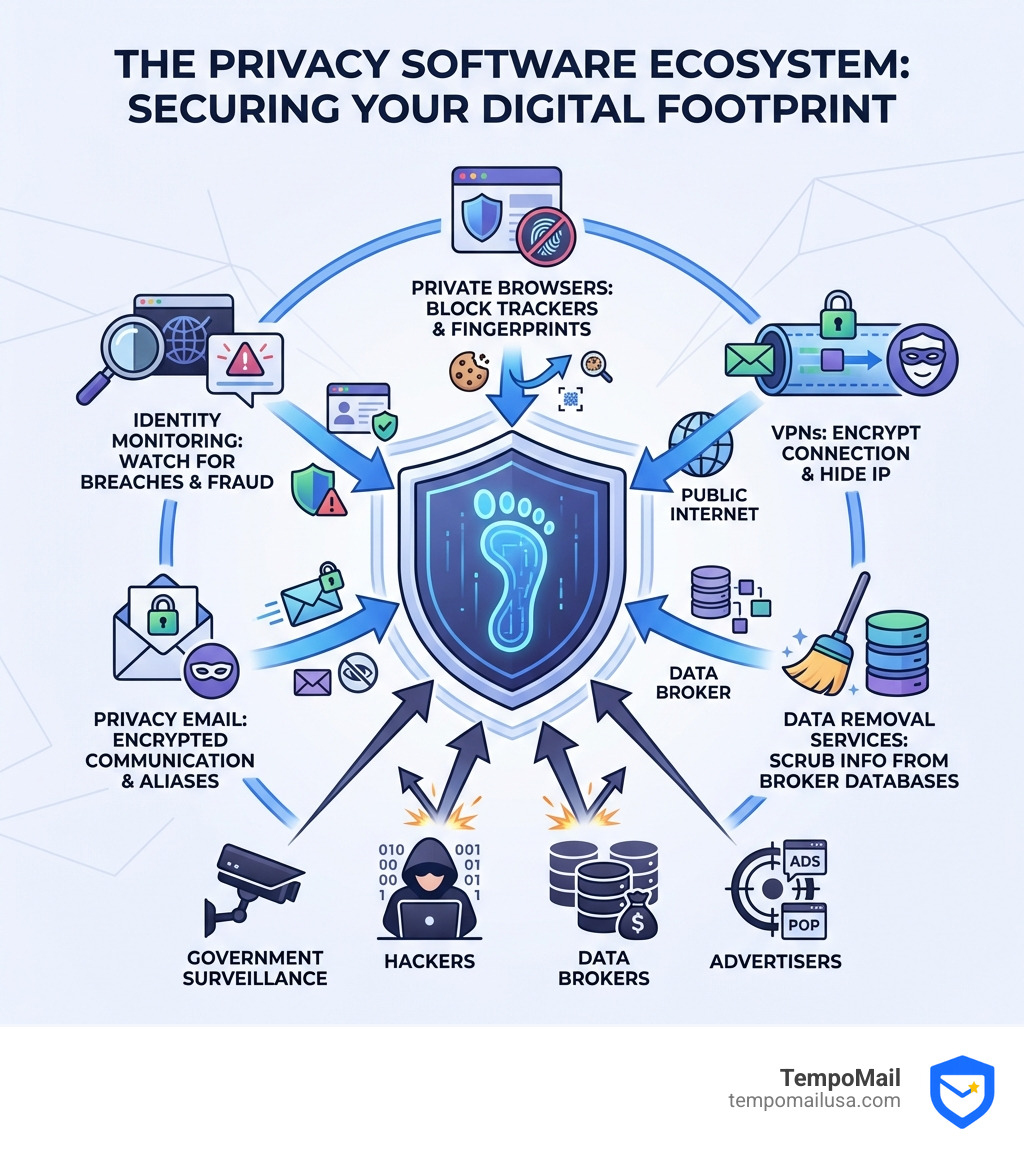
Online privacy software is your digital defense system against tracking, data harvesting, and identity theft. Here are the essential categories you need to know:
Core Privacy Tool Categories:
- Private Browsers - Block trackers, cookies, and fingerprinting by default.
- VPNs - Encrypt your connection and mask your IP address across all devices.
- Data Removal Services - Automatically remove your info from hundreds of data brokers.
- Privacy Email Providers - End-to-end encryption and disposable aliases for secure communication.
- Identity Monitoring - Dark web scans and breach alerts with theft insurance.
You are being watched. Private and state-sponsored organizations are monitoring and recording your online activities. Every website you visit, every form you fill out, and every search you perform leaves a data trail that hundreds of companies collect, aggregate, and sell without your knowledge.
The consequences are real. Identity theft, targeted manipulation, and data breaches expose your most sensitive information. The average person has their personal data scattered across countless databases, vulnerable to anyone willing to pay for it.
But here's the good news: you can take back control.
Modern privacy software has evolved far beyond simple ad blockers. Today's tools use sophisticated techniques like zero-knowledge encryption, behavioral tracker analysis, and automated data removal to protect you from both commercial surveillance and malicious actors. Research shows that organizations using comprehensive privacy tools see an 80% decrease in privacy incidents and save over $654,000 in compliance costs.
The "nothing to hide" argument falls apart when you consider who might be watching. You want to hide your banking details from fraudsters, your identity from thieves, and your location from burglars. You don't know who these threats might be—that's exactly why protection matters.
I'm Mohammad Waseem, and I've spent years building and optimizing privacy-focused platforms including temporary email services and secure web tools. Through testing various online privacy software solutions and analyzing their real-world effectiveness, I've learned what actually works versus what's just marketing hype.
Essential Categories of Privacy Tools for Daily Use
In our increasingly interconnected world, safeguarding our digital lives requires a multi-layered approach. A robust ecosystem of online privacy software and services exists to help us. These tools range from simple browser extensions to comprehensive identity protection suites, all designed to put you back in the driver's seat of your personal data. When we talk about protecting ourselves online, we're looking at solutions that offer ad-blocking, tracking protection, and defense against tactics like browser fingerprinting, all while employing end-to-end encryption and IP masking. For reliable assessments of these tools, we often turn to trusted review sources like PC Mag or Tom's Guide.
Private Browsers and Search Engines
Think of your standard web browser as a friendly, but overly talkative, companion. It remembers everything you do and often shares that information with advertisers. Private browsers, on the other hand, are designed from the ground up to improve your privacy by minimizing data collection and online tracking.
They often come with built-in ad and tracker blockers, cookie blocking, and anti-fingerprinting measures. Browser fingerprinting is a subtle method of tracking where websites gather unique characteristics of your device to identify you. Private browsers actively work to foil this. A significant benefit is that many users report that websites can load noticeably faster because they're not bogged down by tracking scripts.
Beyond browsing, private search engines focus on independent indexing and zero profiling, meaning your search queries aren't used to build a profile of your interests.
Virtual Private Networks (VPNs) for Anonymity
A Virtual Private Network (VPN) acts as a secure, encrypted tunnel for all your internet traffic. Instead of your internet service provider (ISP) seeing your online activities, they only see that you're connected to a VPN server. This is crucial because ISPs have a history of selling user data. VPNs contribute to online anonymity by masking your real IP address and encrypting your data.
One of the most common use cases for a VPN is when connecting to public Wi-Fi networks. Whether you're at a coffee shop or an airport, public Wi-Fi is notoriously insecure. A VPN encrypts your connection, protecting your sensitive data from potential eavesdroppers. It creates an encrypted tunnel between your device and the internet, routing your traffic through a server in a location of your choice.
Key benefits of VPNs include:
- Public Wi-Fi security: Encrypts your data on unsecured networks.
- ISP tracking prevention: Your ISP can't see your browsing habits.
- Encrypted tunnels: All your data is scrambled and unreadable to outsiders.
- Anonymized browsing: Your real IP address is hidden.
- Multi-device coverage: Many VPNs offer subscriptions that cover multiple devices.
When choosing a VPN, prioritize providers that publish clear no-log policies and back them up with independent audits and transparency reports.
Data Removal and Identity Monitoring Services
Data brokers are companies whose entire business model revolves around collecting and selling your data. They gather everything from your contact details and home address to family members. This information can be used for targeted advertising, but also for scams or identity theft. There are hundreds of data brokers actively trading your data.
Data removal services actively search for your personal information on these databases and then facilitate its removal. They automate the opt-out process, which can be incredibly tedious if you try to do it yourself. These services specialize in scrubbing your Personally Identifiable Information (PII) from these databases.
Beyond removal, identity monitoring services keep a watchful eye on your digital footprint. They offer:
- Automated opt-outs: Continuously work to remove your data from data broker sites.
- People-search sites: Specifically target sites that expose your home address and phone number.
- Identity theft insurance: Many comprehensive services offer financial protection and assistance in recovering from identity theft.
- Dark web monitoring: Scan the dark corners of the internet for your exposed personal information.
- Data breach alerts: Notify you if your online accounts have been exposed in a data breach, helping you react quickly to secure your information.
How Online Privacy Software Protects Your Data
The digital world is a complex landscape where personal data is constantly being collected. This is why online privacy software is a necessity for safeguarding your digital life. Implementing these tools can lead to an 80% decrease in privacy incidents and a $654k reduced cost of complying with privacy laws. These tools address concerns like targeted advertising and identity theft, creating a more secure online experience.
The Role of Online Privacy Software in Email Protection
Your email inbox contains sensitive communications, financial information, and links to your online accounts. Standard email providers often scan your emails for advertising purposes. Choosing a privacy-focused email provider is a critical step in protecting your data.
What features should you look for in a privacy-focused email provider?
- End-to-end encryption: This ensures that only you and your intended recipient can read your messages. Even the email provider cannot access the content.
- No inbox scanning for advertising: Privacy-first services explicitly state they do not scan your emails to target ads.
- Minimal data collection: They collect only the essential data needed to provide the service.
- Anonymous signup options: Some providers allow you to sign up without requiring personal identifying information. Learn more in our guide on Anonymous Email Accounts: Your Guide.
- Disposable aliases: This allows you to create unique, temporary email addresses for different services. If an alias starts receiving spam, you can simply deactivate it without affecting your main inbox.
- Password-protected messages: Some services allow you to send encrypted messages to non-users, protected by a password.
Switching to a privacy-focused email provider is one of the most impactful steps you can take to protect your online privacy.
Reducing Your Digital Footprint with Online Privacy Software
Our "digital footprint" refers to the trail of data we leave behind as we steer the internet. Every click and search adds to this profile. Reducing your digital footprint means minimizing the amount of personal data collected about you.
How can users leverage technology to reduce their digital footprint?
- Data broker removal: Specialized services work to remove your PII from data broker databases, preventing them from selling your information.
- Browser privacy settings: Using private browsers to block cookies and trackers reduces the passive collection of your data.
- Privacy-focused search engines: Opting for search engines that don't log your searches ensures your inquiries don't contribute to your digital profile.
- Disposable email addresses: Using temporary or disposable emails for sign-ups, as offered by services like TempoMail, prevents your primary inbox from being flooded with spam and shields your real email address from data breaches.
- VPN usage: By masking your IP address, a VPN prevents websites from easily correlating your activity with your physical location.
- Secure cloud storage: Storing your files with providers that offer end-to-end encryption ensures that even the provider cannot access your data.
- Automated compliance: Comprehensive data privacy suites can offer tools that automate compliance with privacy settings across various platforms.
By consciously choosing these tools, we can significantly reduce the amount of personal data that ends up in the hands of third parties, shrinking our digital footprint.
Key Features of High-Quality Privacy Tools
Choosing the right online privacy software can feel overwhelming. However, by focusing on a few key considerations, we can make informed decisions that improve our digital security. Whether you're looking for a private browser, a data removal service, or a VPN, these features are paramount.
Here are the key considerations and features to look for:
- Open-source code: Open-source software allows its code to be publicly inspected. This transparency allows researchers to identify vulnerabilities and ensure there are no hidden backdoors.
- Zero-knowledge architecture: This means that the service provider itself cannot access or decrypt your data. Only you hold the keys.
- Strong encryption: Look for tools that employ robust protocols like AES-256 for data at rest and strong TLS/SSL for data in transit.
- Jurisdiction: The country where a service is based can impact its ability to protect your data. Many privacy-focused services choose to operate outside of intelligence-sharing alliances.
- Warrant canaries: A warrant canary is a statement that a service provider has not received secret legal requests for data. If the canary disappears, it's a signal that such an order may have been received, as highlighted on Wikipedia.
- SOC 2 compliance: This indicates that the organization maintains a high level of information security practices.
- Multi-factor authentication (MFA): This adds an extra layer of security to your accounts, requiring more than just a password to log in.
- Audits and transparency reports: Independent security audits provide external validation of a tool's security claims.
- Business model: Understand how the service makes money. If a service is free without a clear revenue stream, your data might be the product.
These considerations help us minimize data collection and block tracking mechanisms like fingerprinting.
| Feature | Standalone Tools (e.g., private browsers, VPNs) | Integrated Suites (e.g., all-in-one security subscriptions) |
|---|---|---|
| Coverage | Specialized for one area | Comprehensive, bundling multiple features |
| Cost | Often free or subscription per service | Single subscription, potentially cost-effective |
| Complexity | Requires managing multiple apps | Centralized management, potentially simpler |
| Customization | High, custom to specific needs | Moderate, pre-configured bundles |
| Expertise Required | Moderate, user needs to select tools | Lower, "all-in-one" solution |
| Example Benefits | Deep privacy in one area | Convenience, broad protection |
Frequently Asked Questions about Online Privacy Software
What are the risks of not using privacy-enhancing tools?
Ignoring the importance of online privacy software is risky. The potential consequences are significant:
- Identity theft: Without protection, your PII can be harvested by data brokers or stolen in breaches. This data can be used to open fraudulent accounts or impersonate you.
- Targeted manipulation: Your browsing habits are analyzed to build profiles of your preferences. This data is used for targeted advertising and psychological profiling.
- Data breaches: A lack of privacy measures means that when a company suffers a breach, your exposed data is more extensive. Strong passwords and MFA can mitigate the impact.
- Permanent digital shadows: Information shared online can persist indefinitely, creating a "digital shadow" that can impact future opportunities.
- Financial fraud: Exposed financial details can lead to direct losses. Masked credit card numbers can prevent dishonest merchants from overcharging you.
Employing privacy tools significantly minimizes these risks, helping you keep your personal information out of the wrong hands.
How do data removal services address data brokers?
Data brokers collect and sell personal information from public records and social media. Data removal services tackle this issue through several mechanisms:
- Automated requests: These services automate the process of sending removal requests to a vast network of data brokers.
- Legal opt-outs: Many privacy laws, like the CCPA, give individuals the right to opt out of having their data sold. Removal services leverage these frameworks.
- Continuous monitoring: Data brokers often re-collect information. A good service continuously monitors for your PII and resubmits removal requests.
- PII deletion: The primary goal is the deletion of your name, address, and phone number from these databases.
- Reducing spam: Removing your contact information from these lists often leads to a reduction in telemarketing calls and spam emails.
Can privacy software prevent all forms of tracking?
While online privacy software offers a powerful defense, no single tool can provide 100% immunity. However, it significantly mitigates common tracking methods:
- Fingerprinting mitigation: Private browsers and specialized tools work to reduce the uniqueness of your browser fingerprint. The EFF's Cover Your Tracks project has documented this extensively.
- Cookie isolation: Many browsers implement cookie isolation, which prevents third-party cookies from tracking you across different websites.
- Global Privacy Control (GPC): This allows users to signal their privacy preferences directly from their browser. Tools like Privacy Badger send the Global Privacy Control signal by default.
- Behavioral analysis: Some tools employ an algorithmic approach to observe the behavior of third-party domains and block those that appear to be tracking you.
- Layered defense: The key is to combine multiple tools. A private browser, a VPN, and a privacy-focused email service create a robust shield.
While complete anonymity is difficult, these tools significantly reduce your attack surface and empower you to control your digital identity.
Conclusion
In an age where personal information is constantly being monetized, embracing online privacy software is a fundamental aspect of modern digital hygiene. We've explored how tools like private browsers, VPNs, and privacy-focused email work together to build a robust defense around your digital life.
Protecting your personal data is essential. The good news is that we now have an ever-growing arsenal of tech tools available to help you take control. Whether you're looking to browse anonymously or secure your communications, these solutions are a massive help. You can actually use technology to reduce your digital footprint.
At TempoMail, we understand the importance of safeguarding your Personally Identifiable Information (PII). Our identity proxying services are designed to act as a firewall, protecting your real details from online services by generating secure aliases. This proactive protection is part of a larger strategy to maintain your digital sovereignty.
With the right tools and a proactive attitude, you can take your privacy into your own hands. Don't get caught naked online; equip yourself with the best online privacy software and services available.
For more insights into securing your online identity and managing your digital footprint, visit Temp Mail USA - Your Go-To Solution for Disposable Emails.