

CCSPayment Scam or Legit? How to Spot Fake Debt Notices Fast

Is the CCSPayment Scam Real? Here's What You Need to Know First
A ccspayment scam is when fraudsters impersonate Credit Collection Services (CCS) — a real, legitimate debt collection agency — to trick you into paying fake debts or handing over sensitive personal information.
Quick answer:
- CCSPayment itself is NOT a scam. It is the official online payment portal for Credit Collection Services (CCS), a real debt collector founded in 1966 and based in Norwood, Massachusetts.
- However, scammers DO impersonate CCSPayment using fake emails, texts, calls, and lookalike websites.
- Before you pay anything, verify the debt is real and the contact is actually from CCS.
Here's how to tell the difference at a glance:
| Signal | Legitimate CCS | Likely a Scam |
|---|---|---|
| Provides written debt validation | Yes, within 5 days | Refuses or avoids it |
| Payment method | Standard traceable methods | Gift cards, crypto, wire transfer |
| Contact hours | 8 AM – 9 PM local time | Any hour |
| Threatens arrest | Never | Common tactic |
| Verifiable contact info | Yes, matches official site | Suspicious or mismatched |
Getting an unexpected debt notice is stressful. Your first instinct might be to pay immediately just to make it go away — or to dismiss it entirely as a scam. Both reactions can hurt you.
The FTC received over 200,000 debt collection scam reports in 2024 alone. At the same time, CCS has over 3,700 complaints on the BBB — meaning even the real company has a complicated reputation. That combination makes it genuinely hard to know what you're dealing with.
This guide will walk you through exactly how to tell a real CCSPayment notice from a fake one, what your legal rights are, and what to do if you've already been targeted.
What is CCSPayment and Is It a Legitimate Company?
When we see a charge or a letter from "CCSPayment," the first question is usually: "Who are these people, and why do they want my money?"
To clear the air: CCSPayment is the official online payment portal for CCS Companies (also known as Credit Collection Services). Based in Norwood, Massachusetts, this company has been around since 1966. They aren't a fly-by-night operation; they are a major U.S. debt collector that handles accounts for hospitals, utility companies, banks, and insurance providers.
However, legitimacy doesn't always mean a five-star customer experience. If you check their Better Business Bureau profile, you'll see thousands of complaints. Most of these involve consumers disputing the validity of a debt or complaining about persistent phone calls. This high volume of negative feedback often leads people to believe they are witnessing a ccspayment scam, even when the company is technically operating within the law.
Because CCS is so large and well-known in the industry, they are a primary target for impersonation. Scammers know that if they use a name like "Credit Collection Services," a certain percentage of people will assume the debt is real because they've heard the name before.
| Feature | Legitimate CCS Portal | Scammer Impersonation |
|---|---|---|
| Website URL | www.ccspayment.com | Lookalikes like ccspayments.com or .net |
| Founding Date | 1966 | Usually very recent or hidden |
| Physical Address | 725 Canton Street, Norwood, MA | P.O. Boxes or no address listed |
| BBB Status | Accredited (usually) with many complaints | Not listed or fake "seal" images |
| Official Site | the official website | Broken links and "Urgent" pop-ups |
If you are dealing with a different agency, you might want to check our Detailed Guide to Payne Richards Associates Scam Status to see how other companies compare.
Identifying a CCSPayment Scam: Red Flags and Tactics
Scammers love the debt collection niche because it relies on two powerful emotions: fear and urgency. A typical ccspayment scam begins with a message that makes your heart race. You might get a text saying your "account is in arrears" and legal action is imminent unless you click a link immediately.
How Scammers Use the CCSPayment Scam to Steal Data
In many cases, the goal isn't just to get a one-time payment. It’s a phishing expedition. By directing you to a spoofed version of the CCSPayment portal, scammers can capture:
- Your full name and Social Security number (under the guise of "verifying your identity").
- Your bank account or credit card details.
- Your login credentials for other financial sites.
They often use domain variations that look almost identical to the real thing—perhaps adding an extra 's' (ccspayments.com) or using a different extension like .biz or .info. If you're wondering Why Am I Getting So Many Spam Calls All of a Sudden, it's often because your contact information was leaked in a data breach and sold to these fraudulent "collectors."
Common Impersonation Methods

- Fake Emails: These often feature the CCS logo but come from a generic address like "collections-dept@gmail.com" or a random string of characters.
- Short Code Texts: While legitimate collectors can text you, scammers use them to send malicious links. Real CCS texts often come from specific short codes like 30601, but you should still be cautious.
- Threatening Calls: A real collector cannot threaten to have you arrested. If a caller says the "sheriff is on the way" unless you pay via a gift card or cryptocurrency, hang up immediately. Those are the hallmarks of a ccspayment scam.
For more tips on spotting these fake representatives, see our guide on How to Identify Spectrum Scam Calls.
How to Verify a Debt Collector and Protect Your Rights
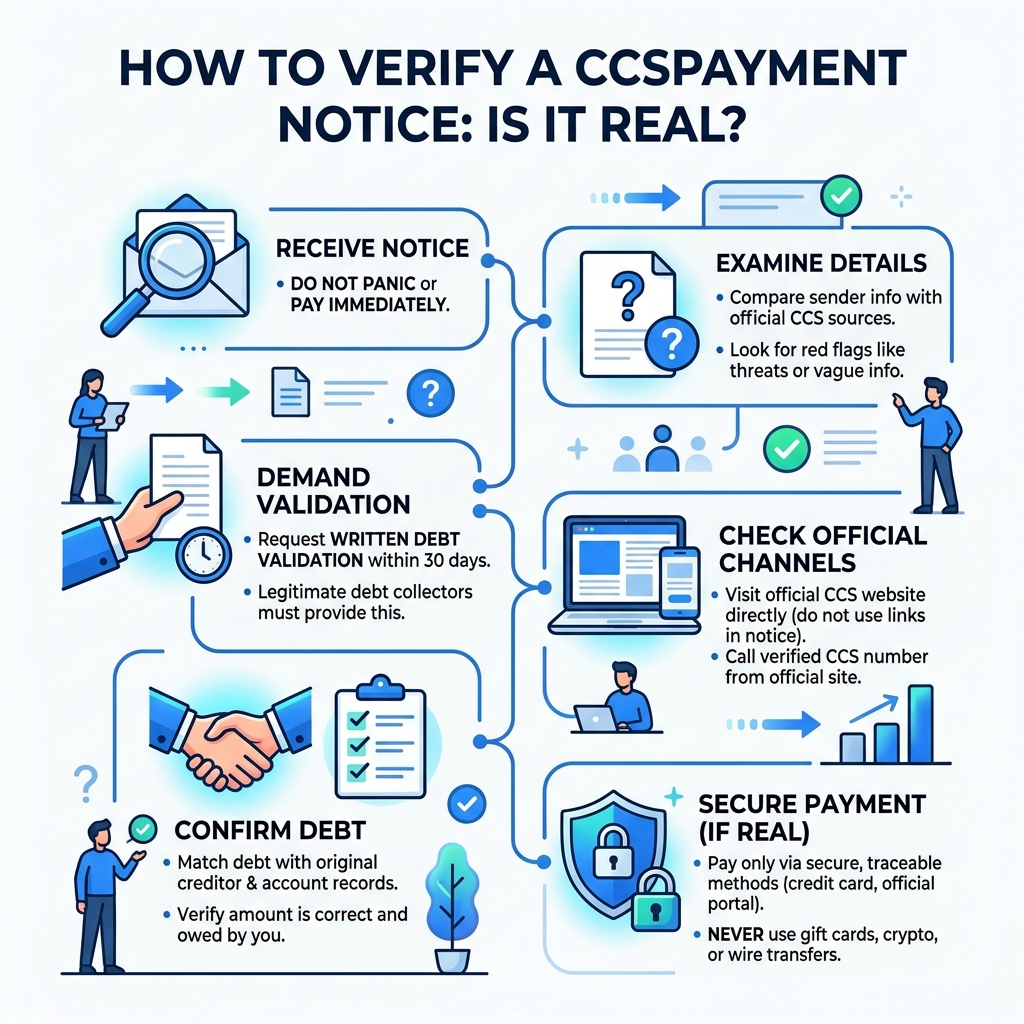
If you receive a notice, don't panic, but don't ignore it either. You have powerful protections under the Fair Debt Collection Practices Act (FDCPA).
The most important tool in your arsenal is the Validation Letter. By law, a debt collector must send you a written notice within five days of their first contact. This letter must include:
- The exact amount of the debt.
- The name of the original creditor (e.g., the hospital or utility company).
- A statement that you have 30 days to dispute the debt.
If they refuse to provide this in writing, it is almost certainly a ccspayment scam.
Steps to Verify the Debt:
- Check Your Credit Report: Go to AnnualCreditReport.com to get your free weekly report. If the debt is legitimate and has been sold to collections, it should appear there.
- Contact the Original Creditor: If the letter says you owe money to "City Hospital," call the hospital's billing department directly using a number from their official website. Ask if they have assigned your account to CCS.
- Use Official Channels: Never use the phone number or link provided in a suspicious email. Instead, go to the official website to find their verified contact details.
If you're being contacted by other agencies and aren't sure if they're real, read our breakdown of the Halsted Financial Scam: Real Debt Collector or Fraud?.
Legal Limits on Debt Collection Contact
The FDCPA isn't just a suggestion; it's the law. Legitimate collectors like CCS must follow these rules:
- Time Limits: They can only call between 8 AM and 9 PM your local time.
- Workplace Privacy: If you tell them (orally or in writing) that your employer doesn't allow personal calls, they must stop calling you at work.
- No Harassment: They cannot use profane language, call you repeatedly to annoy you, or publish your name on a "bad debt" list.
If you are outside the U.S., agencies like the Financial Conduct Authority in the UK provide similar protections and oversight for consumer credit.
What to Do If You’ve Encountered a CCSPayment Scam
If you realize you've engaged with a scammer, speed is your best friend.
- Stop Communication: Do not reply to further texts or emails. Block the numbers.
- Notify Your Bank: If you provided card info or a bank transfer, call your financial institution immediately. Ask for a "transaction reversal" and consider closing the account or getting a new card issued.
- Report to the FTC: File a report at ReportFraud.ftc.gov. This helps authorities track the scammers and protect others.
- Protect Your Identity: If you shared your SSN, you should look into freezing your account with the three major credit bureaus (Equifax, Experian, and TransUnion). This prevents scammers from opening new lines of credit in your name.
- Monitor Your Credit: Stay vigilant. For insights on handling data breaches, check out Protect Yourself from 700 Credit LLC Data Breach Insights.
Frequently Asked Questions about CCSPayment Scams
Can a debt collector legally contact me by text or email?
Yes, under updated FDCPA rules, debt collectors can use modern communication methods. However, they must provide a way for you to "opt-out" of these messages, and they must still identify themselves as debt collectors. If you receive a text that is vague, contains a suspicious link, or doesn't allow you to unsubscribe, it is likely a ccspayment scam.
What happens if I ignore a legitimate debt from CCSPayment?
Ignoring a legitimate debt is a bad idea. While a scammer can't do anything to you, a real agency like CCS can:
- Damage your credit score: A collection account can stay on your report for seven years, making it hard to get a mortgage or car loan.
- Sue you: If the debt is large enough, they may take you to court.
- Wage Garnishment: If they win a court judgment, they may be able to take a portion of your paycheck legally.
How can I stop future debt collection fraud?
The best way to stop fraud is to limit how much of your personal data is available online. Scammers get your "file" from data brokers and leaked databases. Using fraud alerts on your credit files and staying informed about Why Am I Getting So Many Spam Calls can help you stay one step ahead.
Conclusion
Navigating debt collection is like walking through a minefield. On one side, you have legitimate companies like CCS that might be pursuing a real (or mistaken) debt. On the other, you have the ccspayment scam artists waiting to pounce on your anxiety.
At Tempo Mail USA, we believe the best defense is a strong offense. Most of these scams start because your primary email address and phone number are floating around the web, linked to your real identity. By using our temporary email aliases, you create a secure identity proxy—a digital firewall that protects your real PII (Personally Identifiable Information) from being harvested by shady services or leaked in data breaches.
When you sign up for new services or "free" offers with a temporary email, you ensure that if that service's data is ever sold to a scammer, your real inbox remains clean and your identity remains safe.
Stay safe, stay skeptical, and always verify before you pay. Visit https://tempomailusa.com to start protecting your digital footprint today.
Need a disposable temporary email?
Protect your real inbox from spam and promotional clutter instantly and free.
Received a suspicious email, text, or charge alert?
Verify whether the sender domain is disposable, spoofed, or unverified before clicking links.