


What a Tax Abatement and Relief Office Actually Does (And Why It Matters)
A tax abatement and relief office is a government agency — federal, state, or local — that helps taxpayers reduce, delay, or eliminate certain tax debts, penalties, or property assessments they cannot fully pay.
Here's a quick breakdown of what these offices offer:
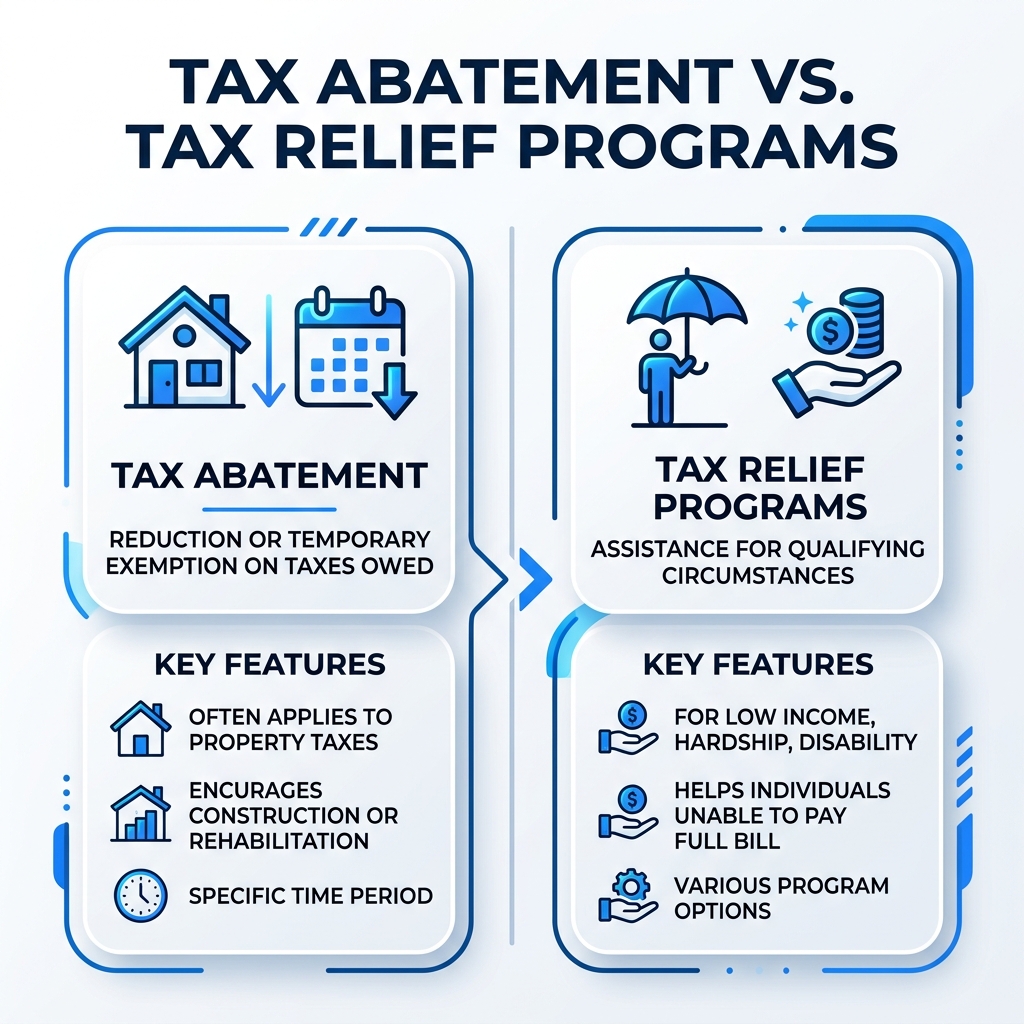
- Tax abatement - A reduction or temporary exemption on taxes owed, often applied to property taxes to encourage construction or rehabilitation
- Tax relief programs - Assistance for individuals who cannot pay their full tax bill due to low income, hardship, disability, or other qualifying circumstances
- Penalty relief - Removal or reduction of IRS penalties for failure to file, pay, or deposit — including First Time Abate and Reasonable Cause options
- Payment arrangements - Structured plans to pay off tax debt over time instead of all at once
- Offer in Compromise - A program that lets eligible taxpayers settle their debt for less than the full amount owed
Tax problems are incredibly common — and stressful. Whether you're a homeowner disputing an inflated property assessment, a low-income earner struggling to keep up, or a business owner facing IRS penalties, there are real programs designed to help.
The challenge is knowing which office to contact, what programs exist, and how to apply without getting scammed.
This guide covers all of it — from federal IRS penalty relief to city-level property tax abatements, state-specific programs, application deadlines, and how to protect your personal information along the way.
Understanding Tax Abatement and Relief Office Programs

Navigating taxes often feels like trying to read a map in a different language. When we talk about a tax abatement and relief office, we are essentially looking at two different branches of financial help. While they both aim to lower your bill, they function very differently.
| Feature | Property Tax Abatement | Income Tax Relief |
|---|---|---|
| Focus | Physical property/real estate | Individual/business earnings |
| Goal | Encourage development/renovation | Assist with financial hardship |
| Eligibility | Location, property type, improvements | Income level, age, disability, status |
| Duration | Often temporary (e.g., 10 years) | Case-by-case or permanent |
Property tax abatements are usually tied to the physical property itself. Local governments use these to encourage people to fix up old houses or build new ones in specific areas. On the flip side, income tax relief is personal. It’s based on your financial situation—how much you earn, your age, or whether you’ve hit a sudden patch of bad luck.
One of the most powerful tools in the relief arsenal is the Offer in Compromise Program. This allows taxpayers to settle their tax debt for less than the full amount they owe. It isn't a "get out of jail free" card; the government usually only agrees to this if they believe the full amount is truly uncollectible or would create severe financial hardship.
Services Provided by a Tax Abatement and Relief Office
These offices aren't just there to collect checks; they provide a suite of services designed to keep taxpayers compliant without ruining them financially.
- Debt Assistance: Helping you navigate what you owe and finding the right program to lower that burden.
- Payment Arrangements: If you can't pay in full, you can often set up a monthly plan. Even if you can't pay a dime right now, the experts suggest you still file your return. This prevents additional "failure to file" penalties.
- Hardship Programs: For those on fixed incomes, like Social Security or pensions, specific "Indigent Relief" or "Hardship" programs can pause or reduce tax collections.
- Guidance on Nonpayment: If you've received an income tax notice, the office provides instructions on how to respond. You can find more details on nonpayment of taxes guidance to understand the next steps before the collection process ramps up.
Contacting Your Local Tax Abatement and Relief Office
Finding the right person to talk to is half the battle. Depending on your issue, you might need to call a different department:
- Property Tax Issues: Contact your local Assessor’s Office or the Office of Property Assessment. For example, in Philadelphia, you can reach the abatement unit at (215) 686-4334.
- Income Tax Issues: Contact your State Comptroller or the IRS. You can also find online inquiry forms on most state treasury websites or call the IRS toll-free at 1-800-829-1040 for individual assistance.
- Stuck in Red Tape?: If you’ve tried the normal channels and gotten nowhere, the Taxpayer Advocate Service is an independent organization within the IRS that helps taxpayers resolve problems that haven't been fixed through normal channels.
Federal and State Relief: From IRS to Local Counties
When it comes to the IRS, many people don't realize that penalty relief is actually written into the tax code and IRS policy. If you have been a compliant taxpayer for the last three years but slipped up this year, you might qualify for the First Time Abate (FTA) policy. This can provide relief from failure to file, failure to pay, and failure to deposit penalties.
Other Administrative penalty relief details include "Reasonable Cause." This is for situations where life happened - think natural disasters, serious illness, or being unable to get records. If you can show you exercised ordinary business care and prudence but still could not comply, the IRS may waive the penalties. Beyond these programs, there are also statutory exceptions - specific laws that can automatically exempt certain entities, such as some government or charitable properties, from particular taxes.
Some states also use "Fresh Start" branding for their own tax debt or compliance initiatives. Because these programs vary by state and can change over time, always confirm current eligibility dates and application windows directly with the relevant state tax agency before applying.
State-Specific Programs and Eligibility
Every state has its own flavor of relief. Here are a few notable examples from our research:
- Maryland: Offers a robust Offer in Compromise, state compliance assistance, and specific Low-Income Taxpayer Programs for those on fixed incomes.
- Philadelphia: Provides 10-year abatements for new construction or the rehabilitation of residential and commercial properties. This is a major incentive for developers and homeowners alike.
- Salt Lake County: Uses a "Circuit Breaker" program. If you are 66 or older, or a qualifying surviving spouse, and your household income falls within program limits, you could see a significant drop in your property tax bill.
- Kansas: Focuses heavily on business. They offer property tax abatement assistance for startups and existing businesses making private capital investments, though they specifically exclude residential housing from this particular program.
Targeted Relief for Specific Groups
The tax abatement and relief office often has programs aimed at specific demographics:
- Veterans: Many counties offer exemptions for veterans with service-connected disabilities.
- Seniors: Aside from income-based relief, some areas offer deferral programs that let older residents postpone payment.
- Disabled Homeowners: Numerous states and counties provide property tax exemptions or reductions for homeowners with qualifying disabilities, often requiring documentation from a physician or the Social Security Administration.
- Federal Workers: During shutdowns or other disruptions, some state tax agencies may offer extra time or payment flexibility for affected workers.
- Renters: It is not just for owners. Some areas, like Utah, offer Mobile Home Rent Relief for qualifying low-income seniors.
The Application Process: Deadlines and Documentation
Applying for relief isn't just about filling out a form; it's about proving your case. For federal penalty relief, you'll often use Form 843 (Claim for Refund and Request for Abatement). For business abatements in places like Kansas, you might need to complete a Cost Benefit Analysis (CBA) Worksheet to show the state why giving you a tax break is good for the local economy.
If you are disputing a property assessment, you might be required to submit an Information Requisition Form. In Boston, for example, failing to return this form within 30 days is a one-way ticket to a denied application. For new constructions, you may also need to provide a certificate of occupancy to prove the building is ready for use. If you have received a specific income tax notice, follow the income tax notice instructions carefully to ensure your documentation matches the requirements.
Key Filing Deadlines to Remember
Missing a deadline is the easiest way to lose your right to relief. Many programs operate on fiscal year cycles, often with a December 31st cutoff for eligibility in the following year. Mark these on your calendar:
- Boston: The deadline for Fiscal Year 2026 real estate tax abatement applications is February 2, 2026.
- Philadelphia: Applications for certain abatements must be submitted within 60 days of getting your building permit.
- Maryland: The Fresh Start program for 2025-2029 taxes opens in late January 2026.
- General Rule: Most property tax abatements must be filed after you receive your third-quarter tax bill (usually late December or early January).
Post-Application: Review and Appeals
Once you hit "submit," the waiting game begins. Most offices, like the Boston Assessing Department, have about three months to review your application. During this time, they might send an inspector to your property to verify its condition.
If you get a "no," don't panic. You usually have a window (often 90 days) to appeal the decision to an Appellate Tax Board. This is a more formal process, almost like a mini-court, where you can present evidence as to why the tax abatement and relief office made the wrong call.
Security First: Verifying Legitimacy and Avoiding Scams
Whenever "tax relief" is mentioned, scammers appear like moths to a flame. The IRS Dirty Dozen 2026 report highlights that billions are lost to tax fraud every year.
The most important thing to remember is that the IRS will always send a letter first. They do not call you out of the blue demanding immediate payment via gift cards or cryptocurrency. Be wary of private collection agencies; while the IRS does use them, they will always notify you by mail first. If someone calls you claiming to be from the "Tax Mediation and Resolution Agency" (a favorite fake name for scammers), just hang up.
How to Spot a Tax Relief Scam
- The "First Call" Rule: As we've noted in our guide on American Tax Advocates Scam Calls, the IRS never calls first. If you haven't received a pile of mail about the issue, the call is fake.
- Payment Methods: Real government offices want checks, bank transfers, or official online payments via IRS.gov. They will never ask for a wire transfer, Bitcoin, or an Apple Gift Card.
- Aggressive Threats: Scammers use fear. They'll tell you the police are on their way or your driver's license is being revoked. Real tax offices use a much slower, much more bureaucratic process involving lots of paper.
- Verify Everything: If you're unsure, go to ReportFraud.ftc.gov to see common tactics or report a suspicious interaction.
Frequently Asked Questions about Tax Relief
Do I still need to pay taxes while an abatement is pending?
Yes! This is a common trap. Filing an application for an abatement does not "stay" (pause) the collection of the tax. You should pay the bill as assessed. If your abatement is granted later, the tax abatement and relief office will issue you a refund plus interest. If you don't pay and your application is denied, you'll be hit with massive late fees and interest.
What happens if my tax relief application is denied?
You have the right to appeal. Most states and municipalities have an Appellate Tax Board or a Board of Equalization. You typically have 30 to 90 days from the date of the denial notice to file an appeal. Make sure you keep all your documentation, as you'll need to prove the office's assessment was "overvalued" or "disproportionate."
How do I verify if a tax resolution officer is legitimate?
If a private collection agency calls you, they must be authorized by the IRS. You should have received two letters: one from the IRS telling you your account was assigned, and one from the agency itself. If the caller can't reference the specific taxpayer ID or the letters sent to you, they are likely a scammer. You can always check your actual account status directly at IRS.gov/payments.
Conclusion
Dealing with a tax abatement and relief office can be intimidating, but these programs exist because the government recognizes that taxpayers sometimes face impossible situations. Whether it's a 10-year property tax break in Philadelphia or a "Fresh Start" for those re-entering society, the help is out there—you just have to ask for it and follow the rules.
At Tempo Mail USA, we know that privacy is a huge part of your financial life. When you're researching tax relief or signing up for newsletters to stay informed about deadlines, you are often asked for your email address. This can lead to your inbox being flooded with spam or, worse, your data being sold to "tax debt" scammers.
Our secure proxying service acts as a firewall for your digital identity. By using a temporary email alias from Tempo Mail USA, you can protect your real personally identifiable information (PII) from third-party services. Stay safe, stay informed, and keep your private life private.
Visit tempomailusa.com to secure your privacy today.