

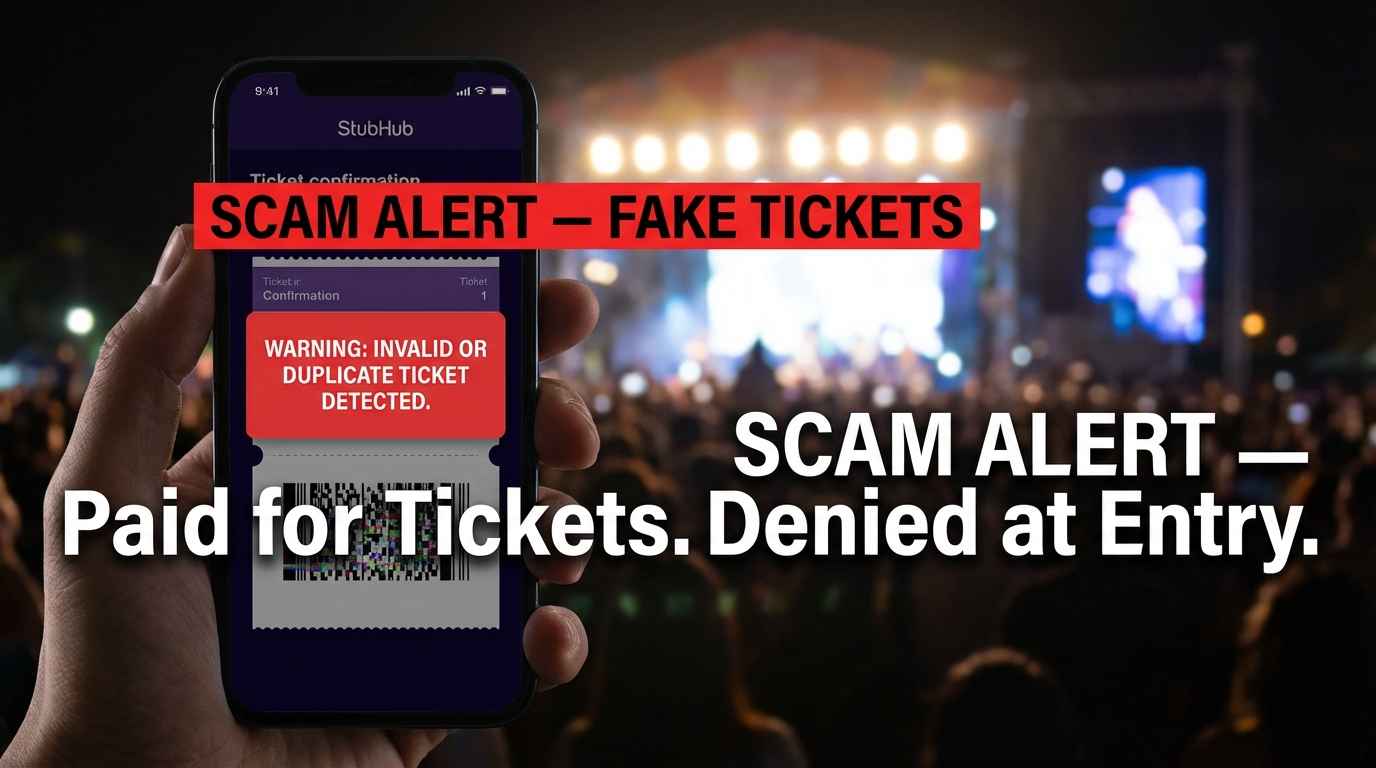

StubHub Scams Are Real — Here's What You Need to Know Fast
StubHub scam activity is more common than most ticket buyers realize. Before we go deep, here's a quick summary of the most important facts:
Quick answers:
- Is StubHub legit? Yes — it's a real platform with buyer protections, but scams still happen both on and around it
- Most common scams: Fake websites, counterfeit tickets, duplicate listings, account hacking, and gift card fraud
- Are you protected? StubHub's FanProtect Guarantee offers some coverage, but it has limits
- What to do if scammed: Contact StubHub support, file a chargeback with your bank, and report to the FTC at ReportFraud.ftc.gov
Ticket resale is booming. And wherever money moves fast, scammers follow.
StubHub is one of the biggest names in secondary ticket sales. Millions of people use it every year for concerts, sports, and live events. Most transactions go fine. But the platform has nearly 6,800 BBB complaints in three years — and users lose an estimated $2.3 million annually to fraud on the platform.
Some scams come from outside StubHub entirely — fake websites, phishing calls, and social media fraudsters impersonating the brand. Others happen inside the platform, through hacked accounts, duplicated barcodes, and phantom ticket listings.
One Indiana Pacers season-ticket holder discovered his StubHub account had been hijacked — his contact details changed, and $1,100 in ticket sale proceeds routed to a fake PayPal account before he even knew something was wrong.
He's not alone.
Whether you're buying tickets to a sold-out show or listing your extra seats, understanding how these scams work is the first step to not becoming the next victim.
Is StubHub Legit? Understanding the Marketplace
To understand why a stubhub scam can happen, we first have to understand what StubHub actually is. It isn't a primary ticket seller like the box office at your local stadium. Instead, it is a peer-to-peer secondary marketplace. This means StubHub doesn't actually own the tickets; they just provide the digital "room" where buyers and sellers meet.
Because anyone can technically list a ticket, the platform relies on its FanProtect Guarantee to build trust. This guarantee promises that:
- You will get your tickets in time for the event.
- Your tickets will be valid for entry.
- If an issue arises and the seller cannot deliver, StubHub will find comparable or better tickets, or offer a full refund (or 120% credit in some cases).
While this sounds bulletproof, the reality is more complex. As noted in StubHub Scams & Price Gouging: Avoid Pitfalls in 2026!, the open nature of this marketplace has turned it into a target for sophisticated fraudsters. While resale regulations exist, they vary by state, and scammers often operate across borders where local laws can't reach them.
Common StubHub Scam Tactics to Watch For
Scammers are creative. They don't just sell "fake" tickets; they exploit the technical gaps in how digital tickets are transferred. One of the most heartbreaking scenarios is the counterfeit ticket. These often look identical to real digital passes but feature a barcode that won't scan at the gate.
Another rising threat is the duplicate listing. A professional scammer might list the exact same ticket on multiple platforms or multiple times on StubHub. Because only the first person to scan the barcode gets in, the other buyers are left stranded at the turnstile.
We also see a surge in phishing. Scammers send emails that look exactly like official StubHub notifications, claiming there is a "problem with your order" to steal your login credentials. If you want to stay safe, you should master how to spot phishing emails so you don't hand over your account keys.
Perhaps the most brazen tactic is the gift card scam. As reported by the Dallas Morning News, fake representatives manipulate callers by hijacking "Call Now" buttons in search results. They spend hours on the phone being overly polite, only to eventually demand payment via gift cards for "security verification." Remember: No legitimate company will ever ask you to pay or verify your account with a gift card.
With an estimated $2.3 million lost annually to these schemes, the stakes are high.
The "Too Good to Be True" StubHub Scam
We've all seen them: front-row seats for a sold-out Taylor Swift or Beyoncé show listed at a fraction of the market price. This is almost always a stubhub scam.
Scammers use "speculative listings," where they list tickets they don't even own yet, hoping to buy them cheaper later and pocket the difference—or simply disappear with your money. They also use fake websites that mimic the StubHub interface to trick you into entering your credit card info. This is very similar to how fraudsters operate in other sectors; for instance, learning how to identify Amazon refund text scams can help you recognize the same "urgency" tactics used in ticket fraud.
Red flags for "too good to be true" deals:
- Prices significantly lower than other listings in the same section.
- Sellers asking you to move the conversation to social media or WhatsApp.
- Urgent demands for payment via non-protected methods (Zelle, Venmo, or Wire).
- Pre-sale tickets listed before the official box office has even opened.
Account Takeovers and Seller Fraud
It’s not just buyers who are at risk. Sellers often face "Account Takeovers." This happens when a hacker gains access to your StubHub account—often through a leaked password from another site—and changes your payout information.
In a high-profile case, a sports fan lost $1,100 after a hacker changed his email and phone number on the account, ensuring he never received the "change of info" alerts. The money from his legitimate ticket sales was then routed to a PayPal account named "Jack Smith."
This is why staying updated on OTP fraud surges is vital. Scammers are finding ways to bypass one-time passwords to hijack accounts and manipulate payouts. If your account is linked to your primary email and a saved credit card, a single breach can lead to identity theft and massive financial loss.
Analyzing BBB Complaints and User Dissatisfaction
The Better Business Bureau (BBB) paints a sobering picture of the platform. With 6,792 complaints in the last three years, it's clear that even when a transaction isn't a "scam" in the criminal sense, users are often left feeling cheated.
| Complaint Category | Primary Issue Reported |
|---|---|
| Hidden Fees | Service charges appearing only at the final checkout screen. |
| Delivery Delays | Tickets arriving minutes before (or even after) an event starts. |
| Invalid Tickets | Being turned away at the gate with no immediate support. |
| Currency Confusion | Being charged in USD when the price was displayed in CAD or AUD. |
| Account Security | Unauthorized charges after a data breach or hack. |
Many users complain about "junk fees" that can add up to 30% to the ticket price. This lack of transparency is a common grievance in many digital industries, much like the JoinFansClub hidden charges that catch subscribers off guard. When you combine high fees with the risk of a stubhub scam, user frustration is understandably high.
How to Protect Yourself from a StubHub Scam
We believe that the best defense is a good digital offense. You don't have to stop going to concerts, but you do need to change how you shop for them.
First, never pay with anything other than a credit card. Credit cards offer the strongest chargeback protections if the tickets turn out to be fake. Avoid debit cards, and definitely avoid Zelle or wire transfers.
Second, practice excellent password hygiene. Use a unique, complex password for StubHub that you don't use anywhere else. Enable Two-Factor Authentication (2FA) immediately. This ensures that even if a hacker gets your password, they can't get into your account without a code from your phone.
Third, be wary of emails. Scammers often use fake requests to get you to click links. Just as you should be cautious of a Docusign email scam, you should never click a link in a StubHub email to "log in." Instead, always type stubhub.com directly into your browser.
What to Do if You Suspect a StubHub Scam
If you realize you've been targeted, you must act fast. Time is the scammer's best friend.
- Contact StubHub Support: Use their official chat or call their verified number (888-720-9452). Be persistent. As seen in the StubHub Community reports, the fraud department can sometimes be slow to respond, so keep a record of every interaction.
- Call Your Bank: If you see an unauthorized charge, tell your bank immediately. Mention that it is "fraudulent activity" to initiate a chargeback.
- File an FTC Report: Go to ReportFraud.ftc.gov. This helps authorities track the scammers and potentially shut down their infrastructure.
- Police Reports: For large losses—like the fan who lost $1,100—a police report is often required by ticket platforms before they will issue a manual refund.
Frequently Asked Questions about StubHub Safety
Does the FanProtect Guarantee cover every StubHub scam?
Not necessarily. While it covers invalid tickets and non-delivery, it often does not cover cases where you were tricked into buying tickets on a fake website that looked like StubHub. It also may not cover "rescheduled" events, only those that are fully canceled.
Why are StubHub fees so high compared to the original price?
StubHub charges a service fee (often around 15%) and a fulfillment fee. Because they are a middleman, they take a cut from both the buyer and the seller to cover their "guarantee" and platform costs.
Is it safe to buy tickets before the official public release?
No. This is a major red flag. If the official box office hasn't sold tickets yet, any listing on a resale site is a "speculative listing." The seller is gambling that they can get tickets later. If they can't, you'll get a refund, but you'll miss the show.
Conclusion
The reality of the digital age is that your personal information is the most valuable currency you own. A stubhub scam often starts with a compromised email address or a leaked password. Once a fraudster has your "digital identity," they can buy tickets, reroute your payments, and drain your accounts.
At Tempo Mail USA, we provide a firewall for your PII (Personally Identifiable Information). By using our temporary email aliases, you can create a secure proxy for your identity. Instead of giving your primary, "life-linked" email to every marketplace and service, you use a secure alias. If that service is ever breached or targeted by scammers, your real inbox—and your real identity—remain shielded.
Protect your data, secure your accounts, and don't let scammers ruin your next big event. Protect your data with Tempo Mail USA and take control of your digital privacy today.