



Your Primary Inbox Is a Digital Breadcrumb Trail
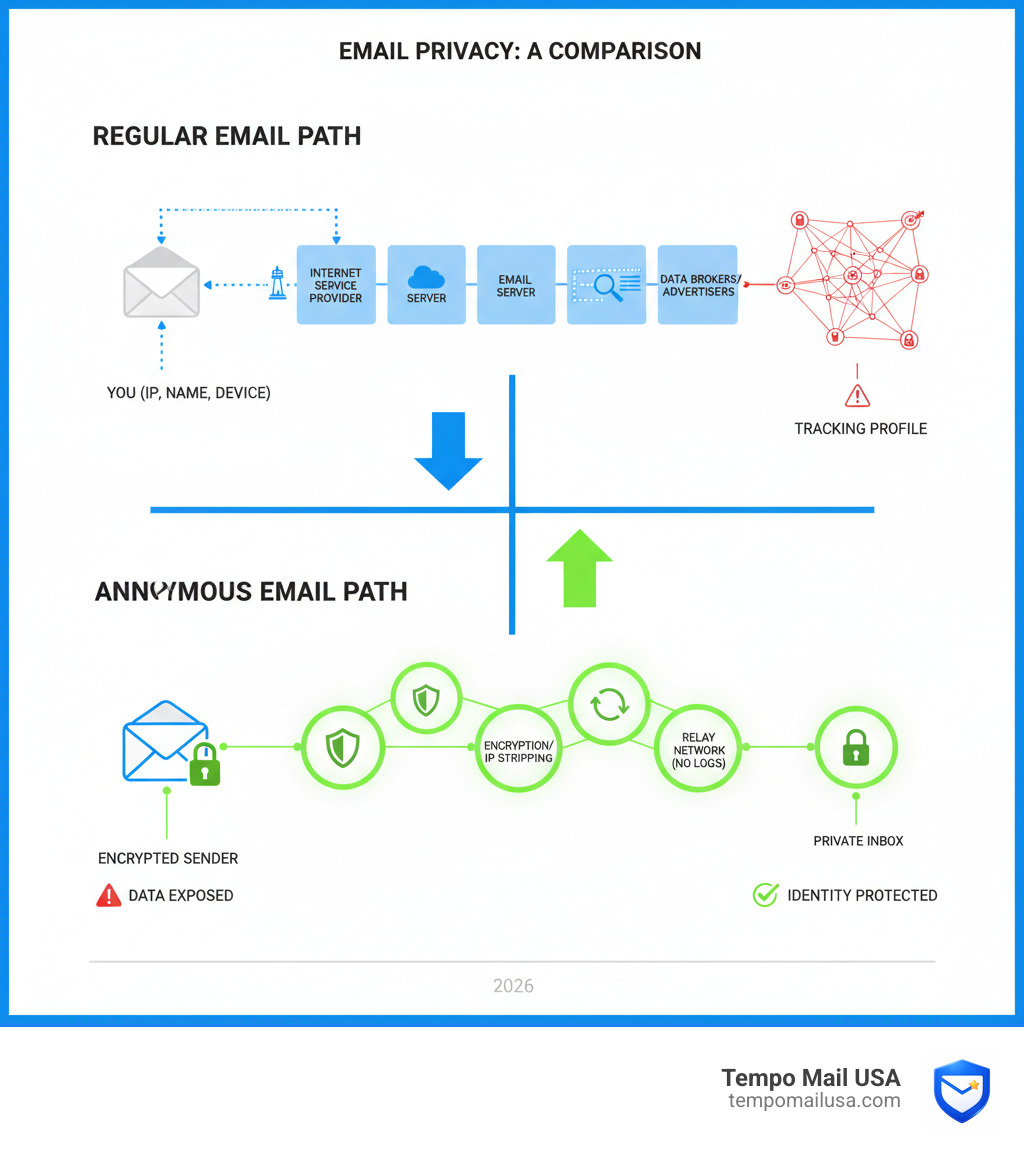
Secure anonymous email is a type of email service that hides your identity by removing personal information like your IP address, name, and device data — so your messages can't be traced back to you.
Here's a quick breakdown of what makes an email service truly secure and anonymous:
- No personal info required to sign up (no phone number, no real name)
- End-to-end encryption so only you and your recipient can read messages
- IP address stripping so your location stays hidden
- Zero-access architecture so even the provider can't read your emails
- No data logging so there's no trail to hand over to third parties
- Metadata removal from attachments and messages
Think about every app, newsletter, forum, and free trial you've ever signed up for. Each one got your email address. And that address — your real one — is quietly linking all of those accounts together into a detailed profile of who you are, where you live, and what you do online.
Data brokers buy and sell this information. Advertisers use it to target you. Hackers use it to find you.
Most people don't realize that their email address is a more persistent tracking tool than cookies or IP addresses. You can clear cookies. Your IP address changes. But your email address follows you everywhere — across devices, platforms, and years of browsing history.
The fix isn't complicated. But it does require understanding what a truly private email setup looks like, and why the free inbox you've had since college isn't cutting it anymore.
This guide covers everything: the best services, how to set one up without a phone number, and the extra steps that actually make a difference.
Why Your Primary Inbox is a Liability
Your primary inbox is essentially a digital homing beacon. In our investigations into data privacy, we’ve found that a single email address can be used to cross-reference your identity across thousands of databases. This makes you a prime target for identity theft and sophisticated phishing campaigns. In fact, research suggests that 92% of targeted cyberattacks start with an email.
When you use a standard provider, your data is the currency. These services scan your messages to build advertising profiles, effectively harvesting your life for profit. If you aren't using a secure anonymous email, you are leaving a trail of PII (Personally Identifiable Information) every time you click "Sign Up." This is why secure email hosting is no longer just for tech enthusiasts; it’s a necessity for anyone wanting to reclaim their digital boundaries.
The Anatomy of a Secure Anonymous Email Service

What separates a "private" email from a truly secure anonymous email? It comes down to the architecture. Most legacy providers fail the privacy test because they are built for data collection, not data protection.
A truly secure service utilizes End-to-End Encryption (E2EE). This means the message is encrypted on your device and only decrypted on the recipient's device. Even the service provider cannot peek inside. Furthermore, Zero-Access Architecture ensures that if the provider's servers are ever seized or hacked, your stored emails remain encrypted and unreadable.
Key technical pillars include:
- No IP Logging: The service does not record the address of the device you use to log in.
- Metadata Stripping: The service automatically removes hidden data (like your location or device type) from the email headers.
- Open Source Code: The software is available for public audit to ensure there are no "backdoors" for surveillance.
Why You Need a Secure Anonymous Email in 2026
By May 2026, the digital landscape has become even more colonized by "surveillance capitalism." Whether you are a whistleblower, an investigative journalist, or just a citizen concerned about doxxing, anonymity is your shield.
With over 100 million users worldwide now opting for encrypted services, the shift toward privacy is undeniable. People are tired of their personal conversations being used to train AI models or sell mattresses. Privacy-focused communication tools have already facilitated millions of secure messages, proving that the demand for "no-questions-asked" communication is at an all-time high.
Global Jurisdictions and Privacy Laws
Where your email provider is headquartered matters as much as the encryption they use. In secure anonymous email, jurisdiction is destiny.
- Switzerland: Famous for strict privacy laws, Swiss-based providers are often outside the reach of US and EU subpoenas.
- Germany: The German Bundesdatenschutzgesetz provides robust protections, and constitutional courts have repeatedly struck down mass data retention laws.
- Iceland: Known for its "Armored Email" culture, Iceland offers a strategic advantage for those who want instant data deletion and legal anonymity.
Choosing a provider outside the "14 Eyes" alliance (an international intelligence-sharing agreement) is a critical step in your privacy journey. To further mask your trail, many users combine these services with a VPN. You can understand VPN tunnels for email privacy to see how this creates a double layer of protection.
Top-Rated Privacy Solutions and Reliability in 2026
Not every service that claims to be "anonymous" is reliable. We’ve seen many free providers get blacklisted by major websites because they are abused by bots. This "reputation crisis" means you need to choose your provider carefully.
| Feature | Free Plans | Paid/Premium Plans |
|---|---|---|
| Storage | Usually 500MB - 1GB | 15GB to 500GB+ |
| Custom Domains | Rarely included | Almost always supported |
| Aliases | Limited (1-10) | Unlimited or high volume |
| Support | Community-based | Priority helpdesk |
| Reliability | High risk of domain blocking | Low risk (cleaner domains) |
Free vs. Paid: When to Upgrade
While free plans are great for casual use, power users and businesses often need more. Over 50,000 businesses have migrated to premium encrypted mail to comply with GDPR and other privacy regulations. Paid plans often give you access to "cleaner" domains that are less likely to be flagged as spam. If you're wondering what the benefits of using temporary email are versus a permanent paid account, it usually comes down to whether you need a long-term identity or a one-time "burner" address.
Reliability and Website Blocking
⚠️ Warning: Not all anonymous emails are created equal. Many websites now use aggressive filters to block sign-ups from known privacy providers. This is often a response to bot abuse. To bypass this, top-tier providers use "Proof of Work" (POW) challenges—human-only tasks that prove you aren't a robot without requiring a phone number. If you find your favorite service is being blocked, it might be time to look for the best privacy email alternatives in 2026.
How to Send a Secure Anonymous Email Without a Phone Number

The biggest hurdle to anonymity is the "phone number bottleneck." Most mainstream services demand a mobile number for "security," which immediately links your digital account to your real-world identity and SIM card.
To create a truly secure anonymous email, look for providers that offer:
- No-PII Registration: You only need a username and a strong password.
- Seed Phrase Recovery: Instead of a "recovery email" (another tracking link), you get a master list of words to regain access.
- Cryptocurrency Payments: If you upgrade to a paid plan, use Monero or Bitcoin to ensure your bank doesn't have a record of the transaction.
For those who just need a quick sign-up, learning how to use temporary email safely can save you from the phone number trap.
Technical Steps for a Secure Anonymous Email
✅ Safe Practice: Always strip EXIF data before sending attachments. Even with a secure provider, your own habits can betray you. If you send a photo taken on your phone, that file contains metadata (EXIF data) that reveals your GPS coordinates and device ID.
Follow these steps for maximum security:
- Use a VPN: Mask your IP from the provider themselves.
- Tor Integration: Some providers have ".onion" addresses for access via the Tor browser.
- Self-Destructing Messages: Set a timer so your email disappears from the recipient's inbox after it's read.
Many users on Reddit's privacy communities emphasize that "OpSec" (Operational Security) is just as important as the tool you use.
Enhancing Anonymity with Encryption and Tracking Protection
Standard email is like a postcard; anyone who handles it can read it. OpenPGP encryption turns that postcard into a locked safe. By using 4096-bit keys, you ensure that even if a government intercepts the data, it would take millions of years to crack.
Furthermore, modern trackers can tell a sender exactly when, where, and on what device you opened an email. Top-tier anonymous services block these "spy pixels" by default. You can even secure your sign-ups with password-enabled temp mail to add an extra layer of gatekeeping to your communications.
Anonymous Mailboxes vs. Identity Proxying Aliases
There is a major difference between an anonymous mailbox and an alias.
- Anonymous Mailbox: A full inbox where you store messages long-term.
- Identity Proxying Alias: A "firewall" address that forwards mail to your real inbox without revealing your true address.
Identity proxying acts as a shield between you and the web. When you use an alias, the website thinks they have your email, but you can "kill" that alias the moment they start sending spam. This is the core of a disposable email inbox strategy.
The "Plus Trick" Failure and Reverse Aliases
❌ Scam Sign: Using "yourname+service@gmail.com" does NOT hide your identity. Many people think adding a "+" sign to their Gmail address makes them anonymous. It doesn't. Data brokers simply run a script to remove everything after the plus sign, revealing your primary address instantly.
True anonymity requires Reverse Aliases. This technology allows you to reply to an email using your alias, so the recipient never sees your real "from" address. With the data broker market valued at over $200 billion, protecting your identity with tools like Tempma is the only way to stay off the auction block.
Frequently Asked Questions
Can a secure anonymous email be traced?
While no system is 100% foolproof, a secure anonymous email uses zero-knowledge architecture and IP stripping to ensure that even the provider cannot link your messages to your real-world identity. If you use it alongside a VPN and the Tor browser, tracing becomes nearly impossible for all but the most advanced state actors.
Is it legal to use anonymous email services?
Yes. Anonymous email is a vital tool for GDPR compliance, freedom of speech, and personal security. It is legally protected in most democratic jurisdictions as a means of exercising the right to privacy. However, users must adhere to anti-abuse policies; anonymity does not grant legal immunity for criminal acts like fraud or harassment.
How do I create an account without a phone number?
Choose a provider with a no-logs policy that offers anonymous signup via seed phrases or token-based authentication rather than SMS verification. Many privacy-focused services allow you to sign up using only a username and password. For a step-by-step breakdown, check out our complete guide on how temporary email works.
Conclusion
"If you aren't paying for the product, you are the product."
Your email address is the master key to your digital life. Every time you hand it over to a "free" service, you are giving away a piece of your identity. By switching to a secure anonymous email or using an identity proxy, you take back control.
Tempo Mail USA provides the ultimate privacy firewall, allowing you to manage your digital trail without sacrificing convenience. Whether you are signing up for a one-time coupon or managing sensitive communications, our tools act as a barrier between your personal data and the world’s trackers. Stop giving away your identity to every website you visit.