



What is a Ponzi Scam? Definition and Overview
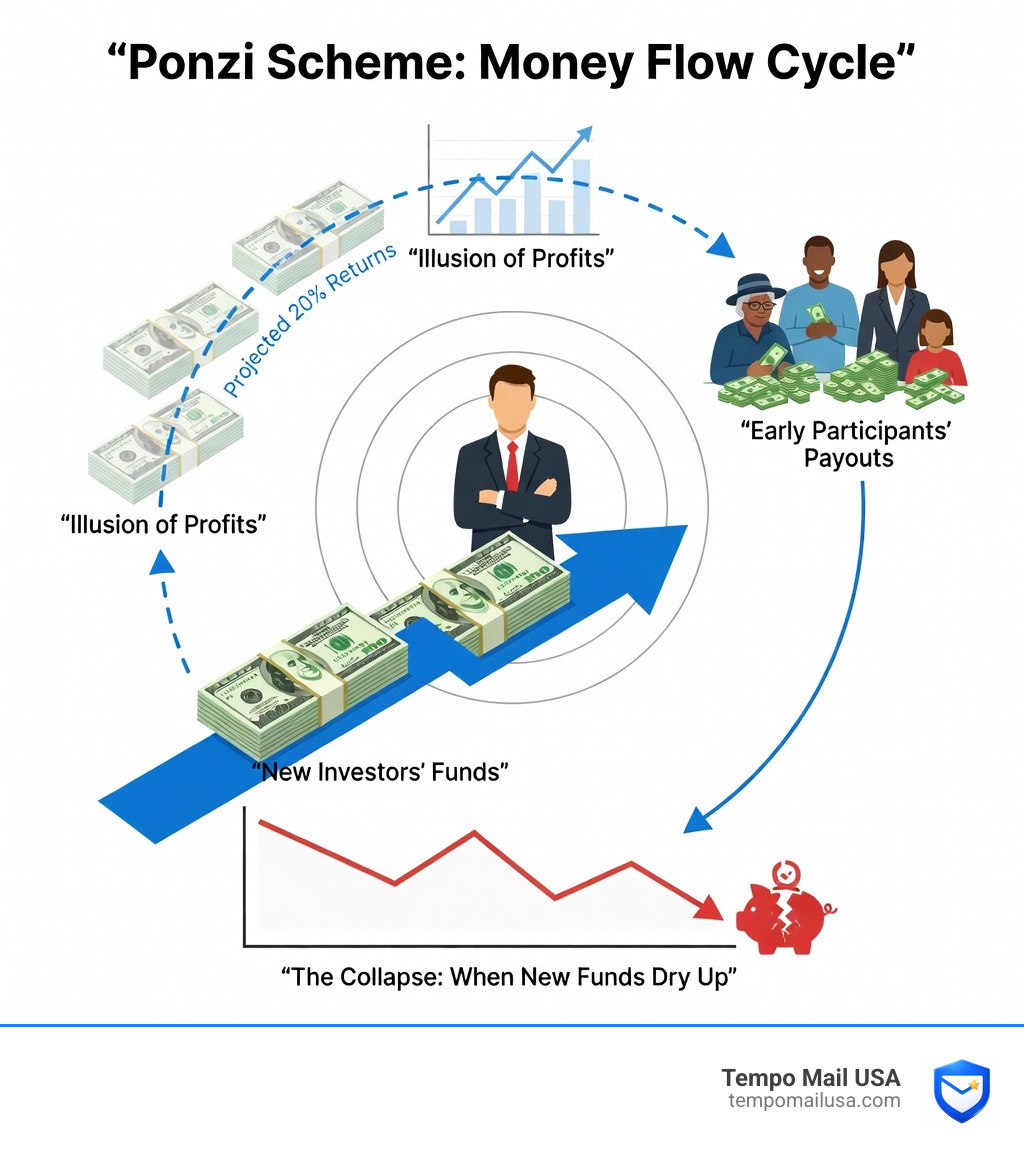
A Ponzi scam is a fraudulent investment operation where early investors are paid using money from new investors rather than from actual business profits. The scheme relies on a continuous cycle of new capital to maintain the illusion of high returns with little to no risk.
Quick Summary of a Ponzi Scam:
- What it is: A fraudulent investment operation with no real underlying business.
- How it works: New investors' money is used to pay earlier investors, creating the illusion of returns.
- Who runs it: A single operator or small group at the center of the scheme.
- Why it fails: It requires a constant stream of new money—when that slows, the whole thing falls apart.
- Who gets hurt: Everyone who invested, but later investors typically lose the most.
The name comes from Charles Ponzi, who in the 1920s defrauded investors through a postage stamp arbitrage scheme. Today, these frauds remain prevalent, with the Bernie Madoff case standing as the largest in history, defrauding investors of $64.8 billion over 17 years.
How a Ponzi Scam Works: The Mechanics of Fraud
To understand what is a ponzi scam, think of it as a redistribution of capital rather than an investment. According to the FBI's official definition of Ponzi schemes, these are investment frauds where clients are promised large profits with little to no risk.
The 4 Stages of a Modern Ponzi Scam
- The Hook: Scammers promise extraordinary returns on non-existent investments like "high-tech AI," "offshore oil," or "exclusive real estate."
- The Illusion: Early investors receive "returns" (actually their own money or funds from new members) to build trust.
- The Viral Spread: Satisfied early investors provide "social proof," recruiting friends and family to the scheme.
- The Capital Depletion: The operator siphons funds for a lavish lifestyle to maintain an image of success.
Modern scammers use professional websites to hide their tracks. For those navigating the digital world, more info on identifying online scams can help you distinguish between legitimate platforms and fraudulent ones.
Why Do Ponzi Schemes Collapse?
- Recruitment Slowdown: If the flow of new investors dries up, there is no "new money" to pay the "old investors."
- Liquidity Crisis: During economic downturns, many investors try to withdraw their principal at once, exposing the lack of cash.
- The Exit Scam: The operator decides they have enough money, clears out the accounts, and vanishes.

History of Ponzi Scams: Famous Real-World Examples
While Charles Ponzi gave the fraud its name, several historical figures used the same playbook:
- Adle Spitzeder (1870s): Amassed 38 million Gulden from 32,000 victims in Germany.
- Sarah Howe (1870s): Defrauded women of $500,000 via "The Ladies' Deposit."
- William Miller (1899): Known as "520 per cent" Miller for promising to quintuple investor money.
- Bernie Madoff (2008): The most devastating modern example, defrauding 4,800 clients of $50 billion in liabilities.
According to the SEC's historical overview of Ponzi schemes, Madoff's success relied on fabricated trading reports that appeared legitimate to untrained eyes.
Spotting the Warning Signs: Ponzi Scam Red Flags
Knowledge is your best defense. Use the following comparison to evaluate investment opportunities.
Legitimate Investment vs. Ponzi Scam
| Feature | Legitimate Investment | Ponzi Scam |
|---|---|---|
| Returns | Vary based on market conditions | Guaranteed and unusually high |
| Risk | Always present; clearly disclosed | "Little or no risk" promised |
| Transparency | Audited financial statements available | Secretive or "too complex" to explain |
| Registration | Registered with SEC/State regulators | Often unregistered securities |
| Liquidity | Clear process for withdrawals | Difficulty getting your money back |
Top Red Flags to Watch For:
- Guaranteed High Returns: No legitimate market can guarantee specific high returns. If they say you will make 20% every month, they are lying.
- Consistent Performance: Real markets fluctuate; fake ones only go up regardless of the economy.
- Unlicensed Sellers: Always verify credentials with state or federal regulators.
- Paperwork Errors: Sloppy statements often indicate manual data entry rather than real trades.
- Withdrawal Difficulties: If an operator resists your withdrawal request or offers "higher returns" to stay in, the scheme is likely collapsing.
For more tips on staying safe, check out our guide to verifying site legitimacy.
Ponzi vs. Pyramid Schemes: Key Differences Explained
Though often confused, these schemes have distinct structures:
- Ponzi Scheme (Hub-and-Spoke): The operator is the central hub. Investors are passive and interact only with the operator. They do not need to recruit others to get paid.
- Pyramid Scheme (Recruitment-Based): Participants are active recruiters. They earn commissions by bringing in new members who pay entry fees. The "product" is often secondary.
According to the Wex definition of Ponzi mechanics, the key distinction is the level of participant activity and how the money is distributed within the fraud.
Legal Consequences and How to Report a Ponzi Scam
Operating a Ponzi scheme is a serious federal crime. Authorities like the SEC and CFTC can freeze assets and "disgorge" (take back) ill-gotten gains.
How to Report Fraud
- SEC Whistleblower Program: Report original information to potentially earn 10% to 30% of collected sanctions over $1 million.
- Anonymity: You can report fraud anonymously through an attorney to avoid retaliation.
- Federal Agencies: Contact the FBI's Internet Crime Complaint Center (IC3) or your state's Attorney General immediately if you suspect a scam.
Frequently Asked Questions (FAQ) about Ponzi Scams
Can victims recover their money from a Ponzi scheme?
Recovery is difficult. Court-appointed trustees may use clawback litigation to sue early investors who profited, redistributing those funds to later victims. However, 100% recovery is rare because operators usually spend the funds on lavish lifestyles.
How is cryptocurrency used in modern Ponzi scams?
Scammers exploit the hype around Initial Coin Offerings (ICOs) and use "Smart Ponzis" on the blockchain. They also perform rug pulls, inflating a token's price before selling all holdings and leaving the token worthless.
What should I do if I suspect an investment is a scam?
- Stop all payments immediately.
- Do not pay fees to "unlock" your previous funds.
- Gather documentation (emails, bank transfers, statements).
- Report the activity to the SEC, FBI, or FTC.
Conclusion: Protecting Your Financial Future
Understanding what is a ponzi scam is the first step in protecting your wealth. By recognizing red flags like "guaranteed" high returns and unlicensed sellers, you can avoid financial traps.
At Tempo Mail USA, we believe protection starts with your identity. Using a secure email alias acts as a firewall, ensuring your real PII (Personally Identifiable Information) remains shielded from scammers who buy lists of potential victims.
Stay vigilant and always perform due diligence. If you find yourself targeted, ensure you know how to report fraud to the FTC the right way to help protect others.