


Your Data Is Being Collected Right Now — Here's What You Need to Know
Online privacy is the ability to control what personal information you share, store, and expose while using the internet.
If you want a quick answer:
What online privacy means for you:
- Your name, email, location, and browsing habits are collected constantly by websites, apps, and data brokers
- This data can be sold, leaked, or used against you in identity theft and scams
- You have tools and rights to limit what gets collected and shared
- Simple steps — like using strong passwords, adjusting privacy settings, and protecting your email — can significantly reduce your exposure
The scale of the problem is hard to ignore. In 2023 alone, more than 3,200 data compromises occurred in the United States, affecting roughly 353 million people. Last year, over a million people reported identity theft to the FTC.
And yet most people don't think about their data until something goes wrong.
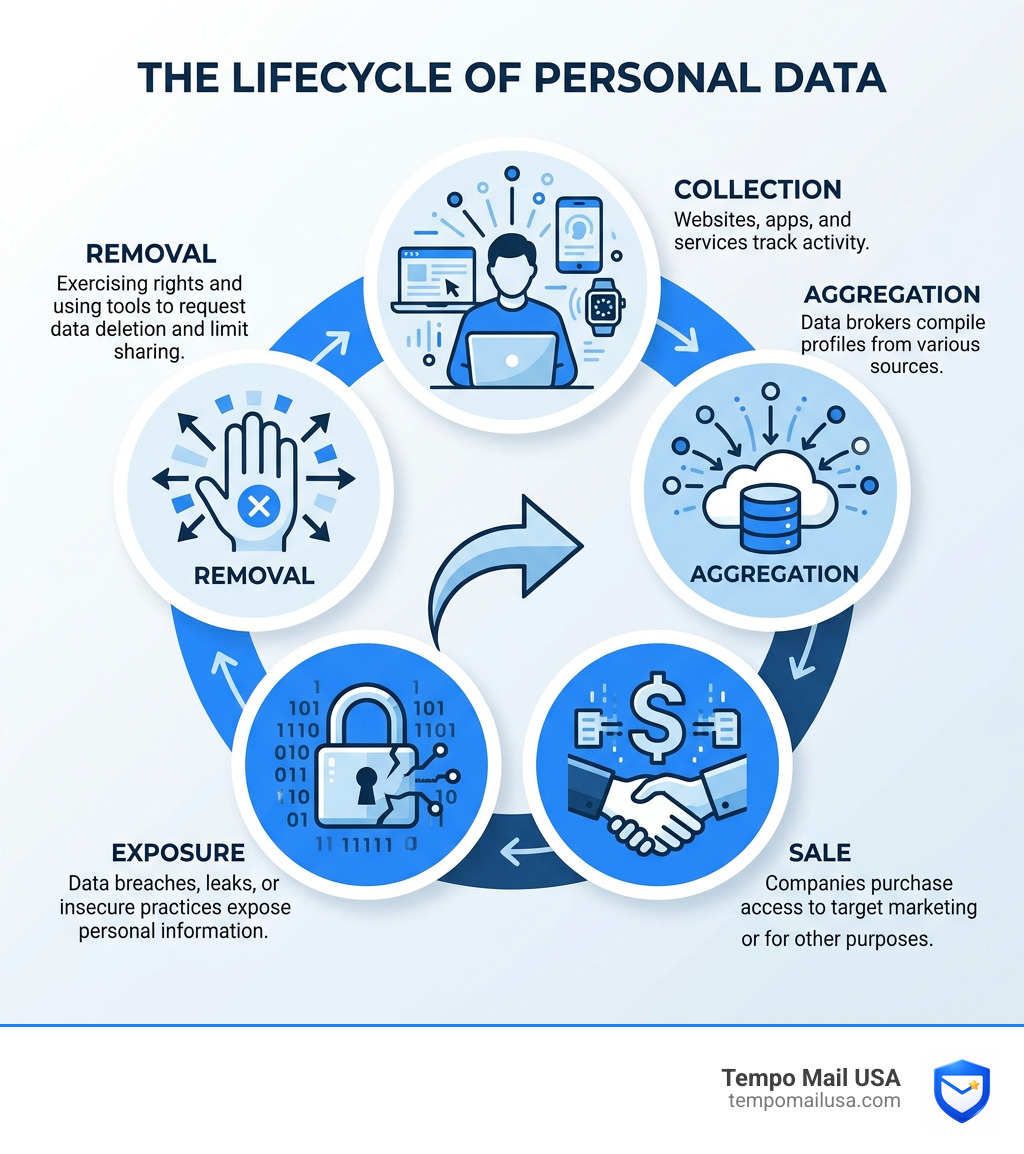
Every time you sign up for a website, download an app, or search for something online, you leave a trail. That trail gets collected, packaged, and often sold — sometimes to people you'd never want to have it. Telemarketers, identity thieves, and even abusive individuals can access your personal details cheaply and easily through data brokers.
The good news: you're not powerless. Understanding how your data moves — and where it's exposed — is the first step to protecting it.
What is Online Privacy and Why is it Important?
When we talk about online privacy, we are really talking about our "digital persona." In the physical world, you wouldn't let a stranger follow you into a store, watch what you buy, and then record your home address. Yet, in the digital world, this happens every second. Our digital footprint is the trail of data we leave behind, and it has become the most valuable currency in the modern world.
According to the General Data Protection Regulation (GDPR), personal data is "any information" related to an identified or identifiable person. This isn't just your name; it’s your phone number, your credit card details, your license plate, and even your IP address. In the digital economy, this data is often called the "new oil," but many experts argue it is actually far more valuable. Oil is used once; data can be sold, analyzed, and repurposed forever.
But why should we care? As security expert Bruce Schneier pointed out in The value of privacy, privacy is essential for human dignity and autonomy. It isn't just about hiding "bad" things; it's about having the power to choose what we reveal to the world. Without privacy, we lose our ability to act freely. If you knew someone was watching every keystroke, you might change how you speak or what you search for.
Protecting yourself and why email privacy matters is about more than just avoiding annoying ads. It’s about maintaining control over your life. When your data is sensitive—think medical history, financial records, or private messages—the stakes are even higher. A breach of this data doesn't just result in spam; it can lead to financial ruin or personal safety risks.
Common Threats to Your Digital Footprint
The internet is a bit like a giant, invisible spiderweb. Everywhere you go, you’re being tracked. Some of these threats are well-known, while others are "sneaky" technologies designed to bypass traditional protections.
Tracking Cookies and Their "Zombie" Cousins
Most of us know about cookies—those tiny files websites drop on our computers to "remember" us. While 58% of users have deleted cookies at least once, and 39% delete them every month, advertisers have found ways to stick around. Enter the Evercookie. These are JavaScript-based files that store data in multiple places on your browser. If you delete one, the others "resurrect" it. It’s the zombie of the tracking world.
Device Fingerprinting
Even if you clear your cookies, you might still be tracked via device fingerprinting. This technique looks at your browser version, screen resolution, installed fonts, and battery level to create a unique "fingerprint" of your device. It’s so accurate that a third of popular websites use it to identify you even when you’re in incognito mode.
Data Brokers and the 2023 Crisis
Data brokers are companies you’ve likely never heard of that make billions by selling your name, home address, and phone number. They provide this info to anyone for a few dollars. The 2023 data compromise statistics show that these compromises impacted 353 million people in the U.S. alone. This is often how your email ends up on the dark web.
The Risks of a "Smart" Life
We love our gadgets, but IoT (Internet of Things) devices are notorious for poor security. From smart doorbells to fitness trackers, these devices are often entry points for hackers. Even medical apps are a concern; a study of 29 migraine apps found that while 76% had privacy policies, 55% were sharing data with third parties for advertising.

How Tech Platforms and Apps Handle Your Data
The big tech giants have a complicated relationship with online privacy. On one hand, they offer advanced security; on the other, their business models often rely on knowing everything about us.
AI-Powered Security and Encryption
Platforms like Google use massive amounts of data to power security. For example, AI-powered spam filtering blocks nearly 1 crore (10 million) spam emails in Gmail every single minute. They also use AI safety and technique advancements like "red teaming" to find vulnerabilities before the bad guys do.
Encryption is another shield. Most of the web now uses HTTPS and Transport Layer Security (TLS) to ensure that when you send a message, it can’t be read by anyone in between. Authentication has also evolved; we’ve moved from weak passwords to passkeys and two-factor authentication (2FA).
The Reality of App Collection
While security is high, so is collection. A 2023 report found that shopping and food delivery apps like Wish and DoorDash collect the most data. Social media platforms aren't far behind, often engaging in what the FTC calls "vast surveillance."
| App Category | Primary Data Collected | Privacy Risk Level |
|---|---|---|
| Social Media | Interests, Contacts, Messages | High |
| Shopping | Payment Info, Location, Habits | High |
| Health Apps | Medical Conditions, Biometrics | Critical |
| Navigation | Real-time Location, History | High |
Many platforms now offer auto-delete controls. For instance, some companies set the default to automatically delete your activity data after 18 months. While this is a step in the right direction, 18 months is a long time for a profile to exist.
Legal Protections and the Role of Data Brokers
In the United States, there is no single federal law that covers online privacy. Instead, we have a patchwork of state laws and FTC guidelines.
The Rise of State Laws
As of 2024, 20 states have passed comprehensive privacy laws. These laws generally give you the right to access, correct, and delete the data companies have on you. You can check the US state privacy legislation tracker to see if your state is among them. By 2026, it is estimated that 43% of Americans will be covered by these protections.
The FTC and Consumer Protection
The Federal Trade Commission (FTC) is the primary watchdog. They handle cases where companies deceive users about their privacy practices. If you think your data has been misused, you should Report fraud to the FTC. Last year, identity theft reports to the FTC exceeded one million.
Dealing with People Search Sites
People search sites are a specific type of data broker that puts your address and phone number on a public webpage. This is a massive safety risk. Fortunately, you have the "right to delete." Most companies will honor a request to remove your data if you ask, though they don't always make it easy. Removing your personal information from the internet is a tedious but necessary task for high-level privacy.
Practical Steps to Enhance Your Online Privacy
You don't need to be a computer scientist to protect yourself. We recommend a "defense-in-depth" approach—layering different security measures to create a tough shell.
1. Master Your Passwords
Stop using "123456" or your pet's name. Use a password manager to generate unique, 20-character strings for every site. Reusing passwords is like having one key for your house, car, and office; if a thief gets that one key, you lose everything.
2. Enable Two-Factor Authentication (2FA)
Even if a hacker gets your password, 2FA stops them in their tracks. Always opt for an authenticator app over SMS codes, as "SIM swapping" can allow hackers to intercept text messages.
3. Audit Your App Permissions
Go into your phone settings right now and look at which apps have access to your microphone, camera, and location. Does that calculator app really need to know where you are? Probably not. Remove apps you don't use—they are just "data leaks" waiting to happen.
4. Use Browser Plugins
We suggest using tools like uBlock Origin to stop malicious ads and Privacy Badger to block invisible trackers. You can also enable Global Privacy Control (GPC), a setting that tells websites you do not want to be tracked.
5. Protect Your Family
Kids are especially vulnerable. Use Online tools for family safety to set boundaries and manage what information your children share. What goes online stays online—often forever.
Managing Online Privacy with Search Results
Google has introduced a tool called "Results About You." This free service monitors the web for your personal contact info and alerts you if it finds your phone number or address in search results. You can then request removal with a single click. It’s a "no-brainer" for anyone looking to reduce their digital footprint.
Privacy-Focused Alternatives for Online Privacy
If you want to go a step further, look for "private-by-design" products. This means the company builds the product with privacy as the default, not an afterthought.
- Search: Use DuckDuckGo or SearXNG instead of traditional search engines.
- Browsing: The Tor Browser or Firefox Focus are excellent for anonymous browsing.
- Communication: Use encrypted messaging apps that don't store your metadata.
Frequently Asked Questions about Online Privacy
What are the biggest threats to my data today?
The biggest threats are weak, reused passwords and the "vast surveillance" of data brokers. AI-powered phishing is also becoming a major concern, as scammers can now create incredibly convincing fake emails and text messages to trick you into giving up your PII (Personally Identifiable Information).
How do do I remove my name from people search sites?
You can visit each site individually and look for an "Opt-Out" or "Privacy" link, usually at the bottom of the page. You will often have to provide the URL of the record you want removed. For a more comprehensive approach, there are services that automate this process for you, though they often require a subscription.
Are smart home devices a risk to my privacy?
Yes. Many smart devices, like voice assistants and security cameras, record audio and video that may be stored in the cloud. If your account isn't secured with a strong password and 2FA, hackers could access these feeds. Additionally, if you sell a "smart" home or car without clearing the data, the new owner could access your personal history.
Conclusion
At the end of the day, online privacy is about safety. We live in an era where our digital and physical lives are inseparable. A leak in one leads to a crisis in the other.
At Tempo Mail USA, we believe that the best way to protect your data is to never give it away in the first place. By using temporary email aliases, you create a "PII firewall." When a website asks for your email, you give them an alias. If that site gets hacked, or if they sell your data to brokers, your real identity remains shielded. It’s a simple, effective way to maintain your data sovereignty.
Don't wait for a data breach to take action. Start by protecting your personal information from scammers today. Whether it's using a VPN, tightening your social media settings, or using a secure email alias, every step you take makes you a harder target. Your data is your business—let's keep it that way.