


Your Inbox Is More Exposed Than You Think
The least secure email providers are some of the most popular ones in the world — and that's exactly what makes them dangerous.
Here's a quick answer if you need it fast:
| Email Provider | Key Security Risk |
|---|---|
| Yahoo Mail | 3 billion accounts breached in 2013; NSA backdoor created in 2016 |
| AOL Mail | 2014 breach exposed emails, passwords, and contact data |
| Gmail | Third-party inbox access; AI-driven data collection |
| Outlook | 2019 breach exposed email metadata and folder names |
| Apple Mail | Slow vulnerability patching; closed-source, unverifiable claims |
These aren't obscure services. They're the platforms hundreds of millions of people use every single day — for banking alerts, medical notes, work documents, and private conversations.
The problem isn't just hackers. It's the providers themselves.
Free email services are built on a simple trade: you get a free inbox, and they get your data. That data gets scanned, analyzed, and shared — with advertisers, AI systems, and in some cases, government agencies.
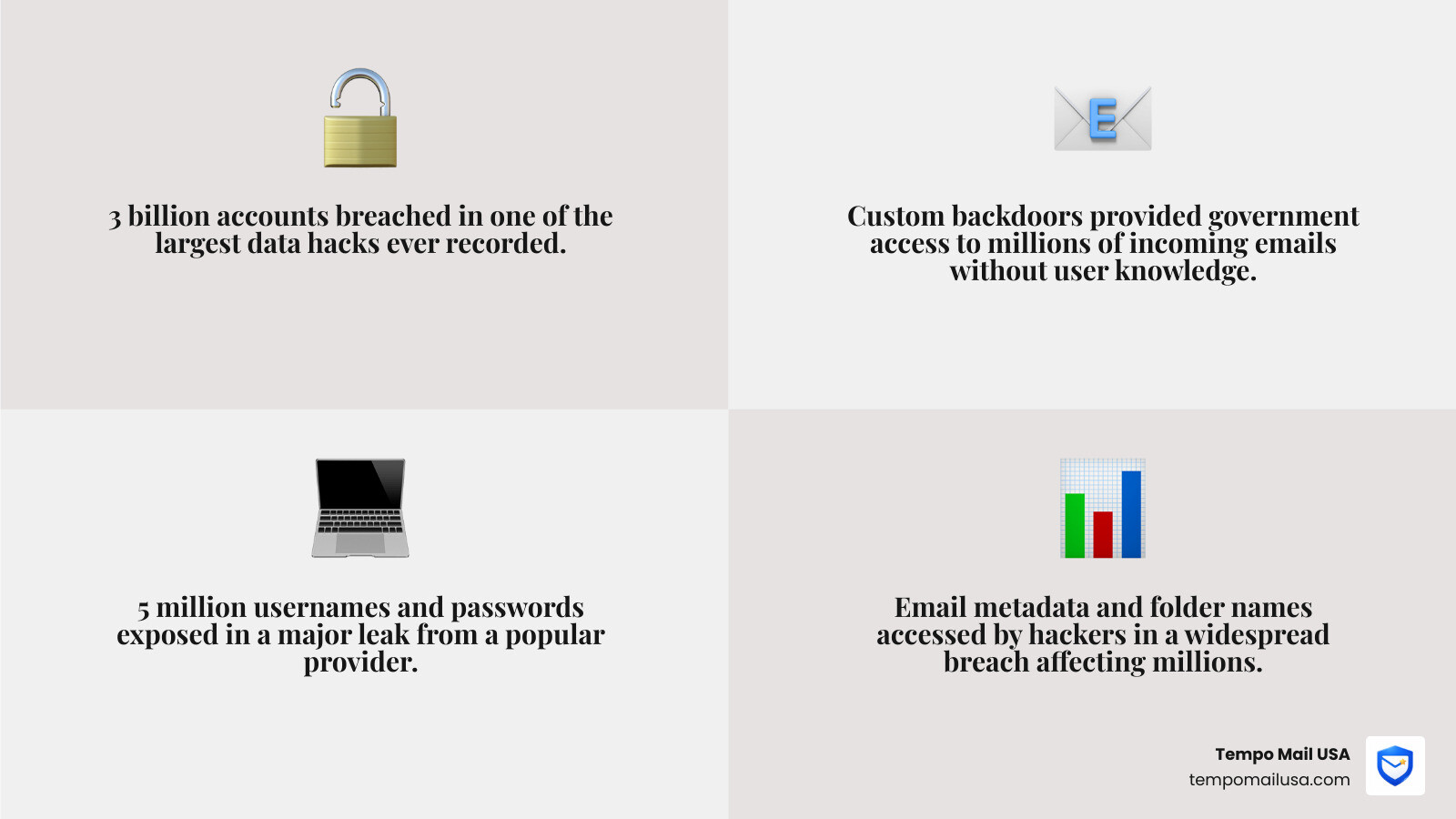
Yahoo is perhaps the most striking example. In 2013, every single one of its 3 billion user accounts was compromised in what became the largest data breach in history. Then in 2016, the company reportedly built a custom tool to give US intelligence agencies access to hundreds of millions of incoming emails — without users knowing.
That's not a bug. That's a business decision.
Most people have no idea this is happening to their inbox right now.
The Hall of Shame: Exposing the Least Secure Email Providers
When we talk about the least secure email providers, we aren't just nitpicking small glitches. We are looking at a history of catastrophic failures that have left billions of people vulnerable to identity theft. If you use a mainstream provider, your digital life is likely sitting on a server that has been, or currently is, a primary target for global cyber-syndicates.
The statistics are staggering. Beyond the 2013 Yahoo disaster, Google’s Gmail suffered a leak in 2014 that exposed nearly 5 million usernames and passwords. Microsoft Outlook followed suit in 2019 with a breach that allowed hackers to view email metadata and folder names. These aren't just "accidents"; they are systemic vulnerabilities inherent in centralized, ad-supported platforms.
For many, these breaches are the first step toward a total financial takeover. This is why identity theft protection services have become a billion-dollar industry. Without a "firewall" between your real identity and these porous platforms, a single leaked password can grant a hacker access to your bank accounts, tax records, and social media.

Yahoo and AOL: Historical Breaches and the Erosion of Trust
Yahoo and AOL (now both under the umbrella of Apollo Global Management) represent the "old guard" of the internet, but their security practices feel stuck in the 90s. In 2016, it was revealed that Yahoo provided backdoor access to hundreds of millions of user accounts for U.S. intelligence agencies. They didn't just lose the data; they actively built a tool to scan it.
AOL Mail isn't much better. Their 2014 breach didn't just leak email addresses; it stole mailing addresses, contacts, and even employee information. When a company loses control of your contact list, they aren't just putting you at risk—they are turning your friends and family into targets for phishing attacks. For businesses still using these legacy accounts, the lack of modern encryption makes cybersecurity insurance an absolute necessity, as the liability of a data leak could be company-ending. How Temporary Emails Protect You from Data Breaches
Why Big Tech Platforms are Often the Least Secure Email Providers
You might think Gmail or Outlook are "safer" because they have more money for developers. In reality, their business models make them some of the least secure email providers for privacy. These platforms often use server-side encryption. This means they hold the keys to your "vault." If a government agency serves them a warrant, or a rogue employee decides to snoop, your "private" messages are as clear as day.
Furthermore, these platforms are notorious for allowing third-party app access. Have you ever "Signed in with Google" on a random shopping site? You may have just given that site permission to read your entire inbox. This creates a massive gap in data privacy compliance. To combat this, many users are forced to invest in advanced malware protection just to catch the phishing links that these providers let slide into their primary folders. What is Temporary Email and How to Use It Safely
Why Free Services Fail Data Privacy Compliance and Enterprise Security
The hard truth is that "free" email is never actually free. You pay with your privacy. Most mainstream providers do not offer end-to-end encryption (E2EE) by default. Without E2EE, your email is vulnerable at three points: on your device, on the provider's server, and in transit.
| Feature | Mainstream (Gmail/Yahoo/Outlook) | Tempo Mail USA Infrastructure |
|---|---|---|
| Encryption Type | Server-side (Provider holds keys) | End-to-End or Zero-Knowledge |
| Data Mining | Scans for ads and AI training | No scanning / Identity Proxying |
| Jurisdiction | Often US (Five Eyes Alliance) | Privacy-friendly (Switzerland/Germany) |
| Anonymity | Requires phone/PII for signup | Anonymous / Alias-based |
For a corporation, using these services is a nightmare for data privacy compliance. If you are handling HIPAA-protected health info or GDPR-regulated European data, a standard Gmail account simply doesn't cut it. This is why many organizations are moving toward secure cloud storage for business that integrates with encrypted communication channels rather than relying on legacy webmail. The Ultimate Guide to Private Disposable Email
The Hidden Cost of "Free" Secure Cloud Storage for Business
When you store "free" data, the provider tracks your metadata. They know who you talk to, how often, and from what location. This metadata is often more valuable than the email content itself because it builds a "fingerprint" of your life. These supercookies and tracking pixels follow you across the web, making it nearly impossible to maintain a private digital footprint.
If your business relies on these "free" ecosystems, you are likely failing your data privacy compliance audits. To protect your assets, you need more than just a password; you need identity theft protection services and credit monitoring software to watch for the inevitable day your provider's "secure" cloud gets breached.
Preventing Phishing with Disposable Email Infrastructure
We believe that the best way to stay safe isn't to "fix" a broken email provider—it's to stop giving them your real information in the first place. This is where Tempo Mail USA becomes your most powerful tool. By using a temporary email alias, you create a digital "burn layer" between your sensitive data and the rest of the internet.
Tempo Mail USA provides a premium temporary email utility that acts as an identity proxy. When a website asks for your email to "download a whitepaper" or "sign up for a discount," you don't give them your primary address (the one linked to your bank). You give them a Tempo Mail alias. If that site gets hacked, or if they start selling your data to spammers, you simply "kill" the alias. Your real identity remains untouched. This is a critical component of advanced malware protection because it stops the threat before it ever reaches your real inbox. Why Use Temporary Email: Protect Yourself from Spam
Security Checklist: Hardening Your Digital Identity
To move away from the risks of the least secure email providers, follow this rigorous security checklist:
- Use unique aliases for every service: Powered by Tempo Mail USA, this ensures that a breach at one site doesn't compromise your entire digital life, acting as a manual form of identity theft protection services.
- Enable hardware-based 2FA: Use a physical key (like a YubiKey) for your most important accounts. SMS-based 2FA is easily bypassed via SIM swapping.
- Audit third-party app permissions: Go into your Google or Microsoft settings and revoke access for any app you haven't used in the last 30 days to maintain data privacy compliance.
- Implement a zero-trust email policy: Treat every incoming link as suspicious. Use disposable email for all non-essential interactions to keep your primary inbox clean and safe.
Beyond the Inbox: Enterprise VPN Solutions and Identity Theft Protection
Email security is just one piece of the puzzle, the threats have evolved. Hackers are now using AI to craft perfect phishing emails and deepfake audio to trick employees into transferring funds. To stay safe, you need a holistic approach.
This includes using enterprise VPN solutions to mask your IP address and encrypt your traffic, especially when working remotely. A VPN prevents "man-in-the-middle" attacks where hackers intercept your data on public Wi-Fi. Furthermore, pairing your email security with credit monitoring software ensures that if someone does manage to steal your PII (Personally Identifiable Information), you are alerted the moment they try to open a line of credit in your name.
Scaling Data Privacy Compliance for Small Businesses
Small businesses are the #1 target for email-based attacks because they often lack the massive IT budgets of Fortune 500 companies. However, you don't need a million dollars to be secure. By implementing DMARC protocols and SPF records, you can prevent hackers from "spoofing" your business email address.
Strategic use of temporary email tools allows your marketing and sales teams to test platforms and sign up for research without exposing the core company infrastructure to spam or breaches. This is how you achieve data privacy compliance on a budget. Beyond the Inbox: How to Master Temporary Email Tools
Frequently Asked Questions about Email Security
What is the least secure email provider?
While many "Big Tech" providers have improved their technical defenses, Yahoo Mail and AOL Mail remain at the top of the list due to their history of massive breaches and lack of default end-to-end encryption. Any provider that scans your content for advertising purposes should be considered high-risk for privacy-conscious users.
How do I protect my business from email-based identity theft?
The most effective strategy is a multi-layered defense: use identity theft protection services, implement enterprise VPN solutions, and mandate the use of temporary email aliases for all external, non-essential sign-ups. This limits the amount of real data available for hackers to steal.
Is Gmail safe for sensitive business data and compliance?
Standard Gmail is generally not sufficient for high-level data privacy compliance (like HIPAA) because Google retains the ability to access your data. For sensitive business operations, you should use an encrypted workspace or a provider that offers zero-knowledge architecture where only you hold the decryption keys.
Why should I use a temporary email for online sign-ups?
Using a temporary email from Tempo Mail USA acts as a "firewall" for your identity. It prevents trackers from following your browsing habits, stops spam from reaching your primary inbox, and ensures that if a website is breached, your real email address and associated PII remain safe.
Conclusion
The era of trusting big tech with our most private thoughts is over. As we've seen, the least secure email providers are often the ones we've been told to trust the most. Whether it's Yahoo's billion-user breaches or Gmail's pervasive data mining, the risks to your data privacy compliance and financial security are real and growing.
Tempo Mail USA is your indispensable identity firewall. By proxying your identity through our secure, temporary infrastructure, you drastically reduce your digital footprint and fortify your online presence against the pervasive threats of the modern web. Don't wait for the next major breach to be the reason you change your habits. Protect your identity, your business, and your future now. Protect your identity now