


The Ghost Preparer Tax Scam Is More Dangerous Than You Think
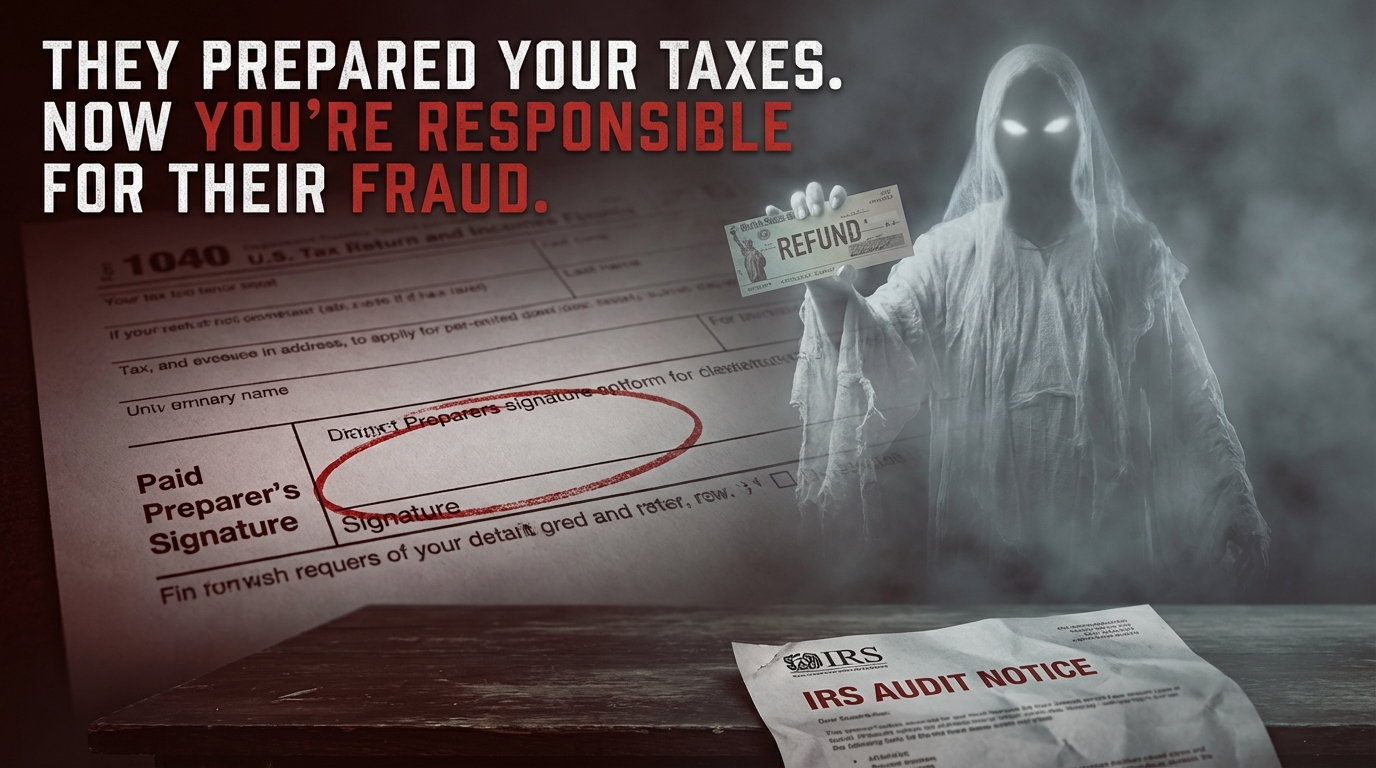
The ghost preparer tax scam is one of the most deceptive frauds to watch out for during tax season. A ghost preparer is someone who charges you to prepare your tax return — but deliberately refuses to sign it or include their identifying information. They take your money, your sensitive personal data, and vanish. If the IRS comes knocking, you're the one left holding the bag.
Here's a quick breakdown of what you need to know:
- What it is: A paid tax preparer who files or prepares your return without signing it or including their IRS-required Preparer Tax Identification Number (PTIN)
- How it harms you: They may steal your refund, fabricate deductions, or commit identity theft — and because your name is on the return, you are legally responsible for any errors or fraud
- Key red flag: A legitimate paid preparer is required by law to sign your return and include their PTIN. No signature = major warning sign
- What to do: Verify your preparer's PTIN, review your return before signing, and report suspicious preparers to the IRS using Form 14157
This scam peaks every year between January and April. And with new tax law changes on the horizon, experts warn that 2026 could be an especially risky season for unsuspecting taxpayers.
What is a Ghost Tax Preparer?
To understand the ghost preparer tax scam, we first need to look at how a legitimate tax professional operates. In the eyes of the Internal Revenue Service (IRS), anyone who is paid to prepare or assist in preparing federal tax returns must have a valid Preparer Tax Identification Number (PTIN). This isn't just a suggestion; it is a federal mandate.
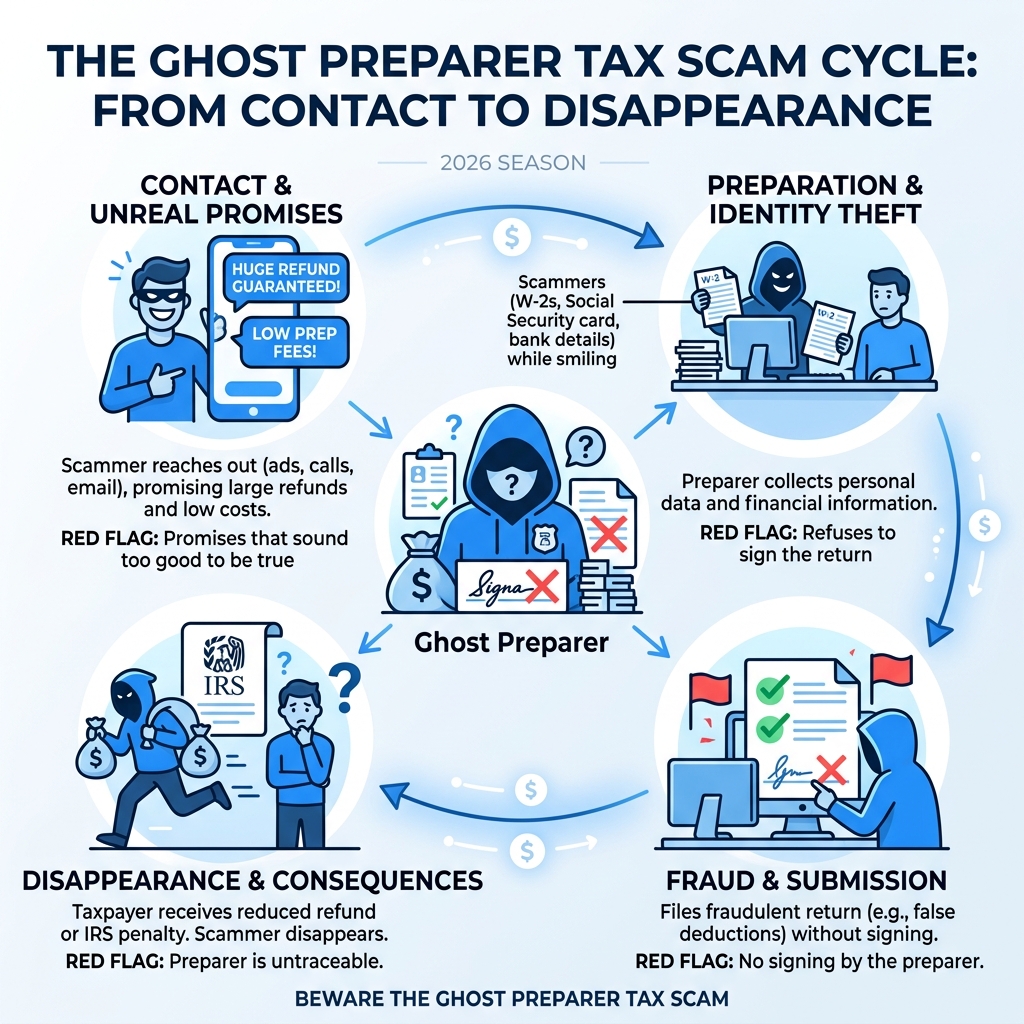
A "ghost" preparer is a fraudster who haunts the tax industry. They function like a real tax preparer—they sit down with you, look at your W-2s, and crunch the numbers—but when it comes time to file, they become invisible. They refuse to sign the return as the paid preparer. Instead, they might print the return and tell you to sign and mail it yourself. If they e-file it, they will refuse to digitally sign it as the preparer.
By staying off the paperwork, they ensure that the IRS only sees your name. To the government, the return looks "self-prepared." This allows the scammer to engage in shady math or outright theft without leaving a paper trail that leads back to them.
The PTIN Mandate and IRS Requirements
The IRS is very clear: Paid preparers must sign and include their PTIN on the return. This number is the primary way the government tracks the accuracy and honesty of tax professionals. When a preparer refuses to use one, they are essentially telling you they aren't willing to stand behind their work.
Legal Accountability
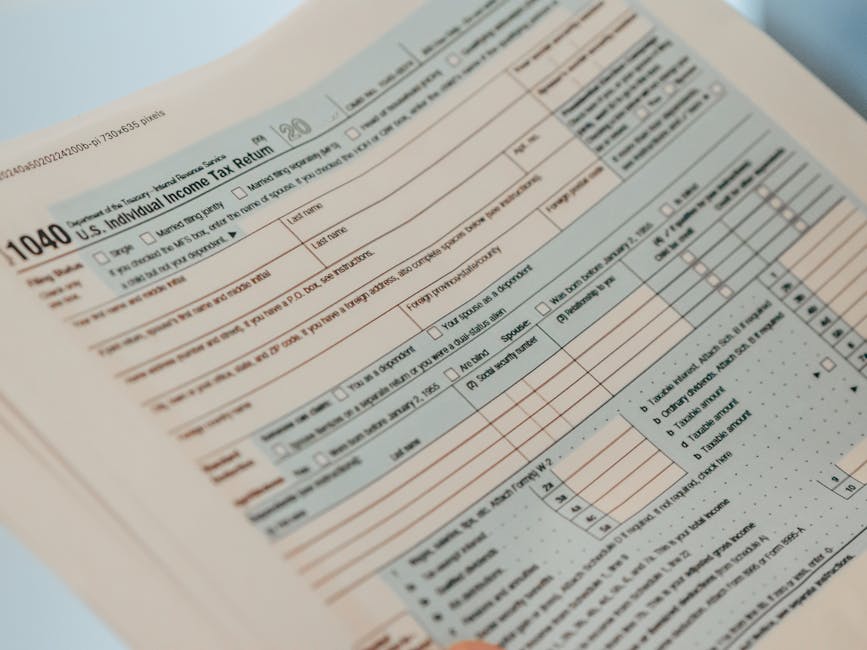
We often hear from people who think that if a professional did their taxes, any mistakes are the professional's fault. Unfortunately, that isn't how it works. When you sign that tax return, you are declaring under penalty of perjury that everything in it is true and accurate. If a ghost preparer invents a $10,000 business loss to get you a bigger refund, the IRS will come after you for the back taxes, interest, and penalties—not the "ghost" who has already vanished with your fee.
Common Tactics Used in a Ghost Preparer Tax Scam
Ghost preparers are clever. They don't usually walk around with "scammer" written on their foreheads. Instead, they use specific tactics to lure in taxpayers who are looking for a deal or a large refund.
The "Big Refund" Bait
The most common tactic is promising a refund that seems too good to be true. They might claim they have "secret" knowledge of the tax code or special software that finds hidden deductions. In reality, they are often just making things up. They might fabricate medical expenses, invent charitable donations, or claim business credits you aren't eligible for.
Refund Percentage Fees
Legitimate tax preparers usually charge a flat fee or an hourly rate. A major red flag of a ghost preparer tax scam is a preparer who wants a percentage of your refund as their fee. This is actually prohibited by IRS standards because it incentivizes the preparer to cheat on your return to increase their own payday.
The OBBBA Impact (2026 Vulnerabilities)
The 2026 tax season is expected to be particularly "spooky" due to the One Big Beautiful Bill Act (OBBBA). This legislation introduced several new, complex deductions and exemptions, such as:
- No tax on tipped wages up to $25,000.
- No tax on overtime pay up to $12,500.
- An additional $6,000 deduction for seniors.
- Deductions for car loan interest up to $10,000.
While these are great for taxpayers, they are also confusing. Scammers exploit this confusion by misrepresenting these new rules to justify massive, fraudulent refunds. Because these rules are new, taxpayers are less likely to notice when a ghost preparer "fudges" the numbers.
Word-of-Mouth and "Pop-Up" Shops
Many ghost preparers don't have a permanent office. They might operate out of a temporary kiosk, a rented back room, or even their own home. They often build their clientele through word-of-mouth in specific communities, targeting vulnerable populations like seniors, veterans, or non-English speakers. Once April 15th passes, they close up shop and disappear, making it impossible for you to find them when the IRS sends you a correction notice.
We've seen similar patterns in digital fraud as well. Just as a ghost preparer hides their identity, digital scammers use phishing to steal info. You can learn more about spotting phishing emails to see how these "invisibility" tactics work across different industries.
Red Flags of a Ghost Preparer Tax Scam
To help you stay safe, we’ve compiled the most common warning signs. If you see even one of these, we recommend walking away immediately.
| Feature | Legitimate Preparer | Ghost Preparer |
|---|---|---|
| Signature | Signs the "Paid Preparer" section | Refuses to sign; leaves it blank |
| PTIN | Provides a valid IRS PTIN | Has no PTIN or refuses to show it |
| Fees | Flat fee or hourly rate | Percentage of your refund |
| Refunds | Sent directly to your bank account | Asks to split refund or use their account |
| Accuracy | Asks for receipts and records | Encourages "estimating" or inventing numbers |
| Availability | Available year-round | Disappears after tax season |
Direct Deposit Manipulation and Form 8888
One of the most sinister moves a ghost preparer can make involves IRS Form 8888. This form is used to split a tax refund into multiple accounts. A scammer might have you sign a return where a portion of your refund is quietly directed into their bank account. They might also tell you that the refund "must" go to their account first so they can deduct their fee—this is a lie. The IRS recommends that your refund always go directly into your own personal account.
Risks and Consequences for Taxpayers
Using a ghost preparer isn't just a "little shortcut"—it can have devastating financial and legal consequences.
Legal Liability and IRS Audits
As we mentioned, the IRS holds the taxpayer responsible for everything on the return. If a ghost preparer claims a fake "Off-Road Fuel Tax Credit" on your behalf, the IRS won't care that you didn't know what that was. You will be required to pay back the full amount of the fraudulent refund, plus interest that accrues from the original due date of the return.
Interest and Penalties
The penalties for tax fraud or even "substantial understatement" of tax can be 20% to 75% of the underpayment. When you add years of interest to that, a "big refund" from a ghost preparer can turn into a debt that takes a decade to pay off.
Stolen Refunds and Identity Theft
Beyond just filing a bad return, many ghost preparers are actually identity thieves. They now have your Social Security number, your date of birth, your bank account info, and your income details. They can use this to open credit cards in your name or file even more fraudulent returns in future years.
If you find yourself in a situation where you've been scammed, report it. We've put together a guide on how to report fraud to the FTC which is a great starting point for any victim of financial misconduct.
How to Protect Yourself and Verify Your Return
The good news is that you have the power to stop a ghost preparer in their tracks. By following a few simple verification steps, you can ensure your taxes are handled by a pro.
Use the IRS Directory
Don't just take someone's word for it. The IRS maintains a public Directory of Federal Tax Return Preparers with Credentials and Select Qualifications. You can search this database by zip code to find preparers who are officially recognized by the IRS, including CPAs, Enrolled Agents, and Attorneys.
Verify Credentials and PTIN
Before you even hand over your documents, ask the preparer: "Will you be signing my return and providing your PTIN?" If they hesitate or say they "don't need to," leave. A real professional is proud to sign their work.
Review Your Return Carefully
Never, ever sign a blank or incomplete tax return. Before the return is filed, sit down and review it line by line.
- Check the income: Does it match your W-2s and 1099s?
- Check the deductions: Do you actually recognize those expenses?
- Check the bank info: Is the routing and account number for the refund yours and only yours?
Free and Legitimate Resources
If you are worried about the cost of a professional, there are free, safe alternatives:
- VITA (Volunteer Income Tax Assistance): Offers free tax help to people who generally make $64,000 or less, persons with disabilities, and limited English-speaking taxpayers.
- TCE (Tax Counseling for the Elderly): Provides free tax help for all taxpayers, particularly those who are 60 years of age and older.
- IRS Free File: If your income is below a certain threshold, you can use brand-name software to file for free.
What to Do if You Suspect a Ghost Preparer Tax Scam
If you realize you’ve been "ghosted" or that your preparer filed something fraudulent, you need to act fast. The longer you wait, the more interest and penalties will pile up.
- Report to the IRS: Use IRS Form 14157-A, Tax Return Preparer Fraud or Misconduct Affidavit. This tells the IRS that your preparer acted without your consent or cheated on your return.
- Contact Local Authorities: In some areas, like the District of Columbia, the Department of Insurance, Securities and Banking (DISB) handles these complaints. Check your state's revenue department as well.
- Freeze Your Credit: Since the scammer has your SSN, go to the three major credit bureaus (Equifax, Experian, and TransUnion) and place a freeze on your credit report. This prevents the scammer from opening new accounts in your name.
- Watch Out for "Recovery" Scams: Sometimes, scammers will contact you pretending to be the IRS or a "fraud recovery" service. They might send you a fake invoice for "penalties." Be sure to read our guide on how to spot fake invoice email scams so you don't get scammed a second time.
Frequently Asked Questions about Ghost Preparers
Why is it illegal for a paid preparer not to sign my return?
It is illegal because it bypasses the IRS system of accountability. The law requires a signature and a PTIN so the IRS can track who is preparing returns for money. This helps the government identify patterns of fraud and ensure that preparers are following the rules. When a preparer doesn't sign, they are essentially committing tax evasion themselves by hiding their income from the IRS.
How does the One Big Beautiful Bill Act (OBBBA) affect tax scams?
The OBBBA introduced significant changes for the 2025 and 2026 tax years, including tax-free limits on tips and overtime. Because these rules are brand new and have specific caps (like the $25,000 limit for tips), ghost preparers use them as "cover." They might tell a client, "The new law says you don't have to pay tax on any of your tips," even if the client earned $50,000 in tips. This creates a massive fraudulent refund that the taxpayer will eventually have to pay back.
Can I get my money back if a ghost preparer stole my refund?
It is difficult, but possible. If you can prove via Form 14157-A that the preparer changed your bank information or filed the return without your final review, the IRS may be able to assist in a refund theft investigation. However, if the "ghost" has already withdrawn the cash and vanished, the recovery process can be long and complicated. This is why prevention is so much better than the cure.
Conclusion
The ghost preparer tax scam is a haunting reminder that when it comes to your finances, if something sounds too good to be true, it almost certainly is. These scammers rely on your desire for a big refund and your lack of knowledge about IRS signature requirements to steal your money and your identity.
At Tempo Mail USA, we believe that your identity is your most valuable asset. Just as a ghost preparer tries to hide their identity to do harm, we help you protect yours to stay safe. Our temporary email aliases act as a secure identity proxy—a digital firewall that protects your real personal information (PII) from being exposed to services that might not have your best interests at heart.
In an age where data breaches and tax scams are around every corner, staying anonymous and protecting your primary contact info is essential. Whether you are signing up for tax software or just browsing for financial advice, protect your PII with Tempo Mail USA and keep the "ghosts" out of your personal life. Stay vigilant, verify your preparer, and let's make this tax season a lot less scary.