

Fraud Is Trending for a Reason: The Email Scams Behind Fraud Awareness Week — and the Inbox Rule That Stops Them
"Fraud" is trending in the United States right now — #15 on Google Trends, 10,000+ searches, up 700%, and still climbing when I checked at 16:27 IST today. That is not a random Tuesday spike. It has a date on it, a week on it, and a number on it: $20.87 billion, which is what Americans reported losing to fraud in a single year. This article is not another generic "what is fraud" page. The search results for "fraud" are full of those already — government primers and listicles that define the word and move on. What they don't do is follow the money to where it actually starts, which is almost always an inbox, and what they definitely don't do is test anything. So I did the part they skip: I checked what the spike is really about, I read the fraud cases reported today, I took apart a fake fraud alert line by line, and I opened a disposable inbox and timed the one defence that costs nothing.
The Spike Has a Date on It
Fraud Awareness Week runs November 15–21, 2026. It is led every year by the Association of Certified Fraud Examiners, and this year the timing collided with the start of the Christmas shopping season — the exact weeks when purchase scams spike. Bank of Ireland put numbers on that collision this week: purchase scam cases up 68% in the first nine months of 2026 compared with the same period last year, impersonation scams up 26%, investment scams up 24%, and the money lost through scam texts, emails and phone calls up 11%. The bank issued its warning specifically to coincide with Fraud Awareness Week, and it told shoppers to stop, think and check before buying anything advertised through social media.
That is the UK picture. The American picture is worse, and it is the reason the search term is climbing in the US rather than anywhere else. The FBI's Internet Crime Complaint Center received 1,008,597 fraud and scam complaints in 2025 and recorded $20.87 billion in reported losses — a 26% increase on 2024. The Federal Trade Commission, testifying to Congress in March 2026, reported 3 million fraud reports in 2025 with $15.9 billion in losses, up from more than $12 billion in 2024, and noted that reported losses have risen roughly 430% since 2020. Because most victims never report at all, the FTC estimates the true cost of fraud in 2024 alone may have been as high as $195.9 billion. The Association of Certified Fraud Examiners estimates organisations lose about 5% of their revenue to fraud every year.
Read those numbers as a trend story, not a statistics page. Fraud is not growing slowly. It is compounding — 430% in five years — and the growth is driven by large losses: the FTC attributes the trend to a sharp rise in people reporting losses of $100,000 or more, with investment scams alone accounting for roughly half of all reported losses. Imposter scams were the most reported fraud category in 2025, with more than 1 million reports. And the speed is the part nobody talks about enough: research from PYMNTS Intelligence found that nearly two thirds of scam victims send money within 24 hours of first contact. Fraud is a 24-hour business. Your defence has to work in the first ten minutes, not the first ten days.
Fraud Doesn't Start With a Phone Call. It Starts With an Inbox.
Here is the claim most fraud guides get backwards: they treat email as one fraud channel among many, alongside phone calls, texts and social media. In practice, email is the channel that feeds all the others. The phone call that steals your money starts with an email that got your number. The fake investment platform starts with an email that got you to sign up. The "fraud alert" text that panics you into clicking starts with an email address you handed to a site that sold it, leaked it, or never protected it.
Look at the fraud cases reported today, November 18, and count how many began with a message:
A Delhi man lost ₹2.76 lakh to a racket that posed as banking and insurance officials, promising a loan against his life insurance policy. Four men were arrested. The hook was a forged message claiming ₹41.94 lakh had been credited to his account, followed by demands for processing fees, file charges and GST. A Hyderabad businessman lost ₹4.67 lakh after a Facebook advertisement offering Mudra loans led him to a man claiming to represent Mudra Finance, who collected his Aadhaar, PAN and bank details, then demanded payment after payment for processing charges, TDS and RBI compliance fees. A Kochi doctor lost ₹1.57 crore — more than $175,000 — to an investment fraud that began when a woman he met through a dating app introduced him to a trading platform supposedly operating in Dubai. A Telugu actress lost ₹4.14 lakh booking a business-class flight ticket after fraudsters posing as a travel agency extracted her debit card details and one-time passwords. And India's Ministry of Home Affairs now estimates Indians are losing an average of ₹1,000 crore every month to cyber frauds run from compounds in Cambodia, Myanmar, Laos, Vietnam and Thailand — a syndicate in Pune and Mumbai was caught this week smuggling more than 12,000 SIM cards to Dubai for Chinese cyber operatives running investment and task-based frauds.
The pattern is not subtle. Every one of these started with contact: an ad, a message, a call, a signup form. And in the United States the newest version of the same pattern is AI impersonation — US authorities announced charges last week over an alleged global scheme using AI-generated voices and images to impersonate corporate executives and lawyers, reportedly stealing more than $129 million. The voice on the phone is fake. The email that set up the call was real, and it went to an address the victim had given away somewhere.
My opinion, stated plainly: most fraud advice fails because it starts at the wrong end. It tells you how to spot a scam after it reaches you. The useful question is how the scammer got your address in the first place — and the answer, most of the time, is that you gave it to them, for free, on a form that didn't need it.
The Anatomy of a Fake Fraud Alert
The single most effective fraud message in circulation right now is the fake fraud alert, and it works because it borrows the exact language of a real one. Here is how to tell them apart, line by line, using the message in the image below as the model. It is a reconstruction of the real pattern, not a screenshot of any one message — the wording varies, the structure doesn't.
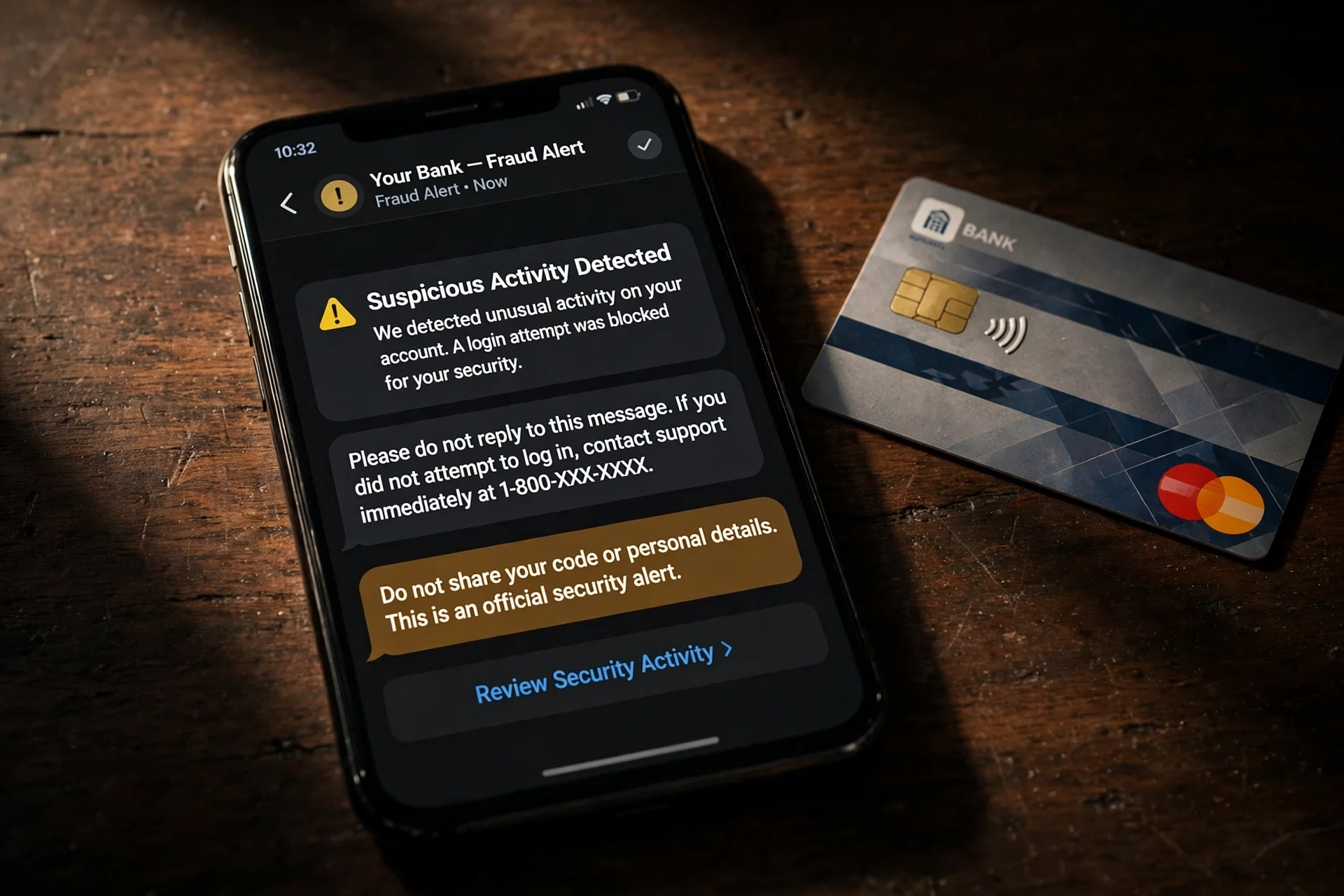
The sender. A real bank alert comes from a short code or a sender ID you have seen before, and it never asks you to reply. A fake one comes from a random long number, an email address with a lookalike domain, or a messaging app. The first check costs two seconds: does this sender match the one your bank has used before? If you have never seen it, treat the message as fake until proven otherwise.
The greeting. Real fraud alerts use your name, because the bank knows it. Fake ones say "Dear Customer", "Dear User", or nothing at all — because the scammer bought a list of phone numbers, not a list of names. A generic greeting on a message claiming to know about your account is a contradiction, and contradictions are the whole game.
The threat. "Suspicious activity detected." "A login attempt was blocked." "Your account will be closed in 24 hours." The threat is always urgent and always vague — never a specific transaction, never an amount, never a merchant. A real alert names the transaction: $43.20 at a store in Ohio, 2:14 p.m. Vagueness is not an accident. It is the only way one message can scare a million people at once.
The action. This is the line that matters. A real bank tells you to open its app, or to call the number on the back of your card. A fake alert gives you a link, or a phone number inside the message, or asks you to reply with a code. The rule is absolute and has no exceptions: never use a link or a number that arrived inside the alert itself. Open the app yourself, or type the bank's address yourself, or call the number printed on your card. If the alert was real, the same warning will be waiting for you there. If it was fake, you have just wasted thirty seconds and saved yourself everything else.
The code request. No legitimate organisation will ever ask you to read back a one-time code, a password, or a PIN — not by text, not by email, not on a call. The Kochi doctor's case and the Hyderabad flight-ticket case both turned on one-time passwords handed to a stranger. The moment anyone asks for your code, the conversation is fraud, whatever they claim to be. Hang up, delete, report.
That five-point check takes about sixty seconds, and it settles almost every fraud alert you will ever receive. The guides ranking for "fraud" list the same points in abstract terms. The difference here is that I am telling you to run the check on the next alert you get, not to memorise it for later — because PYMNTS found that two thirds of victims pay within a day, and the sixty seconds you spend checking are the only part of the timeline you control.
I Opened a Burner Inbox and Timed the Defence
Advice is cheap, so here is the part I actually did. At 16:32 IST today I opened tempomailusa.com and did what the site does for anyone: it issued a disposable address instantly, with no signup, no name, no phone number. The address it gave me was artextest42@rover.info. The homepage counters at that moment read 483,578 emails created and 609,973 messages received. The inbox loaded empty — zero messages — with the note "Waiting for incoming emails. Any message sent to your temporary address will appear here automatically." It showed "Expires in 29d 18h 16m 53s", with the accompanying note that free inboxes last 30 days and Pro inboxes last 365 days, and it offered 468+ domains free to try.
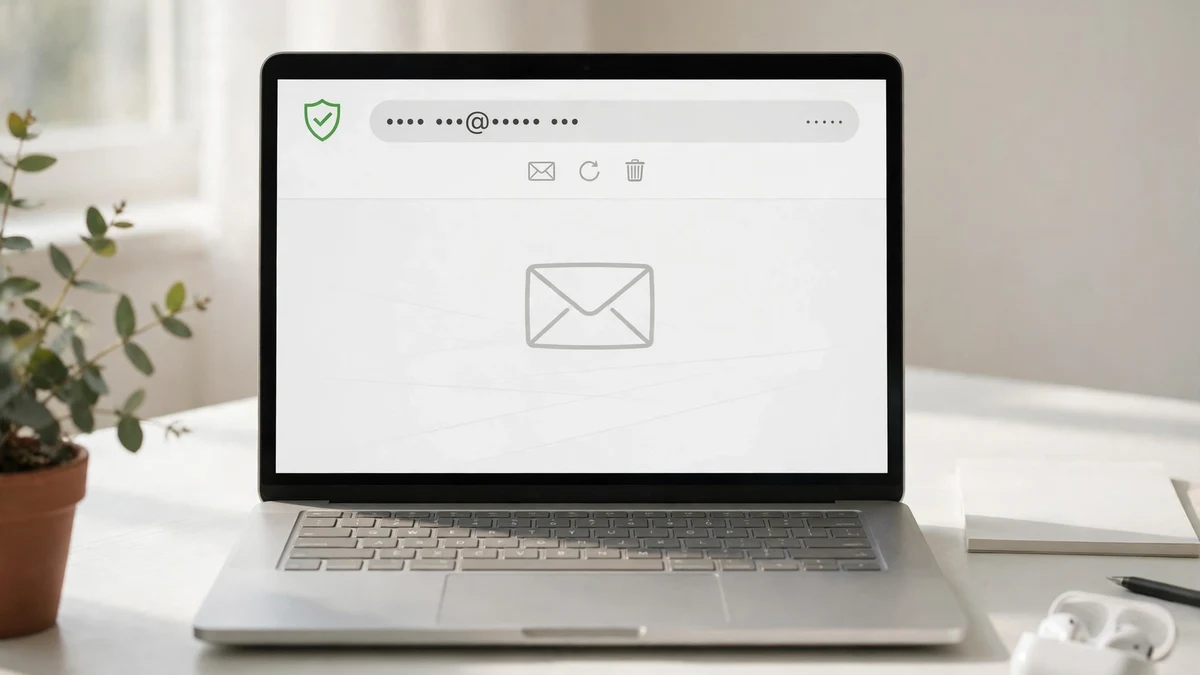
Total time from opening the page to having a working, copyable address: under ten seconds. That is the whole point, and it is also the whole limitation, so let me state both honestly. What the test proves: a disposable address costs nothing, takes seconds, and gives you an inbox you can delete the moment it starts attracting fraud. What it does not prove: I did not test delivery by sending a message to the address, so I am not claiming a measured delivery time. I am claiming the setup, the counters, and the expiry, because those are what I saw on the live page.
Here is why that matters for fraud, specifically. Every signup form that demands your real email is a future fraud vector: the address goes into a database, the database gets breached or sold, and the fraud alert that scares you into clicking arrives at an address you cannot abandon without abandoning your bank, your job, and your family. A disposable address breaks that chain at the first link. If it leaks, you lose nothing — you throw the address away and make a new one. That is not a complete defence. It is a real one, and it is the only defence that works before the fraud starts instead of after it.
Two rules, and they are not negotiable. First, never use a disposable address for your bank, your government accounts, or anything where a password reset is the only way back in — an inbox that expires is an account you can never recover. Second, use the disposable address for everything else: trials, newsletters, downloads, one-off accounts, and any form that wants your email before it shows you anything. The line between the two is the line between an account that matters next month and an account that doesn't. If you are not sure which side a signup falls on, it falls on the disposable side until proven otherwise.
If you want to know which disposable services actually work rather than just exist, I tested nine of them live and wrote up the results in the 9 temp mail sites that actually work. If you want the shorter version, 7 free disposable email addresses that actually work in 2026 covers the same ground. And if you are not sure what a burner address even is, what a burner email is explains the idea in plain terms — including the cases where you should never use one.
The Five Frauds Reaching Inboxes This Week
Not a generic taxonomy. These are the five frauds that are actually moving right now, in the order the data puts them:
1. The fake fraud alert. The most reported pattern of 2026, and the one this article is built around. A message claiming suspicious activity, a link or a number inside the message, and a code request at the end. Defence: the sixty-second check above, every single time, with no exceptions for messages that look official.
2. The purchase scam. Up 68% this year, and the reason Fraud Awareness Week collided with Black Friday. A too-cheap product, a social media ad, a checkout page that takes your card and ships nothing. Defence: never buy from a store you found through an ad without checking it separately, and never pay by bank transfer or gift card. A card payment can be charged back. A wire transfer cannot.
3. Impersonation and investment fraud. Imposter scams were the most reported category of 2025, with more than a million reports to the FTC, and investment scams account for roughly half of all reported losses. The new version uses AI voices and images to impersonate executives and lawyers — the $129 million scheme charged last week. Defence: any investment opportunity that arrives by message, from a stranger, with urgency attached, is fraud until proven otherwise by an independent check you initiate yourself.
4. OTP theft. The one-time password is the last lock on most accounts, and fraudsters have learned to simply ask for it. The flight-ticket fraud and the dating-app investment fraud both turned on codes the victim read out. Defence: a code is never shared, with anyone, for any reason, including someone claiming to be your bank. If a real bank needs to verify you, it will ask you to verify yourself in its app, not to read a code aloud.
5. The fake invoice and business email compromise. The quietest fraud and the most expensive per victim. An email that looks like it comes from a supplier, a boss, or a client, with changed payment details and a deadline. ACFE's estimate — 5% of organisational revenue lost to fraud — is mostly this. Defence: any change of payment details gets confirmed by a second channel you already trust, a phone number you already have, not a number from the email. If the email says "don't call the old number", that is the fraud talking.
One thread runs through all five: the fraud arrives as a message, and the message arrives at an address you gave away. Testing how one-time codes actually behave — email, SMS, and authenticator, three ways — is worth doing before you need it, because the day a fraudster asks for your code is not the day to learn how codes work.
The First Ten Minutes After You Click
Most fraud guides end with "be careful". That is useless advice after the fact, so here is the ten-minute version for the moment you realise you clicked, replied, or paid:
First, stop. Do not click anything else, do not reply, do not "confirm" anything. Close the tab or the message. Second, if you entered a password, change it now, from the real site, and turn on multi-factor authentication while you are there. Third, if you entered card details, call your bank on the number printed on the card — not any number from the message — and tell them what happened. A card can be frozen in a minute; a fraudulent charge can be disputed, but only if the bank hears about it fast. Fourth, if you sent money by bank transfer or gift card, call the bank and the police immediately; recovery is unlikely but not impossible in the first hours, and it becomes impossible after a day. Fifth, report it: in the US, ReportFraud.ftc.gov, and the FTC's phone line is 1-877-382-4357. Reporting matters even when the money is gone, because the FTC's numbers — the 3 million reports, the $15.9 billion — are the reason anyone is paying attention this week at all. Your report is part of the dataset that makes the next warning possible.
Then do the boring part, which is the part that actually protects you next time. Check which address the fraud reached you at. If it was your real address, ask yourself where you gave it away, and start giving the next ten signups a disposable one instead. The fraud economy runs on real addresses that cannot be abandoned. An address you can throw away is the cheapest security upgrade that exists.
FAQ
What is fraud?
Fraud is deception for financial gain: someone tricks you into giving them money, or into giving them information that lets them take it. The most common forms today are phishing emails, fake fraud alerts, purchase scams, impersonation scams, and investment fraud. The FTC received 3 million fraud reports in 2025, with $15.9 billion in reported losses.
Why is "fraud" trending right now?
Because it is International Fraud Awareness Week, November 15–21, 2026, and the week coincided with fresh numbers: the FBI's Internet Crime Complaint Center reported $20.87 billion in fraud losses for 2025, Bank of Ireland reported purchase scams up 68%, and the start of the Christmas shopping season put purchase scams in front of millions of shoppers at once.
Is a fraud alert text or email real?
Sometimes. A real alert uses your name, names a specific transaction with an amount and a merchant, comes from a sender you recognise, and tells you to open the bank's app or call the number on your card. A fake one is vague, urgent, uses a generic greeting, and gives you a link or a number inside the message. Never use a link or number from inside an alert — open the app yourself.
Should I ever share a one-time code?
No. Never, with anyone, for any reason. No bank, no delivery company, no government agency will ask you to read back a one-time code. The moment anyone asks for your code, the conversation is fraud.
Can a disposable email address protect me from fraud?
Partly, and honestly. It protects you from the first step — it stops fraudsters from getting your real address from signup forms, breaches, and sold lists, and an address that leaks can be thrown away. It does not protect you from clicking a link in a message that reaches your real inbox, and it must never be used for your bank or any account where losing the inbox means losing the account.
How do I report fraud?
In the US, report it at ReportFraud.ftc.gov or call the FTC at 1-877-382-4357. Also tell your bank immediately if money or card details were involved, and keep the messages, receipts, and transaction details — they support the investigation.
The Bottom Line
Fraud is trending because the numbers got worse faster than the warnings did: $20.87 billion in reported losses in a year, up 430% since 2020, with two thirds of victims paying within a day of first contact. The guides ranking for "fraud" will tell you to be careful. I would rather tell you to be unreachable — or at least, to be unreachable at the address that matters. Give the internet a disposable address, keep your real one for the five accounts that actually need it, and run the sixty-second check on every alert that claims your money is in danger. That is not everything. But it is the part that works before the fraud starts, and right now, in Fraud Awareness Week, that is the part worth doing today.
Need a disposable temporary email?
Protect your real inbox from spam and promotional clutter instantly and free.
Received a suspicious email, text, or charge alert?
Verify whether the sender domain is disposable, spoofed, or unverified before clicking links.