


Understanding the Truth Behind Clarity Blue Glasses
Are Clarity Blue Glasses a scam? Based on the research, here's what you need to know:
Quick Answer:
- The automatic vision adjustment claim (100-700 diopters) is scientifically implausible and not supported by established optometry practices
- Blue light blocking for eye strain is not backed by scientific evidence - the American Academy of Ophthalmology does not recommend these glasses
- The aggressive discount structure (50-60% off) and limited-time pressure tactics are common red flags in questionable product marketing
- Real eye strain comes from reduced blinking, not blue light - making these glasses ineffective for their main advertised purpose
Bottom Line: While Clarity Blue Glasses may not be an outright scam with fake products, their marketing makes scientifically unsupported claims that mislead consumers about what the glasses can actually do.
If you've seen ads for Clarity Blue Glasses promising to automatically adjust to your vision and protect you from harmful blue light, you're probably wondering if they're too good to be true. The short answer? They are.
The product makes two major claims that don't hold up under scrutiny. First, the idea that glasses can automatically adjust from 100 to 700 diopters is not how corrective eyewear works. Second, multiple studies and eye health organizations confirm that blue light blocking glasses don't reduce digital eye strain.
The real problem isn't blue light - it's that we blink less when staring at screens. This causes dry eyes, which leads to the discomfort people attribute to blue light. No special glasses can fix that.
The marketing also uses classic pressure tactics: steep discounts, limited-time offers, and vague claims about "verified reviews." These are warning signs that the product relies more on persuasion than performance.
I'm Mohammad Waseem, and I've spent years analyzing online products and marketing tactics as a tech-focused web creator. When researching are Clarity Blue Glasses a scam, I found the gap between their scientific claims and actual eye health research was too significant to ignore.
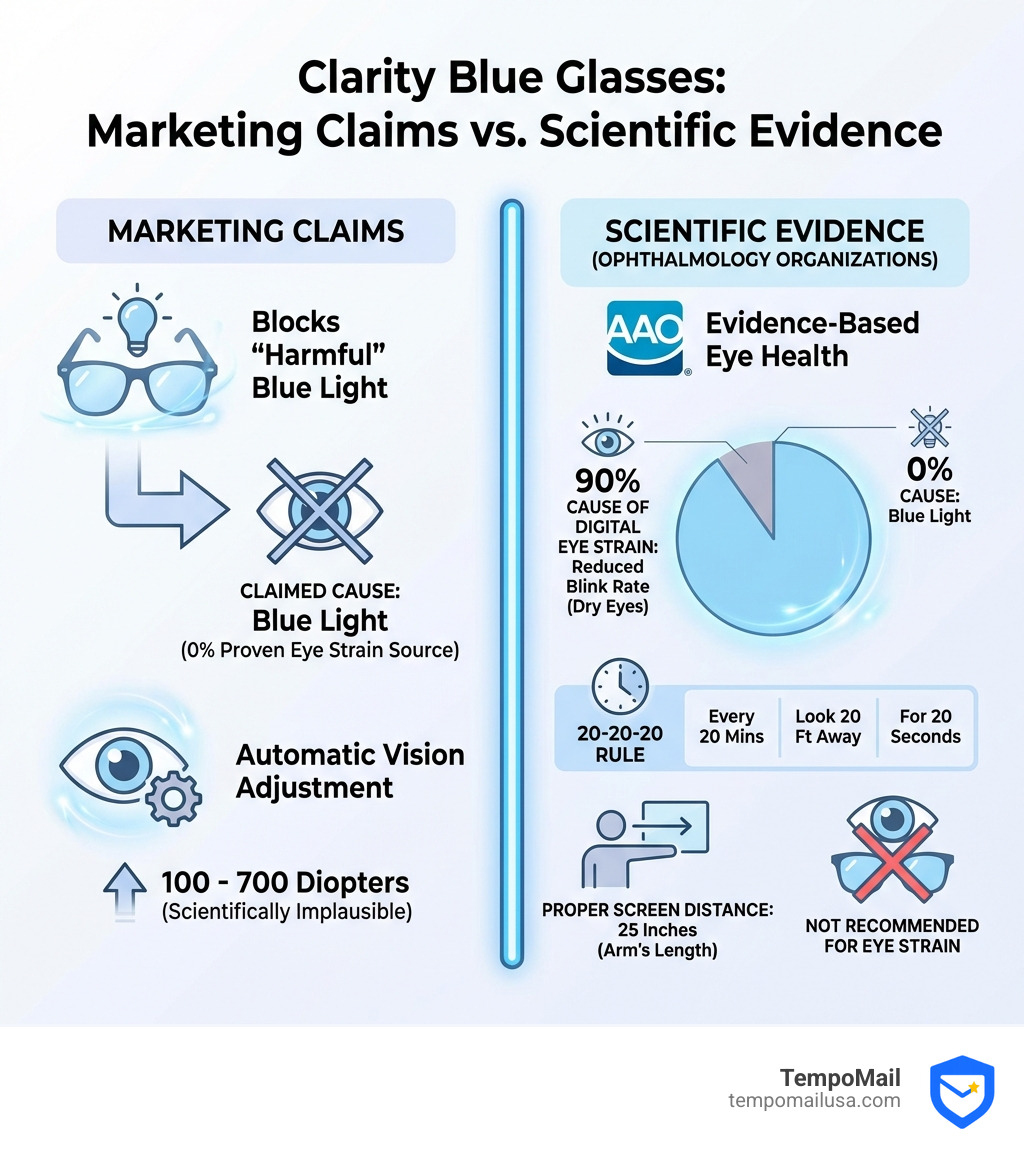
Analyzing the Claims: Are Clarity Blue Glasses a Scam?
When we encounter products like Clarity Blue Glasses, it's easy to get swept up in the promises of effortless vision and ultimate eye protection. Their marketing materials paint a picture of a product, claiming "Clarity Blue Glasses: Revolutionize Your Sight – Clarity Blue Glasses Adapt to You" and boasting an "Effortlessly Adapting to Your Vision Needs" subtitle. They even promote a "New & Improved 2025 Model" with "3,758 Verified Customer Reviews" and "Over a million users worldwide." Sounds impressive, right?
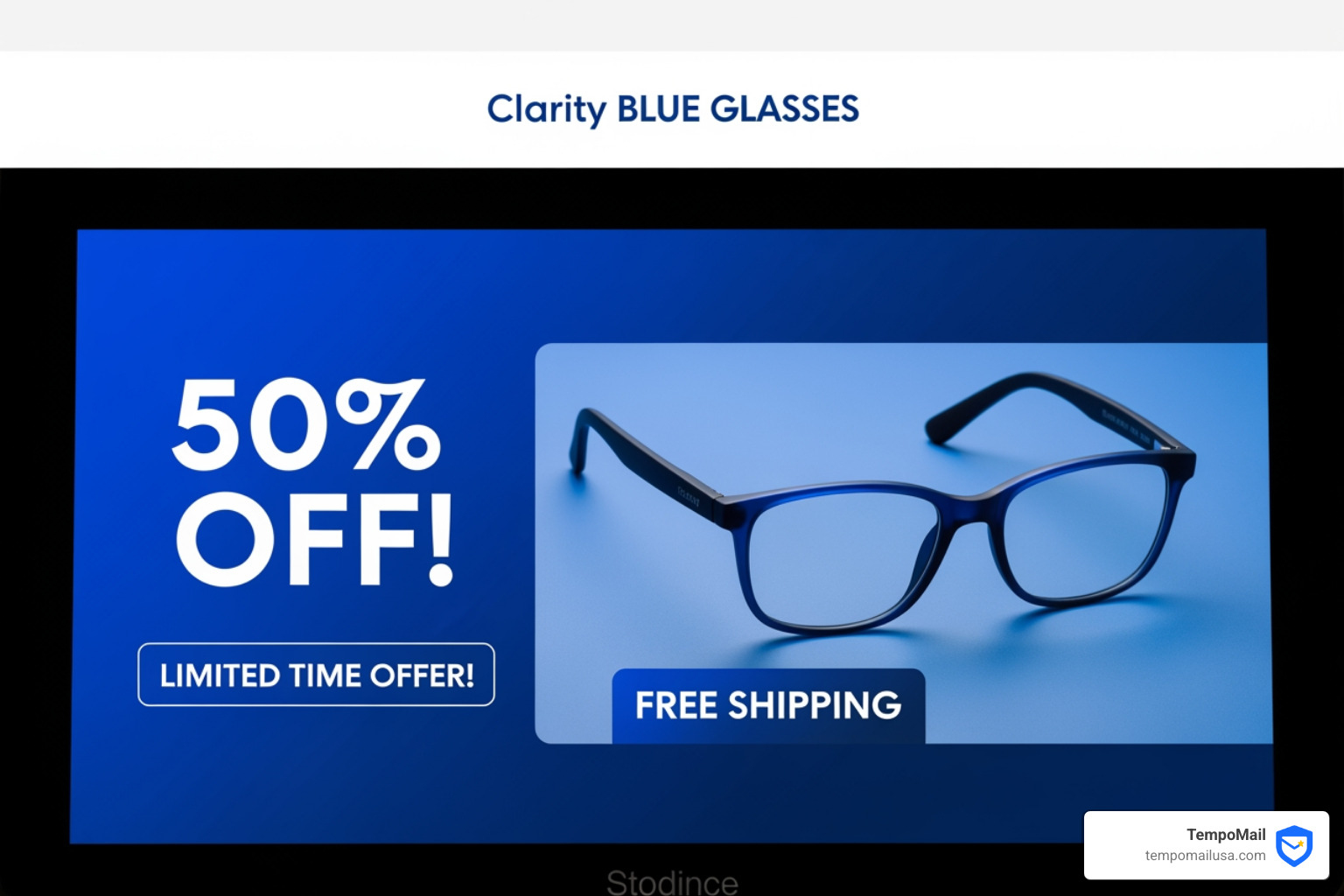
However, when we peel back the layers, we find that the core claims of Clarity Blue Glasses—specifically the automatic vision adjustment from 100 to 700 diopters and comprehensive blue light protection—are the central points of contention. These are bold assertions that immediately raise eyebrows among eye care professionals and anyone familiar with optics. The marketing tactics employed, such as highlighting numerous "verified reviews" and presenting a constant stream of "limited time offers" and "50% OFF + FREE SHIPPING" deals, are common strategies used to create a sense of urgency and social proof. While reviews can be helpful, it's always wise to look for independent, critical assessments rather than relying solely on those curated by the seller. Just as we'd approach other online claims, like those discussed in our article Is Finelo Legit or a Scam? Ultimate Checklist, a healthy dose of skepticism is key.
Are Clarity Blue Glasses a scam or medically approved?
The question of whether Clarity Blue Glasses are a scam often boils down to medical approval and scientific backing. Do ophthalmologists and reputable eye health organizations give these glasses a thumbs up? The short answer is a resounding "no" when it comes to the claims of blue light protection for eye strain and automatic vision adjustment.
Our research clearly shows a significant disconnect between marketing claims and established medical consensus. The American Academy of Ophthalmology (AAO) explicitly "does not recommend blue light-blocking glasses because of the lack of scientific evidence that blue light is damaging to the eyes." This stance is echoed in multiple studies, with findings suggesting that blue light-blocking glasses "do not improve symptoms of digital eye strain." This isn't just one dissenting voice; it's a consistent message from leading experts and organizations dedicated to eye health.
The idea of "automatic vision adjustment" to cover a massive range of diopters (100-700) is particularly problematic from a medical standpoint. Traditional corrective lenses work by precisely altering how light enters the eye to focus it correctly on the retina. Achieving this across such a broad spectrum, automatically and without any user input or complex mechanics, simply isn't feasible with current, widely available optical technology. This claim falls firmly into the field of marketing fantasy rather than medical reality. While the product might exist physically, its claims lack the medical approval and scientific plausibility that would deem it a legitimate solution for the problems it purports to solve.
How to tell if Clarity Blue Glasses are a scam based on pricing?
The pricing and discount structure of Clarity Blue Glasses is another element that warrants a closer look when trying to determine if are Clarity Blue Glasses a scam. We've seen sales pages offering steep discounts, often ranging from "50% OFF" to "60% OFF," sometimes even higher for bulk purchases. These offers are frequently accompanied by phrases like "LIMITED TIME ONLINE OFFER!" or "Get Your Item Now, Before Supplies Run Out..."
This aggressive sales strategy, characterized by significant markdowns and a manufactured sense of urgency, is a classic marketing tactic often employed by products with questionable underlying value. When a product is consistently sold at a deeply discounted price, it can indicate that the original "full price" was artificially inflated to make the discount seem more appealing. It's a psychological trick designed to make consumers feel like they're getting an incredible deal, prompting impulse purchases.
While not inherently indicative of a scam on its own, when combined with scientifically implausible claims and a lack of medical endorsement, this pricing model becomes a red flag. Legitimate, high-value optical products typically maintain more consistent pricing and rely on scientific efficacy and brand reputation rather than perpetual, high-percentage discounts. Our previous investigations into other online deals, such as Is Temu a Scam Site? Uncover the Truth Today, highlight how these pricing strategies can be part of a broader approach to consumer engagement that prioritizes sales over transparency.
The Science of Blue Light and Digital Eye Strain
Let's explore the actual science behind blue light and how it affects our eyes, because this is where the narrative around blue light glasses often gets cloudy. Blue light is a part of the visible light spectrum, and it's naturally present in sunlight. In fact, natural blue light exposure during the day is crucial for regulating our circadian rhythm, boosting our mood, attention, and reaction times. It helps tell our bodies when it's daytime and when it's time to be awake.
The concern arises with blue light emitted from digital screens (computers, phones, tablets). While these screens do emit blue light, the amount is significantly less than what we're exposed to from the sun. Despite marketing claims suggesting otherwise, there is "no scientific evidence that the light coming from computer screens is damaging to the eyes." Furthermore, a study reprinted by the National Library of Medicine found "no measurable UVA or UVB radiation (the most harmful part of light) from computer screens."
So, if blue light isn't the villain, what's causing all that discomfort we feel after hours of screen time? The most likely culprit is a phenomenon called digital eye strain, and its primary cause isn't blue light, but rather a significantly "reduced blink rate" when we focus intently on screens. We tend to blink less frequently and less completely, leading to dry eyes, irritation, and discomfort. This can manifest as tired, irritated, and uncomfortable eyes.
This understanding is critical because it fundamentally shifts the conversation away from blue light and towards behavioral and environmental factors. As our research indicates, "Several studies suggest that blue light-blocking glasses do not improve symptoms of digital eye strain." The American Academy of Ophthalmology (AAO) maintains its stance against recommending blue light-blocking glasses precisely because of this lack of scientific evidence.
Placebo effect in blue light eyewear
It's fascinating how our minds work, isn't it? When we truly believe something will help us, sometimes it does, even if there's no inherent scientific mechanism at play. This is known as the placebo effect, and it might be a significant factor in why some people report feeling better when wearing blue light glasses.
As one of our sources points out, "For those who think they do notice a difference while wearing them, it could just be a placebo effect." The desire for relief from eye strain is strong, and if a product promises to deliver it, our brains can sometimes trick us into perceiving an improvement. This doesn't mean the discomfort wasn't real; it simply means the relief experienced might be more psychological than physiological, unrelated to the blue light filtering itself.
The marketing for Clarity Blue Glasses, with its emphasis on "clearer vision and less fatigue," taps directly into this desire for relief. If you invest in a product with the expectation of feeling better, and you focus on that expectation, you might genuinely experience a perceived reduction in symptoms, even if the glasses aren't doing what they claim scientifically. This is a common phenomenon that makes it challenging to objectively assess product effectiveness without rigorous, blinded scientific studies.
Real causes of screen-related fatigue
Now that we've debunked the blue light myth as the primary cause of screen-related fatigue, let's talk about what actually causes it and, more importantly, what we can do about it. The real culprits are often surprisingly simple and behavioral.
First and foremost, as we've discussed, is the "reduced blinking" rate. When we're interested in a screen, our blink rate can drop by as much as 50%, leading to dry, irritated eyes. Think about it: a car's windshield wipers work constantly to keep the glass clear; your eyelids do the same for your eyes!
Other significant factors include:
- Improper screen distance and angle: Sitting too close or having your screen positioned incorrectly can strain your eye muscles. Experts recommend sitting about "25 inches (arm's length) from the computer screen" and positioning it so you are gazing slightly downward.
- Poor lighting and glare: Excessive brightness, reflections, or glare on your screen can force your eyes to work harder. Adjusting room lighting, increasing screen contrast, and using a matte screen filter can help.
- Uncorrected vision problems: An outdated prescription or an underlying vision issue can be exacerbated by screen use. Ensuring your eyeglass prescription is up-to-date is a simple yet effective step.
- Infrequent breaks: Staring at a fixed distance for prolonged periods fatigues the eye muscles.
The good news is that the solutions are often free or low-cost and don't involve special glasses. The "20-20-20 rule" is a widely recommended best practice: "every 20 minutes, look at an object at least 20 feet away for at least 20 seconds." This simple act helps reset your focus and encourages blinking. Using artificial tears when eyes feel dry, adjusting your workspace ergonomics, and taking regular breaks are all scientifically-backed ways to alleviate digital eye strain.
The goal is to address the root causes of eye fatigue, not to rely on products that offer solutions to problems that may not exist.
Evaluating the "Automatic Vision Adjustment" Technology
This is perhaps the most audacious claim made by Clarity Blue Glasses: "EFFORTLESSLY ADAPTING TO YOUR VISION NEEDS" with an "automatic vision adjustment" that spans from "100 to 700 diopters." Let's be clear: this claim is scientifically implausible with current consumer-grade technology.
To understand why, consider how traditional prescription glasses work. Each lens has a fixed optical power (measured in diopters) designed to correct a specific refractive error, such as nearsightedness, farsightedness, or astigmatism. Progressive lenses offer multiple prescriptions in one lens, but they still require precise measurements and a fixed design. Adjustable focus glasses exist, but they typically involve manual adjustment (e.g., sliding lenses) or complex, expensive electronic components, and even then, they don't cover such a vast, continuous range automatically and seamlessly in a lightweight, affordable frame.
The idea that a single, passive pair of glasses can automatically and continuously adjust its optical power across such a wide "diopter range" (from 100 to 700, which is an enormous range in optical terms) is akin to magic, not science. It suggests that the lenses can dynamically change their curvature or refractive index in real-time to perfectly match any individual's vision needs at any distance. This level of technology, if it existed in a consumer product, would be and would be heralded by the scientific community, not just advertised on a sales page.
Therefore, we can confidently conclude that the "automatic vision adjustment" claim is a marketing tactic designed to appeal to a broad audience tired of multiple pairs of glasses or changing prescriptions. It's a promise that sounds convenient but lacks any basis in established optical science. When considering such grand claims, it's always helpful to compare them against what we know to be true, much like how we would approach other seemingly too-good-to-be-true offers, such as those sometimes found when Uncovering Crestwood Loan.
Risks of self-adjusting eyewear
Relying on products that claim "automatic vision adjustment" like Clarity Blue Glasses carries significant risks, primarily because they can lead to neglecting proper eye care. Our eyes are complex organs, and their health is paramount.
Firstly, if you have a genuine refractive error (nearsightedness, farsightedness, astigmatism), you need an accurate, professionally prescribed lens to correct it. "Prescription accuracy" is crucial for clear vision and preventing further strain or worsening of conditions. Self-adjusting eyewear, especially with such a vague and scientifically dubious adjustment range, cannot provide this precision. It might offer a generalized "better" view for some, but it won't correct specific vision problems optimally.
Secondly, relying on such glasses can cause you to "neglect eye health" in a broader sense. Regular eye exams aren't just about updating your prescription; they are vital for detecting serious eye conditions like glaucoma, cataracts, or diabetic retinopathy, often before symptoms become noticeable. An optometrist or ophthalmologist checks the overall health of your eyes, not just your vision. If you believe a pair of glasses can handle "all your vision needs" and negate the need for professional check-ups, you might miss early warning signs of potentially blinding diseases.
Finally, these glasses fail to address the "root causes" of eye strain. As we've established, digital eye strain is largely behavioral. By putting on these glasses and expecting a magical fix, you might overlook the crucial steps like taking breaks, adjusting screen distance, or using artificial tears, which are genuinely effective. This reliance on an unproven product can create a false sense of security, potentially leading to more discomfort and even delaying necessary medical intervention for underlying eye issues.
Long-term effects of blue light exposure
The marketing for Clarity Blue Glasses often implies that they offer "genuine protection" against the "long-term effects of blue light exposure," hinting at serious damage to our eyes. This taps into common anxieties about screen time. However, the scientific community's understanding of blue light's long-term effects, especially from digital screens, is far less definitive than these claims suggest.
While blue light in general (particularly from the sun) can contribute to retinal damage over a lifetime, the amount of blue light emitted from digital screens is very small and has not been definitively linked to eye disease or long-term vision damage. The American Academy of Ophthalmology states, "There is no scientific evidence that the light coming from computer screens is damaging to the eyes."
The main concern regarding blue light and long-term effects revolves around its impact on the "circadian rhythm" and melatonin production, particularly from excessive exposure to any light source in the evening. Disrupting this natural sleep-wake cycle can lead to sleep problems, which in turn can have broader health implications. However, even here, the primary advice from experts is to reduce screen time before bed or use "night mode" settings on devices, which shift colors to warmer tones, rather than relying on blue light blocking glasses.
A comprehensive Cochrane review on blue light-blocking lenses concluded that "it is currently unclear whether blue‐light filtering spectacle lenses affect visual performance, sleep quality, or macular health." This means there isn't enough high-quality evidence to support the claims of genuine protection against long-term eye damage from screen-emitted blue light. While "vision protection" is important, Clarity Blue Glasses are solving a problem that isn't proven to exist in the way they market it.
Frequently Asked Questions about Clarity Blue Glasses
When considering a purchase, especially one with such bold claims, customers naturally have many questions. Let's address some common ones about Clarity Blue Glasses, keeping our scientific and skeptical hats firmly on.
The sales pages often highlight features like a "30-day money-back guarantee" and "one-year warranty," alongside promises of excellent "customer support." While these sound reassuring, the effectiveness of such guarantees often depends on the responsiveness and reliability of the company behind the product. It's always wise to investigate independent reviews about a company's return process and customer service, rather than solely relying on their own promotional material.
Do Clarity Blue Glasses actually work for eye strain?
Based on the overwhelming consensus from ophthalmologists and scientific research, the answer is no, Clarity Blue Glasses do not actually work for eye strain in the way they are marketed. As we've extensively discussed, "several studies suggest that blue light-blocking glasses do not improve symptoms of digital eye strain." The primary cause of eye strain from screens is a reduced blink rate leading to dry eyes, coupled with factors like improper screen distance, glare, and uncorrected vision. Blue light itself from screens is not proven to be harmful or a significant contributor to eye strain. Any perceived benefits are most likely due to the placebo effect or simply taking more breaks while wearing them.
Can Clarity Blue Glasses replace my prescription?
Absolutely not. This is a crucial point for anyone considering these glasses. Clarity Blue Glasses' claim of "automatic vision adjustment from 100 to 700 diopters" is not a substitute for a professionally determined and prescribed corrective lens. An optometrist or ophthalmologist performs a comprehensive eye exam to accurately diagnose your specific refractive error and prescribe lenses that precisely correct your vision. This ensures optimal clarity and comfort. Relying on a generic, "self-adjusting" pair of glasses in place of your actual prescription can lead to ongoing eye strain, headaches, and potentially mask underlying vision problems that require professional attention. It's vital to prioritize regular eye exams and prescribed eyewear for genuine vision correction.
Are there better alternatives to Clarity Blue Glasses?
Yes, absolutely! There are several scientifically-backed, effective, and often free or low-cost alternatives to alleviate digital eye strain and maintain eye health, especially when compared to unproven products like Clarity Blue Glasses:
- The 20-20-20 Rule: Every 20 minutes, look at something 20 feet away for 20 seconds. This simple practice helps relax your eye muscles and encourages blinking.
- Optimize Your Workspace: Position your screen about 25 inches (an arm's length) away and slightly below eye level. Adjust screen brightness to match your room's lighting and reduce glare.
- Take Regular Breaks: Step away from your screen periodically. Get up, stretch, and give your eyes a rest.
- Use Artificial Tears: If you experience dry eyes, over-the-counter lubricating eye drops can provide significant relief.
- Ensure Correct Prescription: Get regular eye exams to ensure your eyeglasses or contact lens prescription is up-to-date. Uncorrected vision is a major contributor to eye strain.
- Manage Blue Light Naturally: If you're concerned about blue light affecting your sleep, activate "night mode" on your devices in the evening or reduce screen time 2-3 hours before bed. This is more effective than unproven blue light glasses.
These alternatives address the actual causes of digital eye strain and are recommended by leading eye health organizations.
Conclusion
So, after a thorough investigation, what's our final verdict on the question: are Clarity Blue Glasses a scam? While they may not be a scam in the sense of being a completely fake product that never arrives, their marketing makes claims that are scientifically unsupported and misleading. The promises of "automatic vision adjustment" across a vast diopter range and effective blue light blocking for eye strain simply do not hold up under scrutiny from ophthalmological experts and available research.
We've seen that the primary causes of digital eye strain are behavioral—like reduced blinking leading to dry eyes—not harmful blue light from screens. The aggressive discount structures and urgent sales tactics further raise red flags, characteristic of products that rely more on persuasion than proven efficacy.
Investing in Clarity Blue Glasses means buying into claims that lack scientific backing. For genuine "eye health" and relief from screen-related fatigue, we strongly recommend adhering to practices that are proven to work: regular eye exams, proper screen ergonomics, the 20-20-20 rule, and addressing symptoms like dry eyes with artificial tears. Don't let marketing hype overshadow genuine eye care.
Just as we advocate for vigilance in protecting your personal information online, as highlighted in our Is TesterUp a Scam? Survival Guide, we also urge caution when it comes to products making extraordinary health claims without scientific evidence. Your vision is too precious to leave to chance or unproven solutions.
For a truly secure online experience, and to protect your digital identity from misleading claims and potential data breaches, we at TempoMail are here to help. Protect your data with TempoMail and ensure your online presence is as clear and secure as your vision should be.