



Data Breaches Are More Common — and More Costly — Than Most People Realize
Data breaches happen when sensitive or confidential information is accessed, stolen, or exposed without authorization. That could mean your email address, Social Security number, credit card details, or medical records ending up in the hands of someone who was never supposed to see them.
Here's a quick snapshot of what you need to know:
| What | Detail |
|---|---|
| What is a data breach? | Unauthorized access to or exposure of sensitive personal or organizational data |
| How common are they? | Thousands occur every year across every industry |
| Biggest breach ever | National Public Data (2024): 2.9 billion records exposed |
| Average global cost | USD 4.44 million per incident (IBM, 2025) |
| Who's most at risk? | Everyone — but healthcare and finance are hit hardest |
| What do attackers do with data? | Sell it, use it for identity theft, or commit financial fraud |
The scale of the problem is staggering. According to IBM's Cost of a Data Breach 2025 report, the global average cost of a single breach has reached USD 4.44 million. In the United States, that figure balloons to over USD 10 million. And those numbers don't capture the personal damage — the stolen identities, drained accounts, and years spent cleaning up the mess.
Every time you hand over your real email address or personal details to a website or app, you're trusting that organization to keep your information safe. Most of the time, that trust is misplaced.
This guide covers history's most significant data breaches, why they happen, what attackers do with your information, and what you can do to protect yourself.
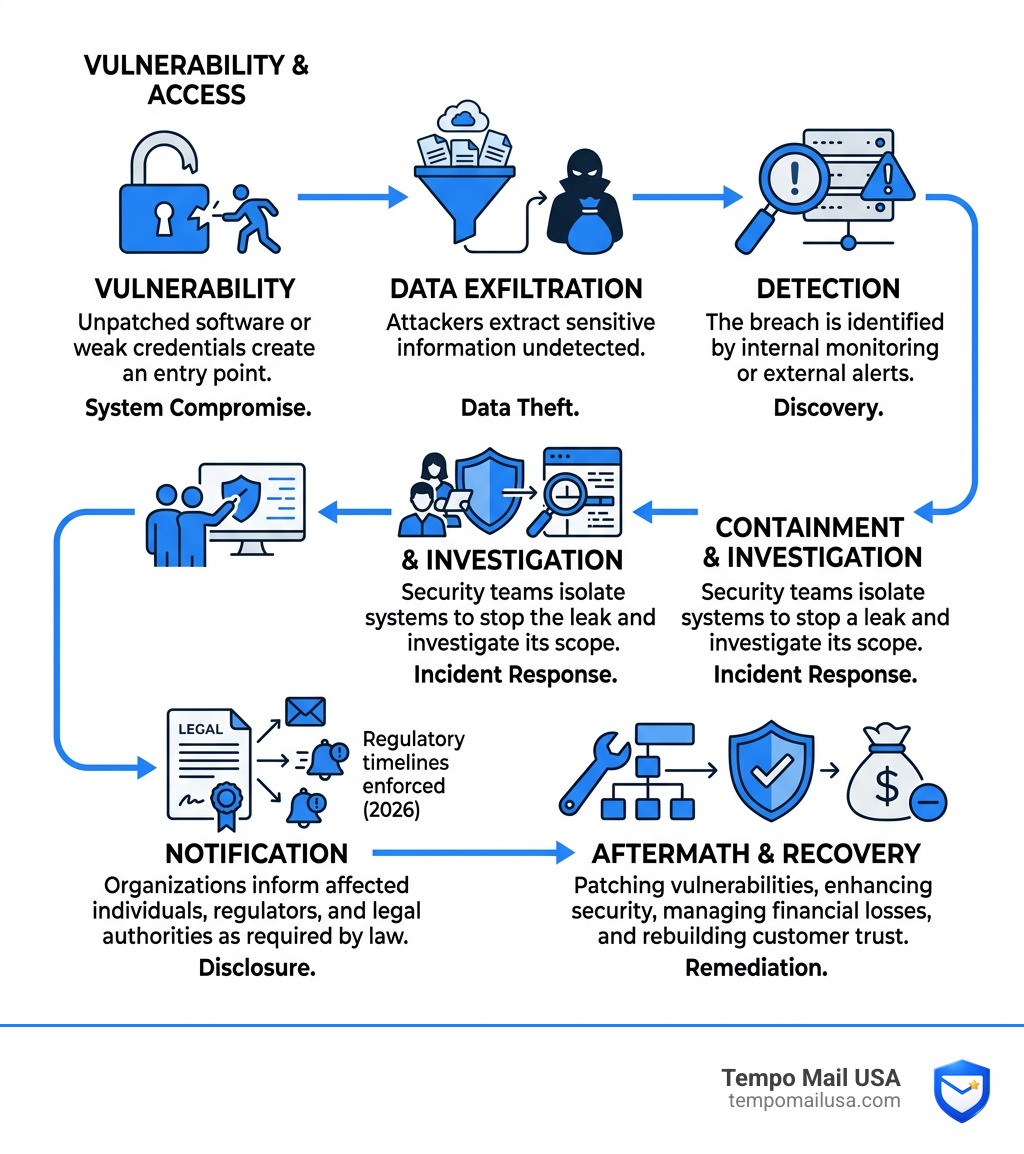
Defining Data Breaches and Their Massive Global Costs
When we talk about data breaches, we are looking at a security incident where confidential information is stolen, leaked, or accessed by unauthorized parties. While we often picture a hooded hacker in a dark room, many breaches are actually the result of simple accidents, like an employee leaving a database unprotected or a server misconfiguration.
The financial toll of these incidents is rising every year. According to the Latest research on the cost of a data breach, the global average cost is now USD 4.44 million. However, this is just the average. If you are operating in the United States, the stakes are much higher, with the average cost skyrocketing to USD 10.22 million—roughly four times the cost of a breach in India.
The industry most under fire is healthcare. For the 14th consecutive year, healthcare has seen the highest average breach costs, reaching USD 7.42 million in 2025. This is largely because medical records contain "permanent" PII (Personally Identifiable Information) like Social Security numbers and health histories that can't be changed like a credit card number.

The Financial Impact of Modern Data Breaches
Breaking down the millions of dollars lost in a breach reveals a complex web of expenses. It isn’t just about a one-time fine; it’s a long-term financial drain.
- Lost Business and Reputation: This is often the biggest hit, averaging USD 1.38 million. When customers lose trust, they take their wallets elsewhere.
- Detection and Escalation: Finding the breach and figuring out the "who, what, and how" costs organizations an average of USD 1.47 million.
- Post-Breach Expenses: Legal fees, settlements, and regulatory fines add up to about USD 1.20 million.
- Notification Costs: Even the simple act of telling victims their data was stolen costs an average of USD 390,000.
For a deeper dive into how these costs manifest in specific sectors, you can read more about hciactive-data-breach-explained-what-you-need-to-know.
The Hall of Shame: History’s Most Significant Incidents
Some data breaches are so massive they change the way we think about digital privacy forever. These aren't just "glitches"; they are catastrophic failures of security.
| Entity | Year | Records Affected | Primary Method |
|---|---|---|---|
| National Public Data | 2024 | 2.9 Billion | Hacked / Exposed |
| Yahoo | 2013-14 | 3 Billion | State-sponsored Hack |
| Marriott (Starwood) | 2018 | 500 Million | Long-term unauthorized access |
| 2019 | 419 Million | Unprotected Server | |
| Equifax | 2017 | 143 Million | Unpatched Vulnerability |
The National Public Data breach in 2024 is a terrifying example of how centralized our data has become, with nearly 3 billion records—including names and SSNs—reportedly exposed. Yahoo remains a legend in the "hall of shame" because it took years for the company to admit that every single one of its 3 billion accounts had been compromised.
If you want to see how these incidents look on a global scale, check out this Interactive map of the world’s biggest data breaches.
What Attackers Do With Stolen Data
You might wonder, "Why does a hacker want my old email address?" The truth is that your data is a commodity. On the dark web, "fullz" (complete sets of PII) are sold to the highest bidder.
Once an attacker has your information, they can:
- Commit Identity Theft: Open new credit lines or take out loans in your name.
- Credential Stuffing: Since many people reuse passwords, attackers use your leaked email and password to try and log into your bank or Amazon account.
- Targeted Phishing: They use your personal details to craft "spear-phishing" emails that look incredibly convincing.
It is vital to stay proactive. We recommend you Check if your email is on the dark web to see if your credentials have already been leaked.
Why They Happen: The Main Causes of Vulnerability
Data breaches rarely happen because of one single "super-hacker." Most of the time, it’s a combination of poor digital hygiene and technical oversight.
- Hacking and Malware: This remains the top cause. Attackers find a way into the system using viruses, ransomware, or specialized tools.
- Unpatched Software: The Equifax breach happened because they failed to fix a known flaw in their software. If you don't update, you leave the door unlocked.
- Insider Threats: Sometimes the "bad guy" is already inside. This could be a disgruntled employee or someone who accidentally shares a sensitive file.
- Social Engineering: Phishing is still the most effective way to start a breach. If an attacker can trick one employee into clicking a link, they have the keys to the kingdom.
- Misconfigurations: We see this often with cloud storage. A company puts a database on the web but forgets to set a password, leaving it open for anyone to find.
How AI is Changing the Landscape of Data Breaches
Artificial Intelligence is a double-edged sword in cybersecurity. On one hand, it helps us detect threats faster. On the other, attackers are using it to automate their crimes.
"Shadow AI" is a growing concern. This happens when employees use ungoverned AI tools to process company data, inadvertently feeding sensitive info into public models. Research shows that 97% of organizations with AI-related incidents lacked proper access controls for those systems.
Attackers are also using AI to create "adaptive attacks." They can generate thousands of unique phishing emails in seconds or use AI to find vulnerabilities in code faster than any human could. This makes it more important than ever to use tools that mask your identity. To see how we help, check out how-temporary-emails-protect-you-from-data-breaches.
The Legal Minefield: Notification Laws and Compliance
When a company loses your data, they can't just keep it a secret. There is a complex web of laws designed to protect consumers and ensure transparency.
- CIRCIA: This requires organizations in critical infrastructure to report cybersecurity incidents to the Department of Homeland Security within 72 hours.
- HIPAA: In the healthcare world, the Official HIPAA Breach Notification Rule mandates that organizations notify affected individuals, the Secretary of Health and Human Services (HHS), and sometimes the media if more than 500 records are involved.
- GDPR: If a company handles data for EU citizens, they must report a breach to authorities within 72 hours or face massive fines (up to 4% of global annual turnover).
- State Laws: In the U.S., all 50 states have their own specific notification laws. This makes compliance a nightmare for national companies, who must navigate 50 different sets of rules.
Failure to comply doesn't just lead to fines; it leads to massive legal settlements. You can see this in action by understanding-the-integris-data-security-settlement-process.
Prevention and Response: Securing the Future
How do we stop the bleeding? While no system is 100% unhackable, we can make it so difficult for attackers that they move on to easier targets.
Best Practices for Organizations
- Zero-Trust Model: This is a strategy that assumes everyone—even people inside the network—is a potential threat. You verify every single access request.
- Employee Training: Your staff is your first line of defense. They need to know how to spot a phishing email and why they should never reuse passwords.
- Multi-Factor Authentication (MFA): Adding a second step to the login process stops the vast majority of credential-based attacks.
- Network Segmentation: Don't put all your data in one "room." If a hacker gets into your marketing server, they shouldn't be able to hop over to your payroll database.
How Tempo Mail USA Protects You
At Tempo Mail USA, we believe the best way to protect your PII is to never give it out in the first place. Our temporary email aliases act as a PII firewall. When you sign up for a new service, you use one of our aliases. If that service eventually suffers one of those "embarrassing" data breaches, the hackers get a useless alias, not your real, permanent email address. This prevents them from linking your accounts or targeting you with phishing.
What to Do if You Are a Victim
If you receive a notification that your data was stolen, don't panic, but act quickly.
- Place a fraud alert or credit freeze on your credit reports at Equifax, Experian, and TransUnion.
- Change your passwords immediately—especially if you reused the one from the breached site.
- Check Steps for individuals after a data breach for a tailored recovery plan.
Frequently Asked Questions about Data Breaches
What are the immediate steps an organization should take after a breach?
The first step is to secure the operations. This means taking affected systems offline (but not turning them off, as forensics experts need the data in the RAM) and fixing the vulnerability that allowed the breach. Next, they must assemble a breach response team, preserve evidence, and consult with legal counsel to determine their notification obligations.
Who must be notified after a data breach occurs?
This depends on the jurisdiction and the type of data. Usually, you must notify:
- Law Enforcement: Particularly the FBI or Secret Service.
- Affected Individuals: Usually via mail or email.
- Regulatory Bodies: Like HHS for healthcare or state Attorneys General.
- Credit Bureaus: If Social Security numbers or financial data were exposed.
How can individuals protect themselves from identity theft?
The most effective way is to use a "least privilege" approach to your own data. Don't give out your SSN unless absolutely necessary. Use a password manager to ensure every account has a unique, complex password. Finally, use temporary email services like Tempo Mail USA to shield your real identity from the thousands of websites that are breached every year.
Conclusion
Data breaches are an unfortunate reality of our digital age. From the billion-user hacks at Yahoo to the sensitive document leaks at insurance firms, the "Hall of Shame" is growing every day. The costs are high—not just in dollars, but in the loss of privacy and security for billions of people.
However, we aren't helpless. By understanding the causes of these breaches and adopting a proactive security mindset—like using MFA, freezing your credit, and utilizing PII firewalls—you can significantly reduce your risk. The less data you share, the less there is to steal.
For more information on how we handle your information and why we advocate for minimal data footprints, please see our More info about data retention and deletion policies. Stay safe out there!