



The Claim Registry Scam Link in Voicemail Message: What You Need to Know Right Now
A claim registry scam link in voicemail message is a fraud where scammers leave you a voicemail claiming you have unclaimed money, a pending legal case, or a government benefit waiting — then direct you to click a link or call back a number to "claim" it. It is not legitimate. No real government agency contacts you this way.
Quick answer — what to do:
- Do not click any link mentioned in the voicemail or sent via follow-up text
- Do not call back the number left in the message
- Delete the voicemail immediately
- Report it to the BBB Scam Tracker, FTC at ReportFraud.ftc.gov, or FCC at fcc.gov/complaints
- Verify any real claims about unclaimed money for free at your state treasurer's website or unclaimed.org
These scams are widespread and growing. The BBB Scam Tracker has logged over 800 reports on one variant alone — the "Dan from MyReliefCheck.com" relief check voicemail — with victims across the country receiving nearly identical messages.
The voicemails are designed to feel urgent and official. They use familiar language, spoofed phone numbers that look real, and website names that mimic government portals. That combination makes them surprisingly convincing, even for people who consider themselves scam-savvy.
And the stakes are real. Once you click that link or call back, scammers try to harvest your name, address, Social Security number, and financial details. That information can be used for identity theft, sold to other fraudsters, or used to drain your bank account.
This guide breaks down exactly how these scams work, what the red flags look like, and how to protect your personal information before a scammer ever gets the chance to use it.
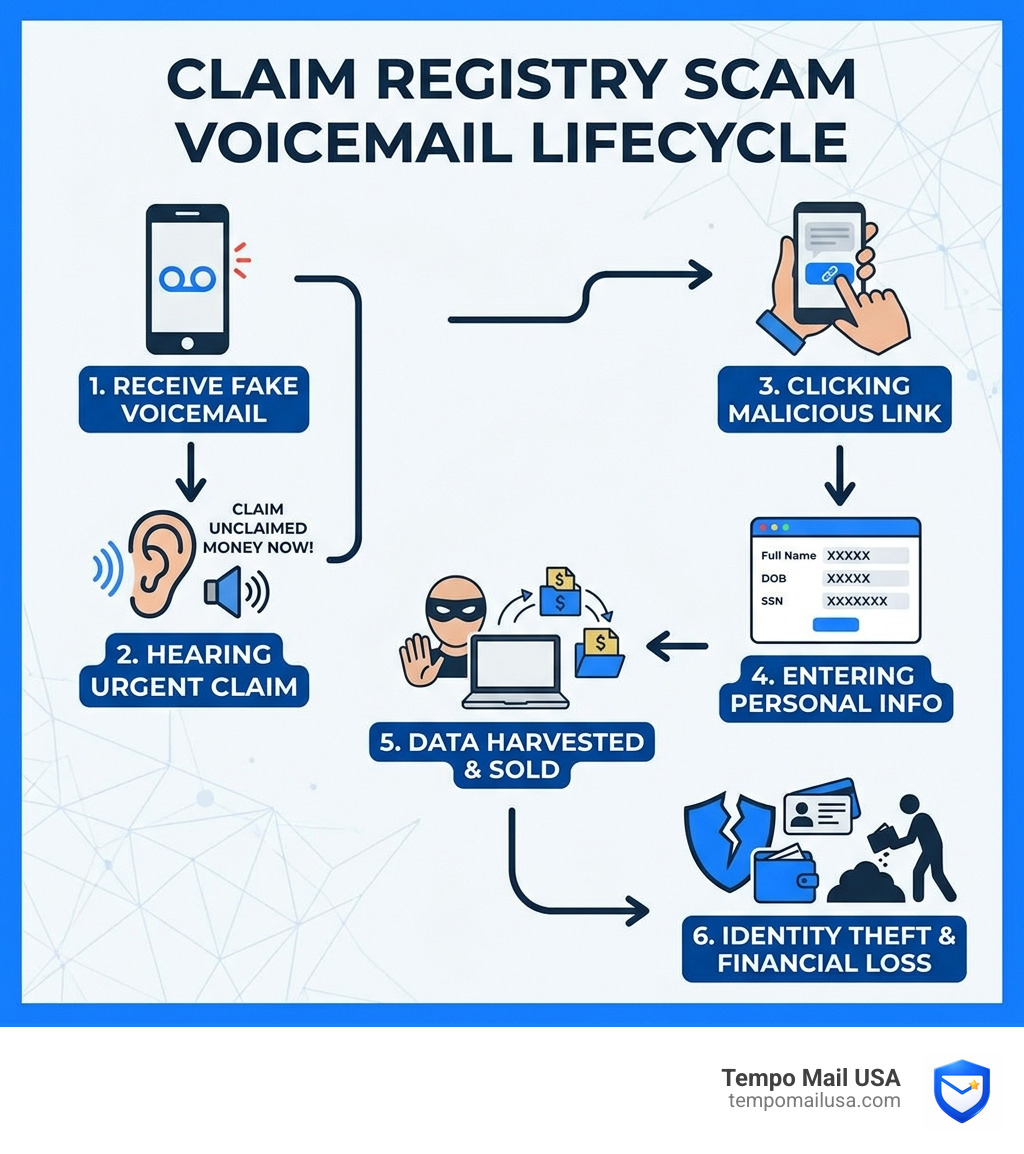
Anatomy of a Claim Registry Scam Link in Voicemail Message
When we look at how these frauds are built, we see a calculated mix of psychological pressure and technical trickery. The claim registry scam link in voicemail message usually follows a specific script. You might hear a friendly, pre-recorded voice like "Dan" from MyReliefCheck.com or "Clara" from DNC Registry Services. These characters aren't real; they are personas designed to lower your guard.
The message typically sounds something like this: "This is Dan from MyReliefCheck. Our records show you have an unclaimed relief check of $5,286 waiting for you. To claim your funds, please visit the US Claim Registry at the link provided in your message."
The "US Claim Registry" Illusion
Scammers often reference a US Claim Registry Scam - Fake Government Notice to make you believe there is a centralized federal database for money owed to you. In reality, no such single federal "registry" exists for general consumer claims. By using official-sounding names, they bridge the gap between a random robocall and a seemingly legitimate government process.
Phishing Links and Credential Theft
The "link" part of the claim registry scam link in voicemail message is where the real danger lies. If you receive a visual voicemail or a follow-up text, the URL often leads to a phishing site. These sites are designed to look identical to government portals or bank login pages. According to researchers, scammers turn to fake voicemail emails to steal personal data by tricking you into entering your email credentials or Social Security number under the guise of "verifying your identity" to release the funds.
Spoofed Numbers
To add another layer of believability, scammers use "spoofing" technology to make your caller ID display a local area code or even the name of a real agency like the IRS or USPTO. This makes it much more likely that you’ll listen to the message rather than dismissing it as spam.

Why Scammers Use a Claim Registry Scam Link in Voicemail Message
You might wonder why scammers bother with voicemails when they could just send an email. The answer lies in the psychology of "vishing" (voice phishing).
- Trust in Voice: We are naturally more inclined to trust a human voice than a block of text. A voicemail feels personal, as if someone specifically took the time to reach out to us.
- High Engagement: People are curious. When we see a missed call and a voicemail notification, our first instinct is to check it. Scammers exploit this habit to get their foot in the door.
- Bypassing Filters: While email providers have become excellent at filtering out spam, voicemail filters are still catching up. A claim registry scam link in voicemail message is more likely to reach your ears than a phishing email is to reach your primary inbox.
- Information Harvesting: Even if you don't fall for the full scam, simply calling back the number confirms that your phone line is active. As noted in the Call Back Voicemail Scam: Why You Should Never Call Unknown Numbers Back | Savi report, this "active" status makes your number more valuable to data brokers, leading to even more scam attempts in the future.
Common Red Flags and Tactics to Watch For
Recognizing a scam is easier when you know the "tells." Scammers almost always rely on three things: fear, greed, or a sense of extreme urgency.
- Extreme Urgency: If the message says you must act "within 24 hours" or your claim will be permanently forfeited, it’s a scam. Real government processes are notoriously slow and involve multiple rounds of paper mail.
- Legal Threats: Claims that you will be arrested, sued, or have your assets frozen are classic red flags. For instance, that voicemail about your IRS balance is a scam if it threatens immediate legal action. The IRS always initiates contact via the U.S. Postal Service first.
- Unofficial Domains: Look closely at the website mentioned. If it ends in .com, .net, or .biz, it is not a government site. Official U.S. government websites almost always end in .gov.
- Generic Greetings: If the voicemail starts with "Dear Citizen" or "To the owner of this number" instead of your actual name, it’s a mass-produced robocall.
Legitimate vs. Scam Communication Comparison
| Feature | Legitimate Communication | Scam Voicemail/Link |
|---|---|---|
| Initial Contact | Official letter via U.S. Mail | Unsolicited voicemail or text |
| Website Domain | Ends in .gov (e.g., treasury.gov) | Ends in .com or .net (e.g., myreliefcheck.com) |
| Payment Method | Verified bank transfer or check | Gift cards, wire transfers, or crypto |
| Pressure | Provides clear deadlines and appeal rights | Threats of immediate arrest or loss of funds |
| Fees | Real unclaimed property is free to claim | Often asks for a "processing fee" or "tax" upfront |
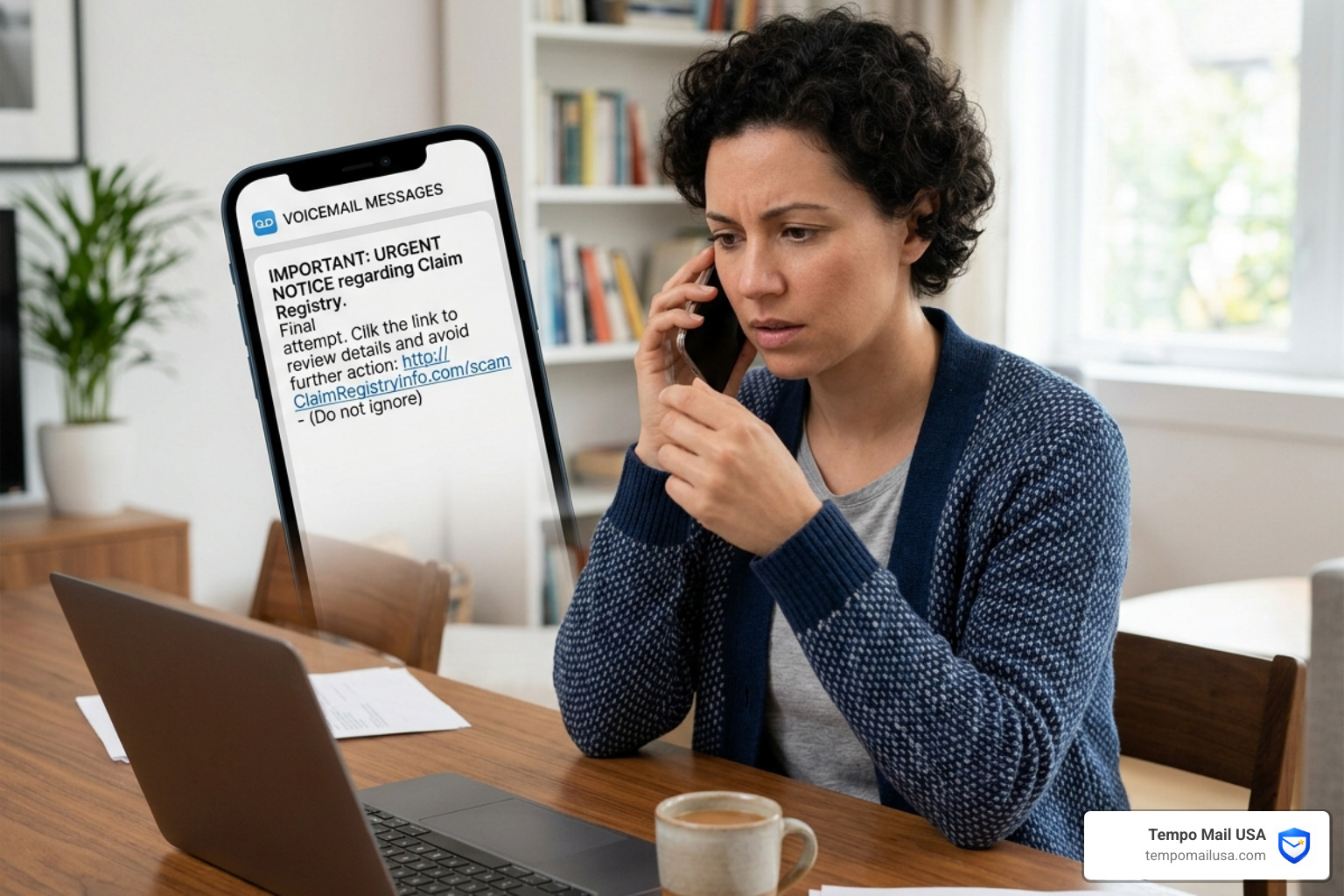
Identifying a Malicious Claim Registry Scam Link in Voicemail Message
Scammers are getting clever with their URLs. They might use URL shorteners (like bit.ly) to hide the final destination, or they might use "typosquatting" — registering domains that look almost like the real thing (e.g., "IRS-tax-claim.com" instead of "IRS.gov").
As reported in the BBB Scam Alert: Fake relief check phone calls claim you have money waiting, sites like MyReliefCheck.com or MyReliefClaim.com are essentially data-harvesting machines. They ask you to search for your name, then prompt you for "verification details" like your date of birth and Social Security number. Once you provide these, the scammers have everything they need to steal your identity.
The Evolution of Voicemail and Registry Scams in 2026
As we move through April 2026, the tactics have become even more sophisticated. We are no longer just dealing with grainy robocalls; scammers are now using AI voice cloning to mimic the tone and cadence of real people or even family members.
AI and High-Tech Impersonation
The FTC has noted a four-fold increase in impersonation scams over the last few years. In 2026, AI allows scammers to generate thousands of unique voicemails in seconds. They can even scrape your LinkedIn or social media profile to mention your specific job title or a recent business filing, making the claim registry scam link in voicemail message feel incredibly personal.
The "Do Not Call" Twist
Ironically, scammers are now impersonating the very services meant to stop them. The fake “Do Not Call Registry” scam is back, where a caller claims they can "permanently block" all spam calls for a small one-time fee. This targets the frustration we all feel with robocalls, using our desire for privacy as a weapon against us.
Exploiting Public Records
Business owners and creators are being targeted through public record exploitation. Scammers scrape the USPTO (U.S. Patent and Trademark Office) databases to find people who have recently filed for a trademark. They then leave urgent voicemails claiming there is a "problem with the claim registry" and provide a link to pay a "maintenance fee." Because the caller knows the exact name of your business and your filing date, it’s very easy to fall for the trap.
International Networks
Much of this activity originates from organized call centers overseas. Jamaican lottery scam rings have historically targeted elderly Americans, leading to estimated losses of over $300 million annually. Similarly, massive Indian call center networks have been dismantled after stealing hundreds of millions from U.S. taxpayers by impersonating the IRS.
How to Protect Yourself and Verify Legitimacy
The best defense is a proactive one. You don't have to be a tech expert to stay safe; you just need to follow a few golden rules.
Use Independent Verification
If you receive a voicemail about a "claim," never use the contact information provided in the message. Instead, go to a search engine and look up the official agency yourself. For unclaimed money, go directly to unclaimed.org (the official site for the National Association of State Treasurers). This service is 100% free.
Report Everything
Reporting a scam helps authorities track the "Dan" and "Clara" personas and shut down their websites.
- BBB Scam Tracker: Great for warning your local community.
- FCC Complaints: Use fcc.gov/complaints to report caller ID spoofing.
- FTC Reporting: Visit ReportFraud.ftc.gov to help federal investigators build cases against international scam rings.
Build a "PII Firewall"
Scammers get your number and info from data breaches and public filings. This is where we at Tempo Mail USA come in. When you are registering for services, filing public documents, or interacting with new platforms, you should never use your primary, permanent contact details.
We provide temporary email aliases that act as a proxy for your identity. By using a secure alias, you shield your real Personally Identifiable Information (PII) from scrapers and hackers. If an alias starts receiving scam "voicemail notification" emails, you can simply delete the alias without ever compromising your actual inbox or identity.
Frequently Asked Questions about Claim Registry Scams
What should I do if I clicked a claim registry scam link in voicemail message?
If you clicked the link and entered any information, you need to act fast:
- Change Passwords: Immediately update the password for your email and any financial accounts. Use a password manager to ensure they are unique and strong.
- Contact Your Bank: If you provided credit card or bank details, call your financial institution’s fraud department to freeze your accounts and request new cards.
- Freeze Your Credit: Contact the three major credit bureaus (Equifax, Experian, and TransUnion) to place a credit freeze. This prevents scammers from opening new lines of credit in your name.
- Scan for Malware: If the link prompted a download, run a full system scan with a reputable antivirus program.
- IdentityTheft.gov: Report the incident to the FTC to get a personalized recovery plan.
Is there a real "US Claim Registry" for unclaimed money?
No. There is no single entity called the "US Claim Registry." Real unclaimed property (like forgotten utility deposits, old bank accounts, or uncashed checks) is held by individual State Treasurers. You can find yours through the official, free portal at unclaimed.org. Any site asking for a fee to find "unclaimed money" is either a scam or a "finder" service charging you for something you can do yourself for free.
Why do I keep receiving a claim registry scam link in voicemail message?
You are likely on a "sucker list" or a "lead list." Scammers buy databases of phone numbers from:
- Public Filings: Trademark applications, property records, and business licenses.
- Data Breaches: Information stolen from major retailers or social media sites.
- Active Number Confirmation: If you have ever called a scammer back or even pressed "1" to be removed from a list, you confirmed your number is active, making you a high-priority target.
Conclusion
The claim registry scam link in voicemail message is a persistent threat because it exploits our natural curiosity and our trust in the human voice. Whether it's "Dan" promising a relief check or a fake legal threat about a trademark, the goal is always the same: to steal your money and your identity.
By staying vigilant, verifying claims through official .gov channels, and using tools to protect your PII, you can stay one step ahead of the fraudsters. Legitimate government agencies will never pressure you to click a suspicious link in a voicemail or pay fees via gift cards.
At Tempo Mail USA, we believe the best way to stop a scam is to prevent the scammer from ever getting your real information in the first place. Use our temporary aliases as your digital shield and turn the tide against digital fraud.