

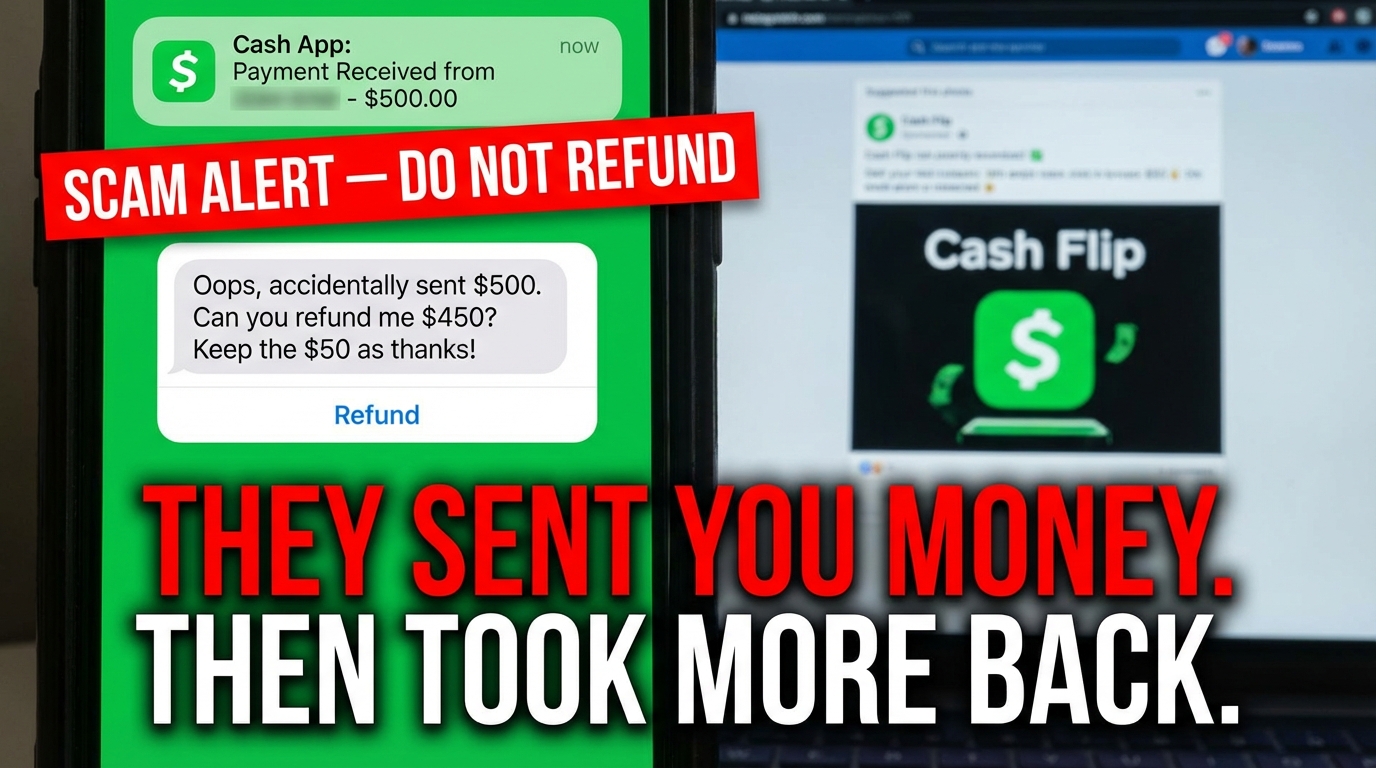

Why Cash App Scams Are More Dangerous Than You Think
Cash App scams are fraudulent schemes that trick users of the popular peer-to-peer payment app into sending money or sharing sensitive information — and they're happening at massive scale.
Here's what you need to know fast:
- Money flipping scams — Scammers promise to multiply your money, then vanish
- Fake giveaways — Impersonators pose as Cash App on social media to steal funds
- Phishing attempts — Fake support reps ask for your PIN or sign-in code
- Accidental payment scams — Someone "mistakenly" sends you money, then steals it back after you refund them
- Deposit scams — Fake pet sellers or landlords take your deposit and disappear
- Bitcoin scams — Irreversible crypto transfers exploited through urgency and fake promises
Cash App processed over a quarter-trillion dollars in 2024. That kind of volume makes it an irresistible target for fraudsters.
And the platform's own operator, Block, was ordered by the Consumer Financial Protection Bureau (CFPB) in January 2025 to pay up to $120 million in consumer refunds plus a $55 million penalty — specifically because of weak security protocols that left users exposed.
The core problem with Cash App fraud is simple: transfers are instant and nearly impossible to reverse. Unlike a credit card dispute, once the money is gone, it's usually gone for good.
This guide walks you through every major scam type, how to spot them, and exactly what to do to protect yourself.
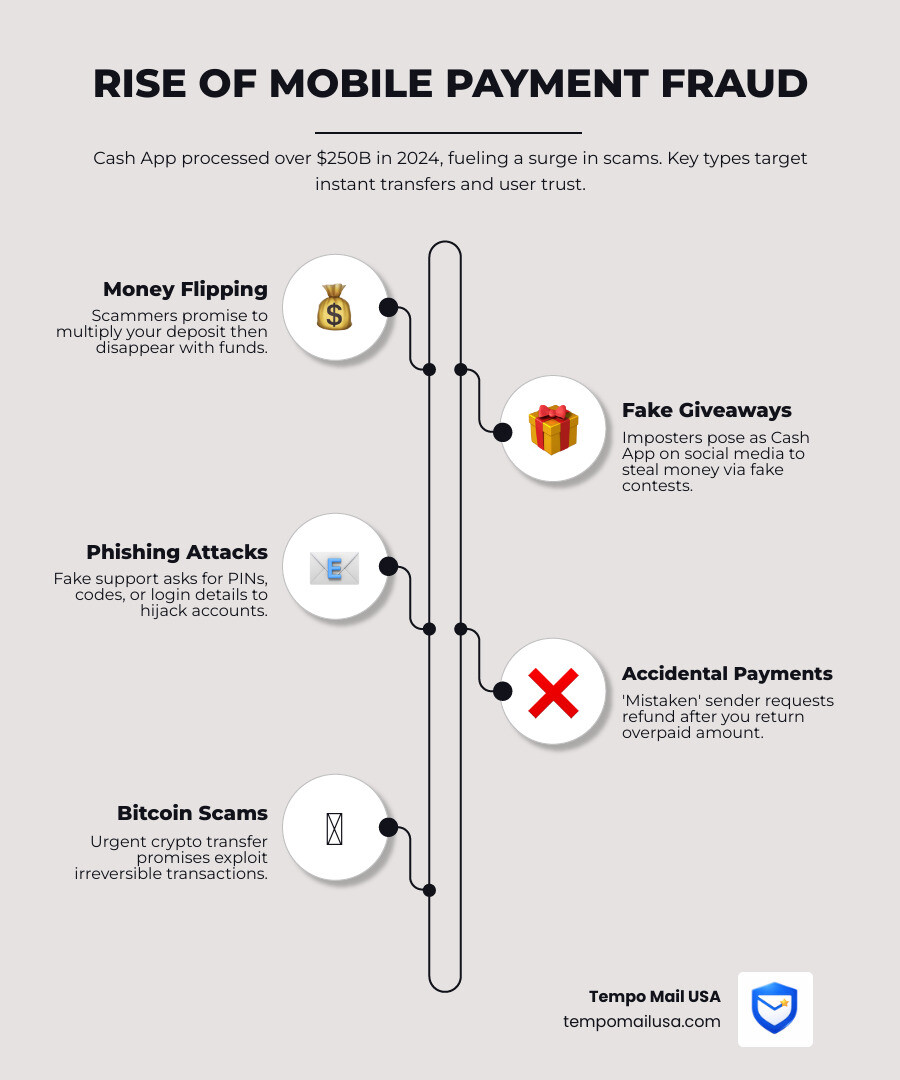
The Anatomy of a Modern Cash App Scam
To understand why a cash app scam is so effective, we have to look at the sheer volume of transactions. With over $250 billion flowing through the app in 2024 alone, scammers view the platform as a digital gold mine. The recent CFPB redress and the $175 million total penalty against Block highlight a critical reality: even major financial platforms can have weak security protocols that leave your PII (Personally Identifiable Information) vulnerable.
When we look at reports from the BBB Scam Alert: Scammers trick victims into sending money through CashApp, a pattern emerges. Scammers exploit the "instant" nature of these transfers. Because the money moves faster than traditional bank wires, victims often realize they've been duped only after the funds have been cleared and moved to an untraceable account.
This is why we advocate for identity theft protection services. Relying solely on an app's built-in safety features is no longer enough. Sophisticated fraudsters use social engineering to bypass basic hurdles, making advanced credit monitoring software and identity safeguards a mandatory part of your digital life.
How Money Flipping and Bitcoin Cash App Scam Tactics Work
Money flipping is the "oldest trick in the book" updated for the smartphone age. A scammer promises to "flip" your $100 into $1,000 through a supposed glitch or insider investment strategy. They often request a "clearance fee" or "account verification deposit" first. Once you send that initial payment, they block you instantly.
Bitcoin takes this to a more dangerous level. Because Bitcoin transactions are recorded on a decentralized ledger, they are 100% irreversible. As noted in the guide to Outsmart Bitcoin Scams, scammers often use urgency—claiming you've won a giveaway or that your account is compromised—to force a quick crypto transfer.
We also see the rise of the Pig Butchering Scam Meaning: How It Works & How to Avoid, where scammers build a romantic or professional relationship over weeks before "fattening" the victim up to "slaughter" them for a large Cash App or Bitcoin payment.
Spotting a Phishing-Based Cash App Scam
Phishing remains the most common entry point for a cash app scam. You might receive a text or email that looks identical to an official Cash App notification, claiming there is an "unauthorized login" or a "pending payment" that requires your attention.
These messages lead to fake login pages designed to steal your PIN and sign-in code. Official support will never ask for your full debit card number or your PIN. To stay ahead, you must Recognize Scams and Keep Your Money Safe with Cash App by verifying that emails only come from @cash.app, @square.com, or @squareup.com.
Furthermore, learning how to Stay Safe: Combatting PayPal Phishing Attacks Effectively provides a great baseline for identifying the same tactics used across all P2P platforms.
Preventing Phishing with Disposable Email Infrastructure
At Tempo Mail USA, we believe the best way to stop a cash app scam is to prevent the scammer from ever reaching your inbox. Most phishing attacks succeed because the fraudster has your real email address, often harvested from a data breach. By using data privacy compliance tools like temporary email aliases, you create a "PII Firewall" between your identity and the public internet.
When you sign up for new services, newsletters, or even social media accounts where Cash App giveaways are common, you should never use your primary, bank-linked email. Instead, use a temporary email from tempomailusa.com. This ensures that if a service is breached, your real email—the one connected to your financial life—remains hidden.
This strategy is a cornerstone of secure cloud storage for business and personal data protection. By proxying your identity, you effectively "de-risk" your digital footprint. To learn more about this essential tactic, check out Why You Should Use Temporary Email for Safe Signups.
Securing Your Digital Identity
Using Tempo Mail USA provides several layers of protection:
- PII Protection: Your real name and contact info stay off "sucker lists" sold on the dark web.
- Spam Mitigation: If an alias starts receiving phishing attempts, you simply delete it.
- Tracking Prevention: Scammers can't use your email to track your activity across different platforms.
Enterprise VPN Solutions and Advanced Malware Protection for Mobile Finance

Many users fall victim to a cash app scam because they access their financial accounts over unsecured public Wi-Fi. Whether you're at a coffee shop or an airport, hackers can use "man-in-the-middle" attacks to intercept your login credentials. This is where enterprise VPN solutions become non-negotiable. A VPN encrypts your data tunnel, ensuring that even if the network is compromised, your Cash App traffic remains unreadable.
Additionally, advanced malware protection is vital for mobile users. Some scams involve "App Glitches" where a fraudster convinces you to download a "support tool" (like AnyDesk) that actually gives them remote access to your phone.
| Feature | Standard App Security | Enterprise-Grade Protection |
|---|---|---|
| Encryption | Standard SSL | AES-256 Bit via Enterprise VPN |
| Email Privacy | Real Email Exposed | Disposable Alias via Tempo Mail USA |
| Access Control | PIN/Biometrics | Multi-Factor + Hardware Keys |
| Threat Detection | Reactive | Proactive Advanced Malware Protection |
| Identity Defense | None | Identity Theft Protection Services |
As highlighted in Cash App Security: Protecting Your Money & Account, the app offers features like Security Lock, but combining these with enterprise VPN solutions creates a far more robust defense.
Identity Theft Protection Services and Credit Monitoring Software Integration
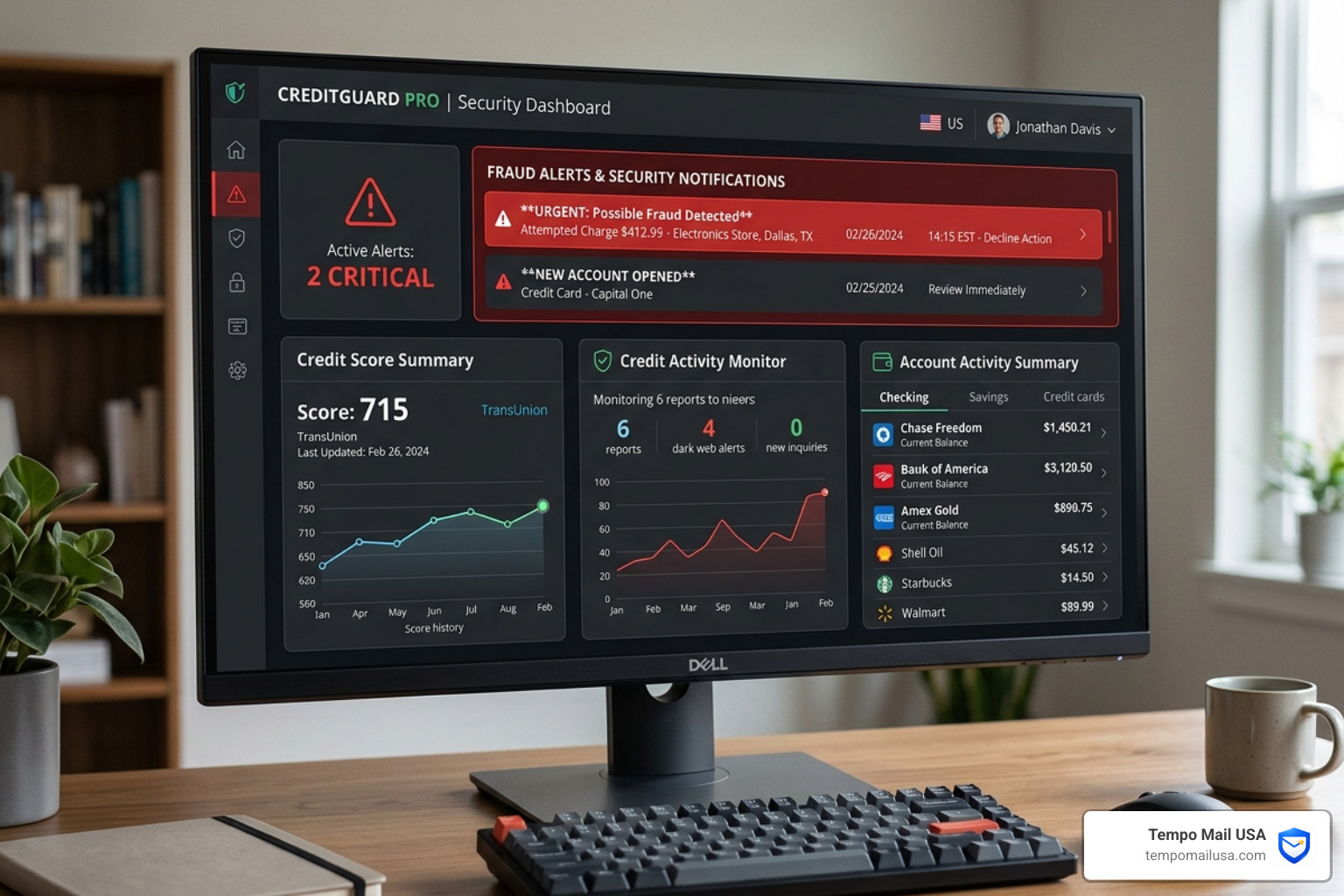
If a cash app scam results in a compromised account, the damage rarely stops there. Scammers often use the stolen PII to open new lines of credit or apply for loans in your name. This is why integrating credit monitoring software into your financial routine is essential. These tools alert you the moment a new inquiry appears on your credit report, allowing you to freeze your credit before the damage escalates.
For businesses and high-net-worth individuals, cybersecurity insurance is another critical layer. While Cash App itself provides limited protection, a dedicated insurance policy can help recover losses from sophisticated social engineering attacks.
Always be wary of emails that look official. For instance, the Visa Click to Pay Scam Email: Real or Fake? guide shows how even trusted brands are used as bait to get you to lower your guard.
Proactive Account Defense Strategies
We recommend a "Zero Trust" approach to your mobile wallet. You should We Help Protect You From Scams - Cash App by enabling every available security toggle:
- Security Lock: Always require FaceID, TouchID, or a PIN for every transfer.
- Notification Alerts: Get a text or push notification for every single cent that moves.
- Contact Syncing: Only send money to people in your verified contact list.
By following the advice in Avoiding Common Scams with Cash App, you can ensure that even if a scammer gets your username, they can't get your cash.
Frequently Asked Questions about Cash App Security
What should I do if I am a victim of a cash app scam?
If you've been hit by a cash app scam, speed is everything. First, go to the transaction in your activity feed, tap the "..." and select "Report a Payment Issue." Next, contact Cash App support directly through the app or at 1-800-969-1940. You should also file a complaint with the FTC and the IC3 (Internet Crime Complaint Center). For more details on specific recovery steps, see the list of Avoid These 9 Common Scams - Cash App.
Is Cash App FDIC insured against fraud?
Cash App is a financial platform, not a bank. While they partner with banks like Sutton Bank to offer FDIC insurance up to $250,000, this insurance usually only applies to funds held in your Cash App Card balance or sponsored accounts. Crucially, FDIC insurance protects against bank failure—it does not protect you if you voluntarily send money to a scammer.
How can I identify a fake Cash App support representative?
A real Cash App representative will never ask for your sign-in code, PIN, full bank account details, or ask you to perform a "test transaction." Official emails will only come from @cash.app, @square.com, or @squareup.com. If someone contacts you on social media claiming to be "Cash App Andi" or "Support," check for the blue verified checkmark.
Can I reverse a payment made to a scammer?
Because Cash App payments are instant, they are generally non-cancelable. Your best bet is to use the "Refund" button on the transaction, but a scammer is unlikely to click "Accept." This is why it is vital to verify the recipient's $Cashtag twice before hitting send. For more on why these are hard to reverse, read What Are Common Cash App Scams? Spot & Prevent Fraud.
Conclusion
Maintaining high "cyber hygiene" is the only way to navigate the modern financial landscape safely. By combining identity theft protection services with the privacy power of tempomailusa.com, you build a formidable wall against fraudsters.
Don't let a cash app scam ruin your financial stability. Stay vigilant, use enterprise-grade tools, and always remember: if an offer on the internet sounds too good to be true—like a random "Cash App Friday" winner message from an unverified account—it almost certainly is. For more tips on spotting fake alerts, read our breakdown of the Microsoft Security Alert Scam: Real Warning or Fake Trap?.