


Your Inbox Is Not as Private as You Think
What are the best email privacy tools? In 2026, the top solutions for securing digital communications include:
- Encrypted Email Providers - Platforms offering end-to-end encryption (E2EE) and zero-access storage.
- Email Alias Services - Tools that generate proxy addresses to shield your primary identity from trackers.
- PGP Browser Extensions - Software that adds Pretty Good Privacy encryption to existing webmail accounts.
- Secure Desktop Clients - Open-source applications with enhanced security and tracker blocking.
- Anonymous Forwarding Tools - Services that strip metadata and forward messages without revealing your real address.
Every time you hand over your email address to sign up for a service, you're taking a risk. That address can end up in a data breach, sold to advertisers, or used to track your behavior through invisible tracking pixels.
Most people don't realize how much information a single email can reveal — when you opened it, where you were, and what device you used.
Mainstream providers like Gmail do use encryption, but it's the bare minimum. They still hold the keys to your messages. Email privacy tools fix that by ensuring only you and your recipient can access your content.
Why You Need Email Privacy Tools in 2026
In 2026, the digital landscape has become more sophisticated, but also more intrusive. The standard email protocols we’ve used for decades were never designed with privacy as a priority.
The Risks of Standard Email
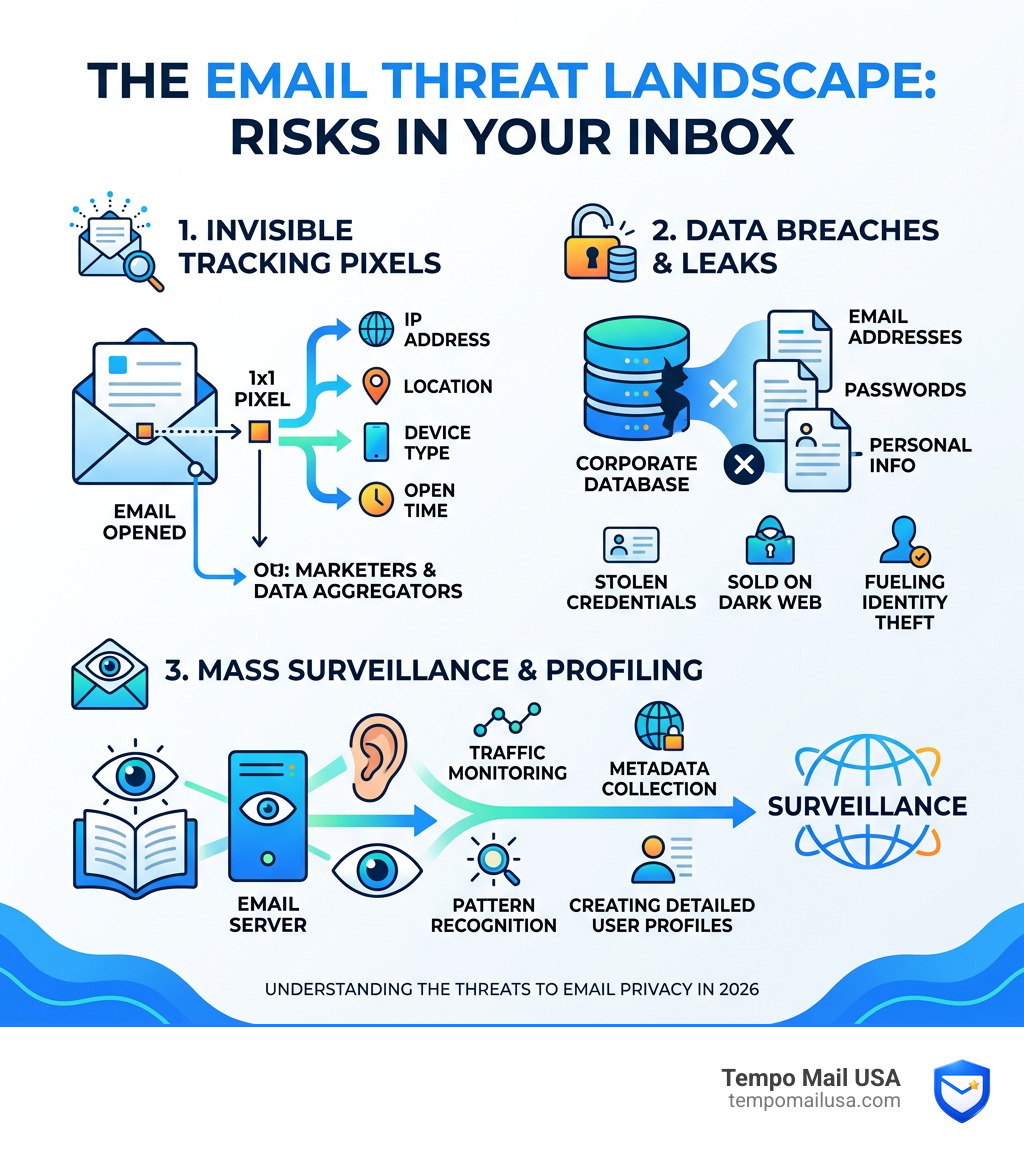
Today, your inbox is a goldmine for "surveillance capitalism." Every message you receive from a retailer likely contains a tracking pixel—an invisible 1x1 image that notifies the sender the moment you open the mail. These pixels reveal your IP address, your physical location, and the device you’re using.
When this data is hoovered up by data aggregators, it builds a profile of your life. Furthermore, data breaches are an "eventually" event. If you use the same email address for every service, a single breach can expose your primary identity. This is why protecting yourself and understanding why email privacy matters is the first step toward digital sovereignty. While every website should use HTTPS to protect data in transit, it doesn't stop the service provider itself from scanning your content.
By using email privacy tools, we can reclaim our right to a clean, private inbox, free from the prying eyes of trackers and identity-linked spam.
Core Technologies Behind Secure Email
To truly understand email privacy tools, we have to look under the hood. Most mainstream providers use Transport Layer Security (TLS). This encrypts the "pipe" through which your email travels, but once the email reaches the server, the provider can often see everything.
True privacy tools employ End-to-End Encryption (E2EE) and Zero-Access Storage. With E2EE, the message is encrypted on your device and only decrypted on the recipient's device. The service provider acts only as a blind courier. Zero-access storage takes this further by encrypting your stored emails with a key derived from your password; if you lose your password, even the provider cannot recover your data.
When choosing a tool, we always look for open-source code and independent audits. These ensure that the "privacy" promised isn't just a marketing slogan but a mathematically verifiable reality. Jurisdiction also matters. Services based in Switzerland or Germany benefit from some of the world's strictest privacy laws, far removed from the invasive "Five Eyes" intelligence alliance.
[TABLE] Comparing Standard TLS vs. End-to-End Encryption
| Feature | Standard Email (Gmail/Outlook) | Encrypted Email (Secure Providers) |
|---|---|---|
| Encryption in Transit | Yes (TLS) | Yes (End-to-End) |
| Provider Access | Can read your emails | Zero-access (Cannot read) |
| Metadata Protection | Limited | High (often masks IPs) |
| Subject Line Encryption | No | Yes (in select services) |
| Account Recovery | Via provider | Via recovery phrase/key only |
How End-to-End Encryption Works in Email Privacy Tools
The magic of E2EE lies in "Asymmetric Cryptography." When you sign up, you get a pair of keys: a Public Key and a Private Key.
- You share your Public Key with the world (or the service does it for you).
- Someone wanting to send you a private message uses that Public Key to scramble the text.
- Once scrambled, only your Private Key can unlock it.
This ensures message integrity and confidentiality. Even if a hacker intercepts the message mid-flight, all they see is gibberish. This "zero-knowledge" architecture means your private life stays private, even from the people running the servers.
The Role of PGP in Modern Email Privacy Tools
Pretty Good Privacy (PGP) has been the gold standard for email encryption for over 30 years. Many email privacy tools use the OpenPGP standard to ensure compatibility. While PGP used to be notoriously difficult to set up, modern tools like browser extensions or dedicated privacy-focused clients handle the key management automatically. You just click "send," and the tool handles the digital signatures and encryption in the background.
Advanced Features of Top Privacy Services
The best email privacy tools offer more than just encryption. They provide a full suite of defenses to keep your digital life secure. For instance, leading encrypted services feature built-in tracker blocking that strips out those pesky invisible pixels before they can "phone home" to advertisers.
Other essential features include:
- Encrypted Calendars: Because your schedule is just as sensitive as your messages.
- Multi-Factor Authentication (MFA): Using apps or physical security keys to prevent unauthorized logins.
- Message Expiration: Allowing you to send a "self-destructing" email that disappears after a set time.
- HIPAA Compliance: Essential for healthcare professionals who need to share patient data securely.
Advanced privacy clients even offer biometric app locks for mobile users, ensuring that even if someone grabs your phone, they can't get into your inbox. Additionally, understanding VPN tunnels for email privacy can help mask your physical location from your email provider entirely.
Protecting Your Identity with Email Aliases and Forwarding
If encryption is the "lock" on your door, email aliases are the "security gate" at the edge of your property. This is where we at Tempo Mail USA focus our expertise.
An email alias is a proxy address. Instead of giving your real, primary email to every website, you give them a unique alias. If that website starts spamming you or gets hacked, you simply deactivate that one alias. Your real identity—and your primary inbox—remains untouched. This is the ultimate "identity firewall."
Using professional alias generation tools allows you to safeguard your online identity. Unlike the "plus trick" (e.g., name+service@gmail.com), which is easily stripped away by advertisers to reveal your real address, true aliases provide genuine PII masking.
Frequently Asked Questions about Email Security
Do I need to change my email address to use privacy tools?
Direct Answer: No, but it is recommended for maximum security. While you can add PGP extensions to Gmail or Outlook, migrating to a dedicated encrypted provider offers "zero-access" security that prevents the provider itself from harvesting your data.
How do I encrypt emails sent to non-secure providers?
To encrypt a message sent to a standard service like Gmail, use the "Password-Protected Message" feature. Your recipient receives a link to a secure portal where they can read the message only after entering a password you have shared with them.
Are free email privacy tools as effective as paid ones?
Yes, reputable privacy providers use the same encryption standards for both free and paid tiers. However, paid plans typically offer essential features for power users, such as:
- Custom Domains: Using your own @yourname.com address.
- Increased Storage: Higher limits for archived messages.
- Unlimited Aliases: The ability to create a unique address for every service you use.
Conclusion
In an era of constant surveillance, your email shouldn't be an open book. Whether you choose to switch to a fully encrypted provider or simply shield your identity with an alias service like ours, taking a step toward better digital hygiene is essential. By using email privacy tools, you aren't just protecting your data—you're reclaiming your digital sovereignty.
Take back control of your digital identity today and turn your inbox back into what it was always meant to be: a private space for your most important conversations.