


Are VPNs About to Be Banned in the UK? What It Means for You Right Now
Are VPNs About to Be Banned in the UK? What It Means for You is one of the most searched privacy questions in Britain right now — and the short answer is: no full ban is planned, but restrictions targeting under-18s are actively moving through Parliament.
Here's what you need to know at a glance:
| Question | Quick Answer |
|---|---|
| Is there a full VPN ban coming? | No. The UK government has said banning VPNs for adults is "not on the cards." |
| What is proposed? | A House of Lords amendment would require VPN providers to implement age checks to stop under-18s bypassing the Online Safety Act. |
| Are VPNs currently legal in the UK? | Yes, completely legal for adults. |
| What triggered this debate? | The Online Safety Act's age verification rules came into force on 25 July 2025, causing VPN usage to more than double overnight. |
| What should you do now? | Stay informed, and consider how you protect your personal data online — not just with a VPN. |
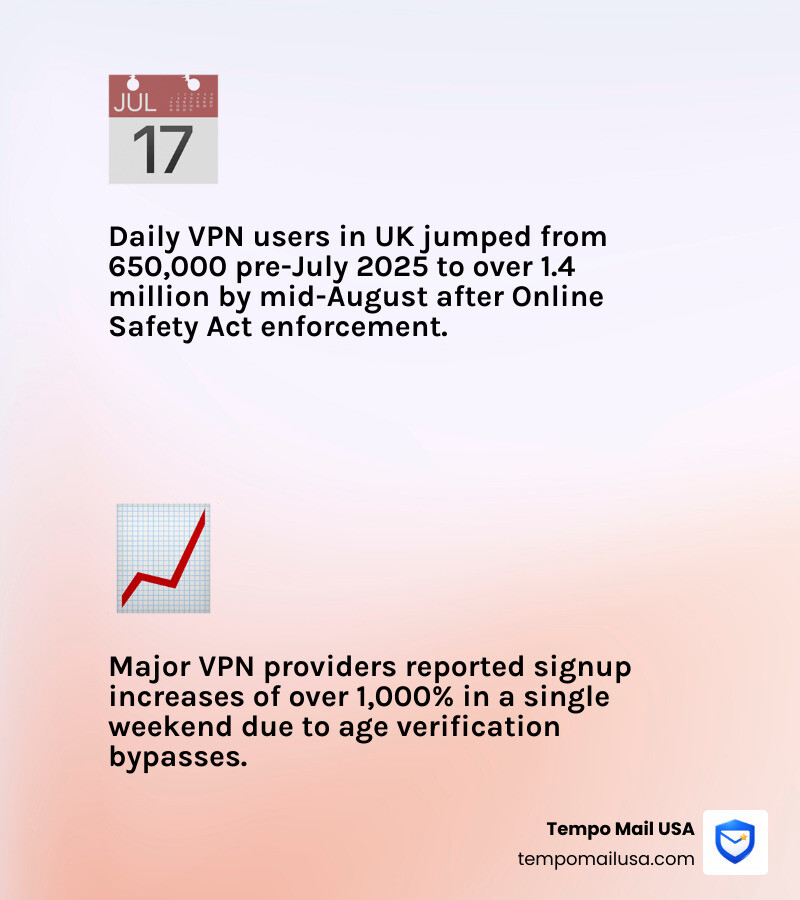
The story starts with the Online Safety Act (OSA). When age checks for adult content became mandatory in the UK in summer 2025, millions of users turned to VPNs to route their traffic through servers outside the UK. Daily VPN users jumped from around 650,000 before July 2025 to over 1.4 million by mid-August. Several major VPN providers reported signup increases of over 1,000% in a single weekend.
That spike alarmed lawmakers. Now, politicians and regulators are asking a pointed question: if the age checks can be bypassed this easily, what was the point?
The debate that followed has raised serious concerns — not just about child safety, but about online privacy, data protection, and whether the UK risks becoming what critics call a "digital pariah state."
The Online Safety Act and the Rise of VPN Usage
The catalyst for the current tension is the Online Safety Act (OSA), which reached a critical enforcement milestone on 25 July 2025. This legislation mandates that platforms hosting adult content or material deemed harmful to children (such as content related to self-harm or eating disorders) must implement "highly effective" age assurance.
In practice, this means many UK residents are now greeted with requests for credit card details, facial scans, or official ID uploads just to access parts of the internet they previously used freely. Naturally, many users — both adults concerned about their PII (Personally Identifiable Information) and tech-savvy minors — looked for a way around these digital checkpoints.
The solution was found in Virtual Private Networks (VPNs). By masking a user's IP address and routing traffic through a server in a different country, a VPN makes it appear as though the user is browsing from a location where the UK's age checks don't apply.
The industry response was staggering:
- One major provider reported a 1,400% increase in new signups per hour on the day age checks went live.
- Another recorded a 1,000% surge in paid subscriptions over the same period.
- A third provider saw UK signups skyrocket by 1,800%.
While the government initially focused on the platforms themselves, the sheer volume of users bypassing these rules via VPNs has shifted the spotlight onto the tools themselves. This has led to discussions about how How a VPN Kill Switch Enhances security, but also how these same security features are now being viewed as "loopholes" by regulators.
| Period | Estimated Daily VPN Users |
|---|---|
| Pre-July 2025 | 650,000 |
| Mid-August 2025 (Peak) | 1,400,000+ |
| End of 2025 | 980,000 |
Are VPNs About to Be Banned in the UK? What It Means for You: Current Proposals and Legislation
So, where does the law stand today? On 21 January 2026, the House of Lords voted in favor of a significant amendment to the Children’s Wellbeing and Schools Bill.
This amendment doesn't seek to ban VPNs for everyone. Instead, it proposes that VPN providers must implement their own age-gating systems. Under this plan, a "Relevant VPN Service" would be prohibited from providing services to UK children unless they have passed a rigorous age verification process.
The official government press release clarifies that the primary goal is child protection. Children’s Commissioner Rachel de Souza has been a vocal proponent of this move, telling the BBC that VPN access is "absolutely a loophole that needs closing." Her office argues that if adult websites are gated, the tools used to jump over those gates should be gated too.
Understanding the "Are VPNs About to Be Banned in the UK? What It Means for You" Rumors
The rumors of a "total ban" often stem from heated parliamentary debates. During a Westminster Hall debate, MPs questioned why VPNs were not already in the scope of the Online Safety Act. Some even suggested that the onus should be on VPN companies to comply with UK law just like any other tech firm.
However, the current Labour government has tried to walk a fine line. Minister for Digital Government Ian Murray stated that while the government is "monitoring" VPN usage, they are not currently planning a blanket ban. Peter Kyle, the Secretary of State for Science, Innovation and Technology, has also noted that banning VPNs is "not on the cards" because of their vital role in Corporate VPN Data Protection.
Despite these reassurances, the government has committed to a formal review of the Online Safety Act — including VPN circumvention — which is expected to be considered in the coming years. This means that while you can use your VPN today, the regulatory environment is shifting from "hands-off" to "active observation."
Privacy Implications of "Are VPNs About to Be Banned in the UK? What It Means for You"
The push to age-gate VPNs has sparked a massive backlash from civil liberties groups. Organizations like the Open Rights Group and Big Brother Watch argue that forcing VPN providers to collect age data creates a massive new privacy risk.
If you have to upload your ID or a facial scan to a VPN provider just to use their service, you are essentially handing over your most sensitive PII to a company whose primary job is to help you stay anonymous. This is what experts call "second-order censorship." By making the workaround as invasive as the original restriction, the government effectively discourages people from using privacy tools at all.
Furthermore, there are concerns about the "Great British Firewall" concept. If the UK forces VPNs to comply with local age-checks, it sets a precedent that could be used by more authoritarian regimes to demand their own backdoors. For those looking for a Mount Sinai VPN: Your Gateway to Safe Browsing or similar secure gateways, the idea of a government-mandated ID check feels like a direct contradiction to the core purpose of a VPN.
Technical Feasibility: Can the UK Actually Ban VPNs?
Even if the government wanted to ban VPNs, could they actually do it? Technically, it is an uphill battle. Unlike a single website that can be blocked by an ISP, the VPN industry is decentralized and highly adaptive.
The UK's intelligence agency, GCHQ, has explored the idea of a "British Firewall" to protect against hackers, but experts warn that turning this into a censorship tool would be incredibly complex. To truly block VPNs, the government would likely need to employ Deep Packet Inspection (DPI). This technology looks at the "shape" of data packets to see if they look like VPN traffic.
However, as we’ve seen in countries like Russia, this is a game of cat-and-mouse. When Russia tried to block VPNs, usage actually surged. Providers simply launched new "obfuscated" servers that make VPN traffic look like standard HTTPS web browsing.
Technical Challenges of "Are VPNs About to Be Banned in the UK? What It Means for You" Enforcement
There are several major hurdles to any proposed VPN restriction:
- HTTPS Mimicry: Modern VPN protocols are designed to blend in with normal web traffic. Distinguishing between a person using a VPN and a person simply visiting a secure banking site is technically difficult and prone to errors.
- Legitimate Business Use: Millions of UK workers use VPNs to connect to their office networks securely. Any blanket attempt to block VPN protocols would likely crash the remote-working economy and put corporate data at risk.
- App Store Pressure: The government could try to pressure Apple and Google to remove VPN apps from the UK versions of their stores. While this would stop casual users, tech-savvy individuals would simply "sideload" apps or change their store region.
- The "Ping-Pong" Process: The House of Lords amendment still has to pass through the House of Commons. If the government believes the technical challenges are too great or the economic impact too high, they may reject the amendment entirely.
Frequently Asked Questions about UK VPN Restrictions
Is it illegal to use a VPN to bypass age checks in the UK?
Currently, it is not illegal for an individual user in the UK to use a VPN to access age-restricted content. The Online Safety Act places the legal burden on the platforms to prevent underage access, not on the users for finding workarounds. However, the Act does make it illegal for platforms to promote VPNs specifically as a way for children to bypass safety checks.
Will the UK government ban VPNs for adults?
The government has repeatedly stated there are no plans to ban VPNs for adults. Ministers recognize that VPNs are essential for cybersecurity, business, and personal privacy. The current legislative focus is almost exclusively on how to prevent children from using these tools to evade safety regulations.
How can I protect my online privacy if VPN restrictions are implemented?
If the UK moves toward mandatory age checks for VPNs, users will need to look at "layered" privacy. This includes using privacy-respecting browsers, minimizing the PII you share with websites, and using tools like temporary email aliases to shield your real identity.
Conclusion: Preparing for the Future of UK Online Privacy
The debate surrounding Are VPNs About to Be Banned in the UK? What It Means for You highlights a growing tension between state-mandated safety and individual privacy. While a total ban is unlikely, the "wild west" era of unrestricted VPN use in the UK may be coming to an end for younger users.
As the government considers more robust ways to monitor and restrict online activity, the importance of protecting your digital footprint has never been higher. At Tempo Mail USA, we believe that privacy shouldn't require you to jump through hoops or hand over your passport details to every service you use.
Our temporary email aliases act as a PII firewall, allowing you to interact with the digital world without exposing your real identity or permanent email address to data-hungry platforms. Whether you're navigating new age verification laws or simply trying to reduce your online exposure, shielding your primary data is the first line of defense.
Stay safe, stay private, and keep an eye on the headlines — the future of the UK internet is being written right now.